POS2041 Quiz 1 (Broward College)
Representation:
Bicameral legislature: two houses. the number of a state’s representatives in each house was to be based on the state’s population. In each state, representatives in the lower house would be elected by popular vote. These representatives would then select their state’s representatives in the upper house from among candidates proposed by the state’s legislature. Once a representative’s term in the legislature had ended, the representative could not be reelected until an unspecified amount of time had passed.
Unicameral legislature: one house, in which each state would have one vote. Smaller states would have the same power in the national legislature as larger states. However, the larger states argued that because they had more residents, they should be allotted more legislators to represent their interests.
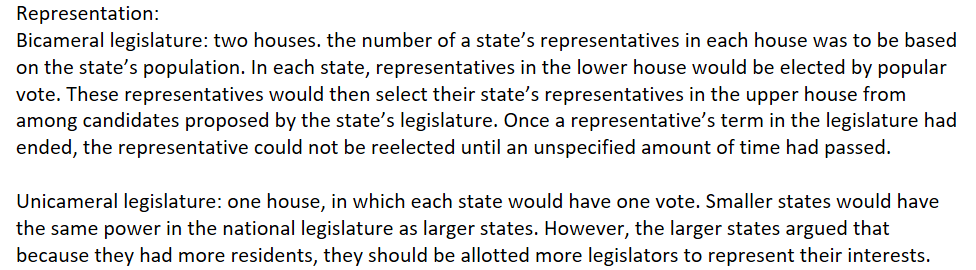
The Great Compromise: Congress, it was decided, would consist of two chambers: the Senate and the House of Representatives. Each state, regardless of size, would have two senators, making for equal representation as in the New Jersey Plan. Representation in the House would be based on population. Senators were to be appointed by state legislatures, a variation on the Virginia Plan. Members of the House of Representatives would be popularly elected by the voters in each state. Elected members of the House would be limited to two years in office before having to seek reelection, and those appointed to the Senate by each state’s political elite would serve a term of six years.
Congress was given great power, including the power to tax, maintain an army and a navy, and regulate trade and commerce. Congress had authority that the national government lacked under the Articles of Confederation. It could also coin and borrow money, grant patents and copyrights, declare war, and establish laws regulating naturalization and bankruptcy. While legislation could be proposed by either chamber of Congress, it had to pass both chambers by a majority vote before being sent to the president to be signed into law, and all bills to raise revenue had to begin in the House of Representatives. Only those men elected by the voters to represent them could impose taxes upon them. There would be no more taxation without representation.
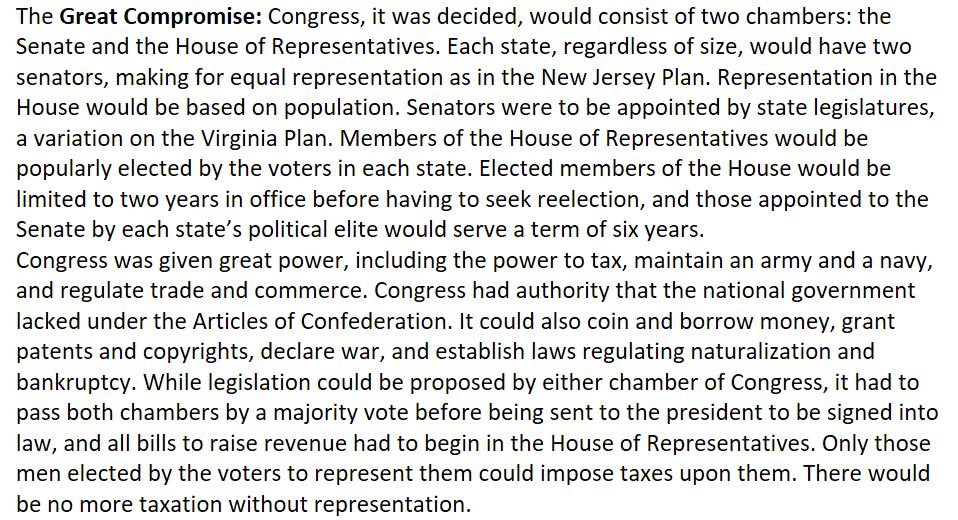
Indeed, the Constitution contained two protections for slavery. Article I postponed the abolition of the foreign slave trade until 1808, and in the interim, those in slaveholding states were allowed to import as many slaves as they wished.8 Furthermore, the Constitution placed no restrictions on the domestic slave trade, so residents of one state could still sell enslaved people to other states. Article IV of the Constitution—which, among other things, required states to return fugitives to the states where they had been charged with crimes—also prevented slaves from gaining their freedom by escaping to states where slavery had been abolished. Clause 3 of Article IV (known as the fugitive slave clause) allowed slave owners to reclaim their human property in the states where slaves had fled.
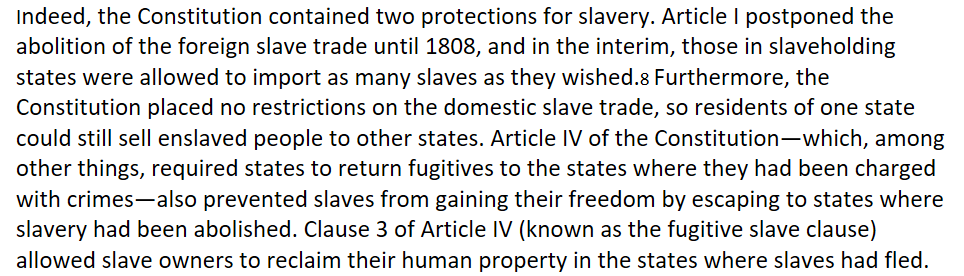
The Three-Fifths Compromise: slaveholding states were
allowed to count all their free population, including free African Americans and 60 percent (three-fifths)
of their enslaved population. To mollify the north, the compromise also allowed counting 60 percent of a state’s slave population for federal taxation, although no such taxes were ever collected. Another compromise regarding the institution of slavery granted Congress the right to impose taxes on imports in
exchange for a twenty-year prohibition on laws attempting to ban the importation of slaves to the United
States, which would hurt the economy of southern states more than that of northern states. Because the
southern states, especially South Carolina, had made it clear they would leave the convention if abolition
were attempted, no serious effort was made by the framers to abolish slavery in the new nation, even
though many delegates disapproved of the institution.
All powers not expressly given to the national government, however, were intended to be exercised by the states. These powers are known as reserved powers.

McCulloch v Maryland: A political showdown between Maryland and the national government emerged when James McCulloch, an agent for the Baltimore branch of the Second Bank, refused to pay a tax that Maryland had imposed on all out-of-state chartered banks. The standoff raised two constitutional questions: Did Congress have the authority to charter a national bank? Were states allowed to tax federal property?
In McCulloch v. Maryland, Chief Justice John Marshall (Figure 3.8) argued that Congress could create a national bank even though the Constitution did not expressly authorize it.20 Under the necessary and proper clause of Article I, Section 8, the Supreme Court asserted that Congress could establish “all means which are appropriate” to fulfill “the legitimate ends” of the Constitution. In other words, the bank was an appropriate instrument that enabled the national government to carry out several of its enumerated powers, such as regulating interstate commerce, collecting taxes, and borrowing money. McCulloch v Maryland was part of a movement in which the power shifted to the national government.
During the administrations of Presidents Richard Nixon (1969–1974) and Ronald Reagan (1981–1989), attempts were made to reverse the process of nationalization—that is, to restore states’ prominence in policy areas into which the federal government had moved in the past.
New federalism: premised on the idea that the decentralization of policies enhances administrative efficiency, reduces overall public spending, and improves policy outcomes.
During Nixon’s administration, general revenue sharing programs were created that distributed funds to the state and local governments with minimal restrictions on how the money was spent. The election of Ronald Reagan heralded the advent of a “devolution revolution” in U.S. federalism, in which the president pledged to return authority to the states according to the Constitution.
In the Omnibus Budget Reconciliation Act of 1981, congressional leaders together with President Reagan consolidated numerous federal grant programs related to social welfare and reformulated them in order to give state and local administrators greater discretion in using federal funds.37
However, Reagan’s track record in promoting new federalism was inconsistent. This was partly due
to the fact that the president’s devolution agenda met some opposition from Democrats in Congress,
moderate Republicans, and interest groups, preventing him from making further advances on that front. For example, his efforts to completely devolve Aid to Families With Dependent Children (a New Deal-era program) and food stamps (a Great Society-era program) to the states were rejected by members of Congress, who feared states would underfund both programs, and by members of the National Governors’ Association, who believed the proposal would be too costly for states. Reagan terminated general revenue sharing in 1986.
Several Supreme Court rulings also promoted new federalism by hemming in the scope of the national government’s power, especially under the commerce clause.
United States v. Lopez: the court struck down the Gun-Free School Zones Act of 1990, which banned gun possession in school zones. It argued that the regulation in question did not “substantively affect interstate commerce.” The ruling ended a nearly sixty-year period in which the court had used a broad interpretation of the commerce clause that by the 1960s allowed it to regulate numerous local commercial activities.
However, many would say that the years since the 9/11 attacks have swung the pendulum back in the direction of central federal power. The creation of the Department of Homeland Security federalized disaster response power in Washington, and the Transportation Security Administration was created to federalize airport security. Broad new federal policies and mandates have also been carried out in the form of the Faith-Based Initiative and No Child Left Behind (during the George W. Bush administration) and the Affordable Care Act (during Barack Obama’s administration.
The national government has greatly preferred using categorical grants to transfer funds to state and local authorities because this type of grant gives them more control and discretion in how the money is spent. In 2014, the federal government distributed 1,099 grants, 1,078 of which were categorical, while only 21 were block grants.45 In response to the terrorist attack on the United States on September 11, 2001, more than a dozen new federal grant programs relating to homeland security were created, but as of 2011, only three were block grants. A common criticism leveled against block grants is that they lack mechanisms to hold state and local administrators accountable for outcomes. Reagan’s “devolution revolution” contributed to raising the number of block grants from six in 1981 to fourteen in 1989. Block grants increased to twenty-four in 1999 during the Clinton administration and to twenty-six during Obama’s presidency, but by 2014 the total had dropped to twenty-one, accounting for 10 percent of total federal grant outlay.
The amount of federal grant money going to states has steadily increased since the 1960s.
Unfunded mandates, aka cross-cutting mandates: federal laws and regulations that impose obligations on state and local governments without fully compensating them for the administrative costs they incur. The federal government has used mandates increasingly since the 1960.
Title VI of the Civil Rights Act of 1964 authorizes the federal government to withhold federal grants as well as file lawsuits against state and local officials for practicing racial discrimination.
The Clean Air Act sets air quality regulations but instructs states to design implementation plans. The Clean Air Act is an example of an unfunded mandate. The Environmental Protection Agency sets federal standards regarding air and water quality, but it is up to each state to implement plans to achieve these standards.
The widespread use of federal mandates in the 1970s and 1980s provoked a backlash among state and local authorities, which culminated in the Unfunded Mandates Reform Act (UMRA) in 1995. The UMRA’s main objective has been to restrain the national government’s use of mandates by subjecting rules that impose unfunded requirements on state and local governments to greater procedural scrutiny. However, since the act’s implementation, states and local authorities have obtained limited relief. A new piece of legislation aims to take this approach further. The 2017 Unfunded Mandates and Information Transparency Act, HR
50, passed the House in July 2018 before being referred to the Senate, where in December it was placed on the legislative calendar. The number of mandates has continued to rise, and some have been especially costly to states and local
authorities.
The Real ID Act of 2005: a federal law designed to beef up homeland security. The law requires driver’s licenses and state-issued identification cards (DL/IDs) to contain standardized anti-fraud security features, specific data, and machine-readable technology. It also requires states to verify the identity of everyone being reissued DL/IDs. The Department of Homeland Security announced a phased enforcement of the law in 2013, which required individuals to present compliant DL/IDs to board commercial airlines starting in 2016. The cost to states of re-issuing DL/IDs, implementing new identity.
Arizona v. United States: the Supreme Court affirmed federal supremacy on immigration. The court struck down three of the four central provisions of the Arizona law—namely, those allowing police officers to arrest an undocumented immigrant without a warrant if they had probable cause to think he or she had committed a crime that could lead to deportation, making it a crime to seek a job without proper immigration papers, and making it a crime to be in Arizona without valid immigration papers. The court upheld the “show me your papers” provision, which authorizes police officers to check the immigration status of anyone they stop or arrest who they suspect is an illegal immigrant.
Marital rights for gays and lesbians have also significantly changed in recent years. By passing the Defense of Marriage Act (DOMA) in 1996, the federal government stepped into this policy issue. Not only did DOMA allow states to choose whether to recognize same-sex marriages, it also defined marriage as a union between a man and a woman, which meant that same-sex couples were denied various federal provisions and benefits—such as the right to file joint tax returns and receive Social Security survivor benefits. In 1997, more than half the states in the union had passed some form of legislation banning same-sex marriage.
By 2006, two years after Massachusetts became the first state to recognize marriage quality, twenty-seven states had passed constitutional bans on same-sex marriage. In United States v. Windsor, the Supreme Court changed the dynamic established by DOMA by ruling that the federal government had no authority to define marriage. The Court held that states possess the “historic and essential authority to define the marital relation,” and that the federal government’s involvement in this area “departs from this history and tradition of reliance on state law to define marriage.”
And in 2015 the Supreme Court gave same-sexmarriage a constitutional basis of right nationwide in Obergefell v. Hodges. In sum, as the immigration and marriage equality examples illustrate, constitutional disputes have arisen as states and the federal government have sought to reposition themselves on certain policy issues, disputes that the federal courts have had to sort out. Figure 3.17 The number of states that practiced marriage equality gradually increased between 2008 and 2015, with the fastest increase occurring between United States v. Windsor in 2013 and Obergefell v. Hodges in 2015.

British colonists in the seventeenth century were greatly influenced by John Locke.
Shays’ Rebellion realized that the government was susceptible to mob rule.
Great Comprimise: compromise between the Virginia Plan and the New Jersey Plan that created a two- house Congress; representation based on population in the House of Representatives and equal representation of states in the Senate

VirginiaaOne of the problems with the Articles of Confederation was the difficulty of changing it. To prevent this difficulty from recurring, the framers provided a method for amending the Constitution that required a two-thirds majority in both houses of Congress and in three-quarters of state legislatures to approve a change.

nd the New Jersey Plan that created a two-
house Congress; representation based on population in the House of Representatives and equal
representation of states in the Senat