BLAW Ch 11 Contract Performance, Breach, and Remedies
Chapter 11 – Contract Performance, Breach, and Remedies
1. Voluntary Consent
Definition: The knowing and voluntary agreement to the terms of a contract.
If voluntary consent is lacking, the contract will be voidable.
2. Mistakes in Contracts
Types of Mistakes:
Only a mistake of fact (not a mistake of value or quality) makes a contract voidable.
2.1 Unilateral Mistake of Fact
Definition: A mistake occurs when one party to a contract is mistaken about a material fact.
Normally enforceable against the mistaken party.
Exceptions:
The other party knew or should have known about the mistake of fact.
The error was due to a substantial mathematical mistake, made inadvertently and without gross (extreme) negligence.
2.2 Bilateral (Mutual) Mistake of Fact
Definition: Both parties are mistaken about the same material fact.
Options for Rescind: Either party can rescind the contract.
Mutual misunderstanding may allow the contract to be rescinded or reformed.
Future Market Value Mistake:
If a mistake concerns the future market value or quality of the object of the contract, the mistake is considered a mistake of value; the contract is typically enforceable.
Not knowing the actual value does not make the contract unenforceable; it implies one side made a bad deal.
3. Misrepresentation
Fraudulent Misrepresentation (Fraud): Misrepresentation that is consciously false and intended to mislead another party.
Typically involves:
A misrepresentation of a material fact must occur.
There must be an intent to deceive.
The innocent party must justifiably rely on the misrepresentation.
To collect damages, a party must demonstrate harm as a result of the misrepresentation.
Types of Misrepresentation:
Misrepresentation by words or actions: Specific actions taken to conceal a material fact related to the contract.
Injury Requirement:
Most courts do not require proof of injury to rescind a contract.
However, proof of harm is universally required to recover damages caused by fraud.
4. Undue Influence
Definition: When one party can greatly influence another, thus overcoming that party’s free will.
Example: Influence of a guardian on a minor.
Presumption of Undue Influence:
Clear and convincing evidence must prove the person did not act of their free will.
5. Duress
Definition: Use of threats to force a party to enter into a contract.
Functions as both a defense against contract enforcement and a ground for rescission of a contract.
Requirements:
Proof of a threat to do something that the threatening party has no right to do.
Example of Insufficient Duress: Giving a bad review or threatening court action (both permissible);
Example of Sufficient Duress: Threatening to get someone prosecuted (not permissible).
6. Third Party Rights
General Principle: After validating an enforceable contract, attention can shift to the rights and duties of the parties involved.
6.1 Privity of Contract
Definition: The relationship existing between the promisor and promisee of a contract.
7. Statute of Frauds
Definition: Identifies types of contracts that must be in writing.
8. Assignment and Delegation
8.1 Assignments
Definition: The transfer of all or part of one’s rights under a contract to another.
Roles:
Assignor: Party assigning the rights to a third party.
Assignee: Party receiving the rights.
General Rule: All rights can be assigned with exceptions:
Assignment is prohibited by statute.
Contract is for personal services.
Assignment significantly alters the risk or duties of the obligor.
The contract prohibits assignment.
8.2 Delegations
Definition: Transfer of duties to a third party through delegation, not assignment.
Roles:
Delegator: Party making the delegation of obligation.
Delegate: Party to whom the duty has been delegated who may fail to perform.
Delegation Prohibitions:
Special trust has been placed in the obligor (attorneys, accountants, physicians).
Performance depends on the personal skill or talents of the obligor.
Performance by a third party will vary materially from what is expected by the obligee.
Contract expressly prohibits delegation.
Enforceability Consideration: The delegate does not possess the right to assign rights or be held responsible as compared to the assignee.
9. Third Party Beneficiary vs. Incidental Beneficiary
9.1 Third Party Beneficiary
Definition: The original parties can agree that performance is to benefit a third person (intended beneficiary).
Enforceability: Intended beneficiaries can enforce the contract.
9.2 Incidental Beneficiary
Definition: A third person who benefits from the contract unintentionally.
Legal Rights: Incidental beneficiaries cannot sue to enforce the contract.
10. Performance of Contracts
Definition: The most common way to discharge or terminate contractual duties is through performance.
10.1 Conditions of Performance
Condition: Qualification based on a future event that triggers legal obligations. If not satisfied, obligations are discharged.
Types:
Conditions Precedent: Must happen before one party’s promise is required (e.g., passing a physical exam in a life insurance contract).
Conditions Subsequent: Legal obligation fulfilled only when a subsequent condition is met.
Concurrent Conditions: Conditions apply to both sides simultaneously.
11. Discharge of Contracts
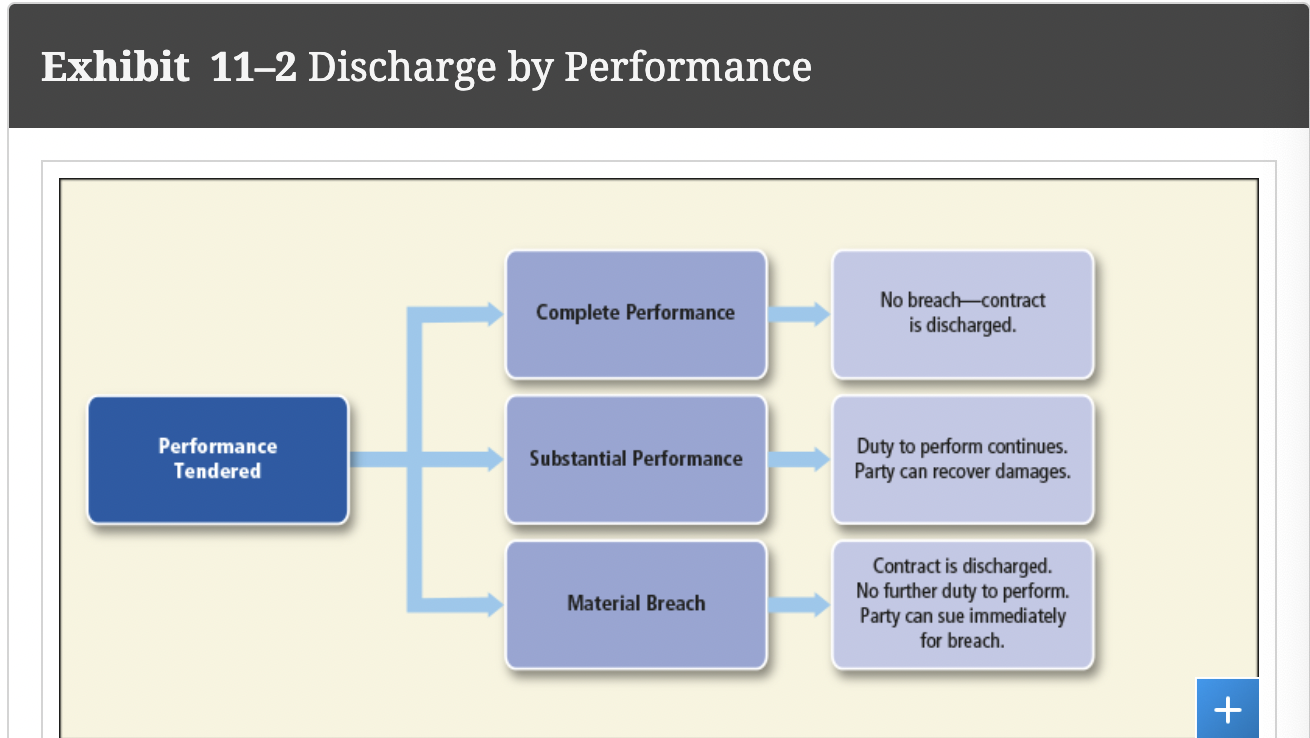
11.1 Discharge by Performance
General Statement: Contract concludes when both parties fulfill their respective duties by performing.
Types of Performance:
Complete Performance: The party performs exactly as agreed; no question of contract performance.
Substantial Performance: A good faith effort that meets most terms of the contract.
Requirements for Substantial Performance:
Performed in good faith (intentional noncompliance is a breach).
Variance from the promised performance is minor and can be remedied by compensation.
Creates substantially the same benefits as promised.
Effects of Substantial Duty Performance:
Other party’s duty remains absolute if performance is substantial.
If not substantial, constitutes a material breach, and the nonbreaching party is excused from further performance.
Measure of Damages for Substantial Performance:
Cost to bring the object of the contract into compliance, if reasonable. If not, the difference in value between actual performance and promised performance.
Time for performance
If a contract does not state a time for performance, a reasonable time is implied based on the contract's substance.
Anticipatory repudiation:
Breach of contract
Before either party to a contract has a duty to perform, one of the parties may refuse to carry out that party’s contractual obligations
11.3 Discharge by Agreement
General Principle: Contracts can be discharged by mutual agreement.
Types of Discharge by Agreement:
Mutual Recission: New agreement formed to rescind the original contract, satisfying all legal requirements.
Novation: Substituting a third party for one of the original parties.
Requirements for Novation:
Existence of a previous valid obligation.
Agreement by all parties to a new contract.
Extinguishment of the old obligation.
Creation of a new valid contract.
Settlement Agreement: A contract reached to settle existing disputes.
Accord and Satisfaction: Parties agree to an alternative performance from the original obligation.
Definitions:
Liquidated Debt: A definite amount due.
Unliquidated Debt: An uncertain amount due.
Release: Forfeiture of the right to pursue legal claims against another party.
11.4 Discharge by Operation of Law
Conditions for Discharge:
Material alteration of the contract.
Statutes of limitations restricting the lawsuit period for claims.
Bankruptcy.
Impossibility of performance:
Objective Impossibility: Literally cannot be done.
Subjective Impossibility: Personal inability to perform.
Types of Performance Impossibility:
Death or incapacity of a party essential to performance.
Destruction of the specific subject matter of the contract.
Changes in law rendering performance illegal.
Temporary Impossibility: Resolved once conditions permit performance.
Commercial Impracticability: May excuse duty to perform.
Frustration of Purpose: Court relieves duty when the contract’s purpose is frustrated.
12. Breach of Contract
12.1 Definition
Definition of Breach: Nonperformance of a contractual duty; effect depends on whether it is a material or minor breach.
12.2 Types of Breaches
Material Breach:
Nonbreaching party is excused from duties and can sue for damages.
Minor Breach:
Nonbreaching party's duty to perform may be suspended until the breach is remedied (but is not entirely excused).
Resumption of performance must follow curing of the minor breach.
13. Damages (Compensatory, Liquidated, etc.)
13.1 Types of Damages
Categories of Damages:
Compensatory: Cover direct losses and costs.
Consequential: Cover indirect and foreseeable losses.
Punitive: Punish and deter wrongdoing (generally not awarded in breach of contract).
Nominal: Small monetary award for wrongdoing without actual damage.
13.2 Compensatory Damages
Purpose: Compensate nonbreaching party for loss of bargain; represents the difference between the promised performance value and the actual performance value, reduced by any avoided loss.
Incidental damages: caused directly by a breach of contract
Examples of Measurement:
Sale of Goods: Difference between contract price and market price.
Sale of Land: Unique nature leads to specific performance remedy.
Construction Contracts: Measure of damages varies depending on which party breaches.
13.3 Additional Damage Types
Consequential Damages: Result from the breach given special circumstances beyond the contract.
Punitive Damages: Rare in contract lawsuits.
Nominal Damages: Generally a minimal award to acknowledge wrongdoing without monetary loss.
Mitigation of Damages: Requirement to minimize damages caused by the breach.
13.4 Liquidated Damages vs. Penalties
Liquidated Damages: Stipulated amount believed to reasonably estimate breaching damages.
Penalties: Amount specified for default, considered punitive rather than compensatory.
Enforceability Considerations:
Was it apparent at contract formation that damages would be hard to estimate?
Was the estimated damage a reasonable measure and not excessive?
14. Waiver of Breach
Definition: An intentional relinquishment of a legal right.
Scope of Waiver: Extends only to the specific matter waived, not the entire contract.
15. Contract Provisions Limiting Remedies
Contracts may include provisions limiting damages recovery for certain breaches or capping damages to a specified maximum amount.
16. Remedies
16.1 Types of Remedies
Recission and Restitution:
Recission: Action to undo or terminate a contract; returns parties to positions before transaction.
Restitution: Equitable remedy restoring parties to original state before loss or as if the breach hadn't occurred.
Specific Performance:
Court orders parties to perform as promised; typically granted when legal remedies are insufficient.
Types of Contracts:
Sale of Land
Personal Services Contracts (generally not enforced).
Reformation:
Equitable remedy for imperfectly expressed agreements (due to fraud or mutual mistake, etc.).
Applies to incorrect written statements or oral agreements, and covenants not to compete.