Self and Self Presentations
Definition (#f7aeae)
Important (#edcae9)
Extra (#fffe9d)
Self concept: The overall set of beliefs that people have about their personal attribute.
Children develop self-concept from things that are concrete, common characteristics such as: age, gender, hobby.
As we mature, we place less emphasis on physical characteristics and more on psychological states (thoughts/feelings) and on considerations of how other people judge us.
Impact of culture towards self-concept:
Independent view of the self: A way to define oneself (thought, feeling, action) without referring to other’s way of thinking, feeling, and action.
Interdependent view of self: A way to define oneself through social relation with others and realizing that their behavior is defined by the thought, feeling, and behavior of others.
Function of the Self:
Self-knowledge: Understanding ourselves.
Self-control: Helps to plan and make decisions.
Impression management: A strategy to present oneself and make other see us the way we want to be seen.
Self-esteem: A strategy to sustain positive regards about oneself.
Self-knowledge:
Introspection: A process when an individual dives into themselves and judges their own thoughts, feelings, and motivations.
Self-awareness theory: A thought occurs when an individual pays attention, evaluates, and compares themselves with the internalised standards and values.
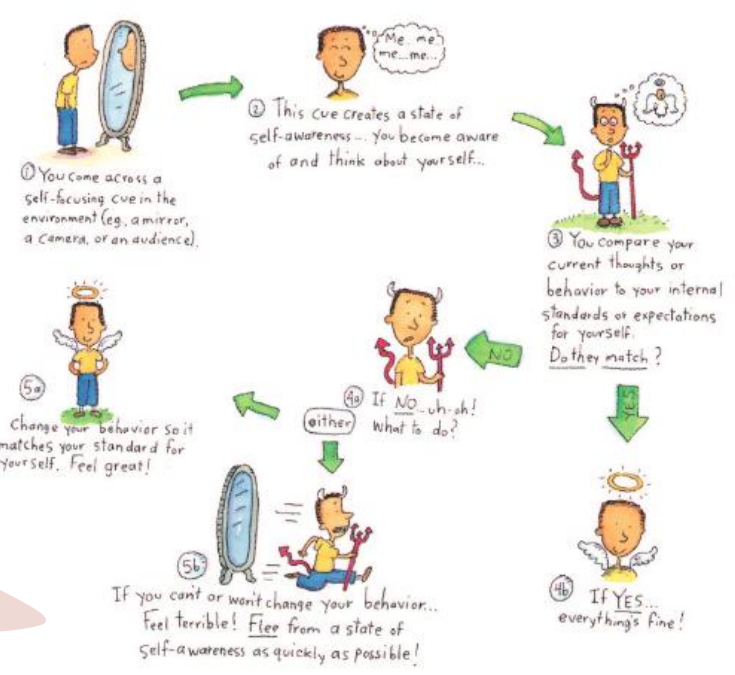
When someone is in a negative self-awareness, they try to “escape” from that condition by avoiding them.
Sometimes it can be in the form of religiosity. Self-focus is not always aversive.
Self-Knowledge: Determining Who We Are
Introspection: To privately think about “who we are”. Effective means of understanding ourselves when is focused on conscious decision making process.
The self from the observer’s standpoint: People can also attempt to learn about themselves by taking an “observer” perspective on their own past.
Personal Versus Social Identity
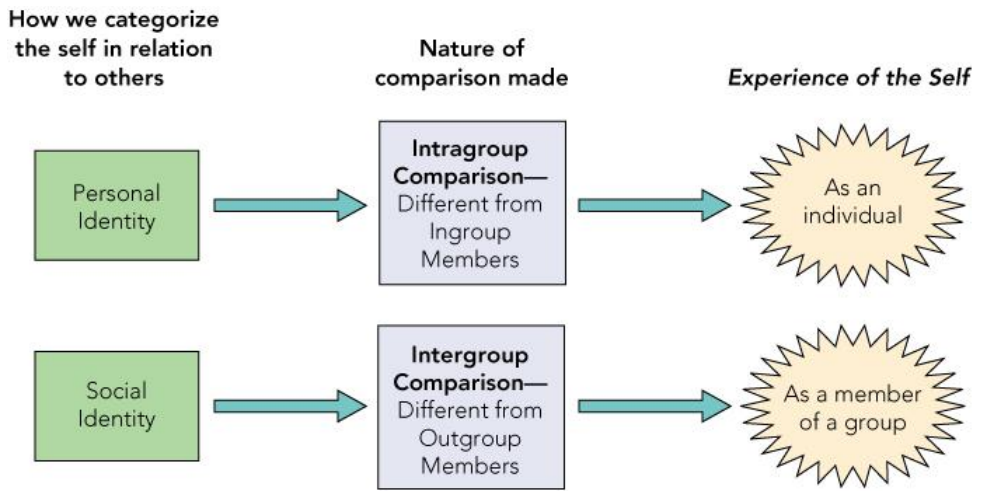
Social identity theory: We perceive ourselves differently at any given moment in time, depending on where we are on the personal-social identity continuum, the self can be categorized as a unique being (personal) or a member of a certain group.
Momentary salience: What is accessible and the focus of our attention.
Intragroup comparisons: Comparing ourselves to members of the same group.
When our group memberships are salient, we think of ourselves at the social identity level, which means we emphasize what we share with other group members.
Intergroup comparisons: They involve a contrast between groups.
Who Am I Depends on:
Relevance: An aspect of the self may be more relevant in a situation.
Distinctiveness: Aspects of ourselves that are unusual in a given context often form the bases of self-perception.
Importance: We are likely to categorize ourselves in terms of a particular personal trait or group identity to the extent that they are important to us.
Other people’s use of language Nouns (woman, student) are likely to activate social identities. Adjectives or verbs (e.g., weak, tall) are likely to elicit personal identities.
Who Am I Depends on Others’ Treatment:
A frequent response to perceived rejection by others is to choose to emphasize the aspect of one’s identity that differentiates the self from those rejecting us.
To create a self-perception as a rebel, one can take on a feature that differentiates members of one’s group from the mainstream.
The Self Across Time: Past and Future