Unit 2: Cell structure & function
Slogan: Structure determines function. Energy Efficiency. Compartmentalization
Critical Unit Notes
2.1 membrane structure
Structure | Description | Example |
Glycolipids (Sugar lipid) |
| 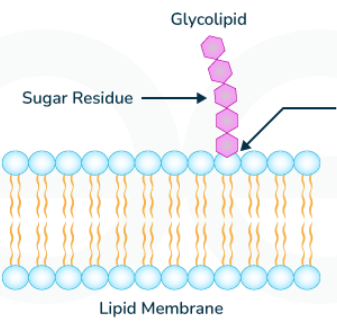 |
Glycoproteins (Sugar protein) |
| 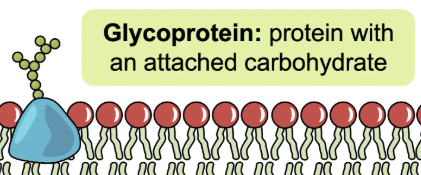 |
Integral Proteins |
| 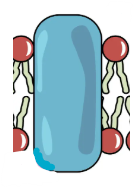 |
Peripheral Proteins |
| 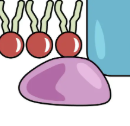 |
Cholesterol |
| 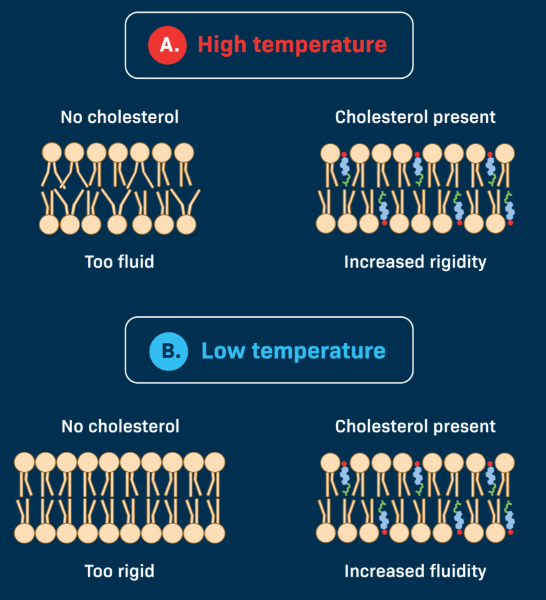 |
Glutanation: White blood cells attack blood cells that aren’t recognized;
blood clot → stroke → die
Membrane Proteins
Transport↴
May provide a hydrophilic channel that is selective for a particular solute
May change shape to get a substance across the membrane
Some proteins hydrolyze ATP to actively pump substances across the membrane
Enzymatic Activity↴
The active site may be exposed to substances in the adjacent solution
Signal Transduction↴
A membrane protein may fit the shape of a chemical messenger like a hormone
Cell-Cell Recognition↴
Some glycoproteins serve as ID tags
this type of cell bonding is short lived
Intercellular joining↴
Membrane proteins may hook together
This bond is long-lasting
Attachment to the cytoskeleton and extracellular matrix↴
2.2 Tonicity and Osmosis
Concentration: A RATIO of the amount of solute to the amount of solvent
Solute: a substance that is dissolved in water
Solvent: the substance into which solutes are dissolved
Diffusion: The process of random movement toward the state of equilibrium
Osmosis: The diffusion of water molecules across a semipermeable membrane/biological membrane
Fully passive; water naturally travels from areas of high water conc. (low solute conc.) to low water conc. (high solute conc.)
Aquaporins: Special protein channels that enhance the passage of water molecules through the plasma membrane found in certain cells
essentially allows water to travel faster through the membrane
Osmoregulation: The control of solute concentrations and water balance
Tonicity
the ability of a solution to modify the volume of cells by altering the water content
Tonicity COMPARES the concentration of two solutions
Hypertonic: when the concentration of a solution is higher than that of the solution you are comparing it too
hyper = higher
Hypotonic: when the concentration of a solution is lower than that of the solution you are comparing it to
hypo = lower
Isotonic: When the concentration of a solution is equal to the concentration of the solution you are comparing it to
Iso = equal
☆Solutes cannot move freely, but WATER can☆
Add visual examples from notes on pg.7
or some kind of explanation
2.3 Water potential
Water potential (Ψ): A measure of water’s potential to do work
2.4 Passive transport
2.5 Active transport
2.6 Cell structure and function
2.7 Cell size
Kahoot Questions!!
Go over prokaryotes vs Eukaryotes
prokaryotes: no nucleus, non membrane bound organelles
Eukaryotes: YES nucleus and membrane bound organelles
Prokaryotes have a LARGER Surface Area:Volume ratios than larger Eukaryotes
Prokaryotes have all ribosomes, cytoplasm, call membrane/wall
More folds (in ER and mitochondria) = more surface area = more efficiency
Rough ER- helps synthesize and package proteins for export
SMOOTH ER DETOXIFIES
If human cell is placed in pure water, the cells will gain water and possibly LYSE
Water potential moves from high to low water potential
Turgor pressure: when a plant’s vacuole exerts a pressure on the cell membrane, which then pushes up against the cell was
What molecules can easily diffuse/pass through the cell membrane without the use of protein channels? Small, non-polar/hydrophobic
High/more acidity is characterized by higher H+ ion concentration
Ions move through the membrane through a specialized ion channel
Mitochondria and chloroplasts are hypothesized to have been engulfed by an ancestor, what evidence supports this theory? The double membranes
Not evidence of the endosymbiotic theory?
Cells can survive on their own
How are ion pumps different from protein channels?
Ion pumps change shape when ATP attaches and detaches channels do not
Ribosomes are the reason for synthesizing proteins
Which organelle contains enzymes that are involved in the breakdown of harmful substances H2O2? Peroxisome
Plasmodesmata is a cell connection found in plain cells rather than animal cells
Which of the following organelles are found in the endomembrane system?
Nucleus, Rough Er, Golgi, Secretory vesicles, and plasma membrane
Essential Questions
1) Which molecules move across the membrane without energy? Small or large? Polar or non-polar?
2) When cells need to transport molecules that do not move easily across the membrane, how do they do it efficiently and effectively?
3) What organelles work together to help the cell process energy? What macromolecules are charged/utilized in this process?
4) What organelles work together to help the cell process information? What macromolecules are shared/utilized in this process?
5) What organelles work together to help the cell transport materials into, out of, and around cells? What macromolecules are shared/utilized in this process?
6) When materials are transported in and out of the cell, what determines how they move? How do cells maximize efficiency in this process?