Unit 1 - Introduction to Ecosystems
Unit 1 Introduction to Ecosystem
- Ecosystems
- Ecosystem: all living and nonliving things in an area
- Biome: large area with similar climate conditions that determine plant and animal species there
- Organism interactions –
- Competition: organisms fighting over a resource like food or shelter; limits population size
- Predation: one organism using another for energy source (hunters, parasites, even herbivores)
- Mutualism: relationship that benefits both organism
- Commensalism: relationship that benefits one organism and doesn’t impact the other
- Predation
- Herbivores: (plant eaters) eat plants for energy
- True predators: (carnivores) kill and eat prey for energy.
- Parasites: use a host organism for energy, often without killing the host and often living inside host
- Parasitoids: lay eggs inside a host organism; eggs hatch and larvae eat host for energy
- Symbiosis (sym = together | bio = living | osis = condition)
- Any close and long-term interaction between two organisms of different species
- Mutualism, commensalism, and parasitism are all symbiotic relationships.
- Any close and long-term interaction between two organisms of different species
- Competition: reduces population size since there are fewer resources available and fewer organisms can survive
- Resource partitioning: different species using the same resources in different ways.
- Temporal partitioning: using resources at different times, such as wolves and coyotes hunting at different times.
- Spatial partitioning: using different areas of a shared habitat.
- Morphological partitioning: using different resources based on different evolved body features.
- Terrestrial (Land) Biomes
- Biome: an area that shares a combination of average yearly temperature and precipitation (climate)
- The community of organisms (plants and animals) in a biome are uniquely adapted to live in that biome.
- Nutrient availability - plants need soil nutrients to grow, so availability determines which plants can survive in a biome.
- Shifting biomes - biomes shift in location on earth as climate changes.
- Aquatic Biomes
- Characteristics of Aquatic Biomes
- Salinity: how much salt there is in a body of water, determines which species can survive and usability for drinking
- Depth: influences how much sunlight can penetrate and reach plants below the surface for photosynthesis
- Flow: determines which plants and organism can survive, how much O2 can dissolve in water
- Temperature: warmer water holds less dissolve O2 so it can support fewer aquatic organisms
- Freshwater: Rivers and Lakes
- Rivers have high O2 due to flow mixing water and air also carry nutrient-rich sediments (deltas and flood plains = fertile soil)
- Lakes = standing bodies of fresh H2O (key drinking H2O source)
- Littoral: shallow water with emergent plants
- Limnetic: where light can reach (photosynthesis)
- No rooted plants, only phytoplankton
- Profundal: too Deep for sunlight (no photosynthesis)
- Benthic: murky bottom where inverts (bugs) live, nutrient-rich sediments
- Freshwater: Wetlands
- Wetland: are with soil submerged/saturated in water for at least part of the year, but shallow enough for emergent plants
- Plants living here have to be adapted to living with roots submerged in standing water (cattails, lily pads, reeds)
- Benefits of wetlands
- Stores excess water during storms, lessening floods.
- Recharges groundwater by absorbing rainfall into soil.
- Roots of wetland plants filter pollutants
- Highly plant growth due to lots of water and nutrients (dead organic matter) in sediments
- Wetland: are with soil submerged/saturated in water for at least part of the year, but shallow enough for emergent plants
- Estuaries: areas where rivers empty into the ocean
- Mix of fresh and salt water (species adapt to this)
- High productivity (plant growth) due to nutrients in sediments deposited in estuaries by river.
- Salt marsh:
- Estuary habitat along coast in temperate climates
- Breeding ground for man fish and shellfish species
- Mangrove swamps:
- Estuary habitat along coast of tropical climates
- Mangrove trees with long, stilt roots stabilize shoreline and provide habitat for many species of fish and shellfish.
- Coral Reef
- Warm shallow waters beyond the shoreline; most diverse marine biome on earth
- Mutualistic relationship between coral (animals) and algae (plant
- Coral takes CO2 out of ocean to create calcium carbonate exoskeleton (the reef) and provides CO2 to the algae.
- Algae lives in the reef and provides sugar (energy) to the coral through photosynthesis.
- Both species rely on the other:
- Coral couldn’t survive without energy from algae.
- Algae need the home of the reef of CO2 from the coral.
- Both species rely on the other:
- Intertidal Zones
- Narrow band of coastline between high and low tide
- Organisms must be adapted to survive crashing waves and direct sunlight/heat during low tide.
- Shells and tough outer skin can prevent drying out (desiccation) during low tides.
- Different organisms are adapted to live in different zones.
- Open Ocean
- Low productivity/area as only algae and phytoplankton can survive in most of the ocean.
- So large though, that algae and phytoplankton of ocean produce a lot of earth’s O2 and absorb a lot of atmospheric CO2.
- Photic zone = area where sunlight can reach (photosynthesis)
- Aphotic zone (abyssal) = area to deep for sunlight
- Carbon Cycle
- Low productivity/area as only algae and phytoplankton can survive in most of the ocean.
- Movement of molecules that contain Carbon (CO2, glucose, CH4) between sources and sinks.
- Some steps are very quick (FF combustion); some are very slow (sedimentation and burial)
- Leads to imbalance in which reservoirs or sinks are storing carbon.
- The atmosphere is a key C reservoir, increasing levels of C in atmosphere. Leads to global warming.
- Carbon sink: a carbon reservoir that stores more carbon than it releases.
- Ocean (algae and sediments), plants, soil
- Carbon source: processes that add C to atmosphere.
- Fossil fuel (oil, coal, natural gas) combustion
- Animal (cow burps and farts = CH4)
- Deforestation, releases CO2 from trees
- Photosynthesis and Cellular Respiration
- Both processes are very quick
- Cycle C between biosphere and atmosphere in balanced amount (no net C increases in atmosphere)
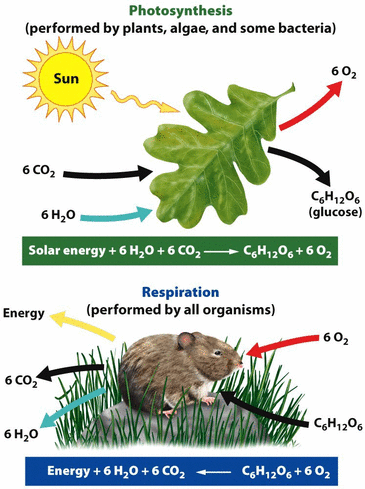 Photosynthesis
- Plants, algae, phytoplankton
- Removes CO2 from the atmosphere and converts it to glucose.
- Glucose = biological form of C and stored (chemical) energy in form of sugar
- CO2 sink
- Cellular Respiration
- Done by plants and animals to release stored energy.
- Uses O2 to break glucose down and releases energy.
- Releases CO2 into atmosphere
- CO2 source (adds CO2 to atmosphere)
- Ocean and Atmosphere
- Direct axchange: CO2 moves directly between atmoshpere and the ocean by dissolving into and out of ocean water at the surface
- Happens very quickly and in equal directions, balancing levels of CO2 between atmosphere and ocean
- Because of direct exchange, increasing atmospheric CO2 also increases ocean CO2, leading to ocean acidification
- Algae and phytoplankton take CO2 out of the ocean and atmosphere through photosynthesis
- Coral reef and marine organisms with shells also take CO2 out of the ocean to make calcium carbonate exoskeletons
- Sedimentation: when marine organisms die, their bodies sink to the ocean floor where they’re broken down into sediments that contain C
- Burial: over long, periods of time, pressure of water compresses C – containing sediments on the ocean floor into sedimentary stone (limestone, sandstone) - long term C reservoir
- Direct axchange: CO2 moves directly between atmoshpere and the ocean by dissolving into and out of ocean water at the surface
- Burial, Extraction, and Combustion
- Burial: slow, geological process that stores C in underground sinks like sedimentary rock or fossil fuels
- Sediments (bits of rock, soil, organic matter) compressed into sedimentary rock or fossil fuels by pressure from overlying rock layers or water.
- Fossil Fuels (FF): coal, oil, and natural gases are formed from fossilized remains of organic matter.
- Extraction and Combustion: digging up or mining fossil fuels and burning them as energy source, releases CO2 into the atmosphere
- Burial (formation of fossil fuels) takes far longer than extraction and combustion, which means they increase concentration of CO2 in the atmosphere
- Nitrogen Cycle
- Burial: slow, geological process that stores C in underground sinks like sedimentary rock or fossil fuels
- Movement of Nitrogen containing molecules between sources and sinks/reservoirs
- Sources releases N into atmosphere; sinks take N out of the atmosphere in increasing amounts.
- Nitrogen reservoirs hold nitrogen for relatively short periods of time compared to the Carbon cycle.
- Atmosphere = main Nitrogen reservoir
- Nitrogen in the atmosphere exists mostly as N2 gas, not usable by plants or animas.
- Nitrogen = critical plant and animal nutrient
- All living things need nitrogen for DNA and amino acids to make proteins.
- Nitrogen fixation
- Process of N2 gas being converted into biologically available (useable by plants) NH3 (ammonia) or NO3- (nitrate)
- Bacterial fixation: certain bacteria that live in the soil, or in symbiotic relationships with plant root nodules convert N2 into ammonia (NH3)
- Synthetic fixation: humans combust fossil fuels to convert N2 gas into nitrate (NO3-)
- Other Nitrogen Cycle Steps
- Assimilation: plants and animals taking nitrogen in and incorporating it into their body
- Ammonification: soil bacteria, microbes and decomposers converting waste and dead biomass back into NH3 and returning it to soil
- Nitrification: conversion of NH4 into nitrite (NO2) into nitrous oxide (N2O) gas which returns to atmosphere
- Human impacts on nitrogen cycle
- Climate: N2O (nitrous oxide) = greenhouse gas which warms earth’s climat4
- Ammonia volatilization: excess fertilizer use can lead to NH3 gas entering the atmosphere.
- Leaching and eutrophication: synthetic fertilizer use leads to nitrates (NO3-) leaching, or being carried out of soil by water.
- Phosphorus Cycle
- Phosphorus cycle basics
- Movement of phosphorus atoms and molecules between sources and sinks/reservoirs
- Rocks and sediments containing phosphorous minerals = major reservoirs
- Phosphorus cycle is very slow compared to Carbon, water, nitrogen cycles.
- Takes a long time for phosphorus minerals to be weathered out of rocks and carried into soil/bodies of water.
- No gas phase of phosphorus (doesn’t enter atmosphere)
- Because the cycle is so slow, it is limiting nutrients, meaning plant growth in the ecosystem is often limited by phosphorus availability in soil and water.
- Phosphorus is needed by all organisms for DNA, ATP (energy), bones and tooth enamel in some animals.
- Movement of phosphorus atoms and molecules between sources and sinks/reservoirs
- Phosphorus sources
- The major natural source of phosphorus is the weathering of rocks that contain phosphorus materials.
- Wind and rain break down rock and phosphate are released and dissolved into water’ rainwater carries phosphates into nearby soils and bodies of water
- Weathering is so slow that phosphorus is often a limiting nutrient in aquatic and terrestrial ecosystems.
- Synthetic: (human) sources of phosphorus = mining phosphate minerals and adding to products like synthetic fertilizers and detergents/cleaners
- Synthetic fertilizers containing phosphates are added to lawns or agriculture. Field: runoff carries phosphorus into nearby bodies of water. Phosphates from detergents and cleaners enter bodies of water via wastewater from homes.
- The major natural source of phosphorus is the weathering of rocks that contain phosphorus materials.
- Assimilation and Excretion/decomposition
- Phosphorus is absorbed by plant roots and assimilates into tissues; animals assimilate phosphorus by eating plants or other animals.
- Animal waste, plant matter and other biomass is broken down by bacteria/soil decomposers that return phosphate to soil.
- Assimilation and excretion/decomposition form a mini loop within Phosphorus cycle just like assimilation and ammonification in nitrogen cycle, photosynthesis and respiration in carbon cycle.
- Sedimentation and Geography uplift
- Phosphate doesn’t dissolve very well into water; much of it forms solid bits of phosphate that fall to the bottom as sediment (sedimentation)
- Phosphorus sediments can be compressed into sediment rock over long time periods by pressure of overlying water.
- Geological uplift: tectonic plate collision forcing up rock layers that form mountain; phosphorous cycle can start over again with weathering and release of phosphate from rock.
- Eutrophication (too much nitrogen and phosphorus)
- Because they’re limiting nutrients in aquatic ecosystems, extra input of nitrogen and phosphorous lead to eutrophication (excess nutrients) which fuels algae growth.
- Algae bloom covers surface of water, blocking sunlight and killing plants below surface.
- Algae eventually die-off: bacteria that break down dead algae use up O2 in the water (because decomposition = aerobic process)
- Lower O2 levels (dissolved oxygen) in water kills aquatic animals, especially fish.
- Bacteria use up even more O2 to decompose dead aquatic animals.
- Create positive feedback loop: less O2 🡪 more dead organism 🡪 more bacterial decomposition 🡪 O2.
- Hydrologic (water) Cycle
- Because they’re limiting nutrients in aquatic ecosystems, extra input of nitrogen and phosphorous lead to eutrophication (excess nutrients) which fuels algae growth.
- Water cycle overview
- Movement of H2O (in different states) between sources and sinks
- States of matter (solid/liquid/gas) as well as where water is moving are ley in H2O cycle.
- Energy from sun drives the H2O cycle.
- Ocean = largest water reservoir
- Ice caps and groundwater are smaller reservoirs but contain fresh useable water for humans.
- Evaporation and Evapotranspiration
- 2 main sources of water (processes that cycle it from liquid on earth back into the atmosphere)
- Sometimes called vaporization since liquid water becomes water vapor (gas) in atmosphere.
- Transpiration: process plants use to draw groundwater from roots up to their leaves
- Leaf openings called stomata open, allowing water to evaporate into atmosphere form leaf.
- Movement of H2O out of leaf creates low H2O potential in leaf, pulling H2O up from roots.
- Evapotranspiration: amount of H2O that enters atmosphere from transpiration and evaporation combined
- Both processes are driven by energy from the sun
- Runoff and Infiltration
- Precipitation (rain) either flows over earth’s surface into a body of water (runoff) or trickles through soil down into groundwater aquifers (infiltration)
- Groundwater (aquifers) and surface waters (lakes/rivers) are important freshwater reservoirs for humans and animals.
- Precipitation recharges groundwater through infiltration, but only if ground is permeable (able to let water pass through)
- Runoff recharges surface waters, but can also carry pollutants into water sources.
 Primary Productivity
- Primary Productivity Basics
- Primary Productivity: rate that solar energy is converted into organic compounds via photosynthesis over a unit of time.
- (Rate of photosynthesis of all producers in an area over a given period of time
- Ecosystems with primary productivity are usually more biodiverse than ecosystems with low primary productivity.
- Primary Productivity: rate that solar energy is converted into organic compounds via photosynthesis over a unit of time.
- Calculating Primary Productivity
- NPP = GPP – RL
- Net primary productivity (NPP): the amount of energy (biomass) leftover for consumers after plants have used some for respiration.
- Think of NPP as the actual amount of the plants paycheck it keeps after taxes.
- Respiration loss (RL): plants use up some of the energy they generate via photosynthesis by doing cellular respiration (movement, internal transportation, etc.)
- Gross Primary Productivity (GPP): the total amount of sun energy (light) that plants capture and convert to energy (glucose) through photosynthesis.
- Ecological Efficiency
- The portion of incoming solar energy that is captured by plants and converted into biomass (NPP or food available for consumers)
- Generally, only 1% of all incoming sunlight is captured and converted into GPP via photosynthesis.
- Of that 1%, only about 40% (or o.4% of total incoming solar energy) is converted into biomass/plant growth (NPP)
- Some ecosystems are more efficient (higher NPP) than others.
- Trends in Productivity
- The more productive a biome is, the wider the diversity of animal life it can support.
- Water availability, higher temperature, and nutrient availability are all factors that lead to high NPP.
- Trophic Levels
- The 10% Rule
- Conservation of Matter and Energy
- Matter and energy are never created or destroyed; they only change forms.
- 1st law of thermodynamics: energy is never created or destroyed.
- Biogeochem cycles demonstrates conservation of matter (C/N/H2O/P)
- Food webs demonstrate conservation of energy.
- 2nd Law of Thermodynamics
- Each time energy is transferred, some of it is lost as heat.
- Applied to food webs: the amount of useable energy decreases as you move up the food chain (organism use up most of it for movement, development, etc.)
- Because available energy decreases with each step up the food chain, trophic pyramid (troph = nourishment or growth) is used to model how energy moves through an ecosystem
- 10% Rule: in trophic pyramids, only about 10% of the energy from one level makes it to the next level; the other 90% is used by the organism and lost as heat.
- Each time energy is transferred, some of it is lost as heat.
- Trophic Levels and 10% Biomass
- Tertiary consumers: animals that eat secondary consumers or carnivores and omnivores (aka top/apex predators)
- Secondary consumers: animals that eat primary consumers or herbivores (aka – carnivores and omnivores)
- Primary consumers: animals that eat plants (herbivores)
- Producers: (plants) “produce” – really convert sun’s light energy into chemical energy (glucose)
- 10% rule also applies to biomass (or mass of all living things at each trophic level)
- Since energy is needed for growth and only 10% of energy transfers from one level to the next, only 10% of the biomass can be grown/supported.
- To calculate biomass or energy available at the next level up, move the decimal place one spot to the left (or divide by 10)
- Food Chains and Food Webs
- Food Web Basics
- Shows how matter and energy flow through an ecosystem, from organism to organism.
- When one organism preys on (eats) another, the matter (C/N/H2O/P) and energy (glucose, muscle tissue, etc.) are passed on to the predator.
- Arrows in food webs indicate direction of energy flow.
- Food Web vs Chain
- The food chain just shows one, linear path of energy and matter.
- Food webs have at least 2 different interconnected food chains
- Interactions and Trophic Cascade
- Food webs show how increases or decreases in population size of a given species impact the rest of the food web.
- Trophic cascade: removal or addition of a top predator has a ripple effect down through lower trophic levels