LGS Notes
- What is law?
- Law consists of rules that regulate conduct of individuals, businesses, and other organizations within society.
- Foundational Principles
- Rule of law
- Constitutionalism
- Federalism
- Separation of powers
- Checks and Balances
- Individual rights
- Due Process
- Presumption of Innocence
- What does the law do?
- It is intended to protect persons and their property from unwanted interference from others. The law forbids persons from engaging in certain undesirable activities.
- Functions of Law
- Keeping the peace
- Shaping moral standards
- Promoting social justice
- Maintaining the status quo
- Facilitating orderly change
- Facilitating planning
- Providing a basis for compromise
- Maximizing individual freedom
- US Businesses and Laws in Other Countries
- Businesses that are organized in the United States are subject to its laws. They are also subject to the laws of other countries in which they operate.
- Businesses organized in other countries must obey the laws of the United States when doing business here.
- Keeping the Peace
- Some laws make certain actions a crime:
Example: Larceny / Theft.– more than 7 million reported each year, making up almost sixty percent of all reported crimes.
- Shaping Moral Standards
- Some laws discourage drug and alcohol abuse
- Promoting Social Justice
- Some laws prohibit discrimination in employment.
- Maintaining Status Quo
- Some laws prevent the forceful overthrow of the government
- Facilitating Orderly Change
- Most laws are enacted only after considerable study, debate, and public input.
- U.S. law facilitates orderly changes through a combination of constitutional mechanisms, democratic elections, legal checks, and civic norms. These systems work best when all actors—government officials, citizens, and institutions—respect the rule of law and democratic principles.
- Facilitate Orderly Planning
- U.S. law facilitates orderly planning by establishing clear authority, funding, legal requirements, and institutional processes across multiple sectors. The combination of constitutional powers, federal statutes, administrative rules, cooperative governance, and public accountability ensures that planning is legal, transparent, and adaptable.
- Facilitating Planning
- Well-designed commercial laws allow businesses to plan their activities, allocate their productive resources, and assess the risks they take;
- Commercial laws allow businesses to plan their activities, allocate resources and risks
- How do we provide a basis for compromise?
- U.S. law provides a basis for compromise through structural features (separation of powers, bicameralism, federalism), legal processes (legislation, judicial resolution, settlement), and constitutional principles (due process, equal protection). These systems are designed to balance competing interests, making compromise a necessity—not just a virtue.
- Separation of Powers and Checks and Balances Constitutional Amendments: Supermajority Requirement
- The Legislative Process 2/3 of both chambers of Congress and ¾ of state legislature
- Bicameral Legislature (House + Senate) must agree; this ensures only widely supported compromises
- Court-Supervised Settlements mediation & Arb. can reshape foundational law;
- Legal Principles That Enable Negotiation Due process, EP, and contract law
- Provide a basis for compromise
- Laws allow for the settlement of cases prior to trial. Appx. 95% of all lawsuits are settled in this manner.
- How do we maximize individual freedom?
- U.S. law maximizes individual freedom by constitutionally protecting rights, limiting government power, ensuring equality under the law, and promoting participation in democratic institutions. Importantly, freedom is not absolute—it’s a legal structure that seeks to maximize liberty while respecting the rights of others and the stability of the system.
- The rights of freedom of speech, religion, and association are granted by the First Amendment to the U.S. Constitution;
- The rights of freedom of speech, religion, and association are granted by the First Amendment to the U.S. Constitution and it’s framework, others are:
- Second Am.- Right to bear arms
- Fourth Am. – Protection from unreasonable search/seizures
- Fifth & 14th Am.- Due process & Equal Protection of the law
- Ninth Am. – Recognizes we have rights beyond those listed;
- Rule of Law: Freedom Through Legal Protections
- Judicial Review and the Role of Courts
- Federalism: Diverse Approaches to Freedom “Laboratories of democracy”
- Civil Society and Free Expression- collective freedoms, 1st Am., challenge org.
- Limiting Government Power- C & B; transparency laws (FOIA); PP rights
- Economic Freedom – Right to contract, own property, engage in business;
- Democratic Participation- Voting Rights Act, petition, run for office
- Qualities of Law

- Fairness
- The American legal system is (said to be) one of the most comprehensive, fair, and democratic systems of law ever developed and enforced.
- Flexibility
- U.S. law evolves and changes along with the norms of society, technology, and the growth and expansion of commerce in the U.S. and the world.
- E.g., new laws on cybercrimes and cybertorts
- U.S. law evolves and changes along with the norms of society, technology, and the growth and expansion of commerce in the U.S. and the world.
- Jurisprudence
- The philosophy or science of the law

- History of American Law
- English system of law generally adopted
- Became the foundation from which American judges developed our common law
- What is English Common Law??
- All states except Louisiana base their legal systems on the English common
- law.
- Louisiana bases its law on civil law.
- Influence of its French heritage
- The French Napoleonic Code
- English Common Law
- Developed by judges who issued their opinions when deciding cases.
- Principles announced in these cases became precedent for later judges deciding similar cases.
- Stare decisis = “let the decision stand”
- Definition: a body of unwritten laws based on legal precedents established by the courts
- In the U.S., law, equity, and merchant courts have been merged.
- Most U.S. courts permit the aggrieved party to seek both law and equitable orders and remedies.

- Constitutional Law (2 types)
- Federal: US constitution
- “Supreme law of the land”
- State: all 50 states have a constitution
- Federal: US constitution
- Sources of Law in the US
- U.S. Constitution
- “Supreme law of the land”
- Established structure of federal government
- Legislative branch
- Executive branch
- Judicial branch
- Enumerates federal powers
- Reserves all other powers to states
- U.S. Constitution
- Articles I and II
- Article 1 Section 1 – All legislative powers shall be vested in a Congress of the U.S. and consist of a Senate and a House of representatives;
- Article 2 Section 1 – The Executive Branch: The President is the head of state and Commander-in-Chief of armed forces and responsible for execution and enforcement of laws created by Congress.
- Article III
- Article III Section 1- Establishes the Judicial branch and Supreme Court
- Checks and Balances
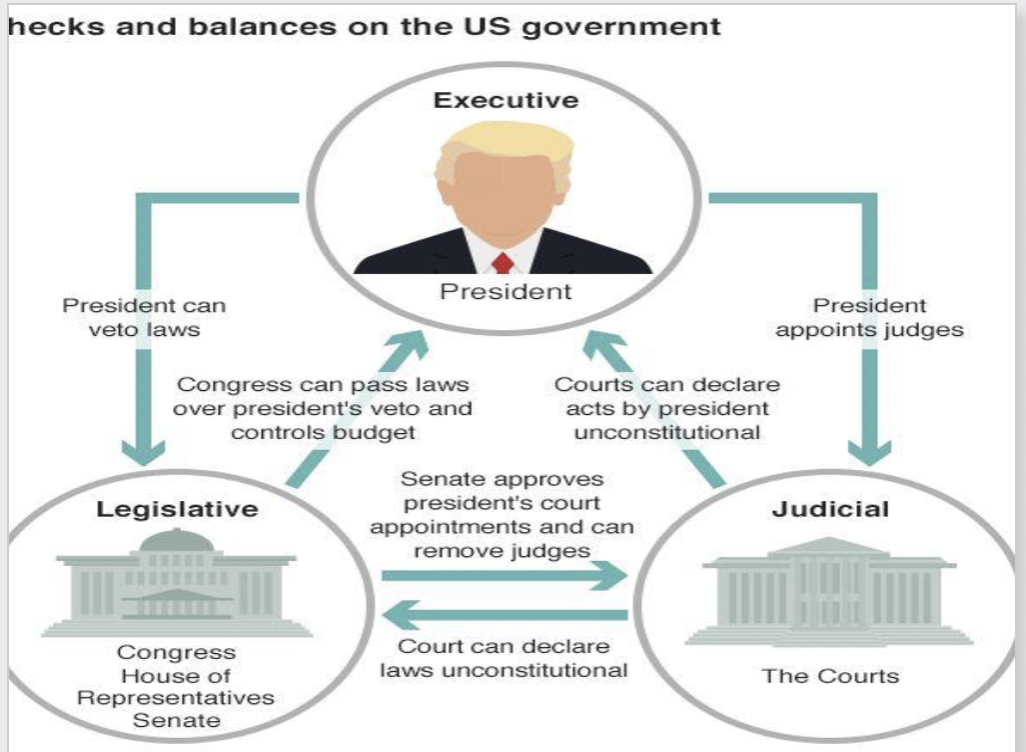
- Horizontal and Vertical Check and Balances
- Horizontal power-sharing of power between the 3 branches of government;
- Vertical power – sharing of power between the different levels of government;


- State Constitutions
- Often modeled after the federal Constitution
- Outlines the structure of the state government
- Governor & Lt.gov, AG = executive branch
- A state legislature = legislative branch
- State courts = judicial branch
- Statutory/ Codified Law
- AKA “the black letter law”
- Law passed by governing bodies
- Sources of law in US
- Codified law: Statutes and ordinances
- Federal statutes.
- State legislatures enact state statutes.
- Municipalities and local government bodies enact ordinances.
- Codified law: Statutes and ordinances
- Federal Statutes
- Statute
- Written laws that establish certain courses of conduct that covered parties must adhere to
- Enacted by the U.S. Congress empowered by the Commerce Clause and other provisions of the U.S. Constitution
- Regulate foreign and interstate commerce
- Organized by topic into code books
- Referred to as codified law
- Statute
- State Statutes
- Enacted by state legislatures
- Placed in code books
- Assessed in the hardcopy code books or online
- Other Sources of Law in US
- Executive orders
- Issued by the president and state governors
- E.g., order requiring federal agencies to buy more hybrid vehicles
- E.g., order allowing oil drilling on federal land
- Power derived from express delegation from legislative branch or implied from constitutional powers
- Executive orders
- Treaties
- The President, with the advice and consent of the Senate, may enter into treaties with foreign governments.
- Congress passes statutes to fulfill treaty requirements.
- Regulations and Orders of Administrative Agencies
- Empowered by legislative and executive branches of government
- Adopt rules and regulations
- Enforce statutes
- Hear and decide disputes
- Many agencies regulate business
- E.g., SEC, FTC, DOT
- Administrative agencies
- Agencies that the legislative and executive branches of federal and state governments are empowered to establish
- Empowered by Congress or state legislatures to adopt administrative rules and regulations
- Consist of the power to hear and decide disputes
- Decisions are called orders
- Informally referred to as “the fourth branch of government”
- Empowered by legislative and executive branches of government
- Sources of Law in US
- Judicial Decisions
- Courts decide controversies.
- Judicial decisions usually state the rationale used by the court in reaching that decision.
- Judicial Decisions
- Doctrine of Stare Decisis
- Based on the common law tradition, past court decisions become precedent for deciding future cases.
- Lower courts follow the precedent established by higher courts.
- Both federal and state courts follow the precedents established by U.S. Supreme Court decisions.
- Courts in one jurisdiction are not bound by precedent of another jurisdiction, but may look at it for guidance.
- Purpose:
- Uniformity
- Efficiency
- Predictability
- Flexibility (power to depart from or change precedent when warranted)
- Priority of Law in the US
- The U.S. Constitution and treaties take precedence over all other laws.
- Federal statutes take precedence over federal regulations.
- Valid federal law takes precedence over conflicting state or local law.
- State constitutions rank as the highest state law.
- State statutes take precedence over state regulations.
- Valid state law takes precedence over local laws.
- Critical Legal Thinking
- IRAC method
- Method used to examine a law case
- IR AC stands for issue, rule, application, and conclusion
- I = What is the legal issue in the case?
- R = What is the rule (law) of the case?
- A = What is the court’s analysis and rationale?
- C = What was the conclusion or outcome of the case?
- Requires that the decision maker to analyze, examine, evaluate, interpret, and apply the law to the facts of the case
- IRAC method
- Law in the Information Age
- The electronic age—computers and other electronic devices—have complicated the application of law
- Information age arrived before new laws were written
- Courts applied existing laws to the new digital and technological environment

