5.1.1 Chloroplast Structure and Function
Structures and Functions
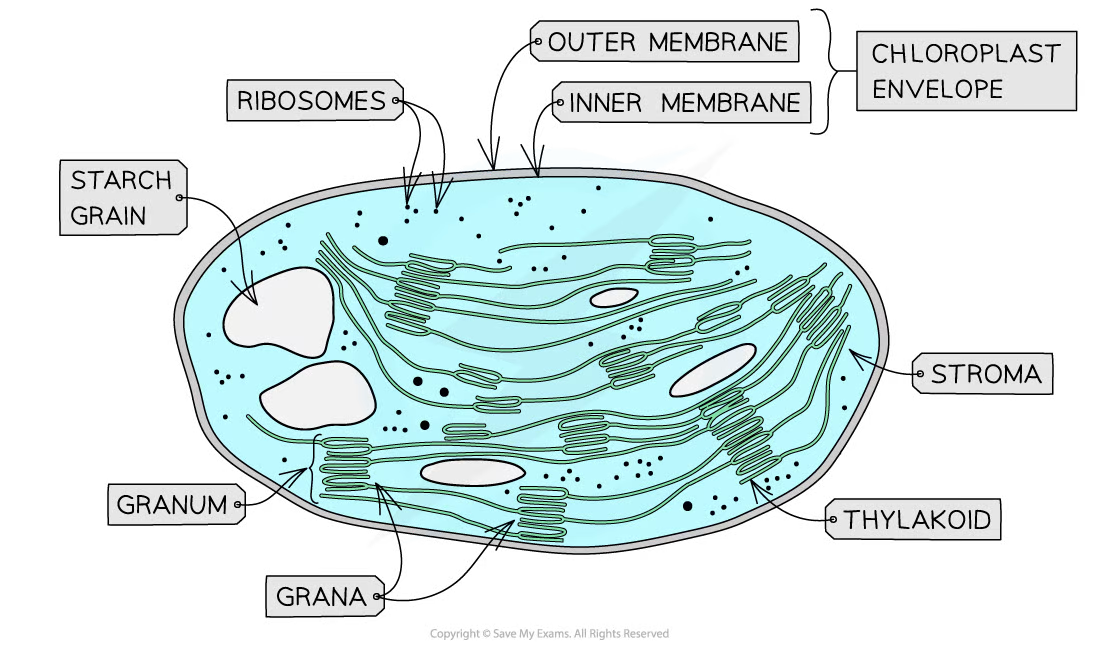
- Each chloroplast is surrounded by a %%double-membrane envelope%%
- Each of the envelope membranes is a %%phospholipid bilayer%%
- Chloroplasts are filled with a %%fluid known as the stroma%%
- The stroma is the %%site of the light-independent stage%% of photosynthesis
- A separate system of membranes is found in the stroma
- This membrane system is the site of the light-dependent stage of photosynthesis
- The membrane %%contains the pigments, enzymes and electron carriers required for the light-dependent reactions%%
- This membrane system consists of a %%series of flattened fluid-filled sacs known as thylakoids%%
- These thylakoids %%stack up to form structures known as grana%% (singular – granum)
- Grana are %%connected by membranous channels called stroma lamellae%%, which ensure the stacks of %%sacs are connected but distanced from each other%%
- The membranes of the grana %%create a large surface area to increase the number of light-dependent reactions that can occur%%
- This membrane system provides a %%large number of pigment molecules in an arrangement that ensures as much light as necessary is absorbed%%
- The stroma also contains small %%(70S) ribosomes%%, a %%loop of DNA%% and %%starch grains%%:
- The loop of DNA %%codes for some of the chloroplast proteins%% (other chloroplast proteins are coded for by the DNA in the plant cell nucleus)
- The proteins coded for by this loop of chloroplast DNA are %%produced at the 70S ribosomes%%
- %%Sugars formed during photosynthesis are stored as starch inside starch grains%%