Chemistry definitions
Term | Definition |
atom | smallest particle of matter that cannot be created or destroyed |
product | substance you finish with in a chemical reaction |
reactant | substance you start with in a chemical reaction |
energy | The capacity to do work; derived from sources such as motion (kinetic), position (potential), heat (thermal), chemical and nuclear |
exothermic | Releases energy to the surrounds |
endothermic | Takes in energy from the surrounds |
dissolution | The process of a solute mixing into a solvent to form a solution. |
chemical reaction | A rearrangement of particles to form a new substance/s. |
reaction rate | The speed at which a chemical change progresses and new product/s are formed. |
combustion | A reaction that involves a substance rapidly combining with oxygen, usually accompanied by a flame; burning. |
Incomplete combustion | A reaction or process which entails only partial burning of a fuel. |
respiration | The combination of an organic molecule (often glucose) with oxygen in a living cell that provides energy for the organism. |
collision theory | The theory that states that for a chemical reaction to occur, the atoms, ions or molecules must collide in the right orientation and with enough energy. |
concentration | The amount of a substance divided by the total volume of the mixture it is in. The more substance per unit of mixture, the more concentrated. |
temperature | A measure of the kinetic energy of particles in a substance. The hotter the substance, the more kinetic energy the particles have. |
catalyst | A substance that increases the rate of a reaction but is not used up in the reaction. |
surface area | A measure of how much of a reactant is exposed to other chemicals. The greater the surface area, the more chance of collisions between particles. |
fossil fuel | Fossilised materials such as coal, oil and natural gas, produced from ancient organisms, mainly plants, that lived millions of years ago. They can be burnt to produce energy. |
petrochemicals | Substances obtained from petroleum and natural gas. |
biofuel | Any source of energy produced from organic (once living) matter. |
polymer | Giant molecule formed by joining many smaller repeating molecules (monomers) together. |
biopolymer | A polymer made by or occurring in living organisms. |
social | To do with society e.g. economy, employment, points of view of different community groups |
ethical | Relates to moral principles -what is 'right' |
Environmental | relating to the natural world and the impact of human activity on its condition 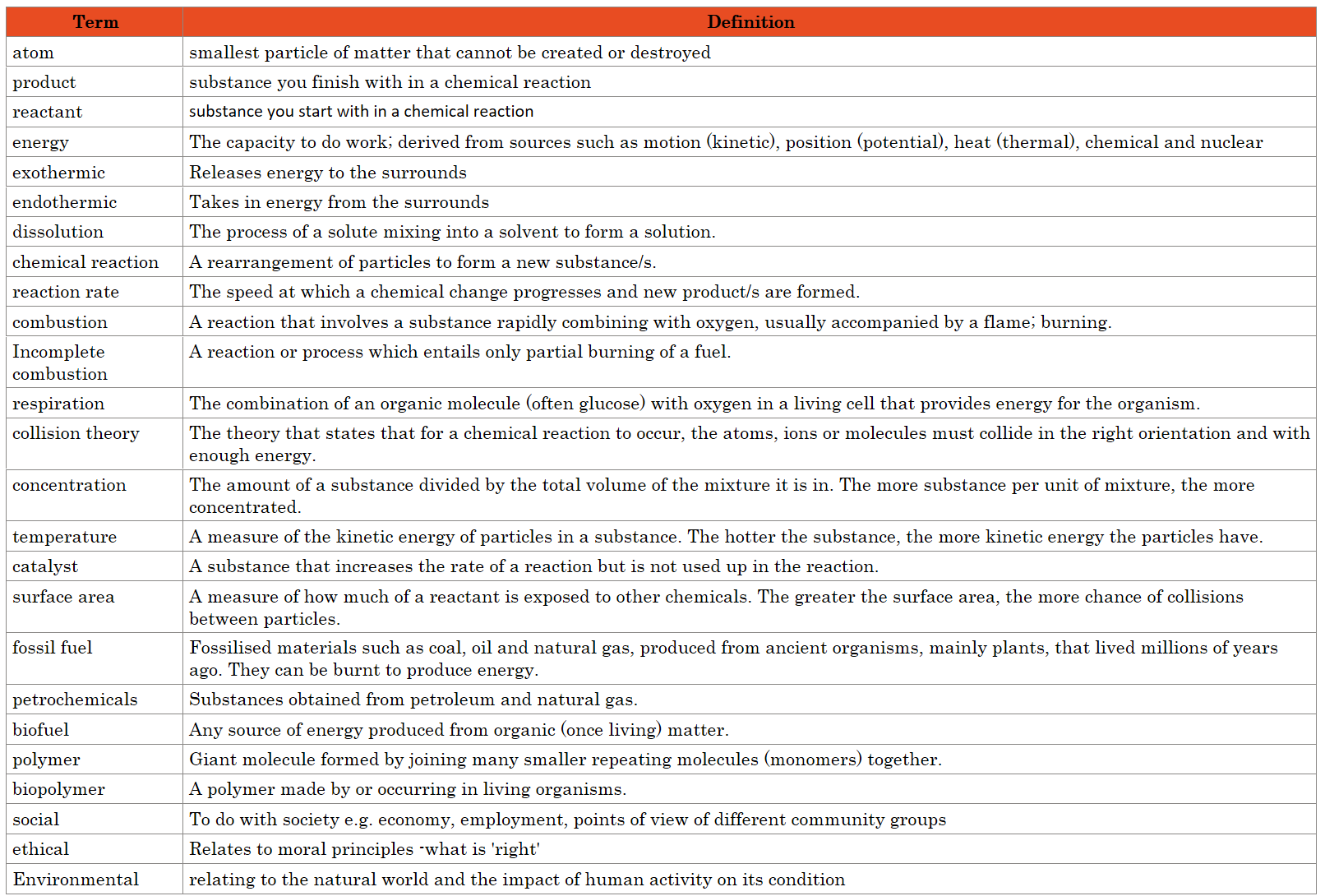 |