Week 18 BBC Article || Anatomy of the Plant
Adaptations of the leaf for photosynthesis and gaseous exchange
- leaves are adapted for photosynthesis & gaseous exchange
- stomata: small holes in the leaf that let CO2 in an oxygen out
- transpiration: water evaporates from leaves, leading to more water to be sucked up by the roots
Functions of leaves
- basic equation for photosynthesis - carbon dioxide and water → glucose and oxygen
Features of leaves
- large surface area - to capture light
- thin - short distance for CO2 to diffuse through
- chlorophyll - absorbs sunlight used for energy
- network of veins - support and for transporting materials
- stomata - see above
Structure of a leaf
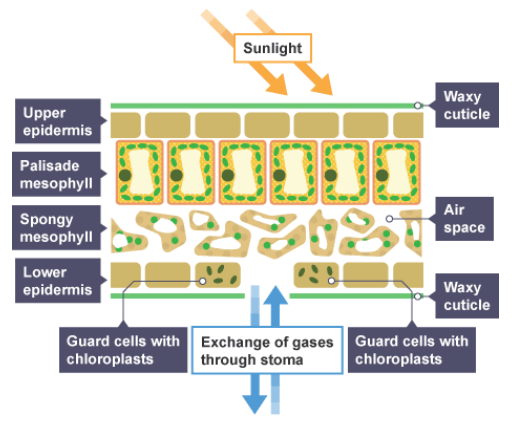
- made as efficient as possible through adapting over time
Functions of tissues of the leaf
- thin/transparent epidermis - allow more light to reach palisade mesophyll cells
- thin layer of wax - prevents infection and water loss
- palisade layer near top - increase rate of photosynthesis
- spongy layer - gases can diffuse in the leaf
Gas Exchange
- Carbon dioxide enters through the stomata and oxygen leaves
- water vapor also diffused out of the stomata
Absorbing light energy
- light absorption occurs in the palisade mesophyll
- palisade cells are packed close together
Transport in plants and the structure of specialised plant cells
- Types of transport systems in the plant:
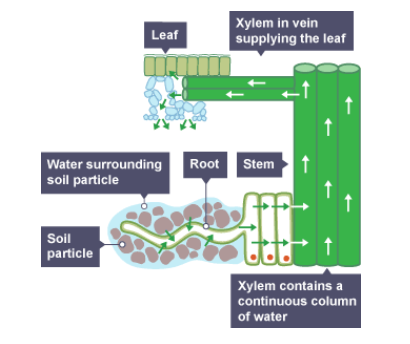
- xylem: moves water and mineral ions from roots to leaves
- phloem: food (sugars and amino acids) is moved from the leaves through the plant
- Movement of food in the plant: translocation
Root Hair Cells
- plants use osmosis to absorb water from the soil
- absorb minerals by active transport (against concentration gradient)
- root hair cells: absorb water and minerals
- Has a large surface area for maximizing rate of absorption
- contain mitochondria so they can provide energy for active transport
- water has many purposes in a plant
- reactant used in photosynthesis (remember light reaction cycle!
- keeps leaves and shoots rigid
- cools leaves by evaporation
- transports dissolved minerals
Stomata
- Plants in dry conditions have a small amount of stomata and only on the bottom of the leaf’s surface to help prevent water loss
- plants regulate size of stomata with guard cells
- guard cells become turgid when there is light and take in water through osmosis
- in low light guard cells become flaccid
- size of the stomata opening helps control wilting
Plant transport tissues - Xylem and phloem
Xylem
- (xylem: moves water and mineral ions from roots to leaves) [copied from earlier]
- xylem is made of dead cells
- xylem forms a hollow tube
- strengthened by lignin - giving support to the plant
- lignified cells = wood
Phloem
- (phloem: moves food from the leaves through the plant)
- sucrose is the transport sugar in the phloem
- phloem uses translocation; form of active transport
- parts of phloem
- sieve tubes - for transport
- no nuclei
- tubes have perforated ends so the cytoplasm in the tubes connects one cell to the next
- sucrose and amino acids are translocated in the cytoplasm of these tubes
- companion cells - provides energy for active transport
- attached to sieve tubes
- sieve tubes depend on these
Transpiration
- transpiration: the plant opens its stomata to let in CO2, then water on the top layer of the spongy and palisade mesophyll evaporate and diffuse out of the cell
- xylem provides water to replace the water that is lost
- (review) water is connected through hydrogen bonds, water molecules in the xylem are attracted to each other - a constant column of water is pulled up in the stem when transpiration occurs
- water travels through the xylem → replaced by water from the roots
- photosynthesis takes 5% of water from the plant
Water uptake and transport across the root
- root hairs are a lengthened part of epidermal cells in the roof
- water enters root hair cells through osmosis; minerals come through by active transport
Factors affecting transpiration
- temperature
- humidity
- air movement
- strength of light
Calculating a mean and principles of sampling
Investigating transpiration
- simple way to experiment with water loss in plants is to measure their change in mass
- variables that can be changed
- air movement (ex. using a fan)
- temperature
- blocking the stomata (ex. using Vaseline)
Method
- remove some leaves from a plant
- find the mass of each leaf
- suspend leaves
- after a predetermined amount of time passes, re-measure mass of leaves
Analysis of results
- there will be variation in leaves, so repeat the experiment and calculate the mean of each data set
Water loss through the stomata
- scientists usually take a representative sample of the leaf’s stomata
- to be representative it must:
- include a decent amount of stomata spread throughout the slide
- must be random and not be an area with few or concentrated stomata
- count stomata in this area with a microscope; repeat the experiment a couple of days and take the mean.
Measuring water uptake - Potometers
Investigating transpiration
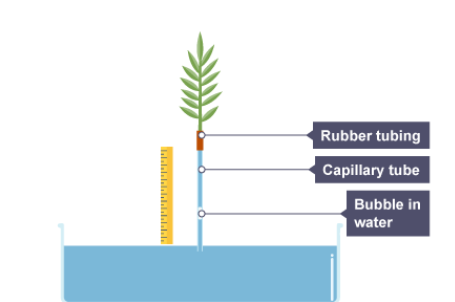
- a potometer can be used to determine the uptake of water
- finding the uptake of water can show the rate of transpiration
- potometer: tubing that is connected to the plant
- water uptake is measured by recording the time that an air bubble takes to travel up a certain distance in the tube
Aim of the experiment
- AIM: to find the rate of water uptake in a plant
Variables
- independent variable - time
- dependent variable - the distance moved by the bubble along the capillary tube
- control variables - temperature, air flow or draughts, water supply
Measuring effect of some environmental factors on water uptake
Investigating factors that affect the rate of transpiration
- factors that affect transpiration can also be observed through the potometer
| Condition | When encountered by plant | How the condition is produced in the laboratory |
|---|---|---|
| air movement | wind | fan |
| coatings that block stomata | pollution, things used for cuttings and Christmas trees | Vaseline applied to leaves |
| high light intensity | sunny, man-made lighting in greenhouses | artificial lighting |
| high temperature | warm climates | heater/greenhouse |
Investigate distribution of stomata and guard cells
Counting stomata
- Why do scientists count stomata?
- to investigate number of stomata
- amount of closed or open stomata at a given time
- to investigate adaptations that are made when put in certain conditions
- effects of heightened CO2 concentration from pollution
Method 1 (for counting stomata)
- put a drop of water onto a slide
- tear the leaf where you’d like to examine so you can reveal the epidermis
- examine
Method 2 (for counting stomata)
- paint leaf’s surface with clear nail polish and let dry
- peel off nail polish
- examine
Recording the distribution
- density of stomata is recorded per unit area (typically sq mm)