Lung Cancer
LEARNING OBJECTIVES
Describe the 4 main types of lung cancer: etiology, pathology, staging, treatment and prognosis.
Distinguish small cell carcinoma from non-small cell carcinoma.
Outline the evidence linking smoking and lung cancer.
Lung Cancer: Aetiology
Highest number of cancer related deaths worldwide.
Lung cancer Risk factors
Age | Ionizing Radiation |
Smoking
| Occupational exposures e.g asbestos, silica, diesel engine exhaust. |
Air pollution | Family History |
Symptoms
Coughing
Weight loss
Shortness of breath
Chest pain
Hemoptysis - coughing up blood, or sputum that is streaked with blood
Fever
Weakness
Lethargy
Rarely: difficulty swallowing or wheezing.
Paraneoplastic Syndromes
Up to 12% of patients.
Most endocrine are related to SCLC (small cell lung cancer).
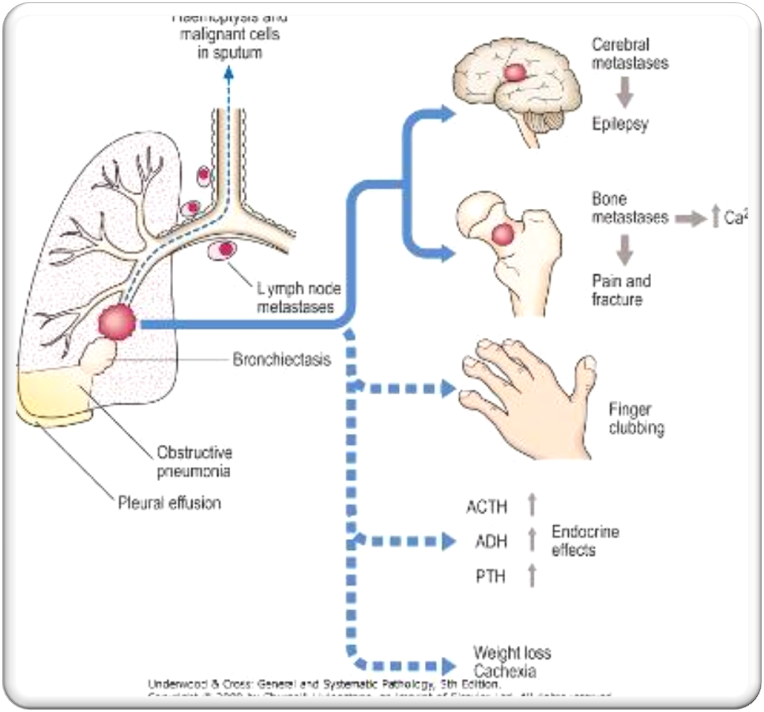
Cushings syndrome with facial edema and cachexia; hypokalemic alkalosis.
Inappropriate ADH secretion - low Na resulting from high urine osmolarity and low serum osmolarity - causes irritability, confusion, weakness and seizure in extreme cases.
Parathormone-like effect - hypercalcemia, lethargy, polyuria, polydipsia, constipation, abdominal pain.
Gonadotropin effects - gynecomastia, testicular atrophy.
Lung Cancer: Types
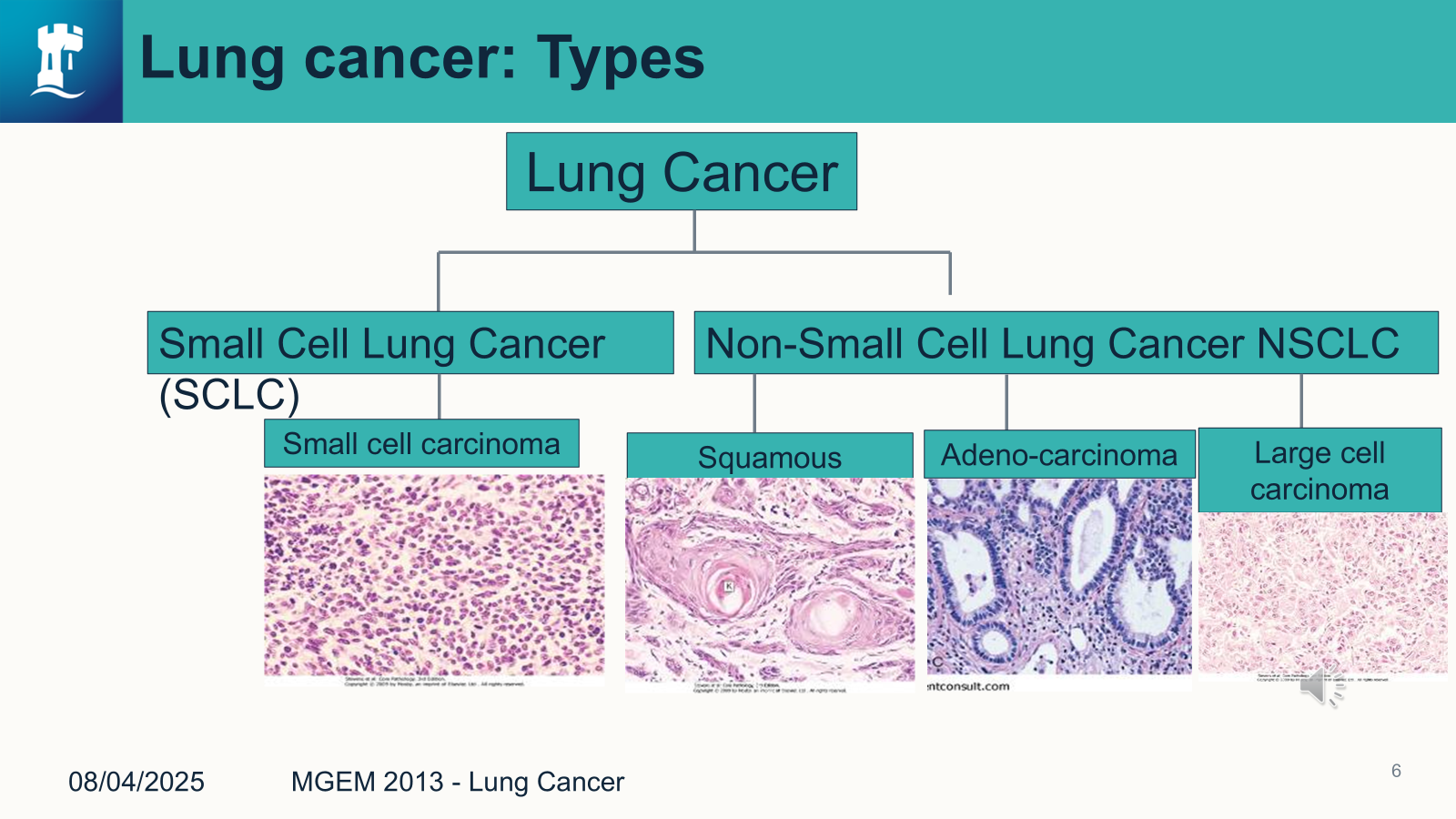
Small cell Lung Cancer (SCLC)
Also known as oat cell carcinoma.
Accounts for 80% of all lung cancer.
More prevalent in male.
Associated with cigarette smoking.
Usually accompanied by a paraneoplastic syndrome (myasthenia of Eaton-Lambert syndrome, ectopic coricotropin production, diabetes inspidus).
More sensitive to chemotherapy.
Poorest survival rate (5 years).
Non-Small Cell Lung Cancer (NSCLC)
Has three main subtypes: squamous cell carcinoma, adenocarcinoma and large cell carcinoma.
Squamous cell carcinoma accounts for 30% of all lung cancers;
has been associated with smoking and exposure to chemical carcinogens.
Starts in the bronchi of the lungs
Adenocarcinoma accounts for 30% of invasive lung cancers
Has a peripheral location and early lymphatic spread.
Most common type of NSCLC especially in non-smokers.
Large cell carcinoma accounts for 10% of all lung cancers
May show features of squamous or glandular differentiation or both.
Tends to grow and spread more quickly than adenocarcinoma and squamous cell carcinoma.
Has the poorest 5-year survival rate of all NSCLC.
Lung Cancer: Diagnosis
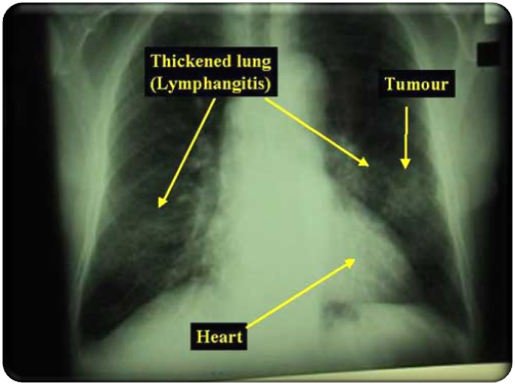
CHEST X-RAY
Solitary pulmonary nodule or mass.
Up to 80% of solitary pulmonary nodules (<4cm diameter) in the over 50 age group are cancer.
Chest X-Ray may also be used to evaluate the size of the tumor and possible involvement of lymph nodes in the chest.
CT SCAN
Particularly useful in identification of lymph node involvement.
The NLST (US National Lung Screening Trial) showed a 20% reduction in lung cancer mortality in high-risk participants (smoking history of ≥30 pack-years) aged 55 to 74 years who were randomly assigned to screening with low-dose computed tomography (LDCT) versus those assigned to chest radiography.
Screening test for early detection of lung carcinoma
Early CDT-Lung is a blood test enabling the early detection of lung cancer.
The test is currently in clinical use and has already shown that within high-risk populations that cancers can be detected early whilst they are still treatable with the potential for increased patient survival and indeed in some cases cure.
BIOPSY
Lung biopsy usually performed when clinical symptoms or findings on a chest x-ray or CT scan suggest lung cancer.
Biopsy sample → pathologist for confirmation → tumor staging
Information will guide treatment for the cancer and determine the disease prognosis.
Complications
30% presenting with symptoms of metastatic disease e.g bone fracture, CNS symptoms, jaundice (liver).
Local spread to nodes characterized by clinical syndromes
SVC syndrome - compression from paratrachial nodes.
Horners syndrome - cervical sympathetic chain.
Prognosis
Most have metastised to distant sites (70%) on presentation (brain, liver, bone, adrenal).
25% have regional lymph node involvement on diagnosis.
Most are inoperable (75% NSCLC, age is a factor)>
1 year survival rate = 30%
5 year survival rate = 9%
5 year survival for localized lung lesion 45%
Smoking and Lung Cancer
Smoking increases lung cancer risk by 20-30 times compared to non-smokers.
Biological mechanisms: presence of carcinogens + DNA damage and mutation.
Dose-response relationship
Pathological evidence.