Bruce Tuckman's Stages of Team Development
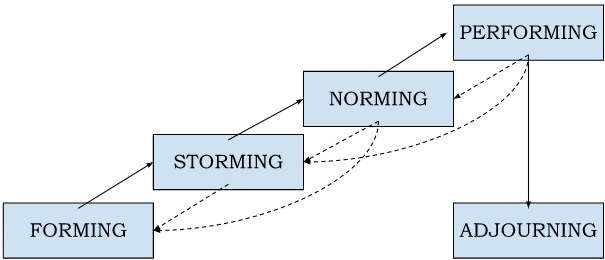
- Existing teams might regress back to an earlier stage of development
- Forming Stage
- A period of testing and orientation in which members learn about each other and evaluate the ^^benefits and costs of continued membership.^^
- People tend to be polite, will defer to authority, and try to find out what is expected of them and how they will fit into the team
- Member Challenges
- Discover expectations
- Evaluate value of membership
- Defer to existing authority
- Test boundaries of behavior
- Storming Stage
- ^^A period of high emotionality and tension and is marked by interpersonal conflict as members become more proactive and compete for various team roles^^
- Member Challenges
- Hostility and infighting
- Compete for team roles
- Influence goals and means
- Formation of coalitions and cliques
- Clarification of members’ expectations
- Norming Stage
- The ^^point at which the members really begin to come together^^ as a coordinated unit as roles are established and a consensus forms around ^^group objectives and a common or complementary team-based mental model^^
- Member Challenges
- Holding team together may over supersede task accomplishment
- Sense of cohesiveness may discourage minority views
- Can result in false sense of team maturity
- Performing Stage
- The point when members have ^^learned to efficiently coordinate and resolve conflicts^^
- Members are highly cooperative, have high level of trust in each other, are committed to group objectives, and identify with them
- Marks the emergence of a mature, organized, and well-functioning team motivated by group goals
- Member Challenges:
- Dealing with complex tasks
- Maintaining effort toward performance
- Adjourning Stage
- Stage occurs when the ^^team is about to disband^^ and team members shift their attention away from task orientation to a relationship focus
- A well-integrated team is able to
- Disband when its work is finished
- Work together in the future
Improving Team Processes
Team Building
- Team development, including sorting out team roles, takes time, so many companies try to speed up the processes through team-building activities
- It is a process that consists of formal activities intended to ^^improve the development and functioning of a work team^^
- Should begin with a ^^sound diagnosis^^ of the team’s health and then select team-building interventions that address weaknesses
Team Norms
- ^^Informal rules and shared expectations^^ team establishes to regulate member behaviors
- Performance Norms: conveys expectations about how hard team members should work and what the team should accomplish
- Norms develop through
- Initial team experiences
- Critical events in team’s history
- Experience or values members bring to the team
Types of Norms
- Ethical Norms
- (+): “We try to make ethical decisions, and we expect others to do the same.”
- (-): “Don’t worry about inflating your expense account; everyone does it here.”
- Organizational and Personal Norms
- (+): “It’s a tradition around here for people to stand up for the company when others criticize it unfairly.”
- (-): “In our company, they are always trying to take advantage of us.”
- High-Achievement Norms
- (+): “On our team, people always try to work hard.”
- (-): “There’s no point in trying harder on our team; nobody else does.”
- Support and Helpfulness Norms
- (+): “People on this committee are good listeners and actively seek out the ideas and opinions of others.”
- (-): “On this committee, it’s dog-eat-dog and save your own skin.”
- Improvement and Change Norms
- (+): “In our department, people are always looking for better ways of doing things.”
- (-): “Around here, people hang on to the old ways even after they have outlived their usefulness.”
Preventing or Changing Dysfunctional Team Norms
- State ^^desired norms^^ when forming teams
- Select members with ^^preferred values^^
- Discuss ^^counterproductive norms^^
- ^^Reward behaviors^^ representing desired norms
- ^^Disband teams^^ with dysfunctional norms