Proteins
Proteins
Functions of Proteins
Gene Coding
Humans have approximately 20,000 genes, each coding for a core protein.
mRNA and Protein Variation
Gene copies can be alternatively spliced, potentially leading to over 100,000 different proteins.
Variation in Proteins
Sources of Variation
Number of amino acids (20 standard, >20 modified).
Sequence of amino acid chains.
Alternative splicing and post-translation modifications.
The Study of Proteins - Proteomics
Proteomics Defined
The field dedicated to studying the vast diversity and functions of proteins.
The Proteome
The complete set of proteins in an organism.
Structure-Function Relationship
Protein function is determined by its structure, which is dictated by the amino acid sequence.
Impact of Mutations
Gene mutations can alter amino acid sequences, affecting protein structure and function.
Protein Structure
Levels of Organization
Biochemists categorize protein structure into several levels.
Mass Measurement
Protein masses are often expressed in daltons (e.g., 64 kDa).
Primary Structure
Definition
The sequence of amino acids in a polypeptide chain, linked by peptide bonds.
Terminology
Each amino acid is referred to as a "residue" or "moiety."
Secondary Structure
Definition
The local spatial arrangement of the polypeptide backbone, excluding side chains.
Hydrogen Bonding
Hydrogen bonds form between NH and C=O groups of amino acids.
Forms of Secondary Structure
Main Types
Alpha helix and beta (β) sheet.
The Alpha Helix
Structure
Right-handed coil with 3.6 amino acids per turn and a vertical distance of 5.4 Å per turn.
Functional Properties of Alpha Helices
Presence in Proteins
Common in many proteins; keratin is primarily composed of alpha helices.
Coiled Coil Structures
Two alpha helices wound together, stabilized by weak interactions and disulfide bridges.
Alpha Helices and Collagen
Collagen Characteristics
Most abundant protein in humans, fibrous, and forms a triple helix.
Haemoglobin is made ‘entirely’ out of alpha helices
Stability of Alpha Helices
Factors Affecting Stability
Electrostatic interactions, bulkiness of R groups, interactions between R groups, and proline residues.
The Beta (Pleated) Sheet
Structure
Composed of beta strands held together by hydrogen bonds.
Stability of Beta Sheets
Types
Parallel and anti-parallel beta sheets, with anti-parallel being more stable.
Importance of Beta Sheets
Trans-Membrane Proteins
Proteins like porins, which facilitate molecular movement across cellular membranes.
Tertiary Structure
Definition
Further folding of the polypeptide chain determined by side-chain interactions. Side chains can be hydrophillic, hydrophobic, charged etc. Proteins exist in aqueous environment so hydrophobic side chains will force folding into 3D structure, pointing side chains away from the water.
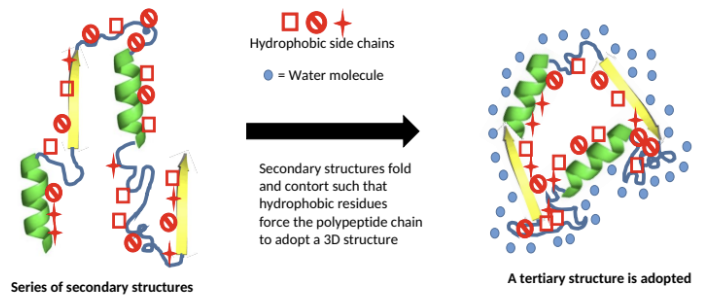
Tertiary structures contain common combinations of secondary nature. Most proteins cointain combinations of very common supersecondary structures such as:
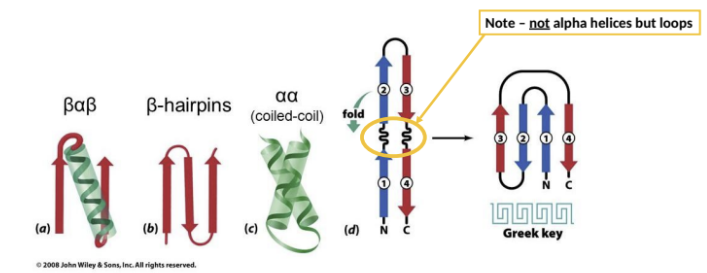
Forces in Tertiary Structure
Stabilizing Forces
Disulfide bonds, electrostatic interactions, and other forces contribute to stability.
Quaternary Structure
Definition
Composed of multiple polypeptides, often greater than 100 kDa, forming a functional protein.
Stabilization of Quaternary Structure
Types of Bonds
Similar to tertiary structure, stabilized by hydrogen bonds,