Myers' Psychology Unit 2: Cognition
Module 2.1a Perception: Influences on Perception
selective attention refers to our conscious awareness focusing on a particular stimulus, such as checking your phone in class for texts
we capture attention based on what we deem is important, revealing the cocktail party effect or our ability to attend to only one voice within thousands of others around us by bringing it to consciousness
our attentional gears shift significantly more than we realize and can often times be fatal in terms of distracted driving and high focus activities
our inattentional blindness is our inability to see visible objects when our attention is directed elsewhere in our environment
change blindness is a form of inattentional blindness, or our inability to notice changes in the environment
through our expectations we develop perceptual sets or mental predispositions to perceive one thing and not another
through experience we form schemas or concepts and frameworks that organize and interpret our information - influencing how we top-down process sensations
our immediate context, motivation, and emotion affects our interpretations of stimuli around us
context based on the situations we are in, our cultural context, and the way we have become accustomed to our surroundings aids interpretations
motivation based on what we want, or are energy we are putting into the goals around us, influence the stimuli’s interpretation (hills, long walks)
emotions we feel can predispose our perceptions in various directions depending on the context
Module 2.1b Perception: Perceptual Organization and Interpretation
people tend to organize visual sensations into a gestalt or an organized whole we perceive based on integrated pieces of information
the Necker cube displays this, as our brain perceives a whole from the sum of all the miscellaneous parts

we filter incoming information and construct the perceptions around us, doing more than simply registering information about our world
our figure-ground is the organization of the visual field into objects (figures) that stand out from their surroundings (the ground)
we process color, movement and light-dark contrast instantly and automatically but use grouping, the perceptual tendency to organize stimuli into coherent groups, through the use of proximity, similarity, and closure
our depth perception is the ability for us to see objects in three dimensions, although the retinal image is two dimensional, allowing us to judge distance
scientists use visual cliffs or a laboratory device to test depth perception in infants and young animals
our two eyes enable binocular cues, a depth cue such as retinal disparity that depends on the use of both of our eyes
convergence is the cue of nearby object’s distance, enabled by combining retinal images
retinal disparity is our binocular cue for perceiving depth, in which comparing retinal images from the two eyes our brain computes the distance (greater the disparity, the closer the object)
at further distances, we rely on monocular cues or depth cues such as interposition and linear perspective, available to either eye alone
we ignore and perceive rapid series of varying images as continuous movement, creating the stroboscopic movement phenomenon
signs exploit this into the phi phenomenon, or the illusion of movement created when two or more adjacent lights blink on and off in quick succession
stationary lights in dark environments cause the illusory movement of light moving, known as the autokinetic effect
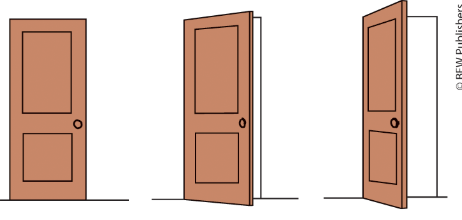
our perception uses top-down processing for perceptual constancy, where we perceive objects as unchanging even as illumination and retinal images change (color, shape, brightness, size)
color constancy is our ability to perceive familiar objects as having consistent color even if changing illumination alters the reflected wavelengths
we see color thanks to an objects relativity to the objects surrounding it
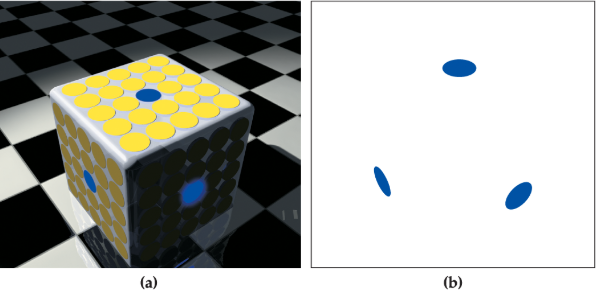
brightness constancy and lightness constancy depend on context as well, where we perceive an object as having a constant brightness even if illumination changes
shape constancy allows us to perceive the form of familiar objects as constant even with changing retinal images, whereas size constancy allows us to perceive an object as having unchanging size even when distance varies
for normal sensory and perceptual development, there is a critical period when exposure to stimuli or experiences is required
our perceptual adaptation is our ability to adjust to changed sensory input, including an artificially displaced or inverted visual field
Module 2.2a Thinking, Problem Solving, Judgements, and Decision Making: Concepts and Creativity
cognition includes all mental activities associated with thinking, knowing, remembering, and communicating; one of these is metacognition or the cognition about our own cognition to keep track of and evaluate mental processes
on basic levels, we form concepts or mental groupings of similar objects, events, ideas, or people
concepts are often formed by developing prototypes or a mental image/best example of a category (matching new items to old prototypes provides sorting of items)
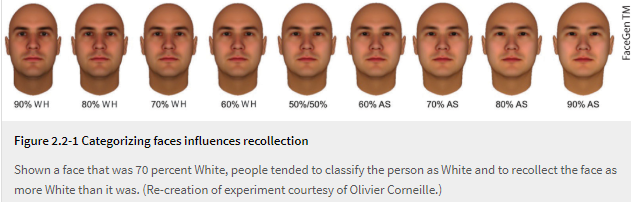
our maturing brains build schemas or concepts and frameworks that organize and interpret information
to explain schemas, we assimilate or interpret new experiences in terms of our existing schemas before we accommodate and adapt our current schemas to incorporate new information
creativity is our ability to produce new and valuable ideas, and often supported by our aptitude or ability to learn
aptitude tests (SAT) require convergent thinking or narrowing the available problem solutions to determine a single best solution, where creativity tests require divergent thinking or expanding the possible problems to solution to diverge in different directions
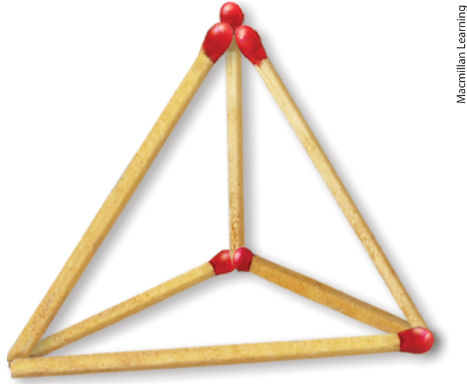
functional fixedness occurs when our prior experiences inhibit our ability to find new solutions
creativity is divided into five components that explain the concept:
expertise or well-developed knowledge forms mental building blocks to combine them for new solutions
imaginative thinking skills provide the ability to recognize patterns and connections
venturesome personality seeks out experience and overcomes ambiguity and risk to persevere
intrinsic motivation is driving interest and satisfaction over external pressures (project over deadline)
creative environments support and refine creative ideas
Module 2.2b Thinking, Problem Solving, Judgments, and Decision Making: Solving Problems and Making Decisions
we strive to improve our executive functions or cognitive skills that work together, enabling us to generate, organize, plan, and implement goal-directed behavior
sometimes we can use algorithms or step-by-step methodical procedures that guarantee solving a particular problem - but nature resorts to heuristics or simple thinking strategies (mental shortcuts) to make judgements and solve problems efficiently
when these fail, we fall on insights or sudden realizations of a problem’s solution without strategy (Aha!)
we seek news that affirms us, for example the confirmation bias or tendency to search for information that supports our preconceptions and ignore contradictory evidence
in cognition, our inability to see a problem from a new perspective is a fixation - a great example being our mental sets or tendencies to approach a problem in a particular way because it was previously successful
intuition is the effortless, immediate, automatic feeling or thought contrasted with explicit, conscious reasoning
using representativeness heuristic allows us to judge the likelihood of events in terms of how well they seem to represent, or match, particular prototypes
stereotypes are prototypes of certain racial groups that lead to unconscious use of this heuristic when judging individuals creating a racial bias
the gambler’s fallacy is the use of the heuristic to judge the likelihood of future events
the availability heuristic involves judging the likelihood of events based on their availability in memory; if the instance comes to mind quickly it is seen as common
cigarette packages for examples use eye-catching warnings and graphic photos that become more emotionally memorable
the tendency to be more confident than correct, or overestimating the accuracy of our beliefs and judgements is to be overconfident
this leads to fallacies like the planning (overestimating future leisure time and income) or sunk-cost fallacy (stick to the original plan since we’ve invested time)
similar to overconfidence is our belief perseverance or the persistence of one’s initial conceptions even after the basis they were formed has been discredited which results in using conclusions to assess evidence
humans also use framing, or the way an issue is posed to effect decisions and judgments - often times can nudge or encourage people to make beneficial decisions
Module 2.8a Intelligence and Achievement: Theories of Intelligence
intelligence is the ability to learn from experience, solve problems, and use knowledge to adapt to new situations often based on culture
our general intelligence (g) according to Spearman and others underlies all mental abilities and is therefore measured by every task on an intelligence test
this stems from factor analysis or a statistical procedure that identifies clusters of related items on a test and uses them to identify dimensions of performance that underlie a person’s total score
the Cattell-Horn-Caroll Intelligence Theory (CHC) suggests that our general ability is based on fluid intelligence (Gf) - our ability to reason speedily and abstractly which deceases in age - and crystallized intelligence (Gc) - our accumulated knowledge and verbal skills which increase with age
the CHC suggests our intelligence is based on g as well as specific abilities, bridge by Gf and Gc
Howard Gardner has identified independent intelligences, or the ability to be intelligence in specific areas
savant syndrome is a condition in which a person otherwise limited in mental ability has an exceptional specific skill, such as computation or drawing
Sternberg agreed that there is multiple intelligences, but his triarchic theory proposes three measured intelligences as analytical intelligence, creative intelligence, and practical intelligence
success is a combination of talent and grit, or passion and perseverance in pursuit of long-term goals
often times, it takes 10-years of intense daily deliberate practice to become a professional
social intelligence is how involved in understanding social situations and managing yourself becomes, critically accompanied by emotional intelligence or our ability to perceive, understand, manage, and use emotions
Module 2.8b Intelligence and Achievement: Assessing Intelligence
an intelligence test is a method of assessing an individual’s mental aptitudes and comparing them with those of others using numerical scores
achievement tests are designed to reflect and assess what a person has learned (AP)
aptitude tests are designed to predict a person’s future performance or the capacity to learn (SAT/ACT)
intelligence tests were designed initially to measure mental age or the level of performance typically associated with children of a certain chronological age - rather serving as a way to improve one’s education and further opportunity
the Stanford-Binet is the widely used American revision of Binet’s original intelligence test
for tests such as these, Stern’s intelligence quotient (IQ) is defined as the ratio of mental age (ma) to chronological age (ca) multiplied by 100 (the average being 100) - now adapted to show relative to the average performance of adults
psychologist David Wechsler created the Wechsler Adult Intelligence Scale (WAIS) or the most widely used intelligence tests that contain verbal and nonverbal subtests consisting of subjects such as similarities, vocabulary, block design, sequencing, etc.
psychological tests must meet psychometric (the study of the measurement of human abilities, attitudes, and traits) through standardization, reliability, and validity
standardization defines uniform testing procedures and meaningful scores by comparison with the performance of a pretested group
scores typically create a normal curve or a bell-shaped curve that describes the distribution of many physical and psychological attributes
scales and tests such as Stanford-Binet and Wechsler are re-standardized and compared with new samples due to the Flynn effect - the rise in intelligence test performance over time and across cultures
tests much have reliability or the extent to which a test yields consistent results through the assessing the consistency of scores on two halves of a test or alternative forms of the test
tests also must have validity or the extent to which a test measures or predicts what it is supposed to
content validity is the extent to which a test samples the behavior that is of interest
construct validity is how much a test measures a concept or trait
predictive validity is the success with which a test predicts the behavior it is designed to predict (test scores vs. criterion behavior)
Module 2.8c Intelligence and Achievement: Stability of, and Influences on, Intelligence
cross-sectional studies include research that compares people of different ages at the same point in time, whereas a longitudinal study includes research that follows and retests the same people over time
children’s intelligence tests predict future scores by age 4, and the consistency increases with the age of the child found by retesting in a cohort or a group of people sharing a common characteristic, like being from a given time period
intelligence also fuels healthier and longer lives thanks to it fueling education, better jobs, healthy environments, living, prenatal events, and well-wired bodies