HumCore Review
The Reluctant Dragon film
Baby Weems → a celebration of Western culture and male genius
Fantasy of the genius who knows everything
Particularly through a Western perspective (Baby Weems is white)
Labeled as someone with all the answers (goes on to solve world problems, governance problems, etc.)
Absurdity: baby genius can just solve all of these problems without having experienced the world
English → deemed as a universal language
Baby Weems is born knowing English → English becomes the dominant/most valued language
Paradigmatically American
Blonde with blue eyes
Elevated English (given an accent that seems to elevate him)
Seemingly trailblazer and a star → belongs to the country
Parents don’t get access to him
Shows exploitation of minors (irony of this being a Disney show → Disney exploits minors)
Consumerist aspect → the public owns Baby Weems
Products become centered around him
Dragon is queer-coded → doesn’t fall under stereotypes
Doesn’t want to be violent and destruction, affinity for tea, poetry, etc.
Features of the dragon are made to make the dragon tolerable and adorable → acceptable within society
More effeminate character and characteristics represent the dragon as different yet accepted
Simultaneously:
Docile, cute dragon → which goes against the norms and traditional conceptions of masculinity.
Coded as queer → made to be different
The dragon’s voice sounds like a mélange of a masculine and feminine tone.
Disney characters are queer coded by not acknowledged as queer
Representation of the dragon → indicative of an image of queerness as monstrous
Undermines the autonomy and uniqueness of queerness
The queerness is dangerous but exceptions can be made to “accept” queer people if they fall under certain social norms (ex: starting “normal” families)
Maps queer eccentricities map onto social and cultural values → respectability politics
Patriarchal trope → wife nags husband
At the end of the film, Mrs. Benchley gets mad that husband was dilly dallying
Misogynistic perspective playing into patriarchy:
Poor husband stuck with a nagging wife
Normalizes flirting and “cute secretary culture”
Women play into supporting roles → not exactly creators
Acting, playing voices, etc.
Double entendre → old hen voiceover (actress is an older lady and also voicing a hen/clucking sounds)
Act as nude models (animals and babies too)
All seeing eye of Disney
Husband becomes instantaneously accepted and welcomed into Disney
Disney “smile” and environment
Represents Disney environment as inclusive and being immersed in the world
You are meant to be there
Welcomed into the community → shown all the inner workings
Everyone called him by names → you matter, we know you, we care about you
Panopticon – all seeing eye; Disney environment is heavily surveilled/omnipresent/omniscient
Celebration of Western societal norms
Racial messages → paint white people as superior
Makes fun of a Chinese animator → Chinese elephants
Sexualized statue of a black women (with zebra legs)
Appropriation and accessibility → immerse and appease the audience
Animal voiceover to opera makes Disney seem accessible/similar to life
European appropriation but with Disney characters
Disney-ification of the real world
A fake version of the surrounding real world but in Disney form
Simulacra of the most common cultural/social norms
Concepts
Simulacrum
Disneyland
Utopia
Orientalism
Week 6 – Queerness
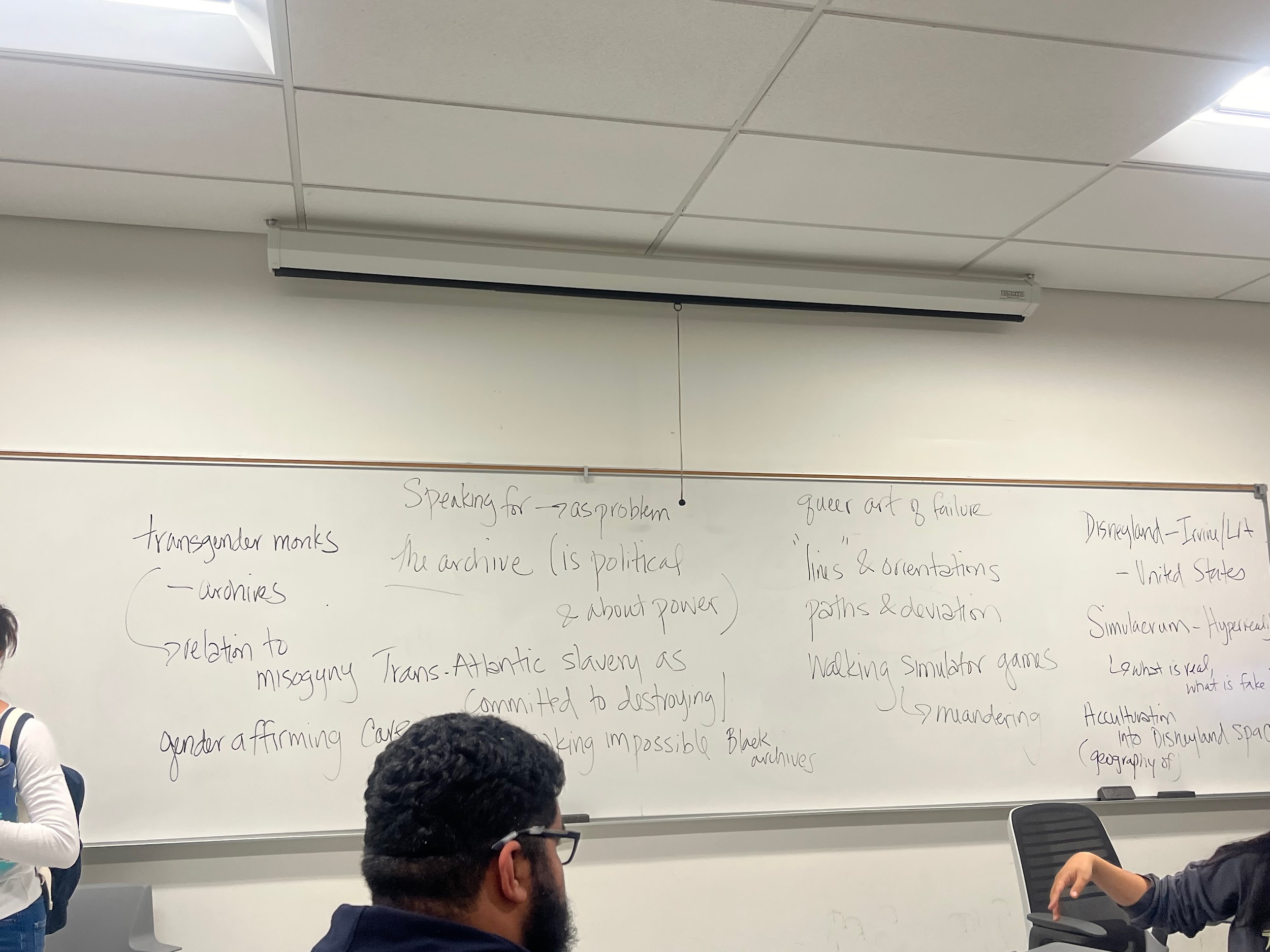
Lines and orientations
Orientation is about the ways we use to find our paths in a given space, whether we have our ways of inhabiting it. Lines represent various forms of alignment, which are usually set by society. Being “in line” reflects our adherence to the majority. In the specific context of sexual orientation, being heterosexual is a way to abide by the “lines”/norms in society, which makes LGBTQs queer constituents in the world.
Paths and deviation
Being “straight” refers to the adherence to a “heteronormative” path. Here, queer individuals are viewed as deviant since they turned away from objects that can help them stick to the “lines”. In other words, queer people are in a direction that is incomprehensible in society.
Walking simulator games - meandering
Case Study: Gone Home (a queer video game)
Derides games that “entail nothing more than walking”.
Association between meandering and femininity.
Walking itself as queer: Access of scattering objects that represent digressions from normative paths (i.e. heteronormative path)
Walking simulators challenge video game’s chrononormativity.
The pre-determined (“linear”) walking process in the seemingly “twisted” house offers limitations in the “freedom” of queer movement→ implicit denunciation of queerness.
Connections/analogies to “dark rides” in amusement parks like Disneyland.
Speed-running as the rhetoric of straight lines.
Queer art of failure
Certain games you need to succeed, and some failure is an integral part of the game. Failure is needed for growth
Our normative time frames are all about succeeding, but these games offer a benefit from failure and learning from it
Normative path: creates a sense of failure; straight line that we “MUST” follow → presents an absolute path that seemingly designates happiness
Birth, education (preschool/K-12), higher education (university/grad school), job + marriage and kids, retirement + grandchildren
Makes it difficult for people who don’t follow the path (particularly queer community)
Homonormativity – way in which homosexual relationships follow this path
Children's desires are polymorphous, not completely driven by the endpoint of children and marriage; no mandatory heterosexuality yet.
In the context provided, "polymorphous" refers to the idea that children's desires are diverse and multifaceted, not solely focused on conventional or predetermined goals such as having children or getting married. Instead, children's desires are varied and can encompass a wide range of possibilities and experiences beyond traditional societal expectations.
They are anarchic
Queer – as identity (sexuality and/or gender), umbrella term for anyone in the LGBTQIA+ spectrum who does not fit heteronormativity or cisnormativity (dominant social norms of heterosexuality and cisgender)
Queer – as a conceptual term, used in queer theory to describe something that does not fit dominant cultural norms, especially but not exclusively related to desire, intimacy, and power
Can be a verb → to overturn, reimagine, recast in queer light, reclaim for queer people
Theory based on lived queer politics
Theory definitions:
Queerness is “the exceptions to the conventional ordering of sex, reproduction, and intimacy.” - Mel Chen
Queerness is “a rejection of a here and now and an insistence on the... possibility for another world.” - José Esteban Muñoz
Queerness is “a basic desire to live life otherwise.” - Jack Halberstam
Idea that the “normal” world is not for queer people → queer people must make their own worlds/deviate (spaces to live, love, relate, and create)
New worlds are built not just by creators but by how we navigate the world
Sexuality as orientation in the meaning of space
The ways in which we orient ourselves in space/inhabit space affect our life and orientation
Straight movement → follows a heteronormative path
Following the expectations of society
Queer culture deviates from this “linear” path
Takeaways:
Following the designated straightforward path is a “straight” way of moving through the world
Deviating from the established path/not moving in a straight line is a queer way of moving through/remaking the world
END OF THE WORLD/QUEER APOCALYPSE: queerness seen as a threat to society as people view it as the end of children and thus the end of the world
Week 7 – The Archive
ARCHIVE - collection of primary sources
Why we learn certain stories and who is telling them (is political about power)
Not just mutual it has to do with the views of the powerful
Transatlantic slavery and the two Venuses as an archive. Could not exist because it was a documentation from the slave owners
Problems with the archive
The problem with the historian who tries to speak for other people/ forgotten souls
Creating stories without grappling with the fact these stories are destroyed
In Transatlantic slavery, enslaved people were only included in the archive if they were accused of or the subject of a crime, or as a recipient
Enslaved people couldn’t create their own archive because they were put together with other people that didn’t speak the same language
VENUS: goddess of love, beauty, sex and fertility, name given to slaves as seen as an ironic joke when the name was used on an enslaved woman.
Venus: two cycles of violence; impossible as an archive
Option 1: Reinforce the historical narrative told by enslavers
Archives treated as objective knowledge
Enslaved women like Venus are just a small speck in the archive → not given much voice/place to be seen as real victims → They could not speak for themselves.
Retelling of stories recirculate/reproduce violence
Option 2: create a fictional, historical narrative to represent what her life would have been like
Projection of our ideas on Venus → further victimizes her
Potential room for over romanticization
Ethics of rewriting the narrative
Is it ethically okay to represent and fill out the story
Is it actually for the victims or the author or society → to honor victims or assuage guilt
Desire to humanize such stories and reveal the human figures behind the violence
Problems:
May not be taken as accurate/historical → fantasy
Putting a bow on the horrors of history → projection of our own, fulfilled lives → whitewashing of history
Makes it seem that narratives were allowed to exist when in fact they were not
Committed to destroying or making impossible black archives
No white supremacist archives kept this information such as their names or stories just their sexual encounters
Week 7 – Transgender Monks
History in the archives
Trans-masculine monks are in archive to be celebrated for becoming men and therefore closer to God
Their stories are preserved not to honor their experience as trans people but to out them after they have died
Might not refer to them as transgender and it may shift, but nonetheless we can understand these gender identity ranges
Monks that born female and died as male monks - today we call transmonks
They are not talked about as the experience from trans-monks
Patriarchy
The relation to misogyny.
Trans male monks were celebrated for being closer to God and trans female monks were denigrated because they were moving down the cycle of perfectionism
Trans masculinity and patriarchal influence and misogyny
Trans masculinity celebrated (females → males)
Biological women are giving up bodily, female urges → become closer to men → become closer to God
Men = closest to angels → moving closer to God/more pure form
Trans masculinity → social/religious ascension
Virginity → taken as a masculine trait (rejection of bodily pleasures = masculine)
Story of Pelagius – sex worker, Pelagius, who eventually transcends to trans masculinity
Toleration for female masculinity → acceptable for a woman to pursue male characteristics
Only tolerable for so far; can’t go too far
Asceticism – masculine, monk-like behavior; associated with deprivation of body of desires and pleasures
Story of Anastasius – loses feminine features
Trans femininity denigrated (males → females)
Women = human and individual → moving away from God/less pure form
Trans femininity → social/religious decline
Sexuality and temptation → taken as a feminine trait (sexual behavior is the fault of a woman)
Intolerable for male femininity → hatred of femininity
Unacceptable for men to cross the boundary to more feminine characteristics
Byzantine Era
Gender-conforming care
Vasectomies
Top surgery for men who had large mammaries and women who had large clitorises - gender conforming surgery not gender affirming
Male and female were done through gender-affirming care
Men with bigger breasts would have surgery to make it smaller
Or a woman with a big clitoris would get it cut to be more feminine
Empress
Within a generation, we don’t know much about this empress
She wanted bottom surgery
She was not recorded positively & sufficient in records, where the only documents about her were negative descriptions.
Her trans identity was not celebrated but it was used as a way to make fun of her
Weeks 8-10 – Simulacrum - Disneyland
Simulacrum - no original, a fake original, misrepresentation of original
Then what is an authentic original?
Hyperreality - a built world that feels real but isn't
Hyperreality - a world that feels real but is totally constructed (ex. Films, disneyland)
Hyper reality is a world filled with simulacrum
A world full of simulacrum
Hard to distinguish what is real
Inorganic / master planned
Ex. Disney, Irvine, LA
Disney is like a miniature United States maybe?
Connection between Disney/Irvine/LA
Disneyland is a built environment, Irvine is a built environment. Top-down culture and a lot of imagining.
Connection to how to live safely in a science fiction universe
Sci-fi zone is another hyperreality
Irvine is a built world
All planned - everything is intentional
Made by a corporation
Architect of irvine created disney
Nothing can be organically added
No room for changes
Hollywood is an integral part of LA, and LA is an integral part of Disney. Bringing in palm trees.
The Spectrum - orientalist imagery without mention of the countries it’s related to.
Galaxy’s edge - supposed to be mysterious and scary, a ride in disneyland that is islamophobic because the architecture is modeled after middle eastern architecture and it is supposed to represent something scary.
Storm troopers - nazis
Simulacrum
What is real and what is fake
Spectrum = orientalist imagery → manicured and curated exoticism
Inspired by the Alhambra in Spain → touristic and exotified representation
Disneyland space
Assimilated you to the Disney mindset of Disney World
Acculturation into Disneyland space - the geography
How it becomes a part of the experience
A Hyperreality
The experience of living in the simulacrum is hyperreality. Everything is mediated of simulacrum
Theme park ride is an assembly line and the theme park is the factory → the way in which technology turns us into products
YOU are the product being made
Moved along a sort of assembly line and put through a series of scenes stimulating the senses → produced and manipulated to fall under idealisms of park
Factory workings become masked → produces elaborate theme park
Automation → robots/structures personified
Ex: Fred of space mountain in Disneyland
Subject formation shapes the suburbs, amusement parks, etc.
People become the subject to be influenced and shaped through parks, malls, etc.
Humanization of animatronics (amazon warehouses) - anthropomorphisation, makes us to connect with non-sentient objects
Simulacrum: fake copy but intended to have a specific effect on you.
flexible positional superiority
Idealism
Foster a really safe and comfortable environment to be open to new ideas and share
Model minority