INTEGUMENTARY SYSTEM
INTEGUMENTARY SYSTEM
- Outermost covering of organisms
EPIDERMIS
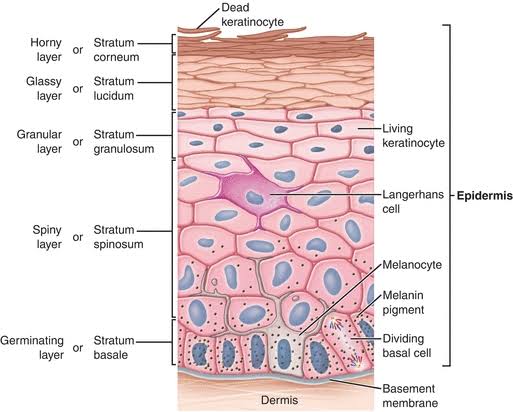
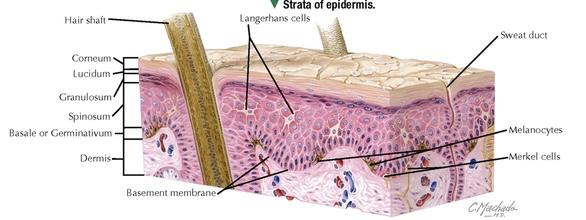
- mammals have 5 epidermal layers
- STRATUM CORNEUM (outermost)
- STRATUM LUCIDUM
- dead; only found in the thickest layers of skin
- STRATUM GRANULOSUM
- living; contains granules that are made of keratohyalin
- protects against dehydration/loss of water
- living; contains granules that are made of keratohyalin
- STRATUM SPINOSUM
- appears spiny under microscope
- spines are desmosomes (form junctions btw skin cells)
- STRATUM BASALE / STRATUM GERMINATIVUM
- continuously dividing; cells produced here get pushed up, forming the upper layers of the skin
EPIDERMAL FEATURES
- mostly dead cells (stratum corneum & lucidum)
- no blood vessels
- Oxygen comes directly from environmental gas exchange
- heavily keratinized in some vertebrates
- Esp in reptiles
- Defense, prevents dehydration
- CALLUS: patch of skin constantly exposed to friction, contains keratin
BASEMENT MEMBRANE
- Under epidermis
- FUNCTIONS:
- Support (anchors epidermis to dermis)
- development (contains substances in other skin layers to develop better)
- protection (provides a protective layer against harmful cells)
- LAYERS:
- BASAL LAMINA - collagen & glycoproteins
- RETICULAR LAMINA - fibers
DERMIS
- Under basement membrane
- Thickest layer of skin
DERMAL FEATURES
- dermal bone (bone that is formed within the dermis)
- presence of:
- collagen (for flexibility; reduces with age)
- Fibroblasts (creates connective tissues found in dermis)
- Adipose
- vascular tissue (blood vessels, arteries, etc)
- nerves
SPECIALIZED INTEGUMENTARY FEATURES
- the epidermis/dermis may produce specialized features in some animals
- other systems may work w the integumentary system regarding these modifications
INTEGUMENTARY MODIFICATIONS
- epidermal, keratinized
- Epidermis produces keratinized structures that extend out from the skin
- NAILS: primates (for grasping)
- CLAWS: carnivorans, reptiles (for grasping, latching on to surfaces, hunting, defense)
- HOOVES: ungulates (support, prevents injury to delicate features within the foot)
- Epidermis produces keratinized structures that extend out from the skin
- epidermal + skeletal
- HORNS
- epidermal: external;
- HORNS
skeletal: internal
- TRUE HORNS (unbranched; has inner bone & outer keratinized sheath)
- FALSE HORNS (unbranched; only made of keratin, no bony layer underneath)
- ANTLERS
(branched; has a bony inner core)
- As the organism develops, a bone (called VELVET), protrudes outward. The velvet is eventually shed off, leaving only the bony structure behind)
- epidermal + dermal protrusions
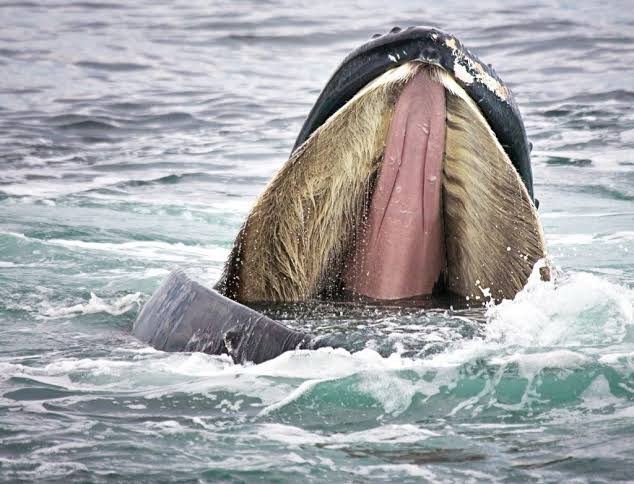
- BALEEN
- brush-like structure; mouth protrusions inside the mouths of whales
- Primarily for feeding (used to filter out organisms in the water, such as krill, plankton, etc)
- BALEEN
- cutaneous respiration
- Breathing thru skin
- Frogs, sea snakes, newts and salamanders, turtles
- pigments (CHROMATOPHORES)
- multiple functions
- Defense (APOSEMATIC COLORATION - allows organisms to warn predators against eating them bc their coloring is conspicuous)
- Reproduction (to attract mates)
- communication
- multiple functions
GENERAL FUNCTIONS OF THE EPITHELIUM
- injury resistance
- EPIDERMAL/DERMAL
- Immunity (barrier from potential pathogens)
- EPIDERMAL/DERMAL
- Structural
- BASEMENT MEMBRANE
- osmotic regulation & diffusion (balancing salt content in the body)
- BASEMENT MEMBRANE
- Sensory
- BASEMENT MEMBRANE
- Thermoregulatory (contains blood vessels which help contain/retain heat)
- BASEMENT MEMBRANE
- Pigmentation
- CHROMATOPHORES
- defense & courtship
- flight
- hunting
VERTEBRATE EPITHELIA
FISH INTEGUMENT: GENERAL
- not keratinized (w some exceptions)
- they don’t need keratin to prevent dehydration bc they live in aquatic habitats
- MUCOUS CUTICLE
- Outermost layer found in fish
- immune function
- predator defense
- makes the fish slimy, so harder to grasp
- used for signaling; production of compounds that are released into the water to warn other fish abt predators
- water flow
- allows water to flow more freely around the fish and enable them to swim more smoothly bc there is less friction between the fish and its surroundings (this also allows them to conserve energy better)
- Outermost layer found in fish
- epidermal cells + unicellular glands (responsible for producing mucus)
- dermal bone
- ex. Fin rays, dermal scales
- Collagen (makes skin bouncy and elastic)
GNATHOSTOME INTEGUMENT: CHONDRICHTHYES
- absence of dermal bone
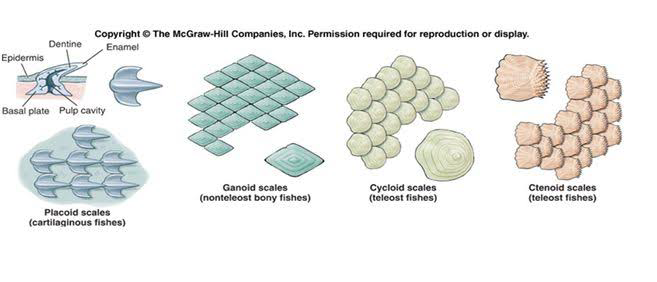
- dermal placoid scales
(like small razors; sandpaper-like texture)
- very elastic dermis
- Chromatophores
- Ex. COUNTERSHADING
- a form of concealing coloration in which the upper side of the body (dorsal side) is more darkly pigmented than the ventral side
- enables the animal to camouflage into its environment better
- Ex. COUNTERSHADING
GNATHOSTOME INTEGUMENT: SARCOPTERYGII & ACTINOPTERYGII
- mucous cuticle
- Dermal bones
- scales
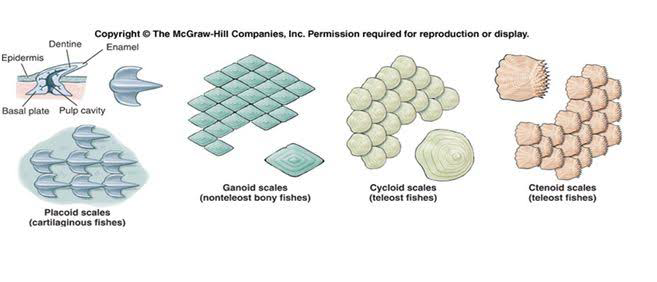
- GANOID SCALES
- Palaeonisciformes
- diamond -shaped w/ 2 small spikes embedded in the skin
- CTENOID SCALES
- Comb-like (brush-like structure along the outer edges called the ctenii)
- CYCLOID SCALES
- Ring-like, overlapping pattern
- GANOID SCALES
TETRAPOD INTEGUMENT: GENERAL FEATURES
- Keratinization
- Needed bc tetrapods are more prone to dehydration as terrestrial organisms
- dermal multicellular glands (found in dermis), secreted thru ducts
- PROBLEMS:
- Abrasion (bc there's no lubrication material to protect their skin against abrasion
- desiccation
- skin permeability (thick skin decreases ability of skin to breathe)
- uv light (terrestrial organisms are exposed to uv light; can damage skin & dna)
AMPHIBIAN INTEGUMENT
- Poison glands (for defense against predators)
- Mucus glands (protective purposes; keeps organism moist)
- chromatophores
REPTILE INTEGUMENT
- REPTILIAN SCALES AND SCUTES
(made of keratin; hardens surface, protects against abrasion & desiccation)
- FEATHERS (for birds)
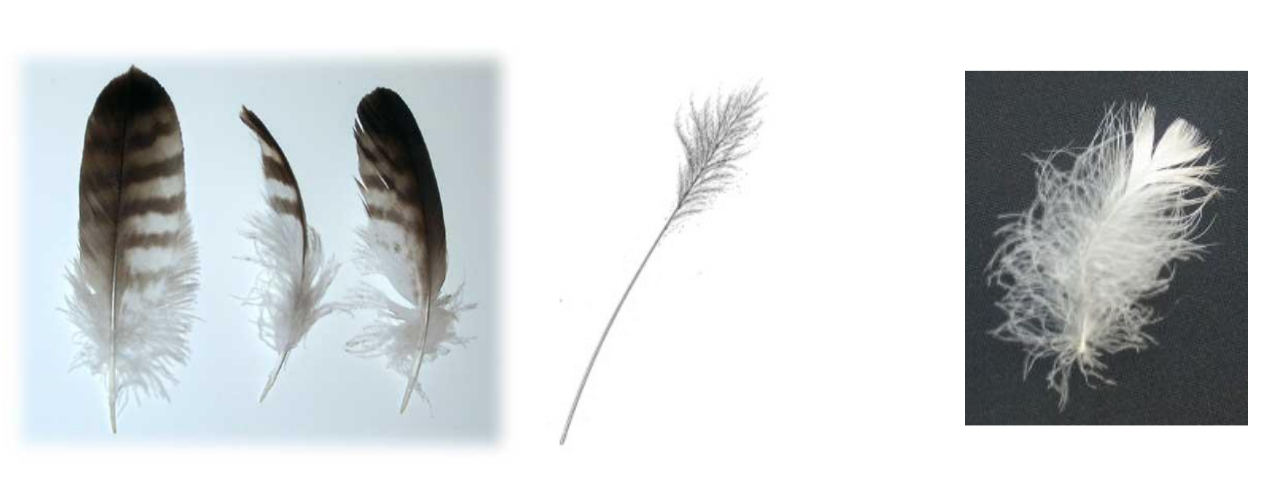
- CONTOUR: used for flight
- FILOPLUME: serves a variety of specialized functions; associated with birds' ability to sense diff stimuli around them (ex. Wind direction)
- DOWN: found in chicks, used for insulation
MAMMALIAN INTEGUMENT
- epidermis: 5 layers
- dermis: vascular, presence of nerves, blood vessels and smooth muscles
- ARRECTOR PILI muscles (smooth muscles)
- Associated w hair
- When contract, enable hair to stand up (goosebumps), which conserve heat by preventing it from escaping the body
- ARRECTOR PILI muscles (smooth muscles)
- True hair
- Thermoregulation
- Ex. goosebumps, protective outer coat. Air can circulate between hair and skin, which allows heat to be in constant contact with body
- Defense (hair is hard to digest)
- Sensory (Ex. associated w skin receptors to sense touch)
- Thermoregulation
- glands: sebaceous & sweat glands
- SEBACEOUS: produces oil (called sebum); lubricates the skin and prevents excessive water loss
- SWEAT: for thermoregulation purposes; allows the body to cool down