Lecture 2 Light Reaction of Photosynthesis
Chapter Reading
Required reading: Chapter 19 - Light Reaction of Photosynthesis
I should know by the end of the chapter…
Describe the light reactions
Identify the key products of the light reactions
Explain how redox balance is maintained during the light reactions
Explain how ATP is chloroplast is synthesized in chloroplasts
Describe the function of the light-harvesting complex
19.1 Phototrophy Converts Light Energy into Chemical Energy
Phototrophy- “The process of converting electromagnetic radiation into chemical energy”
can be accomplished by using just two proteins
When in use: How organism will capture energy, which are called phototrophs (meaning “Light feeders”)
Fun fact: an example of this phenomenon is Halobacterium Salinarum which grows in very salty waters. It will grow under low oxygen conditions which leads it to generate more ATP.
When capturing light it converts CO2 into carbohydrates (photosynthesis) but most commonly in this course oxygenic photosynthesis.
Oxygenic photosynthesis is named because of the water electron donor and oxygen is product waste.
CO2 + H2O —→ (CH2O) + O2
[CH2O] are carbohydrates such as sucrose or starch
autotrophs - “Self Feeders”
Chemotrophs - energy from chemicals (rather than sunlight)
Photosynthesis
Light and Dark reactions are a part of photosynthesis
Light Reactions- light energy is captured as chemical energy through the formation of ATP and electrons are extracted.
resembles oxidative phosphorylation
Dark Reactions- reduction of CO2 and converts to glucose and other sugars
This is used from the products of the light reactions
opposite of the cellular respiration (oxidation of glucose to CO2 with reduction of O2)
Photosynthesis is the opposite of cellular respiration where instead, the process is reducing CO2 and oxidizing H2O to synthesize glucose.
Respiration and photosynthesis both generate high-energy electrons.
19.2 In Eukaryotes, Photosynthesis Takes Place in Chloroplasts
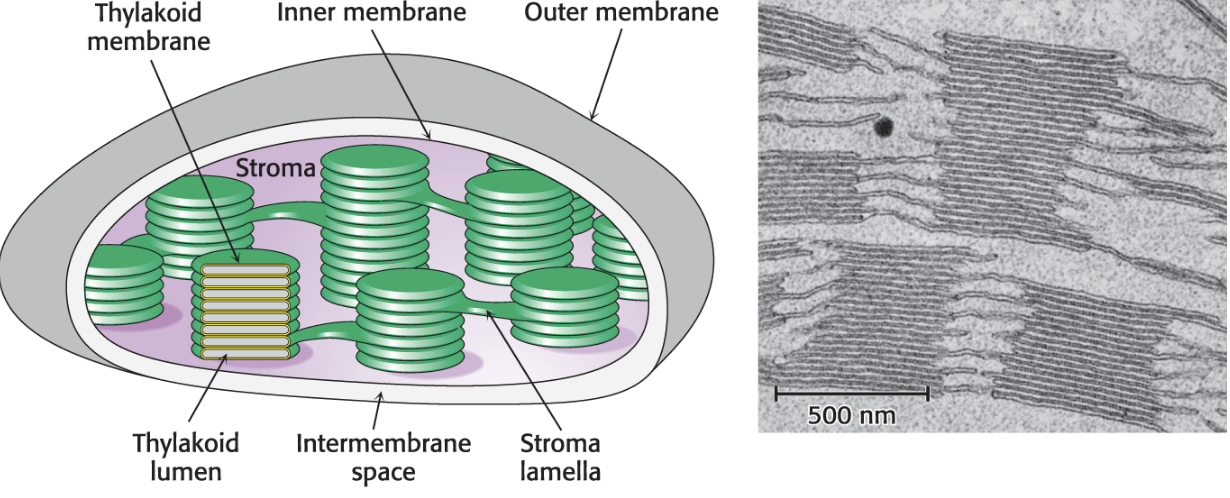
In eukaryotes, photosynthesis takes place in specialized organelles called the chloroplast.
has a inner and outer membrane
The inner membrane surrounds a space called Stroma (where the dark reaction of photosynthesis takes place)
Stroma
within the stroma are thylakoids (flat sacs or disks) which form a granum (stacked).
Thylakoid
It is where photosynthesis takes place (in the thylakoid membranes)
That includes light harvesting proteins, reaction centers, electron-transport chains and ATP synthase.
Chloroplast contains their own DNA. (for replication and expression)
They are not independent from other cells
They have proteins encoded by nuclear DNA
result of endosymbiotic events where an organism lives inside another organism, which can be good causing evolution of the cells.
Little test:
Question: what is the relationship between the following terms: thylakoid, stroma, chloroplast, and endosymbiosis?
“Chloroplasts are descended from an ancient bacterium that was engulfed and became codependent with another organism, a phenomenon called endosymbiosis. Within the chloroplast are thylakoids and stroma (with the thylakoids located inside the stroma)."
19.3 Light Absorption by Chlorophyll Molecules Induces Electron Transfer
Key to phototrophy is trapping light energy (and also photosynthesis).
Chlorophyll is the green pigment that gives leaves its colors (found in the cells of plants).
Carries many conjugated double bonds called conjugated polyenes.
Goes from low to high energy orbitals
strong absorption
Usually when compounds absorb light heat will then be converted but there are some cases when it comes to pigments, such as chlorophyll, will have energy transfer causing photoinduced charge separation.
photoinduced charge separation (the key to phototrophy)- within a molecule or a material when it absorbs light, causing an electron (if nearby) to be excited to a higher energy level leaving a positive charge in its position and this is in the case for chlorophylls
It is also known/called the special pair.
This can also occur in the reaction center.
19.4 Two Photosystem Generate a Proton Gradient and Reducing Power in Cyanobacteria and Photosynthetic Eukaryotes
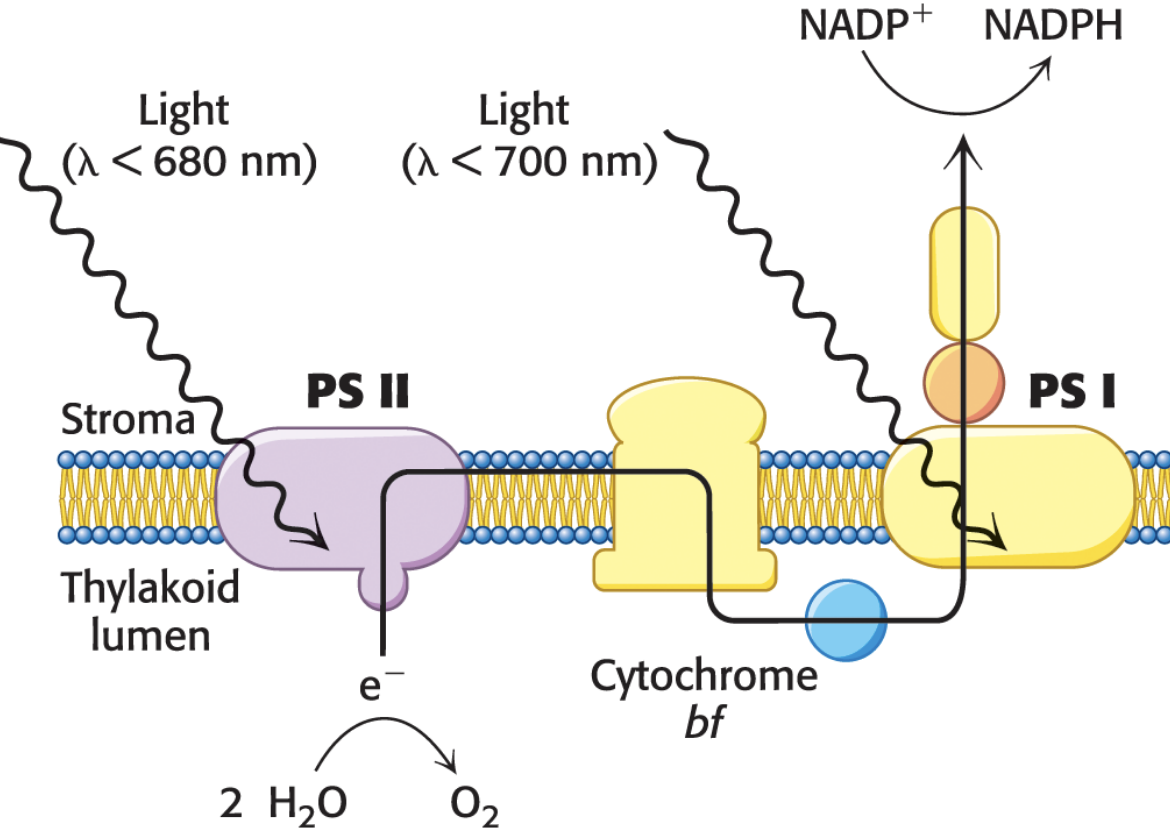
Photosynthesis can be more complicated in eukaryotes and it depends on two kind of membrane-bound, light-sensitive complexes, which are photosystem I and II.
Note: photosystem II acts first in the sequence before I.