C.3 – Atomic Structure: The Bohr and Orbital Models
3.1 Introduction
Niels Bohr – The Danish physicist who provided an insight into the arrangement of electrons in the atom.
3.2 Bohr’s study of spectra
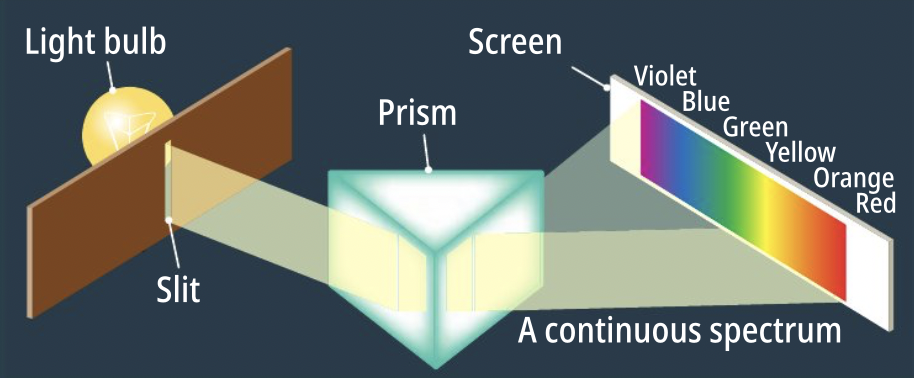
When white light is passed through a glass prism, the light is broken up into an array of colours, or a spectrum. This spread of colours is referred to as a continuous spectrum, i.e. there are no gaps.
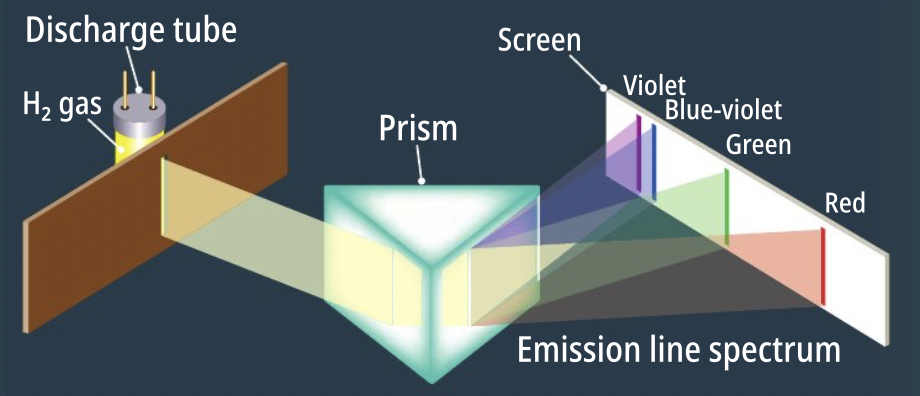
This can be repeated using the light coming from a hydrogen discharge tube in place of white light. This results in a line spectrum. Since the light is emitted when an electric current is passed through the hydrogen, the spectrum is more accurately called an emission line spectrum/line emission spectrum.
Hydrogen discharge tube – a glass tube filled with hydrogen gas at low pressure, through which an electric current is passed.
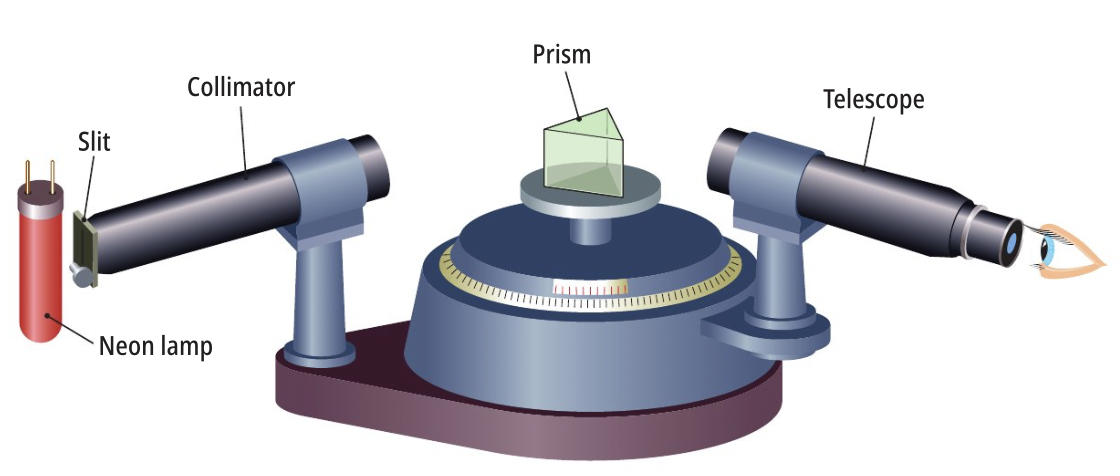
Spectra are usually studied using an instrument called a spectrometer.
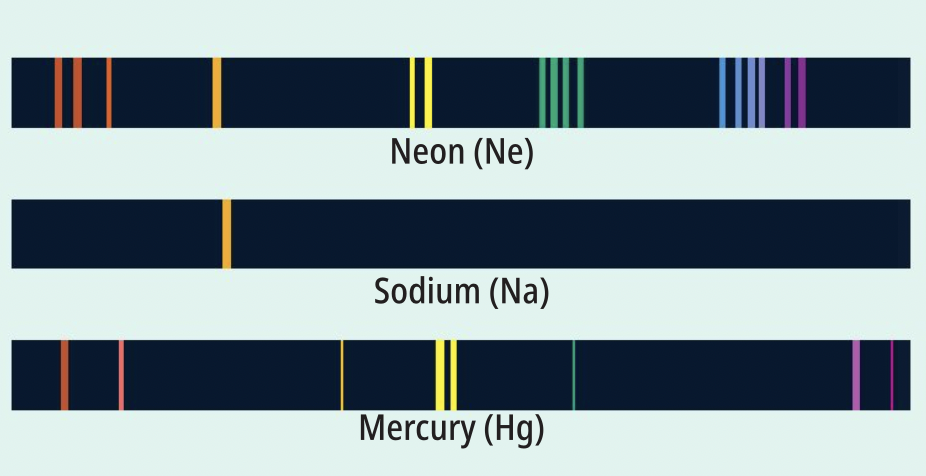
When the light emitted by other elements was studied it was found that these elements also produced unique line spectra. These serve as a sort of fingerprint of the element.



3.3 The Bohr model of the atom
Bohr realised that any model of the atom must explain two things:
Why are the emission spectra of the elements line spectra rather than continuous spectra?
Why is the emission spectrum of each element unique to that element?
These questions were answered by Bohr’s Theory of Atomic Structure.
Prior to Bohr’s theory, scientists thought that electrons in an atom could have any energy value. Bohr’s Theory introduced the idea of quantisation of energy.
Quantisation of energy – the principle that an electron in an atom can only have a fixed amount of energy.
Quantum of energy – the fixed amount of energy that an electron in an atom has.
Quantisation means that electrons can only occupy certain energy levels. Each energy level has a fixed amount of energy associated with it. Bohr’s mathematical calculations showed that the energy levles became closer to one another as the value of n increased.
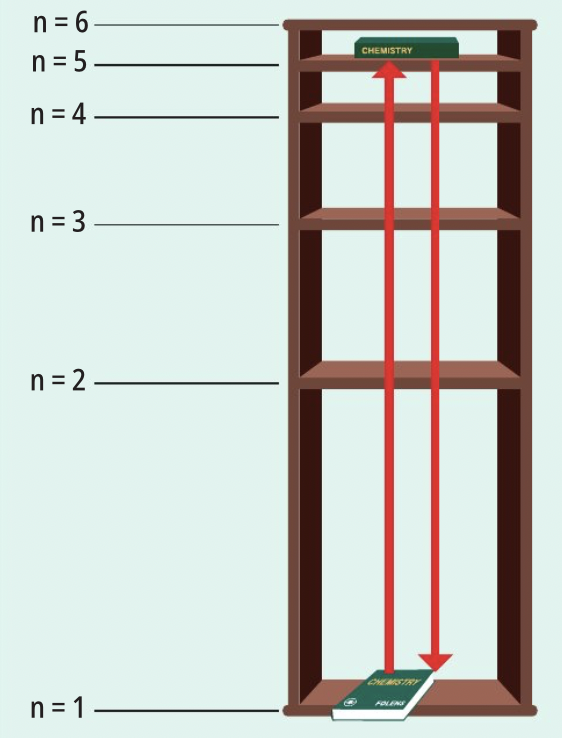
Assumptions of Bohr’s theory:
Electrons revolve around the nucleus in fixed paths called orbits (not entirely true)
Electrons in any one orbit have a fixed amount of energy. The modern understanding of orbits are now referred to as energy levels or shells.
Energy levels are represented by the letter n.
The energy of the electron in a particular orbit (or energy level) is quantised, i.e. fixed at a definite value.
As long as an alectron is in any one particular energy level, it neither gains nor loses energy. This helps to explain why electrons do not lose energy and fall into the nucleus.
Atoms usually exist in the ground state, i.e. the electrons have the lowest amount of energy possibel because they occupy the lowest available energy levels.
When an atom in its ground state is provided with energy, a specific amount of this energy is absorbed and the electrons jump from lower energy levels to higher energy levels. The electrons are now in an excited state.
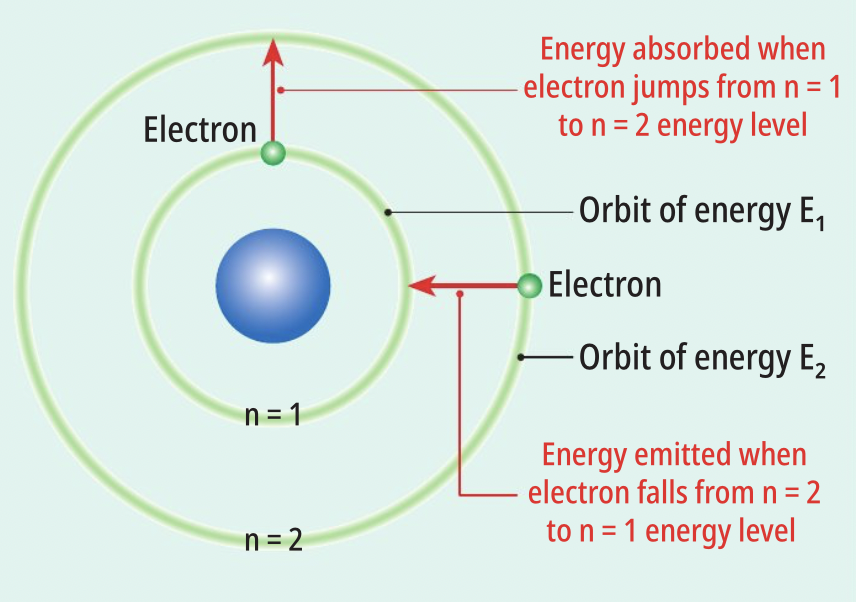
In some atoms of hydrogen, for example, the electron may move to the second energy level; in others, it may move to the third energy level.
The energy absorbed is equal to the difference in energy between the lower energy level (ground state) and the higher energy level (excited state).
Electrons in the excited state are unstable and they will fall back down to lower energy levels after a short period of time.
As an electron falls from a higher energy level to a lower energy level, the excess energy is released in the form of a photon of light which has a discrete (fixed) amount of energy.
Electromagnetic radiation is radiation such as visible light, infrared radiation and ultraviolet radiation.
Since an electron can only fall back to certain definite energy levels, only fixed amounts of light energy can be given off, i.e. light of a definite frequency is given off.
The frequency of the light emitted depends on the difference in energy between the two energy levels and is given by the equation E2 - E1 = hf
E2 represents the energy of the higher energy level, E1 represents the energy of the lower energy level, h represents Planck’s constant (6.62607015 × 10^(-34) Js) and f is the frequency of the light emitted.
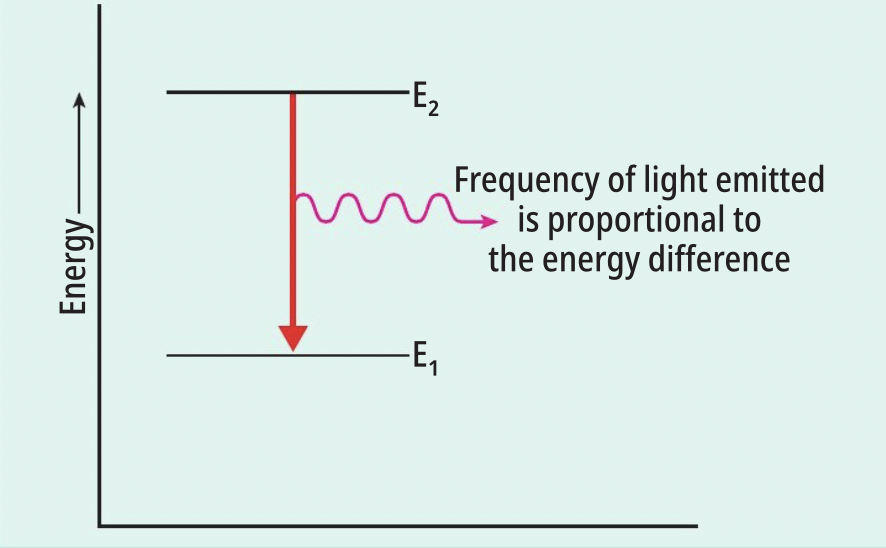
This equation tells us that the energy difference is proportional to the frequency of light emitted.
The definite amount of energy emitted (light of a definite frequency) appears as a line of a particular colour in the emission spectrum. Therefore an emission line spectrum is formed.
Since only definite amounts of energy are emitted, this implies that electrons can occupy only definite energy levels. Each definite amount of energy emitted gives rise to a line in the emission spectrum
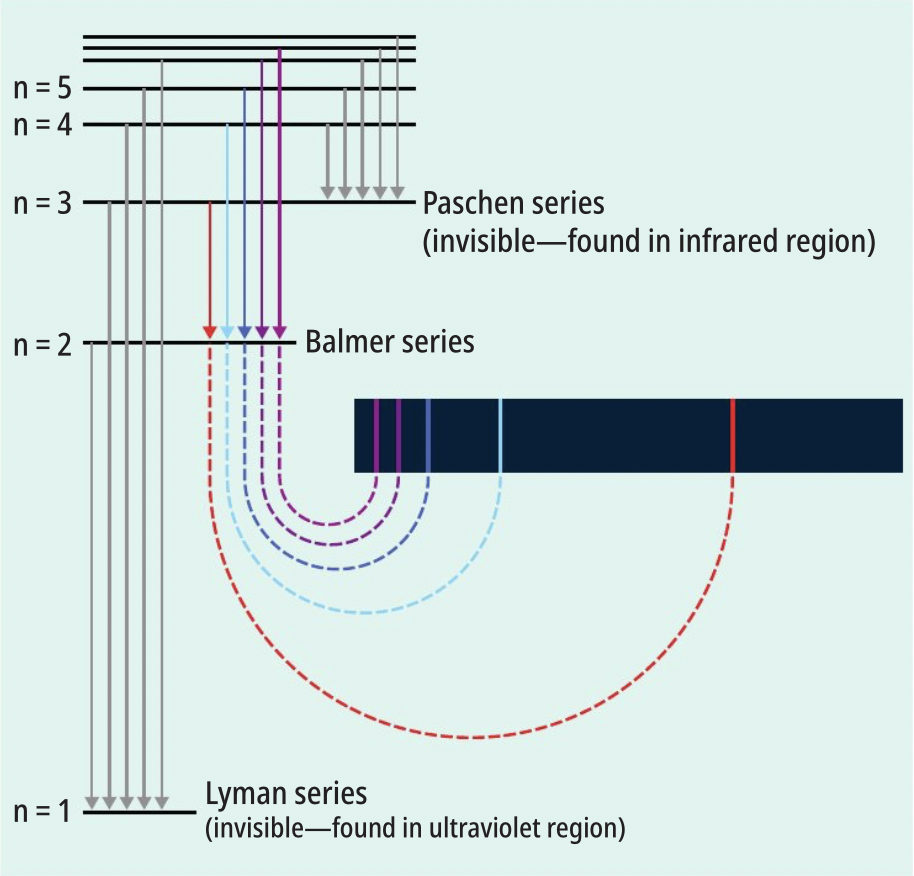
The series of invisible lines in the ultraviolet series, where electrons fall to the n = 1 energy level in an electron transition for hydrogen, is called the Lyman series.
The series of lines in the visible spectrum, where electrons fall to the n = 2 energy level in an electron transition for hydrogen, is called the Balmer series.
The series of invisible lines in the infrared region, where electrons fall to the n = 3 energy level in an electron transition for hydrogen, is called the Paschen series.
The reason that hydrogen has so many possible electron transitions despite having only one electron is because when a sample of hydrogen is supplied with energy, not all atoms may receive exactly the same amount of energy.
Each element gas a unique emission line spectrum because each element has a different number of electrons and has its own arrangement of these electrons in energy levels. Therefore, there will be different numbers and types of electron transitions for each element. These different electron transitions give rise to a different emission line spectrum for each element.
Bohr’s work was both theoretical and experimental, and may be summarised as follows:
He realised that each coloured lin in the emission spectrum of hydrogen has its own particular frequency. Firstly, he calculated the energy corresponding to each of the energy levels n = 1, n = 2, n = 3.
Then he calculated the amounts of energy an electron would lose when falling from higher energy levels down to lower energy levels.
Finally using the equation E2 - E1 = hf, Bohr calculated the frequency and wavelength of the coloured lines corresponding to these electron transitions.
Bohr’s experimental work involved him measuring the wavelengths of each line in the emission line spectrum of hydrogen using a spectrometer.
He found that these calculations lined up with his experimental work. Therefore, the fact that only definite amounts of energy are enitted implies that electrons can only occupy definite energy levels, i.e. Bohr’s theory that energy levels must exist in the atom was proven correct.
Energy level – the fixed energy value that an electron in an atom may have.
Ground state – when the electrons in an atom occupy the lowest energy levels available.
Excited state – when the electrons in an atom occupy higher energy levels than the ones available in the ground state.
Photon – a fixed amount, or quantum, of light energy or other forms of electromagnetic radiation.
Electromagnetic radiation – a form of energy that travels through space os oscillating electric and magnetic fields, perpendicular to each other, at the speed of light. It behaves as both waves and particles (photons).
3.4 Energy sublevels
As the study of spectra developed, more sophisticated spectrometers were becomimg available. In many cases, what appeared originally to be a single line actually consisted of a number of lines very close together. These two lines could not have resulted from electrons dropping to two different energy levels as this would have given rise to lines mouch further apart in the spectrum. To explain this observation, it was proposed that each main energy level, except the first was made up of a number of sublevels, all of which were close in energy.
From the analysis of spectra, it was discovered that the number of sublevels was the same as the principal quantum number for the main energy sublevels/shells, i.e. the n = 2 energy level had two sublevels, etc.
The sublevels are labelled using the letters s,p,d and f (sharp, principal, diffuse and fundamental).
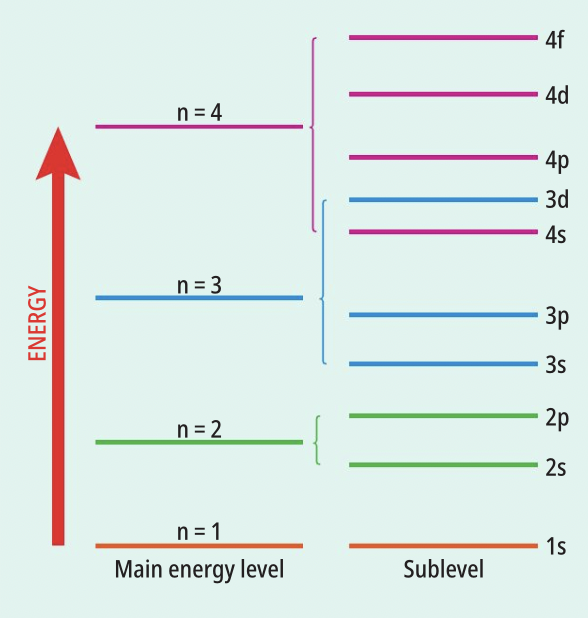
Principal quantum number – a value that tells us the main energy level, or shell, of an electron in an atom.
3.5 Developments leading to changes in Bohr’s model
In 1924, Louis de Broglie proposed that all moving particles have a wave motion associated with them. His calculations suggested that for larger objects such as a tennis ball, this wave motion would be impossible to detect, however for a small object such as an electron, the wave motion should be impossible to detect.
De Broglie was proved correct in 1927 when it was discovered that moving electrons have a wave motion associated with them. This idea that a particle can behave like a wave is called “wave-particle duality”.

This challenged Bohr’s model of the atom because if an electron has a wave motion, then the idea of it travelling in a fixed path at a precise, constant distance from the nucleus is incorrect.
This problem was described mathematically by Heisenberg’s Uncertainty Principle:
Consider using a beam of light to detect the presence of an electron. When the beam strikes the electron the position is determined – but since the electron has such a small mass, its velocity is immediately changed by the beam of light. So trying to measure the properties of something so small actually changes the properties. Therefore you cannot cannot measure at the same time both an electron’s speed and distance from the nucleus (location).
Therefore the idea of an electron moving in a fixed orbit around the nucleus had to be modified. If an electron is not travelling in a fixed path, then we can only talk about the probability of finding it at a partciular position inside the atom.
Limitations of Bohr’s model of the atom:
Failed to account for the many lines in the emission spectra of atoms with more than one electron.
Did not take into account de Broglie’s finding that electrons have a wave motion.
Assumes that both the position of an electron and its velocity are known precisely, which is in conflict with Heisenberg’s Uncertainty Principle – that we can only refer to the probability of finding an electron in a region in space.
Could not explain the splitting of certain lines in emission sepctra and did not take int oaccount the presence of sublevels.
Wave-particle duality – the idea that a particle can behave like a wave.
Heisenberg’s Uncertainty Principle – states that it is impossible to measure accurately both the velocity and position of an electron at the same time.
3.6 The orbital model of atomic structure