Benzodiazepines
Benzodiazepines Overview
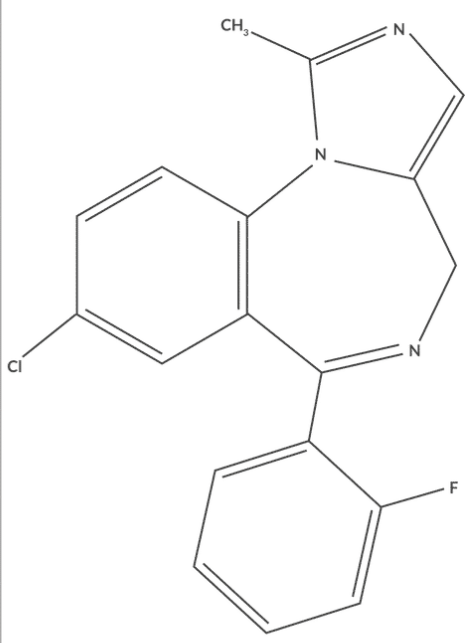
Definition: Benzodiazepines are a class of medications that act as central nervous system depressants.
Mechanism of Action:
Bind to the GABA A receptor in the central nervous system.
Different binding sites compared to barbiturates.
They cause anterograde amnesia.
Function as GABA A agonists similar to IV anesthetics.
Instead of keeping the chloride channel open like barbiturates, they increase the frequency of chloride channel openings, leading to neuronal hyperpolarization.
Chemical Structure
Composed of:
A benzene ring.
A seven-member diazepine ring.
Substitutions at various positions on the rings influence potency and biotransformation information.
Solubility Properties:
Imidazole ring of Midazolam increases water solubility.
Diazepam and Lorazepam are water-insoluble, often due to propylene glycol, contributing to IV pain during administration.
Diazepam more than Lorazepam
Specific Benzodiazepines
Midazolam (Versed)
Uses: Primarily for premedication, sedation, and induction.
Dosage:
Premedication IM: 0.07 - 0.15 mg/kg.
IV Sedation: 0.1 - 0.15 mg/kg.
Induction IV Dose: 0.1 - 0.4 mg/kg.
** pH Dependence**:
At acidic pH: Imidazole ring opens, increasing water solubility.
At physiologic pH: Imidazole ring closes, increasing lipid solubility, allowing it to cross the blood-brain barrier.
Active Metabolite: One hydroxymidazolam.
More potent (0.5 times) and prolongs effects in patients with renal failure.
Rapidly conjugated to an inactive compound.
Cardiovascular Effects:
Sedation dosage shows minimal cardiovascular effects.
Induction dosage results in:
Decreased blood pressure.
Decreased systemic vascular resistance (SVR).
Respiratory Effects:
Sedation dosage shows minimal respiratory effects.
Induction dosage can lead to respiratory depression, particularly concerning in COPD patients due to heightened sensitivity.
Central Nervous System Effects:
Causes anterograde amnesia.
Displays anticonvulsant properties.
Produces anxiolysis.
Lacks analgesic effects and isoelectric EEG.
Facilitates spinally mediated skeletal muscle relaxation; effective as an antispasmodic (used in conditions like cerebral palsy).
Diazepam
Uses: Employed for premedication and sedation.
Dosage:
Premedication Oral Dose: 0.2 - 0.5 mg/kg.
Sedation IV Dose: 0.04 - 0.2 mg/kg.
Elimination Half-Life: Approximately 43 hours due to intrahepatic recirculation.
Applications:
Effective as an anticonvulsant.
Prevents emergence delirium associated with ketamine.
Acts as an antispasmodic by reducing skeletal muscle tone at spinal neuron level.
Lorazepam
Uses: Primarily used for premedication; given orally.
Dosage: 0.05 mg/kg.
Amnestic Action: Lasts up to six hours.
Onset: Slow, limiting its effectiveness as an anticonvulsant.
Remimazolam
Properties: An ultra-short-acting benzodiazepine with high affinity for GABA A receptor.
Usage Guidelines: After reconstitution, must be discarded within eight hours.
Metabolism: Rapidly metabolized by nonspecific esterases due to ester link; associated with:
Lower respiratory depression.
Fast onset and quick recovery.
Contraindications: Should not be used in patients with a history of severe hypersensitivity reactions to dextran 40.
Benzodiazepine Antagonist
Flumazenil
Function: A competitive antagonist of the GABA A receptor and a reversal agent for benzodiazepine effects.
Properties:
High affinity but short duration of action (30-60 minutes).
Requires redosing to prevent resedation.
Initial Dosage: 0.2 mg IV; titrate up to 0.1 mg every minute as needed.
Side Effects:
Postoperative use may worsen anxiety and does not elevate sympathetic nervous system tone.
In cases of chronic benzodiazepine use, cessation can precipitate withdrawal symptoms (e.g., seizures) and can reverse sedative effects more prominently than amnestic effects of benzodiazepines.