Maths Applications Test Revision
Test Criteria
Topic 2.2: Applications of trigonometry
2.2.2 determine the area of a triangle, given two sides and an included angle by using the rule A=1/2 absinC , or given three sides by using Heron’s rule, and solve related practical problems
2.2.3 solve problems involving non-right-angled triangles using the sine rule (acute triangles only when determining the size of an angle) and the cosine rule
2.2.4 solve practical problems involving right-angled and non-right-angled triangles, including problems involving angles of elevation and depression and the use of bearings in navigation
Topic 2.3: Linear equations and their graph
2.3.1 identify and solve linear equations (with the aid of technology where complicated manipulations are required)
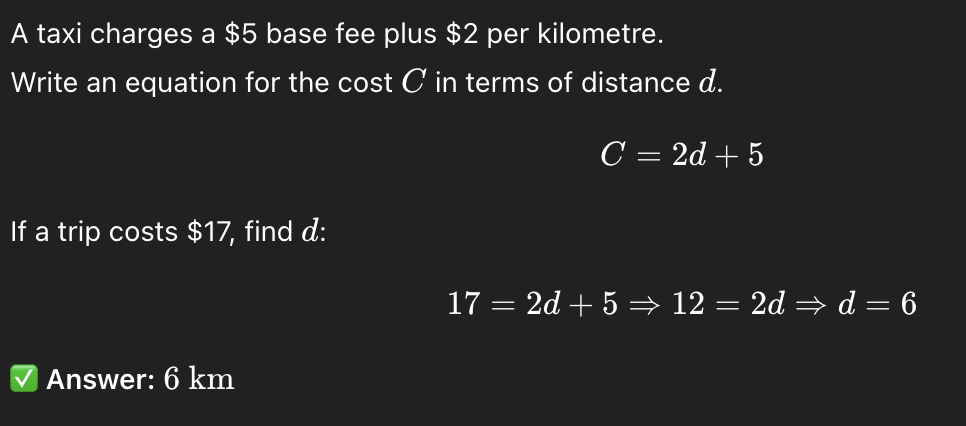
2.3.2 develop a linear formula from a word description and solve the resulting equation
Straight-line graphs and their applications
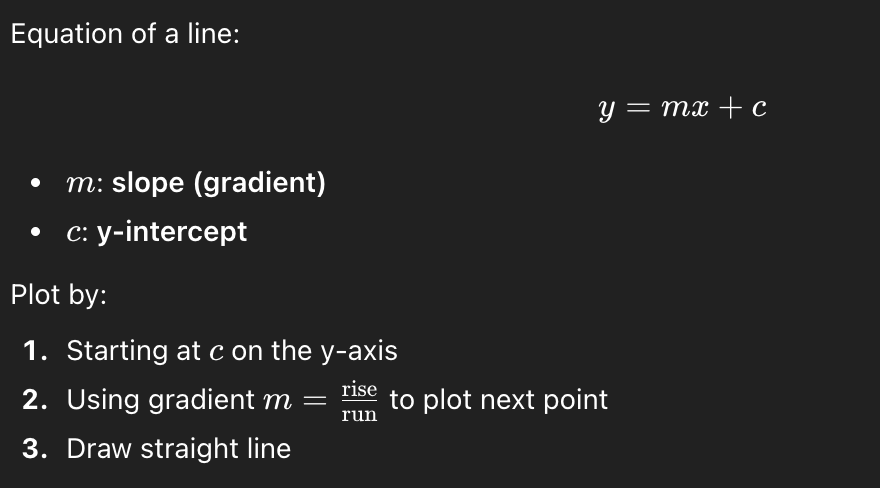
2.3.3 construct straight-line graphs both with and without the aid of technology
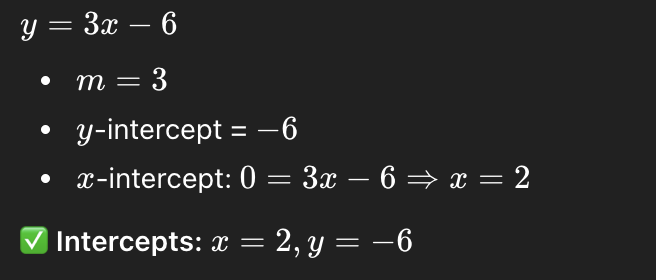
2.3.4 determine the slope and intercepts of a straight-line graph from both its equation and its plot
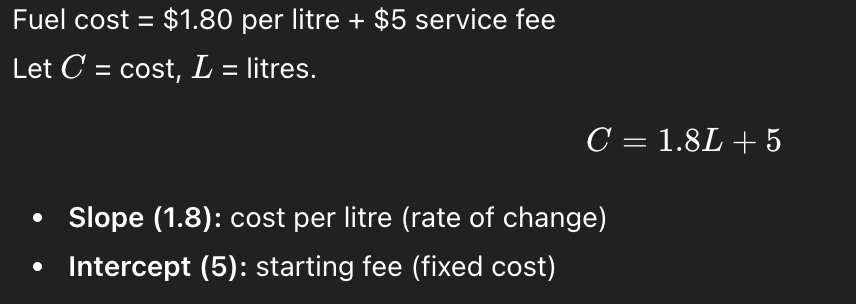
2.3.5 construct and analyse a straight-line graph to model a given linear relationship; for example, modelling the cost of filling a fuel tank of a car against the number of litres of petrol required.
2.3.6 interpret, in context, the slope and intercept of a straight-line graph used to model and analyse a practical situation
applications
2.3.7 solve a pair of simultaneous linear equations graphically or algebraically, using technology when appropriate
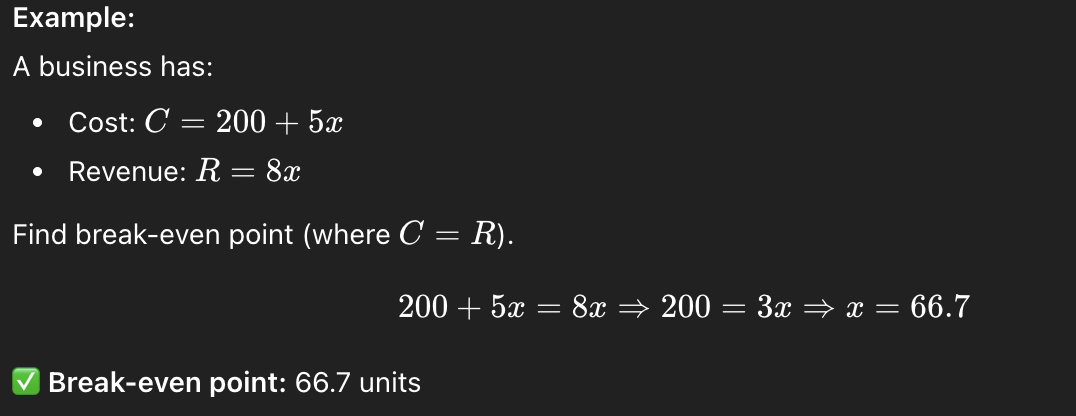
2.3.8 solve practical problems that involve determining the point of intersection of two straight-line graphs; for example, determining the break-even point where cost and revenue are represented by linear equations
Piece-wise linear graphs and step graphs
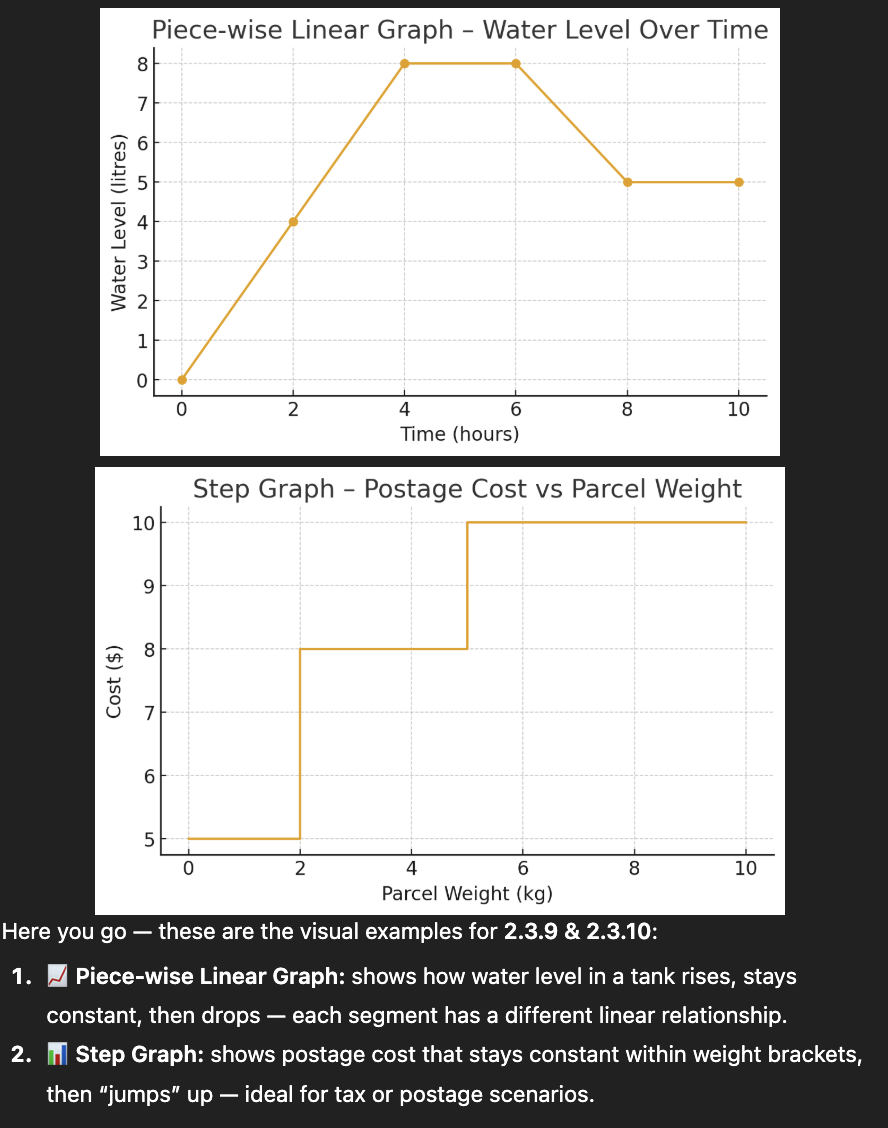
2.3.9 sketch piece-wise linear graphs and step graphs, using technology when appropriate
2.3.10 interpret piece-wise linear and step graphs used to model practical situations; for example, the tax paid as income increases, the change in the level of water in a tank over time when water is drawn off at different intervals and for different periods of time, the charging scheme for sending parcels of different weights through the post
📘 Topic 2.2 – Applications of Trigonometry
2.2.2 Area of a Triangle
1⃣ Formula (Two sides and included angle)
When you know two sides and the included angle (the angle between those two sides):
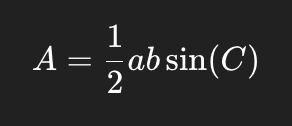
Where:
aaa and bbb are sides of the triangle
CCC is the included angle between them
AAA is the area
2⃣ Heron’s Formula (Three sides known)
When you know all three sides, use Heron’s formula.
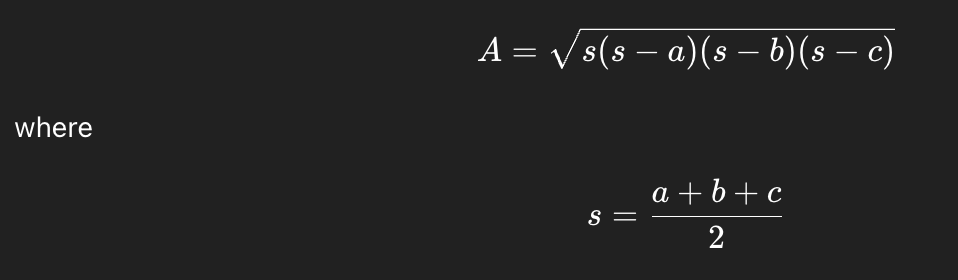
is the semi-perimeter.
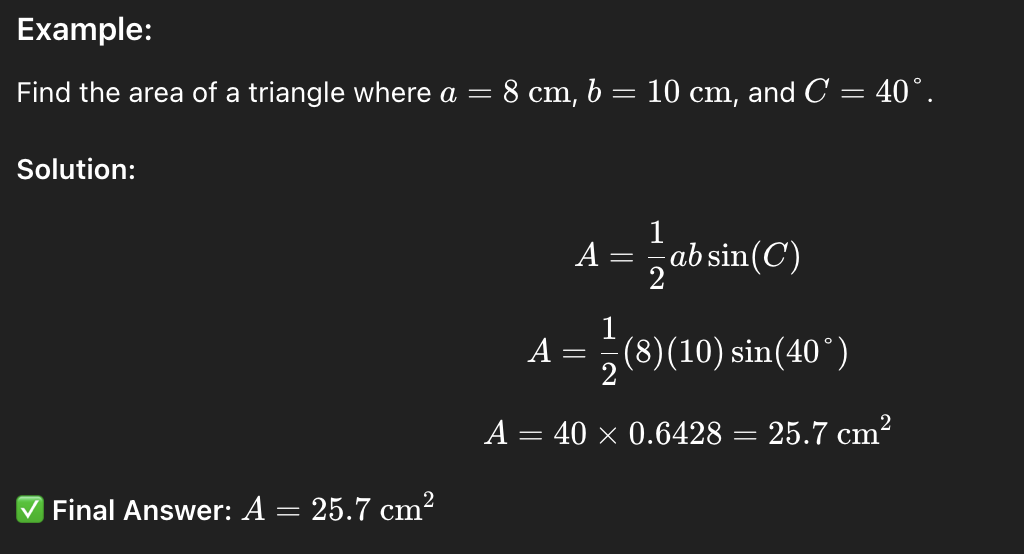
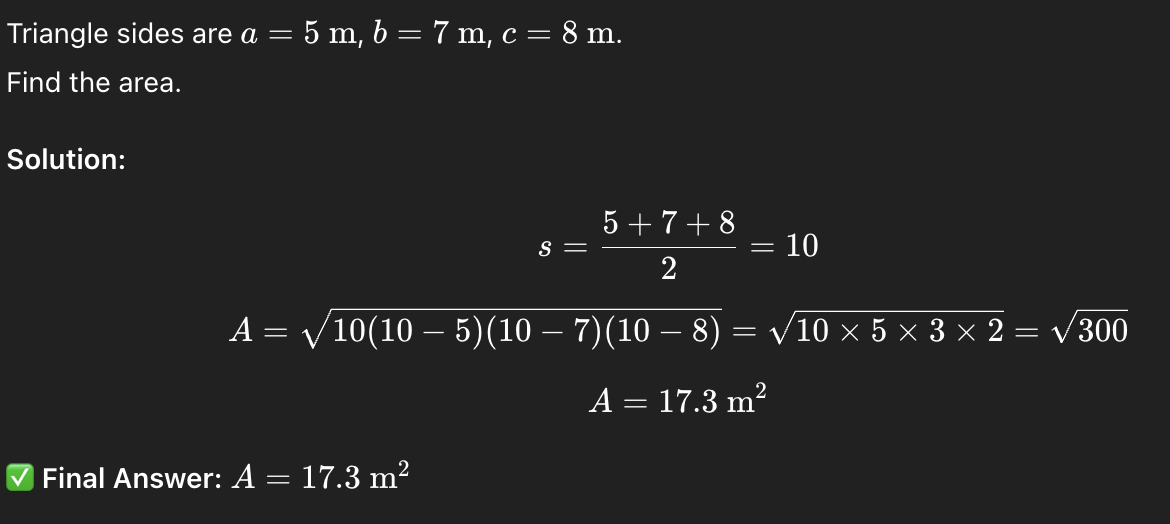
Example:
2.2.3 Solving Non-Right-Angled Triangles
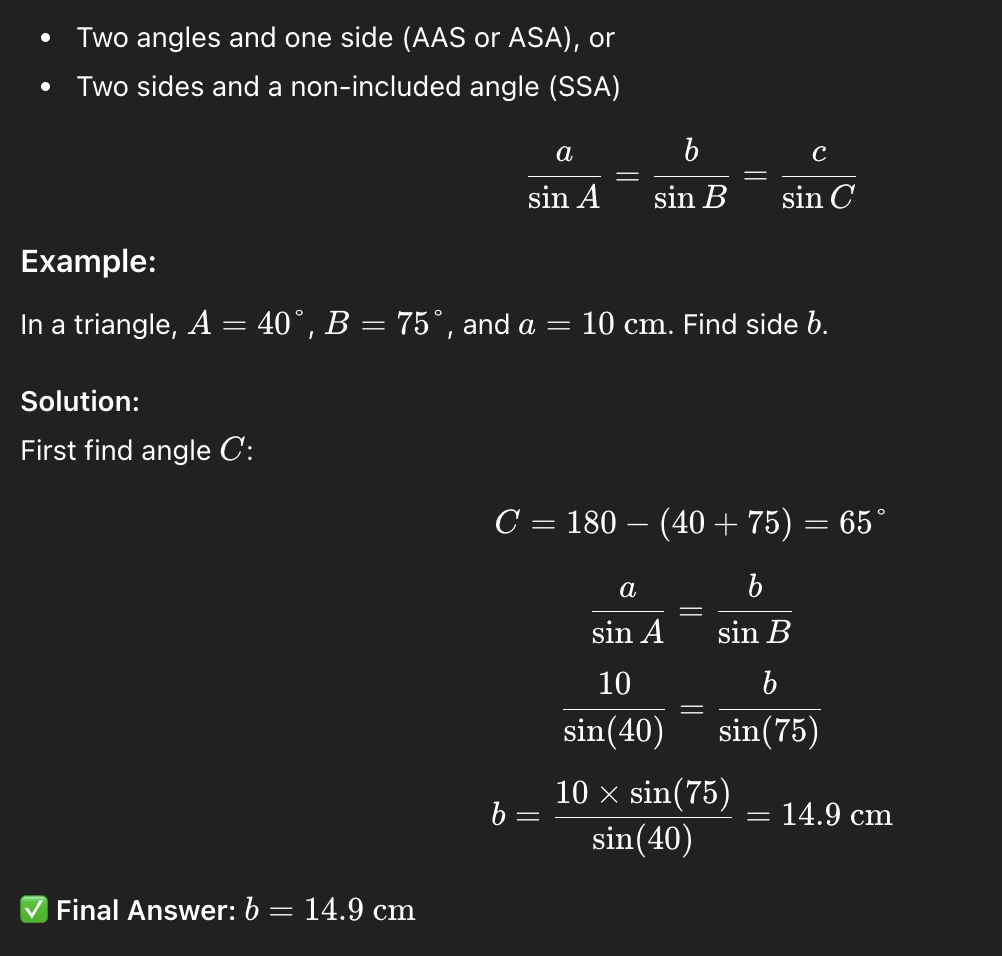
Sine Rule
Used when you know:
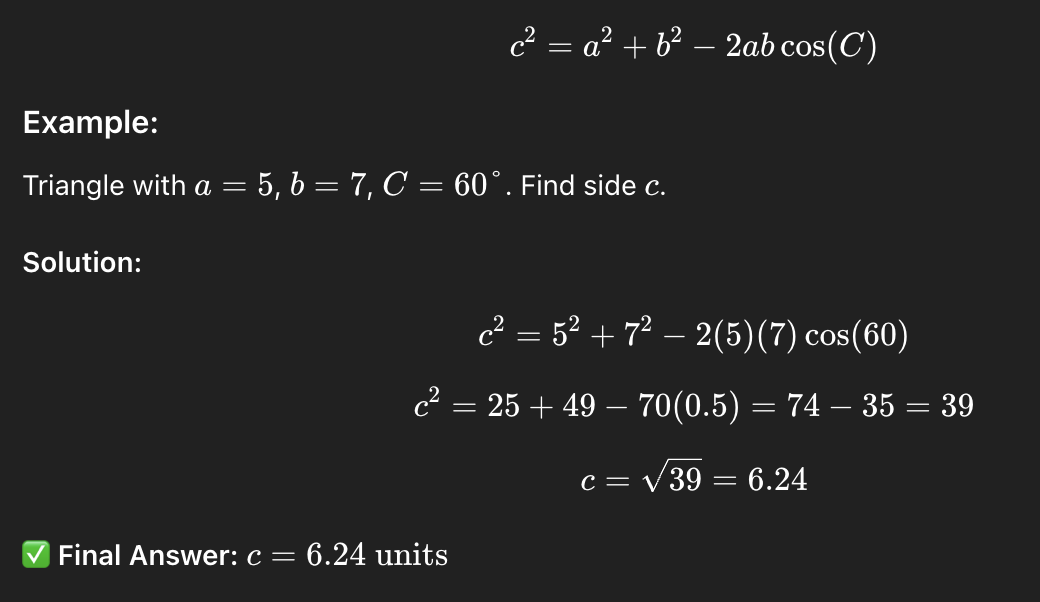
Cosine Rule
Used when you know:
Two sides and the included angle (SAS) to find the third side, or
All three sides (SSS) to find an angle.
2.2.4 Practical Trig Problems (Elevation, Depression, Bearings)
Angles of Elevation and Depression
Elevation: angle upwards from the horizontal
Depression: angle downwards from the horizontal
→ Both measured from a horizontal line
Use sine, cosine, or tangent as in right-angled triangles, or sine/cosine rules for non-right-angled ones.
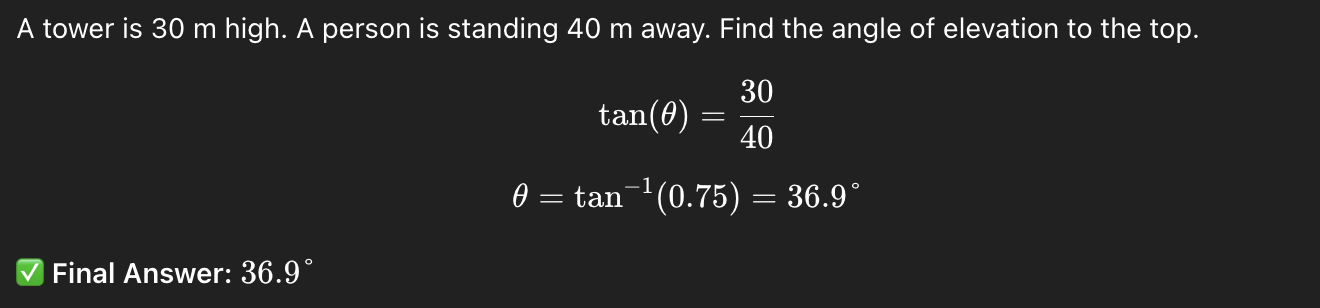
Example (Right-angled):
Bearings
Bearings are measured clockwise from North
Always written as three digits (e.g. 045°, 120°, 270°)
Example (Navigation):
Ship A is 20 km north of Ship B. Ship A sails 15 km on a bearing of 120°. Find the distance between the ships.
→ Draw diagram, apply cosine rule between points.
📘 Topic 2.3 – Linear Equations and their Graphs
2.3.1 Identify and Solve Linear Equations
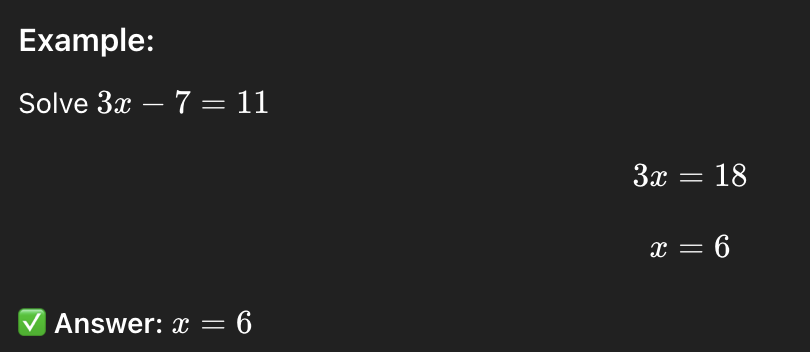
A linear equation is one where the variable has power 1.
Example:
Use technology (e.g. calculator or CAS) if equations are complex (fractions, decimals).
2.3.2 Develop Linear Formula from Word Problem
Example:
2.3.3 Construct Straight-Line Graphs
2.3.4 Determine Slope and Intercepts
From equation y=mx+cy = mx + cy=mx+c:
Slope = mmm
y-intercept = ccc
To find x-intercept → let y=0y = 0y=0
Example:
2.3.5 & 2.3.6 Modelling Linear Relationships
Use straight-line graphs to model real-life scenarios.
Example:
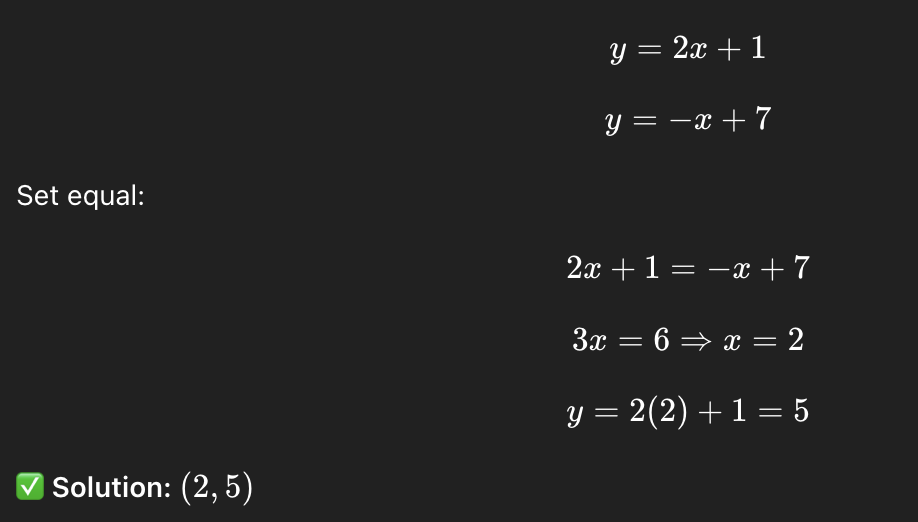
2.3.7 Solve Simultaneous Equations
Two linear equations with two unknowns — find the point of intersection.
Example:
2.3.8 Practical Applications (Break-even point)
Example:
2.3.9 & 2.3.10 Piece-wise and Step Graphs
Used when the relationship changes in different ranges.
Piece-wise Linear Graph:
Graph with different line equations for different intervals.
Step Graph:
Graph made of flat (horizontal) sections—used for things like postage or tax brackets.
Example:
A postage company charges:
$5 for parcels up to 2 kg
$8 for parcels 2–5 kg
$10 for parcels over 5 kg
→ Graph is a step function: horizontal segments that “jump” at 2 kg and 5 kg.
Interpretation Example:
At 4 kg, cost = $8
The jump from $8 → $10 at 5 kg represents an increased rate for heavier parcels.
✅ Summary Table
Concept | Key Formula | Example Type |
|---|---|---|
Triangle area (2 sides + angle) | look up for example | Find area with 2 sides and included angle |
Triangle area (3 sides) | Heron’s formula | Area from 3 side lengths |
Sine Rule | look up for example | Find missing side/angle |
Cosine Rule | look up for example | Find unknown side or angle |
Linear equation | y=mx+cy = mx + cy=mx+c | Find slope/intercepts |
Simultaneous equations | Solve intersection | Break-even or crossover point |
Piecewise/Step graph | Varies by interval | Tax/postage problem |