Structure and function
The nervous system consists of 2 parts, the central nervous system (CNS) and the peripheral nervous system (PNS).The CNS is comprised of the brain and the spinal cord. It receives huge amounts of information from all the sensory organs in your body and coordinates the appropriate response. The PNS is made up of nerves and connects the CNS to the rest of the body, delivering information to and from the CNS.
The nervous system pathway
Responses are coordinated by the nervous system through a specific pathway:
STIMULUS → RECEPTOR → COORDINATOR → EFFECTOR → RESPONSE
Change in Nerves Decision making Muscle or What happens
external or in area = brain gland
internal Unconscious
environment = spinal cord
Receptors
Stimuli are detected using specific receptors found in sense organs. Receptors can be specialised cells, such as those found in the retina, or proteins on the surface of cells such as those which detect glucose or insulin. All receptors convert one form of energy into another. For example, the stimulus could be in the from of light energy, thermal energy or sound energy. Receptors detect the stimulus and send information about the stimulus to the coordinator in the form of electrical impulses.
Coordinator
The coordinator receives information from receptors and determines what the appropriate response is. It will then communicate with the effectors to bring about this response
Effectors
There are 2 types of effectors that respond in 2 differently ways:
Muscle - contract, relax
Gland - produce hormones
Nerves and neurones
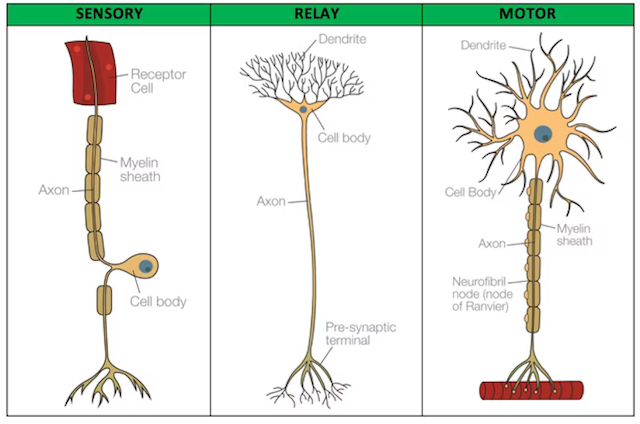
Nerves are made up of collection of many long thin nerve cells called neurones. Information travels along neurones as electrical impulses. Neurones contain the same basic parts of any animal cell. But their structure is specially adapted to be able to carry impulses very quickly.
SENSORY
Connected to receptors - start of peripheral nervous system
The receptor cell detects the stimulus and the dendrite converts the energy into an electrical impulse
myelin sheaths are insulators which cause the impulse to travel faster as it jumps from each one
The cell body contains the nucleus (genetic info) and acts as a control centre keeping the neurone alive
The axon is the whole of the neurone except receptor and axon terminals (diagram is misleading) and is where the electrical impulse travels through
The axon terminals (not labelled but at the bottom of neurone) are what passes the impulse onto the next neurone
RELAY
Connected to sensory neurones in coordinator (brain/spinal cord)
MOTOR
Connected to relay neurone and to effector
Reflex Arc
The nerve pathway involved in the reflex action is called a reflex arc and is the basic working unit of the nervous system. As reflex actions are automatic and rapid, they do not involve the conscious part of the brain. If the peripheral nervous system is involved the coordinator is the spinal cord.