Institutional and substantive Law
Chapter 5 legislation in the European Union
5.4 Competences and conferral
Competence → legal authority, SEA 1987
Principle of conferral: the EU has only the powers Member States have given it through the Treaties.
Article 4(1) TEU thus declares that ‘competences not conferred upon the Union in the Treaties remain with the Member States.
The Court is occasionally called on to evaluate the validity of Union legislation against the principle of conferral.
Legal bases
The Treaty grants the Union legislative competence in several discrete areas.
In accordance with the principle of conferral, every binding act the Union adopts must have a legal foundation either in the Treaties or in a valid pre-existing normative act, the ‘legal basis’ of the act.
The legislature is obliged to indicate the legal basis of binding acts; its choice is amenable to judicial review.
European Parliament committees, for example, are required to verify the legal basis of every proposal referred to them, while its Committee on Legal Affairs may raise the question of its own motion.
Exclusive competences
Union is legally obliged to exercise competence where Member State action would render Union action ineffective
Thus in such areas ‘only the Union may legislate and adopt legally binding acts’, though the Member States may be required to adopt national measures to implement the Union acts in such areas.
Before the Lisbon Treaty, there were situations where the EU had exclusive competence over an area, meaning:
Normally, only the EU could make laws in that area.
But sometimes the EU had not actually made the necessary rules yet.
That created a legislative lacuna - a gap in the law.
The Court of Justice said that, in certain circumstances, Member States could temporarily step in and make national rules to fill that gap.
→ In these cases, the Member States were recognized as “trustees of the common interest”
The list of exclusive competences is provided in Article 3 TFEU.
Shared competences
The bulk of Union competences fall within the category described as ‘shared’
EU and Member States both have competence → but once the EU exercises its competence on a particular matter, Member States are generally pre-empted from legislating on that same matter.
Ancillary/complementary competences
In certain areas, the Union may ‘carry out actions to support, coordinate, or supplement actions of the Member States’
Common Foreign and Security Policy CFSP
The CFSP is given separate treatment compared to all other Union policies.
Under ordinary EU policy-making, you often have:
Commission proposes → Parliament + Council legislate → Court reviews legality
In CFSP, it goes:
European Council + Council → decide CFSP policy
The High Representative then plays a major role in implementing/conducting it.
So the Member States retain much more direct control.
Subsidiarity
Subsidiarity: manifestation of the Member States’ aspiration that ‘decisions be taken as closely as possible to the citizen’ set out in the first article of the TEU.
Protocol No2: the early warning mechanism
On the application of the principles of subsidiarity and proportionality.
→ National Parliaments consulted on a draft
Individual opinion - 2 per MS
Collective opinion - 1/3 of opinions
special legislative opinion - >50% of opinions
No automatic blocking of legislation
Designed to allow national parliaments to ensure Union legislation complies with the subsidiarity test.
The national parliaments then have an eight-week period in which to produce a “ reasoned opinion” on why the draft fails to comply with the subsidiarity principle, which is sent to the President of the EP, the Council, and the Commission.
National parliaments → President of the EP → the Council → the Commission
Special legislative opinion
The national parliaments may adopt a special legislative opinion only when they are examining a Commission proposal under the ordinary legislative procedure.
The threshold for adopting such an opinion is a simple majority of the total votes available (28).
As before, the Commission may choose to maintain, amend, or withdraw the proposal.
→ Where the Commission maintains the proposal, it must once again explain, this time in light of the national parliaments’ contrary positions, how the proposal complies with the subsidiarity test → Reasoned opinion
Scope of the early warning mechanism
The Early Warning Mechanism allows national parliaments to check whether a proposed EU measure respects the principle of subsidiarity.
So national parliaments can examine proposed EU legislation and raise objections if they think the EU is acting at the wrong level.
The mechanism does not apply to every type of EU act.
It mainly applies to legislative acts adopted through a legislative procedure.
It does not cover non-legislative acts: Some EU measures are adopted through procedures that are technically classified as non-legislative, even though they may have effects very similar to legislation.
Non-legislative acts = acts made outside the legislative procedure
Does not cover delegated acts: These are acts where the Commission is given power by a legislative act to supplement or amend certain non-essential elements.
Does not cover implementing acts: These are acts generally adopted by the Commission (or sometimes the Council) to ensure that EU legislation is implemented uniformly across Member States.
Even if national parliaments raise enough objections, they don’t actually have the power to stop the proposal themselves.
If enough national parliaments object, the proposal gets reviewed again by the EU institutions. But ultimately, the matter goes back to the European Parliament and Council.
Judicial review of compliance with the subsidiarity test
Because the principle is written into the Treaties, the author says the Member States intended it to be “justiciable.”
So a Member State can potentially go to the Court of Justice of the EU (CJEU) and argue:
“This EU legislation violates the principle of subsidiarity.”
Proportionality
Principle of proportionality: The EU should not do more than is necessary to achieve its legitimate objective → you used this in the Dublin Court
Is this measure reasonably appropriate and necessary for reducing pollution, or is the EU imposing excessive restrictions?
Proportionality review in EU legislation is generally deferential. The CJEU gives the legislature a wide margin of discretion because legislation involves complex political, economic and social choices. The Court does not substitute its own policy judgment for that of the legislature. However, the legislature must rely on objective criteria and avoid imposing unnecessary or excessive burdens.
As with subsidiarity, each of the institutions is duty-bound to ‘ensure constant respect’ for the principle of proportionality, which respect must be justified in a ‘detailed statement’ accompanying draft legislative acts; the Commission considers proportionality, along with subsidiarity, to be ‘core elements of [its] better regulation agenda which underpins how [it] prepares its policy proposals’.
Legislative and other decision-making procedures
Union law makes an explicit distinction between ‘legislation’ and other forms of normative act, and between primary and secondary normative measures.
‘Legislation’ refers to any act adopted based on a procedure identified in the Treaty legal basis as being a legislative procedure, either ‘ordinary’ or ‘special’.
These are of three kinds: the ordinary legislative procedure (OLP), the special legislative procedures (SLPs), and the various innominate non-legislative procedures (INPs)
The ordinary legislative procedure
The Commission may initiate the procedure only by submitting a proposal.
The Commission may be invited to submit legislative proposals by the European Parliament, by the Council, or by a million citizens from a minimum of a quarter of the Member States → Citizens’ initiative
though not obliged to respond favourably, in each case the Commission must explain its reasons for not so doing.
Having initiated the OLP, the Commission may amend its proposal ‘at any time during the procedure leading to the adoption of a Union act’, as long as the Council has not acted → this allows the Commission to modify its initial proposal to garner the support of a qualified majority which has emerged in the Council discussions.
Thus, in the OLP, the Commission may only alter its proposal before the Council’s first reading, though, of course, the rule is fully applicable to the adoption of Council acts under other procedures.
Where the OLP is not initiated by the Commission, Parliament’s first reading takes place based on an ‘initiative’ (of the Member States), a ‘request’ (from the Court of Justice), or a ‘recommendation’ (from the European Central Bank).
OLP allows a single Member State to call a ‘time-out’ during the adoption procedure, and have the question referred to the European Council for a period of reflection → the emergency brake may only be applied if the Member State considers that the legislation being proposed would affect ‘important’ or ‘fundamental’ aspects of its existing national system.
Special legislative procedures
A large majority of SLPs are derogations from the application of the OLP in a particular area, to take account of national sensibilities of different kinds (notably political, budgetary, economic, and social)
In these ‘derogation’ cases, the SLP is initiated by a Commission proposal, the European Parliament is consulted, and the Council adopts the legislative act by unanimous vote.
The European citizen’s initiative
11(4) TEU + 24 TFEU + Regulation (EU) No 211/2011 of the EP
→ Positive proposal -creation/adoption of new legislation.
Innominate non-legislative procedures
Some normative measures are adopted directly based on the Treaty in accordance with procedures which are not described as being ‘legislative’; these may be dubbed ‘innominate non-legislative procedures’ (INPs).
The procedural requirements tend to be minimal
In many cases, the Council adopts the measure by a qualified majority on the basis of a Commission proposal, often without any participation of the European Parliament or at most after requesting its opinion.
Certain emergency measures may be adopted by an INP—for example, where a Member State is suffering from difficulties in obtaining oil supplies or from a sudden influx of third-country nationals
Character of non-legislative (INP) acts: The distinction between legislative and non-legislative acts is illustrated by the division between agricultural measures adopted under Article 43(2) TFEU and measures adopted under Article 43(3) TFEU. Under Article 43(2), the EU legislature (Parliament and Council) adopts measures involving fundamental policy choices concerning the Common Agricultural Policy. These choices are political and therefore reserved to the legislature.
By contrast, Article 43(3) allows the Council to adopt measures such as fixing agricultural prices, levies and aid. These are considered primarily technical because they implement the policy choices the legislature has already made.
Thus, Article 43(2) concerns deciding what the agricultural policy should be, whereas Article 43(3) concerns the technical implementation of that policy. The key distinction is therefore whether a measure involves a new or fundamental policy choice (Article 43(2)) or merely implements an existing legislative framework (Article 43(3)).
Supremacy of EU law
Supremacy (primacy) means that EU law takes priority over conflicting national law. If a rule of national law conflicts with a valid rule of EU law, the national court must give effect to EU law.
Key case:
Costa v ENEL(1964)
The Court of Justice established the principle of supremacy.
Italy nationalised its electricity sector and created ENEL.
Mr Costa argued that the nationalisation law conflicted with EU law.
The CJEU held that EU law cannot be overridden by national legal provisions, because Member States had transferred certain powers to the EU.
Otherwise, EU law would not be uniform or effective across Member States
Simmenthal 1978 → supremacy in practice.
Principle of proportionality
Art. 5 (4) TEU
→ Ratio legis: limiting power/ rule of law
conditions:
Appropriateness: measure has to be adequate to this goal
Necessity: no alternative measures available that would be less restrictive, but as efficient.
Proportionality sensu stricto: balancing
Proportionality sensu stricto is the final stage of the proportionality test. It asks whether the benefits of a measure are proportionate to the burden it imposes on the affected rights/interests.
Principle of sincere/loyal cooperation
Art. 12(2) TEU → institutions - institutions
Art. 4(3) TEU → institutions - EM
The Union and the Member States to respect and assist each other in carrying out the tasks arising from the Treaties.
Ratio legis:
securing distribution of competences → each EU institution must exercise only the powers given to it by the Treaties.
institutional balance → institutions must respect the powers and roles of the other institutions.
Conditions: 4(3) TEU
negative condition → Member States and EU institutions must not take measures that could jeopardise the attainment of the Union’s objectives.
positive condition → Member States must take all appropriate measures to fulfil their Treaty obligations and facilitate the achievement of EU tasks.
Principle of institutional autonomy
Art. 4(3) TEU + judge-made rule CJEU, 208/80
Ratio legis: Checks and balances.
The principle of institutional autonomy means that each EU institution has a degree of autonomy to organise and perform its functions, within the limits of the Treaties.
Article 4(3) TEU establishes sincere cooperation, requiring EU institutions and Member States to respect and assist each other in fulfilling their Treaty obligations. The CJEU has developed this into broader judge-made principles governing the relationship between EU actors.
The rationale is to maintain checks and balances within the EU institutional structure:
Institutions must be able to exercise their own Treaty-assigned functions independently.
One institution should not interfere with or usurp the powers of another.
At the same time, institutions must cooperate and respect each other’s competences.
Transparency and access to documents
Art. 1(2) + 11(3) TEU → transparency - EU decisions should be taken as openly and as closely as possible to citizens. EU institutions must maintain an open, transparent and regular dialogue with civil society.
Art. 15 TFEU + 42 CFREU → access to documents - promotes transparency and gives citizens a right of access to documents of EU institutions, bodies, offices and agencies, subject to exceptions. Expressly guarantees the right of access to documents of EU institutions, bodies, offices and agencies.
European Ombudsman, Art.228 TFEU → impartial organ
Complaints about maladministration against EU institutions
The European Ombudsman investigates complaints concerning maladministration in the activities of EU institutions, bodies, offices and agencies.
Examples of maladministration can include:
unjustified refusal to provide information;
unnecessary delays;
procedural unfairness;
discrimination;
failure to give reasons;
lack of transparency.
The effects of EU law in the national legal systems
All the national institutions, be it the executive, the court, or even the legislator, become de facto EU institutions when acting within the scope of EU law.
The Union sets up no own network of decentralized agencies within the Member States, which would be present in the Member States and would enforce ‘federal’ EU law.
National institutions thus become servants of two masters: the national States and the EU. It is the subject matter of the case or problem at hand which decides which master the national institution is supposed to serve at a given moment.
Pre-emption means that EU law takes priority over national law in a particular policy area, limiting or excluding Member States’ ability to legislate independently.
The perhaps most significant pre-emption of Member States’ autonomy occurred at the level of principles, which provide for the overall status of EU law in the Member States. Principles like direct effect, primacy, or indirect effect are the overall rules of engagement between the systems: EU law and national law.
In its key decisions in Van Gend en Loos and Costa, the Court pre-empted the potential national choice and diversity with respect to the overall status of EU law in the Member States.
→ The current stage of the Union could be called a type of “cooperative federalism”
National rules, unless…
No EU procedural rules → national procedural autonomy: Member States determine the procedures for enforcing EU law according to their national rules.
if the EU has enacted its own procedural rules, they are to be applied instead of national rules;
if there are no EU rules on the matter, it is the national procedural responsibility to enforce EU law following the general national rules and procedures;
but there are two qualifications to such full national procedural autonomy:
requirement of equivalence;
requirement of effectiveness.
Equivalence: National procedures used to enforce EU rights cannot be less favourable than those used for similar national rights.
Effectiveness: National procedural rules must not make it excessively difficult or practically impossible to exercise EU rights.
EU legislative unification: EU Regulations can create common procedural rules for specific areas. Where they apply, EU rules replace national rules on the same issue.
Example: Brussels I Recast → German courts use the EU rules to enforce an Irish judgment, rather than German rules.
National rules remain valid but apply to situations outside the EU Regulation’s scope (e.g., judgments from non-EU countries).
EU legislative harmonization through Directives: Directives make national procedural rules more similar, but do not replace them. Each Member State continues to apply its own national procedures, adapted to comply with the same EU Directive.
The not-so-autonomous national procedural autonomy
The fact that, unless EU law provides otherwise, it is the national procedures which will govern the enforcement of EU law in the Member States, is often referred to as the principle of ‘national procedural autonomy’
When it comes to national enforcement of EU law, there is no fully ‘autonomous’ space free of EU law on the national level.
Unlike legislation (especially directives), which can only harmonize national procedural rules within the limits set by EU law, the Court of Justice can develop EU procedural principles through its case law across a much wider range of situations.
Legislative harmonization → EU institutions make legislation (e.g., directives) to bring national procedural rules closer together. Its scope is limited by the EU legislature’s legal competence.
Judicial unification → the CJEU interprets EU law and develops principles through its judgments. This can apply across different areas of national procedure, even where there is no detailed EU legislation.
The exercise of EU legislative competence is governed by the principle of conferral → The Union can legislate only in specific areas attributed to it by the Treaties.
EU legislation is one of the area-specific, conferred competences: to become active, the Union must have a concrete legal basis.
In contrast, the logic of the Court’s engagement with national enforcement of EU law is just functional and incidental, but as to its scope, transversal
EU legislature: “Do we have Treaty competence to legislate in this area?” → specific legal basis required.
CJEU: “What national procedural rules are necessary to ensure EU law is effectively enforced?” → can arise in any area where EU law applies.
The attributed competence limitation is fully applicable for adopting original legislation in Brussels. However, once that legislation has been adopted, it enters the national legal order to be implemented and applied. All national rules serving the enforcement of that legislation are an EU law matter.
From equivalence/effectiveness to the principle of effective judicial protection
Most importantly, however, any other non-harmonized questions of national procedure are subject to the dual requirement of equivalence and/or effectiveness.
Equivalence is in essence a prohibition of discrimination: EU law-based claims cannot be treated less favourably than comparable ‘purely national’ claims.
Principle of effectiveness: national procedural rules must not make the enforcement of EU rights impossible or excessively difficult.
Impossible = no effective remedy/procedure exists.
Excessively difficult = enforcement is technically possible but the procedural burden is unreasonably high; assessing this is more context-dependent and may vary depending on the claimant’s circumstances.
Within the scope of EU law?
If a case before a national authority is not within the scope of EU law, then none of the principles discussed further in this chapter are applicable.
The national authority is directly applying an EU legal source at the national level (direct application of an EU source of law). The subject matter of the case at hand is covered by an EU law act, which the national authority applies.
The national authority is applying rules of national origin, which are, however, the national implementation of an EU law obligation (implementation of an EU obligation). That will typically be the case of directives. While formally, the national authority is likely to apply provisions of national law, there are EU law rules in the background that are being transposed and upheld by the Member State at the national level.
A Member State can have its own national law on a particular issue. But that national law may conflict with EU primary law, especially the four fundamental freedoms:
🇪🇺 Free movement of goods
👤 Free movement of persons
💼 Free movement of services
💶 Free movement of capital
So, even if there is no EU directive or regulation specifically governing the matter, EU law can still apply because the national rule interferes with one of these fundamental freedoms.
→ The situation generally needs to involve more than one Member State.
🇫🇷 A French law makes it harder for a French company to sell goods from 🇩🇪 Germany in France.
→ The French national rule potentially interferes with free movement of goods.
→ There is a cross-border element because German goods are entering France.
→ Therefore, EU law can apply.
With an approach like that in Dassonville, if any national rules which are capable of hindering, directly or indirectly, actually or potentially, intra-Community trade, were to be caught, then the reach of EU rules at the national level would indeed be limitless
Article 19(1) TEU exception: Due to rule-of-law concerns, the CJEU has held that Article 19(1) TEU requires Member States to guarantee effective judicial protection in fields covered by EU law, even beyond cases where the Member State is directly implementing EU law under Article 51(1) of the Charter. It is sufficient that the national court could potentially apply or interpret EU law generally; the individual case itself does not necessarily need to concern EU law.
Thus, when structural, transversal issues of judicial independence are at stake, EU law may also reach into cases which may not be within the scope of EU law in the traditional sense outlined in this section. However, that extraordinary remedy should indeed remain limited to extraordinary situations.
Direct effect
Direct effect means that an EU provision becomes the immediate source of law for the national court or administrator. No further implementing act is necessary for its application within the national legal order.
Van Gend en Loos
The principle of direct effect made its first appearance in 1963. A company based in the Netherlands, Van Gend en Loos, imported a quantity of urea-formaldehyde from Germany.
When the product entered the Netherlands, Dutch customs charged an import duty.
“The Netherlands increased the customs duty, and the EEC Treaty says Member States are not allowed to increase customs duties between themselves.”
Customs duties were increased from 3% to 8%.
The relevant provision was Article 12 EEC, now art. 30TFEU:
Member States must not introduce new customs duties or increase existing ones in trade between them.
The CJEU said that certain EU law provisions can give individuals rights directly, and individuals can invoke those rights before national courts.
Based on the Rome Treaty, Member States were obliged to freeze their tariffs.
Not increase existing customs duties between Member States during the transitional period → this is essentially the standstill/freeze obligation.
Gradually reduce and eliminate those internal tariffs.
Establish a Common Customs Tariff (CCT) toward non-member countries.
Direct effect in action
A directly effective provision of EU law may function in several ways.
First, a directly effective EU provision may create a new rule which did not previously exist in national law, and which will then be applied in the case at hand.
Secondly, together with the principle of primacy of EU law, it may exclude the application of an existing but contrary national rule.
Direct effect is not identical for every type of EU legal act. The CJEU gradually extended the doctrine beyond the original context of the Treaties, but the conditions and scope depend on the source of EU law.
Differentiation according to the source of EU law: the possibility, conditions, and scope of direct effect vary depending on whether the rule comes from a Treaty, regulation, directive, decision, etc.
Directive → direct effect is subject to additional limitations, particularly because directives are addressed to Member States and normally require implementation.
Regulation → Article 288 TFEU says it is directly applicable, so its position is fundamentally different from a directive.
Direct effect depends not only on what EU legal source you are dealing with, but also on who is suing whom.
ype | Who is against whom? | Example |
|---|---|---|
Vertical (ascending) | Individual → State | A worker sues the government |
Reverse vertical (descending) | State → Individual | Government imposes a penalty on a person |
Horizontal | Individual → Individual | Employee sues private employer |
Treaty and Charter provisions
Van Gend en Loos and subsequent case law established the direct effect of Treaty provisions. Over the years, the case law of the Court has confirmed the direct effect of the key Treaty provisions, such as those relating to the free movement of goods, persons, or capital; competition law; State aid; and equal pay. Moreover, directly effective Treaty provisions can be invoked in any type of legal relationship: vertical, including reverse vertical, as well as horizontal.
Since 2009, the EU Charter of Fundamental Rights has become part of primary law.
→ Article 6(1) TEU states that the Charter shall have the same legal value as the Treaties; thus, it can have direct effect.
The case law of the Court confirmed the (horizontal) direct effect of some Charter provisions, in particular Article 21 (various types of prohibition of discrimination),45 Article 31(2) (right to annual paid leave),46 Article 47 (right to an effective remedy),47 or Article 50 (prohibition of non bis in idem).
Regulations
Regulations were the optimal candidate for direct effect. From the very beginnings of the EEC, the Treaty stated that a regulation ‘shall be binding in its entirety and directly applicable in all Member States’.
Direct applicability means that unless expressly requested by the regulation itself,53 no national implementing act is by default necessary.
Direct effect, on the other hand, aims at the justiciability of a provision: can it be applied by a national authority directly?
→ Can an individual rely on this EU provision before a national court or authority?
Finally, a regulation is applicable and directly effective in any type of legal relationship: vertical as well as horizontal. Equally, the enforcement of a regulation may naturally include sanctions imposed by a State against individuals.
Decisions
Decisions under Article 288 TFEU are of two kinds: addressed and non-addressed.
This dual nature and use of decisions is also reflected with respect to their potential direct effect.
The direct effect of a decision is, however, limited to vertical situations, in which an individual is invoking a directly effective provision of a decision against the Member State to which it was addressed.
As with directives, the Court has refused to consider decisions as horizontally directly applicable.
They cannot be invoked in a dispute between two individuals to whom the decision was addressed before the courts of their Member State
Differentiation II: types of legal relationship
In Van Duyn, the Court stated that directives may be vertically directly effective.
The Court stated that individuals may rely on a directive’s provisions to vindicate their rights against the Member State. To do so, however, the provision of a directive must be sufficiently clear and precise, unconditional, and the implementation period the Member State had for transposing the directive into the national legal order must have already passed.
The Treaty gave no textual basis for the Court’s conclusion. It stated that directives bind Member States as to the result, while leaving them the choice of form and method of implementation. Thus, directives were seen as obligations of result, binding Member States but not directly applicable like regulations.
Estoppel argument: A Member State cannot rely on its own failure to implement a directive against an individual invoking it. Direct effect therefore acts as a sanction for non-implementation: by failing to implement the directive properly or on time, the State loses its freedom to choose how to implement it.
Marshall case: Mrs Marshall was a woman working for a private employer. She was forced to retire at 62, while men could work until 65. She wanted to rely on an EU directive prohibiting sex discrimination.
The Court said no.
Why?
A directive is addressed to Member States, not private individuals.
Therefore, a directive can impose obligations on the State, but cannot by itself impose obligations on another private individual/company.
So Mrs Marshall could rely on the directive against the State, but not directly against a private employer.
→ Individuals are not the addressees of directives.
No horizontal direct effect of directives: the rule and exceptions
The greatest problem this area of case law has been facing is nonetheless not the choice the Court made in Marshall.
In its subsequent case law, while verbally upholding the ‘no-horizontal-direct-effect-of-directives’ rule established in Marshall, the Court created several alternative avenues for reaching into horizontal relationships.
directive can be relied upon not only against the government itself, but also against certain bodies that are closely connected to the State.
A body can count as the State if it:
is controlled or supervised by the State, OR
has special powers that ordinary private individuals or companies do not have.
A worker cannot normally use a directive against a private company.
But if the employer is a public authority or a state-controlled body with special legal powers, the worker may be able to rely on the directive against it.
→ Therefore, all bodies or entities which are subject to the authority or control of a public authority or the State will, for the direct effect of directives, be considered to be part of the Member State.
Normally, horizontal direct effect is not allowed for directives. But the Court says that if the employer is actually the State, the relationship is still considered vertical, even if the State is behaving like an ordinary private employer.
→ The employees could therefore rely on directly effective provisions of directives as against the employer.
The Court has also allowed a Member State’s failure to notify technical rules as required by EU law to affect private relationships. Even though the private parties were not responsible for, or aware of, the State’s failure, the unnotified rules could become unenforceable against them.
→ Thirdly, the Court affirmed that general principles of law are applicable in horizontal relationships without any limitations.
→ Fourthly, as already explained in section 4.4.1 of this chapter, over the past decade, the Court has held that a number of Charter provisions can be relied upon directly (ie are, for all practical purposes, horizontally directly applicable).
Primacy
The principle of primacy of EU law means that in the case of conflict, EU law prevails over national law.
→ The principle of primacy poses political rather than legal difficulties.
What the Court stated in Costa and further elaborated on in subsequent case law is a claim for an unreserved, absolute EU law primacy: all EU law prevails over all national law.
Primacy in combination with direct effect nonetheless provides for a very efficient enforcement mechanism for EU law in national legal systems.
The scope and effect of primacy
There are three important aspects of the primacy principle which ought to be highlighted.
Primacy of EU law over national law means primacy in application in the individual case at hand → the principle of primacy of EU law requires only that the conflicting national provision is set aside.
If a national law conflicts with EU law, a national court must set aside that national law when dealing with a situation covered by EU law. But the national law is not automatically invalid or erased from the national legal system.
EU law prevails over all hierarchical levels of national law, including constitutional provisions
Primacy of EU law empowers all national judges, from a court of first instance to the supreme jurisdiction → all national judges can set aside national laws that conflict with EU law; they can do this on their own initiative, at any stage of the procedure.
Normally, government officials must follow national law. But EU supremacy allows them to ignore a national rule if it conflicts with directly effective EU law → this gives administrators unusually strong power → omnipotent administrators
Different foundations, same outcome
Member States do not all accept EU supremacy in the same way. Their responses depend on their own constitutional traditions and concerns.
However, most Member States start from a similar basic idea:
EU law may have primacy, but national constitutional law remains the highest law within the national legal system.
Therefore, national courts may sometimes place constitutional limits on EU supremacy.
The exception is monist systems, such as the Netherlands and Estonia. In a monist system, international/EU law can become part of the domestic legal order without needing to be transformed into separate national legislation.
Most countries: Constitution → highest national law; EU supremacy is accepted but may face constitutional limits.
Monist countries: EU/international law is more directly integrated into the national legal system.
State liability
The principle made its first appearance in Francovich, where the Court stated that the principle of State liability for harm caused to individuals by breaches of Community law for which the State can be held responsible is inherent in the system of the Treaty.
This is the EU principle of State liability: when a Member State breaches EU law and that breach causes damage to an individual, the individual can claim compensation from the State.
A wrong → Parliament fails to implement an EU directive, a national authority applies EU law incorrectly, or the State adopts legislation contrary to EU law.
The specific EU rule breached must be intended to give individuals a right they can rely on.
An EU directive requires workers to receive a particular protection. If the State fails to implement that protection, the rule may be considered to confer rights on those workers.
Not every EU-law mistake automatically creates liability. The breach must be serious enough to justify making the state pay compensation.
The individual must actually have suffered loss
There must be a direct causal link. EU-law breach → damage
Liability for breaches of EU law is not limited to the Member States. The Union may also incur non-contractual liability → the conditions are the same as those with respect to wrongs committed by the MS.
Judicial protection and EU remedies
The structure and jurisdiction of the Court of Justice of the European Union
The Court of Justice currently consists of 27 judges → one judge from each MS
and 11 Advocates General who deliver impartial and independent opinions in cases that raise new points of law.
The AGs are members of the Court, but their opinions reflect their personal views on how a case should be decided.
They issue an Opinion recommending how the case should be resolved.
The AG’s Opinion does not bind the judges. They can agree with it, partially follow it, or reject it.
AG gives their own independent legal reasoning, rather than representing the position of the EU, a Member State, or one of the parties.
The Court generally sits in chambers of three or five judges. More unusually, it may sit as a Full Court in some cases provided in the Treaties and where it considers that a case is of exceptional importance.
According to the Treaty, the General Court should be made up of at least one judge from each MS.
The Court of Justice of the European Union (CJEU) is split into two main courts: the Court of Justice (the highest appeal and constitutional court) and the General Court (the first-instance court for direct actions)
Due to the General Court’s workload, the Court of Justice used its legislative initiative under Article 281(2) TFEU to request an increase in judges. Regulation 2015/2422 doubled the number of General Court judges to 54 (two per Member State) by 2019.
→ There are no Advocates General attached to the General Court, but members of this Court may be called upon to perform the role of AGs.
There are four types of direct actions:
Infringement proceedings → Art.258 to 260 TFEU
To challenge an MS’s failure to comply with EU law
Action for annulment → Art. 263 & 264 TFEU
To challenge an EU institution’s unlawful act and have it annulled
Action for failure to act → Art. 265&266 TFEU
To challenge an EU institution’s failure to act when it was legally required to act.
Action for damages → 268 and 340(2)(3) TFEU
To obtain compensation for damages caused by the EU
Plea for illegality → Art. 277TFEU
Allows a party to argue that an EU legal act is illegal, but not as the main subject of the case. Instead, the argument is made within another ongoing case. Consequently, it cannot be brought independently but is always attached to a direct action.
These direct actions and the plea of illegality aim to provide protection against illegal acts and omissions of the EU institutions.
On the other hand, there are two types of references for preliminary rulings provided in Art.267 TFEU → on the interpretation and on the validity of EU law
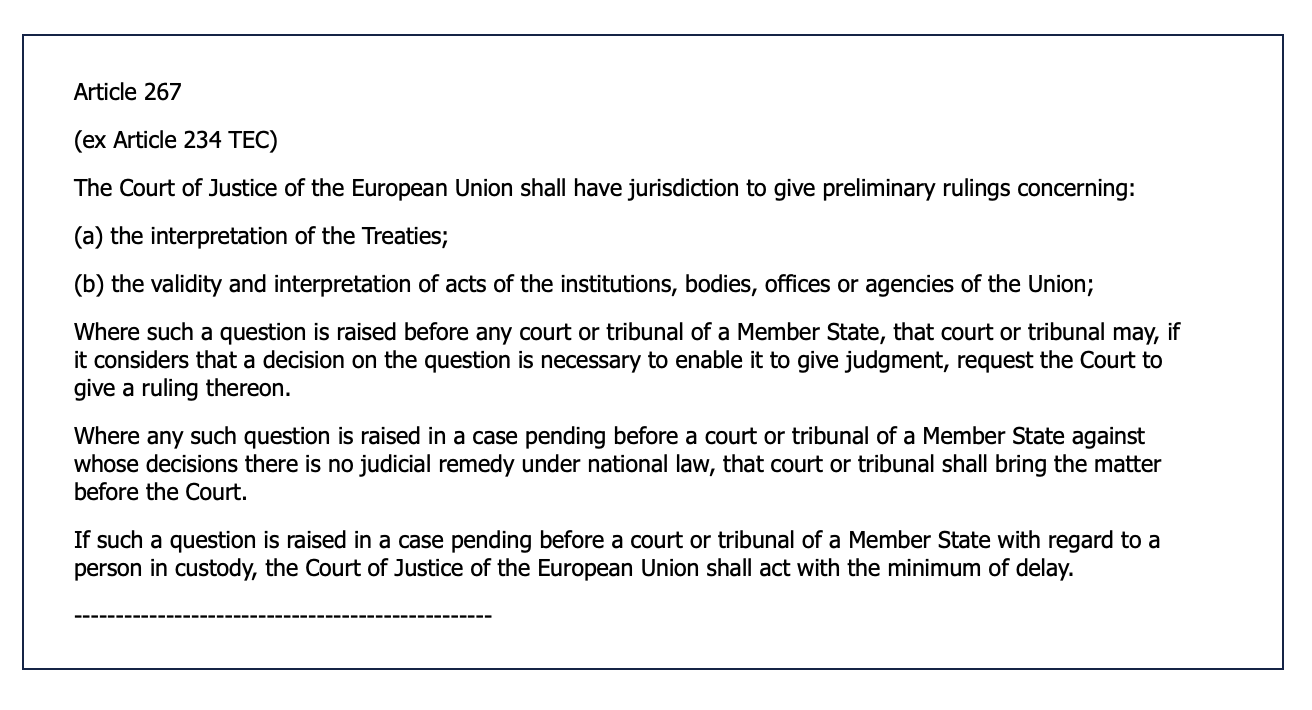
Fundamental rights in the EU
Historical background and development of the case law
After the world wars, European State parties created a new international instrument, the ECHR.
The Convention is a catalogue of civil and political fundamental rights and States parties accepted not only to be bound by its rules but also to establish a supervisory mechanism through the European Commission of Human Rights and the ECtHR.
EU limited accession to the Political Community to those European States that guaranteed fundamental rights as provided in the ECHR.
The development of the case law of the Court of Justice
The fundamental rights gap became all too apparent as defence and political community treaties were abandoned.
The fundamental rights gap meant that the European Communities initially had powers that could affect individuals but no clear EU-level system protecting fundamental rights. National courts feared that governments could use EU institutions to bypass national constitutional rights. So, initially, individuals challenged EU measures by arguing that they violated fundamental rights protected by their national constitution.
National courts insisted on checking EU action against national fundamental rights, threatening the supremacy of EU law. In response, the CJEU recognized fundamental rights as general principles of EU law and began protecting them.
Stauder
(1969)
Stauder argued that being identified by name to receive subsidized butter violated his right to dignity under the German Constitution.
Instead of asking whether EU law violated German constitutional rights, the German court asked whether it was compatible with the general principles of Community law.
The CJEU found that the Commission decision did not actually require identification by name.
More importantly, the case established that fundamental rights are protected as general principles of EU law.
This shifted protection from relying on national constitutions → EU-level fundamental rights protection.
As mentioned previously, the gap-filling function of general principles was of paramount importance not only to ensure that the Communities would be a constitutionally complete system, but also to assuage the fears of national courts in relation to fundamental rights protection.
While at first, some national courts, and especially the German Federal Constitutional Court, were cautious in relinquishing jurisdiction,21 with time it was accepted that the standard of protection afforded by the Court of Justice could be considered equivalent (never identical) to that afforded by domestic courts, so that the latter could entrust the review of the validity of Community/Union acts to the judgment of the Court of Justice.
The response of the political institutions: from the 1977 Declaration to the Lisbon Treaty
It was mentioned previously that the gap in the Treaties concerning fundamental rights protection was largely coincidental; it is not surprising then that the developments in the case law of the Court met with the approval of the political institutions.
After that, every Treaty revision strengthened the protection of fundamental rights in the EU. In particular, following the expansion of Union competences in the field of asylum, immigration, and criminal law, the protection of fundamental rights in the EU became of paramount importance for many of the Member States.
While at first the Charter was ‘merely’ proclaimed by the three political institutions, almost mirroring the 1977 Declaration, the Lisbon Treaty subsequently gave it the ‘same legal value’ as the Treaties themselves (Article 6(1) TEU).
Article 7 TEU and the rule of law crisis
The EU does not have general fundamental rights competence: this means that the Commission (in particular) cannot bring infringement proceedings against a Member State that is violating fundamental rights, unless a connection with EU law can be established.
Article 2 TEU establishes the EU’s fundamental values, including fundamental rights, democracy, and the rule of law. However, the EU cannot automatically force Member States to respect these values. Article 7 TEU, introduced by the Amsterdam Treaty, allows the EU to respond when a Member State seriously and persistently breaches these values. After the Haider case in Austria showed that the EU could only act after a breach occurred, the Nice Treaty expanded Article 7 to also cover a “clear risk” of a breach. Thus, Article 7 provides both a preventive mechanism and a mechanism for responding to actual serious breaches.
For a “clear risk” of breach, the Council can issue recommendations and monitor the Member State. The procedure can be triggered by one-third of Member States, the European Parliament, or the Commission, and requires a four-fifths majority in the Council.
For a “serious and persistent breach”, the European Council must unanimously determine the breach (excluding the Member State concerned), with the consent of the European Parliament. The procedure can be initiated by one-third of Member States or the Commission. The Council can then impose sanctions, such as suspending voting rights or other Treaty rights, while considering the effects on individuals and companies.
The political nature of Article 7 TEU has made it difficult to respond effectively to rule-of-law problems, particularly in Hungary and Poland. Although Article 7(1) was triggered against both countries, the required High Council majority has prevented a decision from being adopted. Sanctions under Article 7(2) are even harder because they require unanimity in the European Council. As a result, the EU has struggled to respond effectively to governments undermining its foundational values.
Addressing the rule of law crisis: the case law and the proposals
The most important constitutional development in this respect stems from the Commission v Poland case on the independence of the judiciary.
It has been mentioned earlier that both Poland and Hungary have attempted to curtail judicial independence through sweeping reforms.
→ The Commission challenged judicial reforms in Poland by relying on a breach of Article 19(1) TEU.
Furthermore, in subsequent cases, the Court refined its reasoning by imposing on the (new?) Member States a non-regression obligation, at least in terms of the independence of the judiciary.
In LG, the Court, building on its own case law and relying on the findings of the ECtHR, clarified that it will refuse a preliminary ruling request from a court that does not satisfy the criterion of independence.
After instituting a rule of law framework to guide its own action in relation to Article 7 TEU proceedings, the Commission has articulated its action around three key concepts: promotion, prevention, and response.
The Charter of Fundamental Rights
The Charter is divided into titles according to six fundamental values → dignity, freedom, equality, solidarity, citizens’ rights, and justice.
The scope of application of the Charter mirrors that of the general principles so that the Charter applies to the Union institutions as well as to the Member States when they implement or act within the scope of Union law.
In the Kadi case, the Court addressed the legality of a Regulation, intended to fight international terrorism, freezing the assets of (inter alia) Mr Kadi. The Court held that while the freezing of Mr Kadi’s assets could in principle have been justified, in the case at issue, it violated his right to property because it did not provide for sufficient procedural guarantees.
The Kadi judgment demonstrates that EU measures pursuing legitimate objectives, such as combating international terrorism, must nevertheless comply with fundamental rights. Although asset-freezing may constitute a legitimate and proportionate substantive measure in principle, its implementation must provide adequate procedural safeguards, including the possibility for the affected individual to effectively challenge the measure.
The scope of application of the Charter
The Charter primarily binds the EU itself, and it cannot avoid the Charter by saying that it is acting outside the normal EU legal framework.
In Ledra Advertising, the European Commission was involved in measures under the European Stability Mechanism (ESM).
The Commission argued, essentially, that it was acting in the context of the ESM, which is technically outside the EU legal framework. But the Court of Justice said that doesn’t free the Commission from its Charter obligations.
In the above-mentioned case of Kadi I, the Court found that EU institutions are bound by EU fundamental rights even when giving effect to a UN Security Council Resolution, which is mandatory international law.
Digital Rights Ireland
In Digital Rights Ireland, two national courts, one in Ireland and one in Germany, asked the Court of Justice to assess whether the EU Data Retention Directive was valid. In particular, they questioned whether it was compatible with the rights to privacy, protection of personal data, and freedom of expression under Articles 7, 8, and 11 of the Charter.
The Directive required providers of telephone, mobile, and internet services to retain communication data for at least six months.
The Court followed a three-step approach. First, it found that the Directive interfered with the rights to private life and protection of personal data. Second, it considered whether this interference could be justified. The Court accepted that combating serious crime and protecting public security were legitimate objectives.
Third, the Court examined whether the interference was proportionate. It concluded that it was not. The Directive applied too broadly and indiscriminately, affecting practically the entire European population. It also did not establish sufficient objective criteria determining when public authorities could access the retained data. Although it allowed data to be stored for between six and 24 months, it did not require the retention period to be based on objective criteria or limited to what was strictly necessary.
The Court therefore concluded that the Directive created a very serious interference with fundamental rights without sufficiently limiting that interference. As a result, the Court annulled the Directive.
However, this did not completely solve the issue because some Member States adopted or maintained similar data-retention rules in their national laws. In Tele2 Sverige, communication providers were required by national authorities to retain data in a similar way to the system established by the Directive.
The Court held that these national rules were also incompatible with EU data-protection law, interpreted in light of the Charter. In this way, the Court effectively applied similar fundamental-rights limits to Member States’ data-retention rules as it had previously applied to the EU legislature.
The application of the Charter to the Member States
Member States are also bound by EU fundamental rights when they exercise a discretion which has either been conferred by Union law (i.e., when they implement a Union law instrument) or when they bring themselves within the scope of EU law by limiting or derogating from one of the free movement rights conferred by the Treaties.
Article 51(1), therefore, states that the provisions of the Charter are addressed to the Member States only when they implement Union law.
The Dublin II Regulation established rules for deciding which EU Member State was responsible for examining an asylum application. One Member State should be responsible for examining the asylum claim, rather than the applicant applying in multiple Member States.
Person enters the EU through Greece → later travels to the UK → applies for asylum in the UK
Under the Dublin rules, Greece might be responsible, because it was the country through which the person first entered the EU, assuming no other responsibility criterion applied.
The sovereignty clause allowed a Member State to choose to examine the claim itself, even if another Member State was technically responsible.
The case is important because Member States were applying EU law (the Dublin Regulation), so the Charter applied under Article 51(1). The Court held they could not transfer asylum seekers where there was a real risk of inhuman or degrading treatment (Article 4 Charter).
Case Study → Immigration, sovereignty, and fundamental rights: the case of Mr and Mrs Carpenter
🇬🇧 ECHR / Human Rights Act → applied to UK actions generally.
🇪🇺 EU fundamental rights / Charter → applied to Member States when they were acting within the scope of EU law.
Carpenter: Fundamental Rights and EU Law
The UK was already required to protect fundamental rights through the ECHR and the Human Rights Act 1998. However, EU fundamental rights do not automatically apply to every action of a Member State simply because it is an EU Member State. EU fundamental rights apply when the Member State is acting within the scope of EU law.
Therefore, Mrs Carpenter could not simply invoke EU fundamental rights against the UK’s immigration decision. Her situation initially appeared to be purely internal: she was a Filipino national, her husband was British, and neither had exercised free movement. The EU rules on free movement would therefore normally not apply.
Counsel, therefore, needed to establish a connection with EU law. He argued that Mr Carpenter provided services to clients in other Member States and travelled to France for business, meaning that he was exercising his right to provide services under Article 56 TFEU. His wife’s presence was important because she cared for their children while he travelled. Deporting her could therefore hinder Mr Carpenter’s ability to exercise his EU freedom to provide services.
Once Article 56 TFEU brought the situation within the scope of EU law, EU fundamental rights could also be taken into account. The Court could then assess whether the UK’s immigration measure was a proportionate restriction of Mr Carpenter’s EU right, taking into account the Carpenters’ right to family life.
Thus, the fundamental right itself was not what brought the case within EU law. Article 56 TFEU provided the EU-law connection, and once that connection was established, fundamental rights could be used in assessing whether the UK’s interference was justified and proportionate. The case, therefore, demonstrates that the key issue is not whether fundamental rights existed, but whether the situation fell within the scope of EU law so that EU fundamental rights could be invoked.
The notion of implementation of EU law for Article 51(1) Charter
In recent years, the Court has also sought to draw the limits of the application of the Charter more precisely by outlining the proximity with EU law necessary before the Charter can apply to acts of the Member States.
→ Akerberg Fransson: a broad definition of “implementing”:
In cases which have a stronger connection with European interests, and especially the internal market, the Court is more ready to find that the Charter applies to acts of the Member States.
ne bis in idem: principle that a person cannot be prosecuted twice for the same offence.
In Åkerberg Fransson, the issue was whether Article 50 of the Charter (ne bis in idem) applied to Swedish tax penalties and criminal proceedings against Mr Fransson for providing false tax information. The Swedish authorities argued that the Charter did not apply because the proceedings were based on national tax law. However, part of the case concerned VAT, which is regulated by EU law. Under the VAT Directive and the principle of loyal cooperation, Member States have an obligation to ensure the effective collection of VAT. Since part of VAT revenue contributes to the EU budget, VAT fraud can also affect the EU’s financial interests, which Member States must protect under Article 325 TFEU. Therefore, the Court found that Sweden was implementing EU law, meaning the Charter applied under Article 51(1). Fransson could consequently rely on Article 50 and the principle of ne bis in idem. The fact that the proceedings also concerned income tax, which is not harmonised at the EU level, did not prevent the Charter from applying because there was a sufficient connection with EU law.
→ McB: EU rules coordinating national procedural rules
Harmonisation means EU law actually sets common/substantive rules that Member States must follow. In those situations, Member States are more directly constrained by EU law, so the Charter can apply when they are implementing those rules.
Coordination means EU law mainly coordinates the different national systems while leaving Member States significant freedom to decide how their own rules operate. Therefore, the Charter has a more limited application, because the EU has not taken over that area of competence.
Article 51(1) says that the Charter applies to Member States only when they are acting within the scope of EU law, and that this must respect the limits of EU competences.
Art. 51(2) does not extend the field of application of Union law.
The EU has competence to coordinate a particular area, but Member States retain substantial control over their national rules. A person cannot simply say:
“My national rule violates a Charter right, therefore the EU Charter applies and the EU can control this whole area.”
No. The EU must first have a Treaty-based competence and the national measure must fall within the scope of EU law. Only then can the Charter be invoked.
Where EU legislation merely coordinates rather than harmonises national rules, Member States retain greater freedom, meaning the Charter’s application is correspondingly more limited.
McB was an unmarried father in Ireland.
Under Irish law at the time:
The mother automatically had custody of her children;
An unmarried father did not automatically have custody;
The father had to obtain custody either through an agreement or a court order.
McB separated from the children’s mother and applied to the Irish courts for custody.
But before the court actually granted him custody, the mother took the children out of Ireland.
This mattered because Regulation 2201/2003 dealt with the wrongful removal of children. Generally, if a child is wrongfully removed from their habitual residence, the courts of the original country retain jurisdiction.
Was the removal actually “wrongful” if McB did not yet have custody rights under Irish law? The Irish court said essentially: No. Because McB had not yet obtained custody, the mother had not removed the children from someone else’s custody rights.
McB argued that the Irish rule, under which an unmarried father did not automatically acquire custody, violated Article 7 of the Charter and Article 8 ECHR. The Court relied on Article 51 to hold that the Charter could be used to interpret the Regulation, but could not be used to assess Irish family law as such. Thus, the Court indirectly considered the national rules through its interpretation of EU law, balancing fundamental-rights protection with the principle that the Charter cannot extend EU competence into areas reserved to Member States.
→ Cases in which the charter does not apply
The Charter applies only in those instances where MS are “implementing” EU law.
In some cases, it is not easy to determine whether the national rules constitute the implementation of EU law or not.
For this reason, the Court has attempted to draw some guidelines on the degree of proximity between EU and national rules required before the Charter can apply
Mr Siragusa had made changes to buildings located in a protected conservation/landscape area in Italy. He later asked for retrospective planning permission, but it was refused, and he was ordered to restore the buildings.
He argued that this interfered with his right to property under Article 17 of the Charter. The Italian court, therefore, asked the CJEU whether the national conservation rules were compatible with the Charter.
Italy’s rules protect the landscape → landscape protection is connected to environmental protection → the EU has extensive powers and legislation concerning environmental protection → therefore, Italy was implementing EU law → therefore, the Charter applies. But the CJEU said that the connection was not enough.
EU competence in an area ≠ every national law concerning that area is implementing EU law.
Is the national legislation intended to implement EU law? was italy adopting this particular rule because EU law required it? if yes there is a strong connection with EU law and the Charter can apply - BUT! if Italy created the rule independently, simply because it wanted to regulate something within an area where the EU also has competence, that is not enough
What is the nature and objective of the national legislation? What is this national law actually trying to achieve? If its objective is to implement an EU objective that supports the Charter's applicability.
Are there specific EU rules governing the matter? Does EU law actually contain rules that regulate or affect this particular situation? If there is a specific EU provision dealing with the situation, then the national measure is more likely to be implementing EU law.
The horizontal application of the Charter
Normally, EU law can operate in two ways:
Vertical effect = individual → government/public authority.
Horizontal effect = individual → another private party, such as an employer or company.
The Charter is, however silent as to whether it also binds individuals, and if yes, in which circumstances. Whereas Directives do not impose duties on individuals and therefore cannot be invoked against a private party, Treaty provisions, even when apparently addressed to Member States, can have horizontal direct effect.
Directives generally do not have horizontal direct effect.
So if an EU Directive imposes an obligation, you normally cannot simply use that Directive to impose a duty on another private person.
This is the case, for instance, for those provisions which enshrine fundamental principles of the EU such as the prohibition of unequal pay for equal work performed by men and women, and the prohibition on discrimination on grounds of nationality.
The issue arose then as to whether the Charter could be invoked by individuals against other individuals: on the one hand, allowing for horizontal application might maximize the effect of the Charter, and would be consistent with the interpretation given to those Treaty provisions which enshrine fundamental EU rights.
If a Treaty provision (TEU/TFEU/Fundamental Rights) contains a fundamental right/principle and the provision has horizontal direct effect, you can invoke it against a private party.
Regulations are always capable of having a horizontal effect → as such, applicability of the Charter to individuals can be easily justified.
Matters are rather more complex in the case of Directives since those are not capable, per se, of having horizontal direct effect.127 The question then arises as to whether the Charter can be invoked against an individual if the only reason why the litigation falls within the scope of EU law is by virtue of a Directive which, in itself, cannot be invoked against an individual.
When there is a Directive that details rights also contained in the Charter, then the Charter is capable of applying in full, even if the Directive cannot be invoked against a private party.
In the Max-Planck and Bauer cases, the Court held that Article 31(2) Charter, which provides for the right to maximum working periods, rest and paid holiday, could be applied in relation to a dispute between private parties by virtue, and within the limits set by, the working time directive. This was the case, even if (and because) the Directive itself was not applicable for lack of horizontal direct effect.
The scope and interpretation of the Charter
Very few fundamental rights are absolute; the vast majority of fundamental rights can be limited in order to protect the rights of others and/or to ensure that public policy objectives can be carried out.
To ensure that a balance can be struck between competing private or public interests, fundamental rights documents often contain derogation and limitation clauses:
The Charter provides for just one general derogation and limitation clause. Article 52(1) states that limitations on the exercise of Charter rights must:
be provided by law;
respect the essence of those rights;
respect the principle of proportionality;
be necessary to meet the objectives of general interest recognised by the Union or the need to protect the rights and freedoms of others.
Direct actions → Judicial protection and EU remedies
Infriengement proceedings
Infriengement proceedings address the situation where an MS has breached EU law.
→ Main applicant - Commission - Art. 258 TFEU/259(rarely)
! Private parties can not bring an infringement action before the Court.
Infringement proceedings have an administrative phase, where the Commission effectively allows a Member State to remedy an infringement of EU law and to submit observations before resorting to litigation, and a judicial phase before the Court of Justice.
If the Member State does not comply, then pecuniary sanctions may be imposed on it by the Court in a subsequent action under Article 260 TFEU.
The elements in Article 258 TFEU
The Commission can start infringement proceedings if it considers that an MS has failed to fulfill an obligation under the Treaties.
Article 258 TFEU, the EU treats the Member State as responsible for the actions of all its public authorities, not just the national government.
So there are two possibilities:
Positive act → the State does something contrary to EU law.
Omission → the State fails to do something required by EU law.
The rule of law crisis
In recent years, a repeated series of high-profile infringement proceedings triggered in response to the ‘rule of law crisis’ in Poland and Hungary have demonstrated both the efficacy of this mechanism to ensure compliance with EU law—particularly when coupled with orders of interim relief and the breadth of the meaning of the expression ‘an obligation under the Treaties’ in Article 258 TFEU.
Interim relief = temporary measures ordered by the CJEU while the case is still ongoing, before the final judgment.
For example, if a Member State introduces a measure that threatens judicial independence, the Court can order the Member State to temporarily suspend or stop applying that measure while the infringement case is being decided.
This makes Article 258 more powerful because you don’t necessarily have to wait years for the final judgment before something happens.
In relation to the first dimension, it bears noting that the activation of the Article 7(2) TEU procedure, which enables the European Council, acting by unanimity, to determine the existence of a serious and persistent breach by a Member State of the Article 2 TEU values—which include the ‘rule of law’ as one of the values on which the Union is founded—is plagued with political and legal difficulties.
Thus, the Article 258 TFEU actions against Poland mainly concerned judicial reforms that threatened the independence of the national judiciary and thus were contrary to Article 2 TEU.
Until recently, the values in Article 2 TEU were difficult to enforce judicially. In ASJP (2018), the Court clarified that Article 19 TEU gives concrete expression to the rule of law in Article 2 TEU, linking it to judicial independence and Article 47 of the Charter. These links became central to the Court’s later rule-of-law cases against Poland.
Procedure
In the infringement procedure, there is both an administrative phase and a judicial phase, both of which are reflected in the letter of Article 258 TFEU.
The first formal step is administrative → Pre-litigation: letter of formal notice, where the Commission defines the subject and provides a basis for the MS to submit observations.
Following the submission of observations, the Commission may deliver a reasoned opinion describing the infringement of EU law and will give MS two months to comply with the opinion.
If the MS fails to comply with the opinion, the Commission may then decide to bring the matter before the CJEU → triggering the initiation of the judicial phase.
Sanctions
The Lisbon Treaty simplified Article 260 TFEU in three main ways:
No second administrative phase for non-compliance with a Court judgment
Previously, the Commission had to repeat the infringement procedure before seeking financial sanctions.
After Lisbon, the Commission can go directly to the Court if a Member State has not complied with the judgment.
Secondly, for the specific case where a Member State has failed to notify measures transposing a legislative directive on time, special arrangements set out in Article 260(3) TFEU will apply. In particular, the Commission may, even at the stage of the original infringement proceedings, suggest the penalty that the Court could set on a defaulting Member State in the judgment delivered at the end of the Article 258 TFEU proceedings. In other words, the need for a second set of proceedings is obviated.
The action for annulment
The action for annulment and the action for a failure to act represent two dimensions of the same remedy, namely one that addresses the situation where an EU institution has either adopted an illegal act (eg enacting a directive that breaches a general principle of law) or has failed to act when it had an obligation to act under EU law (eg the Commission does not respond at all when an undertaking complains of a violation of the Treaty competition rules). Both avenues aim to obtain a decision from the Court that an act or the failure to act of an institution, respectively, contravene EU law.
The EU institution adopted an act, but that act violates EU law.
Institution acts → act is unlawful → Court can annul it → Art 263 TFEU
Action for failure to act → institution did nothing when it was legally required to act → Art 265 TFEU
Article 263 TFEU sets out the principles that the Court will examine when an action for annulment is brought:
compliance with the time limit for bringing the action
the reviewability of the act
the standing of the applicant - where the applicable rules vary significantly depending on whether the applicant is classified as ‘privileged’, ‘semi-privileged’, or ‘non-privileged’;
The existence of possible grounds for the annulment of the act
Privileged applicants → MS, EP, Council, Commission - they don’t need to show any special interest in bringing the action.
Semi-privileged applicants → ECB, Court of Auditors, Committee of the Regions - They must show that the act interferes with their institutional powers or prerogatives.
Non-privileged applicants → Individuals, Companies, other legal persons
Reviewable acts
Reviewable acts: an act of an EU institution, body, office, or agency that can be challenged before the Court of Justice because it produces legal effects.
Article 263 TFEU states that the essential quality for an act to be reviewable is that it should be legally binding - it explicitly excludes recommendations and opinions.
Most frequently, actions for annulment will be brought against regulations, directives, and decisions, which are the three types of binding legal acts listed in Article 288 TFEU.
Non-privileged applicants
if they are the addressees of the act in question, will have automatic standing;
if they are not the addressees of the act, they will have to show that they are directly and individually concerned by it (general test of standing); but
if they are non-addressees and the act they wish to challenge is a regulatory act, they will have to show that they are directly concerned by it and that the act does not entail implementing measures (special standing test or Lisbon test). Importantly, in this scenario, there is no need for applicants to show that they are individually concerned, which, as we shall see, is the most stringent of all the standing conditions imposed on private parties.

An addressee is someone to whom the EU act is specifically addressed.
For example, if the Commission adopts a decision saying:
“Company X must pay €10 million.” ➡ Automatic standing means the addressee does not have to prove direct concern or individual concern.
Non-addressee is someone affected by an EU act but who is not formally addressed by it. For them, Article 263 is much stricter.
There are two possible routes:
General Standing Test: must show Direct concern and Individual concern
Direct concern → The EU act must affect the person’s legal position directly, without leaving the Member State or another authority with significant discretion about how to implement it.
Individual concern → The applicant must be affected because of attributes or circumstances that distinguish them from all other persons, essentially as if they were the addressee.
Special Lisbon Test → regulatory acts
A non-addressee can challenge a regulatory act if:
It is a regulatory act
The applicant is directly concerned
The act does not entail implementing measures
No individual concern is required. ← This is the important advantage.
Imagine an EU regulation directly affects Company A, but Company A cannot satisfy the strict individual concern test.
If the regulation is a regulatory act, Company A may still have standing under the Lisbon test if:
direct concern + no implementing measures
EU Criminal Law
EU criminal law comprises five distinct but related bodies of law.
First, there is the body of law creating and regulating a group of European Union agencies that have been set up to secure the better functioning of criminal justice within the EU.
Secondly, there is a body of law designed to facilitate cooperation between the police forces and other law enforcement agencies of the different Member States.
Thirdly, there is a body of law on what is called mutual recognition: rules requiring the criminal justice systems of all Member States to treat as valid and, if called upon, enforce rulings and decisions emanating from the others.
Fourthly, there is the body of law, the purpose of which is to shape, in certain respects, the substantive criminal law of all Member States.
Establishing EU rules concerning how criminal proceedings are conducted in Member States (e.g., procedural rights of suspects and defendants).
Protection of the EU’s Financial Interests (PIF Crimes)
Problem: Economic integration created specific Union interests that needed criminal-law protection, particularly:
preventing corruption among EU officials;
protecting the single currency;
protecting the EU budget and finances.
PIF Crimes
PIF = protection des intérêts financiers (protection of the EU’s financial interests).
Refers to offences against the EU budget, such as fraud affecting EU financial resources.
PIF crimes have significantly shaped the development of EU criminal law.
Originally:
Prosecution of offences against the EU budget was entirely dependent on Member States.
Landmark case: Greek Maize
The CJEU imposed a positive obligation on Member States to protect Community/EU financial interests.
Member States had to use their national criminal justice systems where necessary to protect those interests.
This marked an important step toward EU-level involvement in criminal law.The EU itself had limited ability to ensure effective criminal enforcement.
OLAF → European Anti-Fraud Office
PIF Directive → harmonises criminal-law rules concerning fraud against the EU’s financial interests
EPPO → European Public Prosecutor’s Office, which investigates and prosecutes certain crimes affecting the EU’s financial interests.
EU agencies are independent entities established under EU law to perform specific technical, scientific, or administrative tasks.
independent entities of EU law:
created an ad hoc act of secondary law
have legal personality
have a certain degree of budgetary and institutional autonomy
take up technical, scientific, and administrative tasks in their respective competence domain
In the AFSJ
Some particularly important AFSJ agencies are:
Europol → facilitates cooperation between national police authorities, particularly regarding serious cross-border crime and terrorism.
Eurojust → facilitates judicial cooperation between national prosecution authorities in serious cross-border criminal cases.
Frontex → supports Member States in managing the EU’s external borders.
European Union Agency for Asylum (EUAA) → supports Member States in implementing EU asylum and international protection law.
legal basis:
Art. 352 TFEU 12 agencies
European Arrest Warrant
issuing state = surrender => executive state
Issuing Member State = the state that issues the European Arrest Warrant because it wants the person arrested and transferred there.
Executing Member State = the state where the person is currently located and which receives/executes the EAW.
The executing state arrests and surrenders the person to the issuing state.
🇫🇷 France wants to prosecute someone who is in the Netherlands.
→ France = issuing state
→ Netherlands = executing state
→ The Netherlands arrests the person and surrenders them to France.
Tensions
Each criminal justice system has its own rules and exceptions, developed together with other requirements of the national legal system. When it comes to the principles of criminal procedure, the collection and administration of evidence, or the powers of the competent authorities.
At the EU level, the key question is whether criminal justice cooperation should follow a horizontal approach (common European rules) or a vertical approach that respects national legal diversity through approximation.
The Treaties also accommodate legal diversity through opt-outs, notably for Denmark and Ireland, and formerly the UK, in criminal justice matters.
The EU prefers helping Member States cooperate rather than replacing their national criminal-law systems with one EU-wide system.
Horizontal solution = cooperation between national systems
France keeps its criminal law.
Germany keeps its criminal law.
The EU creates rules that make them work together.
Example: European Arrest Warrant → one Member State can ask another to surrender a person.
The EU tries to integrate criminal law while still protecting Member States’ sovereignty.
Article 82 TFEU → Criminal procedure
The EU can make rules to bring national criminal procedures closer together, but it must respect differences between national legal systems.
For example, EU rules can facilitate cooperation between Dutch and French courts, but they cannot simply ignore the fact that their legal procedures are different.
Article 83 TFEU → Criminal offences and sanctions
The EU can establish minimum common rules about:
what certain serious crimes are; and
minimum standards for sanctions.
But the EU’s power here is limited — Member States retain substantial control over their criminal law.
→ Emergency brake
If the MS thinks the proposed EU criminal-law legislation would affect “ fundamental aspects of its criminal justice system,” it can refer the matter to the European Council, which pauses the OLP.
So the emergency brake is a safeguard for national sovereignty.
The emergency brake does not prevent the other MSs from continuing with an initiative.
The beginnings: Schengen - alias CISA
Originally, the Community had no competence in criminal law. Cooperation therefore relied on intergovernmental agreements, such as the TREVI group, whose recommendations depended on Member States’ political willingness to implement them.
The first steps towards EU criminal law happened outside the Community framework. In 1985, five countries signed the Schengen Agreement to gradually remove internal border controls. In 1990, CISA was adopted to implement it. In 1997, the Schengen acquis was incorporated into the EU framework through the Treaty of Amsterdam.
CISA introduced measures to compensate, such as:
easier police and judicial cooperation;
easier extradition;
mutual legal assistance;
ne bis in idem (you cannot be prosecuted twice for the same offence);
cross-border surveillance, meaning police can continue following/surveilling someone after they cross into another participating country.
No internal border controls → more freedom of movement → stronger cooperation between police and courts to maintain security.
Current arrangements
After Lisbon, the main powers of the EEU to legislate in criminal justice matters are contained in Articles 82 to 89.
Importantly, the Treaty recognizes for the first time expressly the Union competence to approximate criminal laws under strict conditions as well as a vertical approach to judicial cooperation in criminal matters in the form of the EPPO.
Article 82 TFEU says that EU countries should generally recognise each other’s judicial decisions. This is called mutual recognition.
mutual recognition = “We trust each other’s courts enough to recognise their decisions.”
Article 82 TFEU allows the EU to adopt directives setting minimum rules on criminal procedure, such as evidence, defendants’ rights, and victims’ rights, to facilitate mutual recognition. Member States can still maintain or introduce higher levels of protection.
Article 83 TFEU concerns substantive criminal law. It allows the EU to adopt directives setting minimum rules on criminal offences and sanctions for serious cross-border crimes.
The exhaustive list includes: terrorism, human trafficking, sexual exploitation, drug and arms trafficking, money laundering, corruption, counterfeiting, cybercrime, and organised crime.
Organs
OLAF
Article 325(1) TFEU makes the Union and the Member States jointly responsible for combating fraud and other illegal activities affecting the financial interests of the Union.
OLAF conducts investigations for the purpose of fighting fraud, corruption, and any other illegal activity affecting the financial interests of the Union.
Importantly, OLAF can only carry out administrative investigations and has no power to prosecute a fraud if one is discovered.
Europol
Europol, now called the European Union Agency for Law Enforcement Cooperation, has evolved from an international organization into a Union agency with legal personality.
Each Member State establishes or designates a national unit, which is the liaison body between Europol and the competent authorities of that Member State.
It is a ‘horizontal’ body, with no operational powers, the basic task of which is the collection, storage, analysis, and exchange of information about criminals and crimes.
By Article 3 of the Europol Regulation, the purpose of Europol is to ‘support and strengthen action by the competent authorities of the Member States and their mutual cooperation in preventing and combating serious crime affecting two or more Member States, terrorism and forms of crime which affect a common interest covered by a Union policy.
By Article 88 TFEU, however, Europol can also become involved in operational policing to some limited extent. First, Europol staff may participate in joint investigation teams. Secondly, Europol has the right to formally request national authorities to initiate criminal investigations in respect of a particular case.
Member States that receive such a request are obliged to consider it, but not to act on it. If, however, a Member State decides not to comply with the request, it must give Europol its reasons, unless to do so would be ‘contrary to the essential interests of the security of the Member State concerned’ or ‘jeopardise the success of an ongoing investigation or the safety of an individual’.
Eurojust
The European Union Agency for Criminal Justice Cooperation
If several Member States are investigating the same criminal network, Eurojust gets the relevant prosecutors together and helps them coordinate their strategies.
It helps prosecutors navigate and execute these cross-border judicial cooperation instruments.
Prosecutors and investigators from several countries can formally work together on one investigation. Eurojust can provide legal, technical, and financial support.
→ Each EU Member State sends one person to Eurojust.
The European Public Prosecutor’s Office
The EPPO is the first European body with the power to initiate criminal investigations in the Member States.
The Office represents a significant step forward in integration in criminal matters, since, as we have seen, OLAF can only conduct administrative investigations, Europol cannot initiate criminal proceedings, and Eurojust has no prosecutorial powers.
The EPPO was created not by unanimity but as an exercise in enhanced cooperation: at present, there are 24 participating EU countries.
Denmark had an opt-out under Protocol 22, while Hungary, Ireland, the UK, and initially Sweden and Poland decided not to participate in the enhanced cooperation.
Cooperation between law enforcement agencies
EU criminal law includes many instruments facilitating cross-border information sharing between police, customs, and other law enforcement authorities. These fall into three main types.
Databases for the automated exchange of information → Schengen Information System (SIS) allows authorities to share alerts about missing persons, stolen items, or persons wanted for arrest or extradition under a European Arrest Warrant (EAW). The alert is sent to the central system (CS-SIS), which directs it to all national systems. Prüm allows Member States to directly access each other’s crime databases, including DNA, fingerprints, and vehicle data. It also supports data sharing for major cross-border events and preventing terrorism.
The second type allows law enforcement agencies to request information from other Member States, which must provide it. The Swedish Framework Decision, replaced by a 2023 directive, requires information to be shared as it would be between agencies within the same Member State.
The third type of instruments provides a legal basis for cross-border operations. Of these, the best known are joint investigation teams, or JITs, under Article 13 of the EU Mutual Legal Assistance Convention of 2000.
In 2021, the Commission proposed a legislative package aimed at creating a “ EU Police Cooperation Code”.
JITs are set up by agreement between the competent authorities of two or more Member States for a specific purpose and a limited period.
Mutual recognition and criminal law
In the context of EU criminal law, mutual recognition means that the decisions and rulings of the courts and other competent authorities of one legal system are accepted and applied by those of other legal systems more or less automatically.
Extradition and mutual legal assistance follow a “request model,” where one state requests assistance from another. Mutual recognition follows an “order model,” where authorities directly enforce another Member State’s decision.
Article 82 TFEU declares mutual recognition to be the ‘cornerstone’ of judicial cooperation in criminal matters and essentially makes the promotion of this principle a prerequisite for the EU’s legislative competence in criminal procedure.
The European Arrest Warrant
First, to back up an extradition request, the requesting State had to produce prima facie evidence of guilt. Secondly, it was not available for “political offences” or fiscal offences”. Thirdly, in its earlier history, it was subject to a ‘dual criminality requirement’; the requesting State had to show that the acts of which the wanted person stood accused would have been criminally punishable in the requested State had they been committed there. Fifthly, the process was political as well as legal, requiring the consent of the executive as well as of the courts
EAW was adopted rapidly in the aftermath of the 9/11 terrorist attacks, and the instrument was primarily promoted. The security aspect of the AFSJ provides for nearly automatic enforcement of foreign judicial decisions to meet the immediate need to combat terrorism, without much emphasis on the protection of human rights.
France issues a European Arrest Warrant and sends it to the Netherlands.
The Dutch authorities do NOT conduct a full investigation/trial to determine whether the person actually committed the crime.
“Is this EAW legally valid, and do we have to surrender this person to France?”
That’s why it is called a summary procedure — it’s much faster and simpler than traditional extradition.
The executing State (the former ‘requested State’) is obliged to surrender the wanted person unless one of a limited number of specified ‘grounds for non-execution’ listed in the Framework Decision is made out.
Criticism of the EAW
Excessive scope → It means that critics think the European Arrest Warrant (EAW) can be used for cases that are too minor or too old to justify such a powerful procedure.
The EAW can cover a very wide range of offences, rather than being limited only to extremely serious crimes.
→ does not include a general requirement of proportionality
The second serious criticism of the way the EAW works in practice is the fact that it sometimes returns suspects to countries where they then spend excessive periods in prison before trial.
Andrew Symeou, a British youth, experienced this when, in July 2009, he was surrendered to Greece on charges of homicide, where he spent the next two years awaiting trial, in particularly bad prison conditions.
The third problem is a central issue at the very heart of all mutual recognition instruments, namely ‘trust’ in the functioning of foreign criminal justice systems.
Case study
Under the principle of mutual recognition, Member States more or less automatically enforce each other’s judgments and orders.
Mutual trust is a rule: Courts must trust the other Member State unless an expressly recognised exception applies.
Mutual trust is an aspiration: Courts can say, “I don’t trust this particular decision/system in this particular case, so I won’t recognise it.”
The EU system generally leans toward the first approach: mutual recognition cannot simply be refused whenever a national court thinks the result is unfair.
The European Investigation Order
In 1999, the Tampere programme also floated the idea that evidence lawfully gathered in one Member State should be admissible before the courts of another, taking into account the standards that apply there.
They emphasized, in particular, the need for prior approximation of laws to build up trust, at least for a standard set of ‘core evidence-gathering powers’ that apply in transnational cases in all Member States.
The Directive regarding the European Investigation Order in criminal matters was adopted in 2014.
For example, France is investigating someone, but the relevant bank records are in the Netherlands. France can issue an EIO asking the Netherlands to obtain those records.
This contrasts the European Investigation Order (EIO) with traditional Mutual Legal Assistance (MLA).
Issuing State → proportionality + equivalency
The country requesting the evidence must ask:
Is this investigative measure proportionate, and would we use this measure in a similar domestic case?
equivalency → Would this investigative measure be available or allowed in a comparable domestic situation?
So the EIO isn’t supposed to give another Member State more investigative powers than it would have domestically.
Like other mutual-recognition instruments, an EIO is not automatically executed in every situation. The executing State can refuse it if one of the legally recognised refusal grounds applies. The executing State can refuse the EIO if executing it would result in a violation of fundamental rights.
Overall, the Directive has established a horizontal cooperation regime that falls somewhere between the numerous exceptions of the traditional MLA and the automaticity of previous mutual recognition measures
The effect of Brexit
The UK as a former Member State—now a third country—is in a special position as it applied the EAW and the EIO before leaving the EU and still generates many cases in relation to European transnational criminal justice.148
It is therefore important to note that the Trade and Cooperation Agreement149 (TCA) reached between the EU and the UK in December 2020 contains supplementary rules on judicial cooperation in criminal matters.150 Both the EAW and the EIO are replicated. Under the surrender regime (Title VII), the time limits remain unchanged, with the decision on surrender being taken within 10 to 60 days at the latest. However, there are two significant differences compared to the EU regime: the parties can insist on double criminality (Article 601) even for offences on the Framework Decision List, and there is a possibility to refuse to surrender their own nationals (Article 603)
Harmonization of substantive criminal law
Article 83 TFEU gives the Union the power to adopt common minimum standarts fro particuarly serious crimes with a cross-border dimension.
That said, the list can be extended, although only by a unanimous decision of the Council with the prior consent of the European Parliament.
In every case, the obligation so imposed is to make a given type of antisocial behaviour punishable, and further duties are usually imposed about the type and severity of punishment.
The Union follows a so-called “minimum-maximum” approach and only sets minimum levels of the maximum sanctions for natural persons.
→ thus, there is no harmonization of minimum penalties
Minimum level of the maximum penalty: The EU establishes how high the maximum penalty must be.
Minimum penalty: The EU establishes the lowest punishment that can be imposed.
Article 83(2) TFEU grants an additional power, which allows the Union to adopt common minimum standards for the definition of criminal acts and sanctions, where these are indispensable to ensure the effectiveness of an already harmonized EU policy.
There are three important requirements:
An existing EU policy: The EU must already have adopted harmonisation measures in a particular policy area.
Criminal law is indispensable: Criminal law must be essential to ensure that the policy is effective, rather than merely useful or convenient.
Minimum rules: The EU can establish common minimum rules concerning the definition of criminal offences and sanctions.
In other words, the EU cannot use Article 83(2) simply because it wants to criminalise certain conduct. Criminal law must be necessary to ensure the effective implementation of an existing harmonised EU policy.
Imagine the EU adopts legislation requiring all Member States to limit industrial pollution.
Step 1 — Existing EU policy: The EU harmonises environmental protection rules by establishing common limits on industrial emissions.
Step 2 — The problem: Some companies deliberately release toxic substances into rivers, violating those rules. Administrative fines alone may not be sufficient to ensure compliance.
Step 3 — Article 83(2) TFEU: If criminal-law measures are indispensable to ensure the effective implementation of the harmonised environmental policy, the EU can adopt a directive requiring Member States to criminalise certain conduct and establish common minimum rules on sanctions.
So, when is it ‘indispensable’ to ensure the effectiveness of already harmonized EU policies by means of approximations of criminal laws?
The guiding principles in this regard are that criminal law must be necessary to ensure effective implementation, the general principles of subsidiarity and proportionality must apply, fundamental rights under the ECHR and the Charter must be respected, and the sanctions must be proportionate under Article 49 of the Charter.
Can the EU adopt criminal law legislation only under Title V TFEU, or can it also use other Treaty provisions, such as Article 325 TFEU, to expand its powers?
Title V of Part Three of the TFEU contains the rules on the Area of Freedom, Security and Justice (AFSJ), including specific legal bases for judicial cooperation in criminal matters.
Article 325 TFEU requires the EU and Member States to combat fraud and other illegal activities affecting the EU’s financial interests. The Commission argued that it could rely on Article 325 TFEU, rather than the specific criminal justice provisions in Title V.
Article 83(2) TFEU, which applies where the EU legislator needs to harmonize substantive criminal law to make other (non-criminal) harmonized EU measures more effective.
Harmonization of criminal procedure
Two ways the EU influences national criminal procedure: mutual recognition and harmonisation. The key difference is that one makes Member States recognise each other’s criminal justice decisions, while the other establishes common minimum standards for how people must be treated.
Immigration and asylum
Prior to the Treaty of Amsterdam
Initially, Member States cooperated informally through intergovernmental agreements and non-binding acts. After the Maastricht Treaty, cooperation became a formal intergovernmental system, allowing the Council to adopt Conventions (requiring national ratification), Joint Positions, and Joint Actions.
Due to disagreements about the intensity and substance of the EU’s role in this field, ‘soft law’ measures such as recommendations and resolutions were still widely used.
The intergovernmental nature of the EU’s involvement in these issues during this period was established in particular by the requirement that the Council act unanimously in all cases.
Furthermore, there was no obligation even to consult the European Parliament, the Commission had to share its power to make proposals with Member States, and the jurisdiction of the Court of Justice was excluded (except as an option, as regards Conventions).
The Treaty of Amsterdam
The Treaty of Amsterdam (1999) gradually shifted immigration, asylum, and civil law measures to the Community method, giving EU institutions a greater role in decision-making. A five-year transitional period applied until 1 May 2004, alongside certain exceptions.
During this transitional period, the Commission had to share its monopoly of initiative with MS, the Council still voted unanimously, and the EP was only consulted.
after the transitional period, the Commisson had the only monopoly over the initiative, the Council voted with QMV, and the EP had powers of co-decision.
! however, the Court of Justice was limited → only final courts of the MS could send references for a preliminary ruling to the Court.
UK and Ireland opted-out from most of the subjects though the enhanced cooperation.
On this point, the Treaty of Amsterdam integrated the Schengen Convention and measures based upon it into the EU legal order, without the pariticpation of the UK and Ireland.
The Treaty of Lisbon
The Treaty of Lisbon completed the process of applying the usual “community” method to this area.
This resulted in agreement upon a number of legal migration proposals that had previously been voted by one or more MS.
→ The Court of Justice has since had its full jurisdiction in this area.
Visas and border control
The EU has been more active in the fields of visas and border controls than in any other area of immigration and asylum law, due to the Schengen acquis in this area, integrated into EU law in 1999, and the measures which have built upon the Schengen acquis since.
Border controls
First of all, the Schengen borders code sets out the key rules on the control and surveillance of external borders, as well as the basic obligation to abolish internal border controls between the Member States, subject to limited exceptions.
After the 2011 Arab Spring, EU rules were amended to allow Member States to temporarily reintroduce internal border controls collectively if another Member State failed to control its external borders effectively.
The application of the borders code is complemented by the Schengen Information System, originally established by the Schengen Convention, and replaced by SIS II from April 2013.
The Schengen Information System (SIS) is a database used by Schengen countries to share alerts about people who should be refused entry.
The Frontext agency has a key role supplementing the MS’s border control authorities.
Visa policy
After the integration of the Schengen acquis (which had more fully harmonized visa policy) within the EU legal order in 1999, the Council adopted a Regulation in 2001 which completely harmonized the lists of the countries whose nationals did (or did not) require a visa to cross the external borders.
Since 2014, the EU has had a visa suspension mechanism allowing it to temporarily reintroduce visa requirements for a country that normally enjoys visa-free travel, for example, if there is a large influx of people or insufficient cooperation in accepting the return of its nationals (readmission).
General principles of EU law and EU administrative law
Conferral powers on the Union
Principle of conferral → Article 5(1) and (2) TEU
Comitology committees, comprising MS experts, are designated to supervise and advise the Commission when undertaking implementing activities under Article 291 TFEU.
However, in an increasing number of areas of EU law, Union bodies have also been conferred with the power to take single-case decisions with binding force directly on individuals.
Implementation of EU law by the MS
When EU law does not give EU institutions the power to implement EU law themselves, Member States must implement it through their own national authorities.
Under the principle of sincere cooperation (Article 4(3) TEU), Member States are required to take all necessary measures to ensure that they comply with EU law and fulfil their obligations under the Treaties and EU legal acts.
Thirdly, the application of national procedural rules in the implementation of Union law must be exercised in strict compliance with the principles of equivalence and effectiveness.
Equivalnece and effectiveness
Principle of equivalence: Member States must ensure that claims based on EU law are treated no less favourably than comparable claims based on national law. National procedural rules must be applied equally, regardless of whether the claim concerns a violation of EU law or national law.
→ Where there is no equivalent national law, or where its application does not lead to the result of enforcing or protecting a right under EU law, the principle of effectiveness will override the principle of equivalence. National courts are obliged to set aside:
Principle of effectiveness: Member States may establish their own national procedural rules, but these rules must not make it impossible or excessively difficult for individuals to exercise their rights under EU law.
Case Study → EU data protection law
Composition procedures → Composite procedures are administrative procedures that involve both EU authorities and national authorities working together to make or implement a decision.
An example of these commonplace “composite procedures” is found in EU data protection law, which contains both horizontal cooperation procededures and vertical and diagonal cooperation procedures.
Horizontal cooperation occurs when authorities from different Member States cooperate. For example, under the GDPR, a person can file a complaint in their country of residence, while the data protection authority in the country where the company is located usually leads the investigation under the ‘one-stop shop’ mechanism.
The one-stop shop mechanism under the GDPR means that when a company operates in several EU Member States, usually only one national data protection authority takes the lead in handling a cross-border data protection case.
Under GDRP, when data protection authorities from different Member States disagree about a case, other authorities may get involved to resolve the disagreement.
Composite procedures come with their own set of questions regarding the General principles of EU law, as they are also addressed in Article 41 of the Charter on Good Administration. These include how to ensure the rights of a fair hearing.
Overall, composite procedures raise problems with respect to judicial review, in that it is not always clear which court, within which Member State or the CJEU, is responsible for hearing a case.
Trans-territorial effect → an administrative decision made by one EU Member State can have legal effects in other Member States, not just within the country that made the decision.
- For example, once a product from, say, Brazil has cleared customs via the port of Rotterdam in the Netherlands, that product can be sold throughout the Union without facing any further customs controls or duties
Criteria for legality
Criteria fro the legality of acts of the EU exsits primarily in the from of General principle of EU law.
The function of General principles of EU law is to rpovide a guide to the interpretation of Union law, including the Treaties, to constitute grounds fro the review of Union law.
Proprotionality
Under Article 5(4) TEU, “ the content and form of Union action shall not exceed what is necessary to achieve the objectives of this Treaty”
Proprotionality can be understood as the most widely used General principle of EU law.
One of the reasons for this is that proportionality is a very versatile principle serving to review the legality of:
Acts of EU institutions and bodies when limiting or regulating the exercise of rights of individuals (eg the Commission adopts a decision fining a company for violation of EU antitrust law under Article 101 TFEU)
acts of EU institutions and bodies when limiting Member State powers by adopting EU acts (eg an EU legislative directive on the maximum working time of workers per week);
acts of Member States when limiting or regulating in the context of rights or freedoms guaranteed by EU law (e.g., Greek authorities decide not to grant a broadcasting licence to a private TV station).
The Court of Justice has developed the review of compliance with the principle of proportionality as a three-step test
The principle of proportionality requires that measures adopted by the EU institutions do not exceed the limits of what is appropriate and necessary to attain the objectives.
When there is a choice between several appropriate measures, recourse must be had to the least onerous → least restricting of the rights in question
The disadvantages caused must not be disproportionate to the aims pursued
Rule of law: transparency, legality, legal certainty
The EU is established, as famously pronounced by the Court in Les Verts, as a ‘Community based on the rule of law’.
One requirement of the rule of law is that actions of public bodies of the EU take place under and within the law → legal basis is requried (principle of conferral under Article 5(2) TEU)
With respect to transparenct in the sense of access to documents and freedom of infromation, a key Treaty provision is Article 15 TFEU that requies all proceedings of all bodies are transparent.
Legal certainty
According to the CJEU, the pricniple of legal certainty is a General principle of EU law essentially requiring that:
legal rules be clear and precise
individuals must be able to ascertain what their rights and obligations are
Article 297(1) TFEU lays down that Union acts come into force only after publication, which implies that retroactive entry into force is in principle excluded.
The principle of legal certainty has three important aspects:
Clarity: The law must be sufficiently clear for people to understand it.
Predictability: People must be able to foresee the legal consequences of their actions.
Legal stability: The law should not change unexpectedly or retroactively in ways that undermine legitimate expectations, subject to certain exceptions.
Retroactive effect of Union law is exceptionally possible if such effect explicitly follows from Union law and if the public interest in retroactive effect overrides the private interest in the maintenance of the existing legal situation.
Good administration
Good administration is best understood as an “umbrella” concept containing numerous more specific rights, rules, and principle.
Good administration and its sub-principles are protected as General principles of EU law. Good amdinistration is also recognized as a fundamental right binding EU institutions, bodies, agencies under Article 41 Charter.
The right to good administration can be invoked either under Article 41 of the Charter or as a general principle of EU law (Article 6(3) TEU). The scope of protection differs depending on which legal basis is used.
Article 41 Charter: Primarily covers individual administrative decisions (single case decision-making). It applies only to EU institutions, bodies, offices and agencies. It includes rights such as having one’s case handled fairly, accessing one’s file, and receiving reasons for a decision.
General principle of good administration: Has a broader scope. It can apply to:
General acts, including international association agreements.
Non-legislative acts adopted by the Commission requiring sound administration and a duty of care.
Member States, when acting within the scope of EU law.
Third parties, under certain conditions, when they are sufficiently involved in an administrative procedure.