Energy Release from Fat and Fatty Acid Oxidation
Learning Outcomes
Upon completion of this study material, students should be able to achieve the following competencies regarding fat metabolism:
Indicate the critical importance of triglyceride fat as a medium for long-term fuel storage.
Describe the specific role of adipose tissue lipase in facilitating the breakdown of triglycerides into fatty acids and glycerol.
Explain the activation process of fatty acids into their CoA esters and their subsequent transport into the mitochondria via the carnitine shuttle system.
Detail the enzymatic reactions comprising the -oxidation pathway that generate acetyl-CoA, , and .
Summarise the primary factors that regulate fatty acid oxidation.
Outline the metabolic pathway for fatty acids with odd-numbered carbon chains.
Explain the concept of 'ketone bodies' and the physiological significance of ketogenesis during periods of starvation.
Biological Functions of Lipids
Lipids serve several essential roles within biological systems, categorized by their structural and functional contributions:
Components of Cell Membranes: Phospholipids and cholesterol are primary constituents of the lipid bilayer, which is approximately thick.
Precursors of Hormones:
Cholesterol serves as the precursor for steroid hormones.
Arachidonic acid serves as the precursor for prostaglandins.
Long-term Fuels: Triglycerides (triacylglycerols) act as the body's primary long-term energy storage molecules.
Efficiency and Storage of Triglycerides as Fuel
Triglycerides are highly efficient fuel sources compared to other biological molecules:
Storage Mechanism: Triglycerides are stored as large, compact fat droplets within the fat cells (adipocytes) of adipose tissue.
Comparative Body Stores (Typical adult):
Fat (as TG): .
Liver Glycogen: .
Glucose: .
Energy Efficiency on a Weight Basis:
of fat yields .
of protein yields .
of carbohydrate yields .
Structure and Breakdown of Triglyceride Fat
Chemical Structure: Triacylglycerols are formed by a glycerol backbone linked to three fatty acid chains via ester bonds.
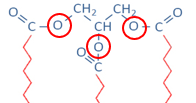
Breakdown in Adipose Tissue: The mobilization of stored fat involves a multi-step enzymatic process:
Enzymatic Cascade:
Triacylglycerol lipase (active): Converts Triacylglycerol into Diacylglycerol (), releasing one fatty acid. Lipase activate by adrenaline and glucagon
DAG lipase: Converts Diacylglycerol into Monoacylglycerol (), releasing a second fatty acid.
MAG lipase: Converts Monoacylglycerol into Glycerol, releasing the third fatty acid.
Transport:
Glycerol: Is water-soluble and diffuses into the bloodstream to all tissues.
Free Fatty Acids: Are hydrophobic and must travel in the plasma bound to the protein albumin. They act as fuels for the muscles, heart, and liver.
Metabolism of Glycerol
Glycerol metabolism varies depending on the tissue and physiological state:
General Uptake: Glycerol is water soluble and taken up by most tissues.
Energy Production: It enter the glycolysis pathway for conversion into pyruvate, which then enters the TCA cycle for oxidation to .
In the Liver (Starvation): In the liver, glycerol enters the glycolysis pathway but is converted to glucose via gluconeogenesis.
Fatty Acid Activation and Coenzyme A
Before fatty acids can be metabolized, they must be activated in the cytosol.
all reactions in the mitochondrial matrix (transport across membrane)
intermediates present as CoA thioesters
biological energy of fatty acid molecules is conserved as the transfer of 2 H atoms to the cofactors NAD+ and FAD to form NADH and FADH2 (no direct ATP synthesis)
series of four enzyme reactions results in removal of two carbon unit as acetyl CoA
Activation Reaction:
Enzyme: Fatty acyl-CoA synthetase.
Process: Long-chain fatty acids are activated by the addition of Coenzyme A ().
Chemical Equation:
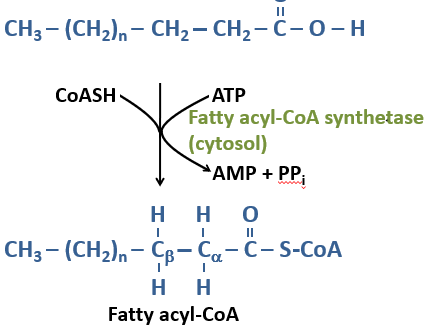
Energy Requirement:
The activation produces from , effectively using one molecule.
However, recreating from requires the hydrolysis of two molecules to :
Therefore, the energetic cost of fat activation is considered to be .
Coenzyme A ():
Composed of a dinucleotide with a vitamin and a sulphur-containing group.
It forms high-energy thioester bonds with carboxylic acids: .
Transport into Mitochondria: The Carnitine Shuttle
Activated fatty acyl-CoA must be transported from the cytosol into the mitochondrial matrix:
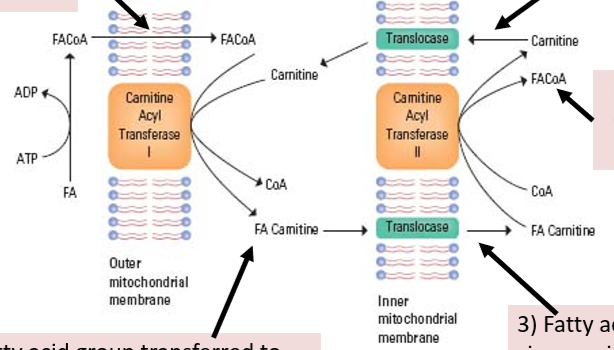
Outer Membrane: Fatty acyl-CoA freely diffuses across the outer mitochondrial membrane.
Conversion: The fatty acid group is transferred to carnitine by the enzyme carnitine acyltransferase I, creating fatty acyl-carnitine.
Translocation: Fatty acyl-carnitine crosses the inner mitochondrial membrane via a specialized translocase.
Reformation: Inside the matrix, carnitine is switched back for by carnitine acyltransferase II, recreating fatty acyl-CoA.
Recycling: Carnitine is transported back into the intermembrane space.
This process is overall energetically neutral.
The -oxidation Pathway
The -oxidation pathway occurs entirely within the mitochondrial matrix. It involves intermediates present as thioesters and results in the removal of two-carbon units.
B-oxidation because the B-carbon undergoes oxidation to produce a carbonyl group (carbon double-bonded to O2)
one round of B-oxidation produces acetyl-CoA and a fatty acyl-CoA that is 2 carbons shorter → 2 carbons carried by acetyl-CoA
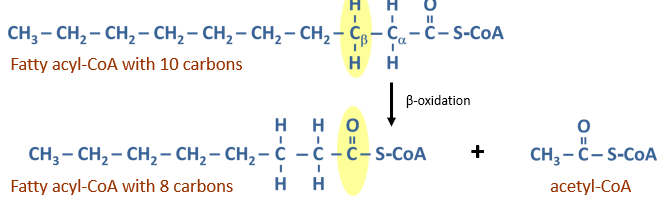
The Four Step Reaction Cycle:
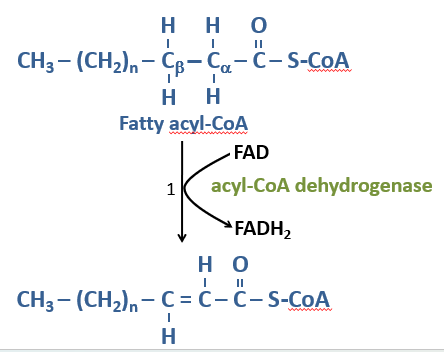
Reaction 1: Removal of 2 H atoms (Oxidation)
Enzyme: Acyl-CoA dehydrogenase.
Cofactor: .
Effect: Formation of a double bond between the and carbons.
Fatty acyl-CoA → Enoyl-CoA
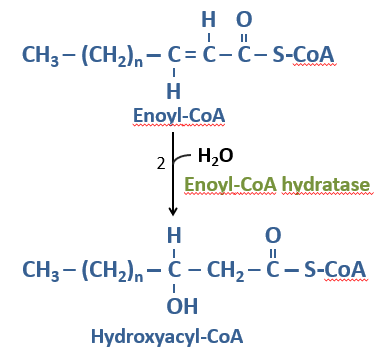
Reaction 2: Addition of water (Hydration)
Enzyme: Enoyl-CoA hydratase.
Reactant: .
Effect: Addition of a hydroxyl group to the carbon, forming Hydroxyacyl-CoA from Enoyl-CoA
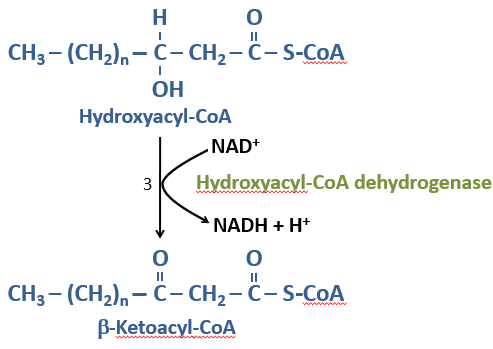
Reaction 3: Removal of 2 H atoms (Oxidation)
Enzyme: Hydroxyacyl-CoA dehydrogenase.
Cofactor: .
Effect: Oxidation of the hydroxyl group on the carbon to a carbonyl group, forming -Ketoacyl-CoA from hydroxyacyl-CoA .
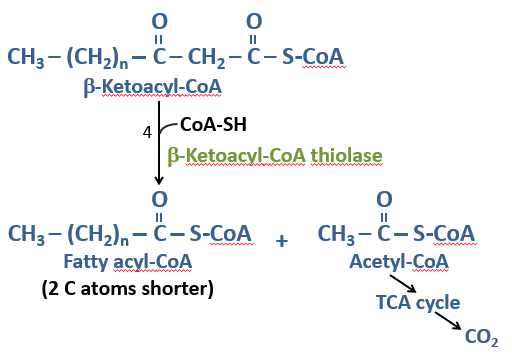
Reaction 4: Cleavage of 2 C units (Thiolysis)
Enzyme: -Ketoacyl-CoA thiolase.
Reactant: .
Effect: Cleavage of the bond to release one Acetyl-CoA ( carbons) and a Fatty acyl-CoA that is carbons shorter.
Note on Metabolism Pattern: This specific sequence (Remove , Add , Remove ) is also seen in the TCA cycle during the conversion of Succinate to Oxaloacetate (via Fumarate and L-Malate).
Summary of B-oxidation:
Activation stage:
addition of CoA
activating enzyme → cytosol
forms fatty acyl-CoA (C16)
travels mitochondrial membranes in the matrix
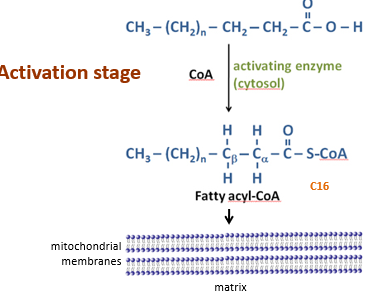
Transport;
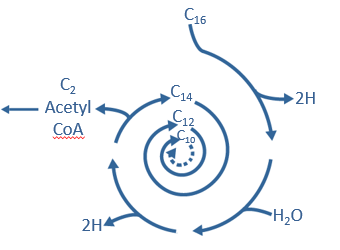
Fatty acid with 16C atoms will pass through 7 repeats of B-oxidation pathway producing 7 NADH and 7 FADH2
Fatty acid with 16C atoms will give rise to 8 acetyl CoA which enter the TCA cycle
Energy Yield from Palmitic Acid (16:0) Oxidation
For the complete oxidation of one molecule of palmitic acid ( carbons):
Activation: .
-oxidation Rounds: rounds are required to split a -carbon chain into Acetyl-CoA units.
.
.
TCA Cycle: turns of the TCA cycle (one for each Acetyl-CoA).
.
.
.
Total Energy Yield: .
Regulation and Special Cases
Regulation Factors:
Hormonal Control: Adrenaline and glucagon activate the lipase enzyme in adipose tissue to release fatty acids.
Mitochondrial Entry: The rate of entry via the carnitine shuttle.
Cofactor Reoxidation: The rate at which and are reoxidized by the Electron Transport Chain ().
Odd-numbered Fatty Acids:
B-Oxidation results in: C15 → C13 → C11 → C9 → C7 → C5 → C3
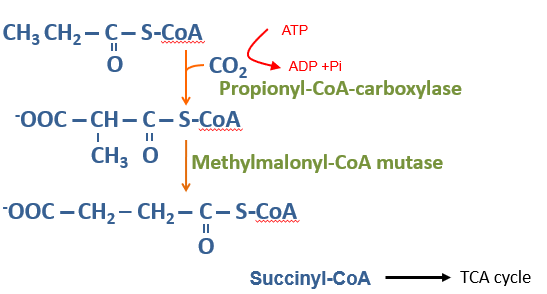
-oxidation proceeds normally until the final three carbons remain as Propionyl-CoA.
Propionyl-CoA is converted to Succinyl-CoA through the following steps:
Propionyl-CoA-carboxylase: Adds (requires ) to form Methylmalonyl-CoA.
Methylmalonyl-CoA mutase: Rearranges the molecule to form Succinyl-CoA, which then enters the TCA cycle.
Ketone Bodies and Ketogenesis
Ketogenesis Conditions:
Occurs when fat metabolism is the primary source of energy, such as in starvation or Type I diabetes.
High levels of fatty acid oxidation in hepatocytes result in concentrations of Acetyl-CoA that exceed the capacity of the TCA cycle.
Formation and Transport:
Excess Acetyl-CoA is converted in the liver into ketone bodies: acetoacetate and -hydroxybutyrate.
These are released into the bloodstream.
Tissue Utilization:
General Tissues: Most cell types convert ketone bodies back into TCA cycle intermediates (acetyl CoA and succinate) for energy.
Liver: Cannot utilize ketone bodies because it lacks the necessary enzymes to break them down.
Brain: Cannot utilize fatty acids directly but can use glucose and ketone bodies as an 'emergency fuel'.
Red Blood Cells: Cannot utilize fatty acids or ketone bodies; they rely solely on glucose due to a lack of mitochondria.", "title": "Energy Release from Fat and Fatty Acid Oxidation"}