Tree of life
How to read an evolutionary tree
The "Great Chain of Being"
Latin: Scala naturae ("the Ladder of Nature")
Concept originated with Ancient Greek philosophers, including Aristotle and Plato
Developed in medieval period
Widely known/accepted until well into 19th century
The Great Chain of Being
"A place for everything and everything in its place"
at the top, God
at the bottom, mud/soil/dirt (or sometimes Hell!)
Everything else arranged in order
Man between animals and angels
Scala Nature—type thinking is still around...
Chapter
Innate Tolerance in the CNS
Part of the series Springer Series in Translational Stroke Research pp 19-35
Date: 08 August 2012
Anoxia Resistance in
Lower and Higher Vertebrates
John W. Thompson, Göran E. Nilsson, Miguel A. Perez-Pinzon
Journal of Biotechnology
Volume 99, Issue 1, 9 October 2002, Pages 1–22
Review
Gene transfer in higher animals: theoretical considerations and key concepts
Kevin R. Smith
What counts as "higher" or "lower"?
Number of genes?
Number of cell types?
Complexity of body plan?
Rate of evolution? (rate of molecular evolution much higher in bacteria than in animals)
What is the dividing line between "higher" and "lower"?
All organisms alive today, from bacteria to plants to humans, have been evolving for exactly the same length of time (~3.5 billion years)!
Alternative to Scala Nature...
- Species not fixed, but can change – one species can transform into another
- idea of evolution (older term = "transmutation")
- No fixed hierarchy – no Great Chain of Being
- Darwin was not the first to suggest that organisms evolve, but he was the first to propose a widely accepted mechanism – natural selection
Charles Darwin’s contributions
- Proposed general evolutionary principles that are still accepted today:
- Mechanism: natural selection → adaptation
- Principle of common descent - all organisms (living and extinct) on Earth are related to each other
“Therefore I should infer from analogy that probably all the organic beings which have ever lived on this earth have descended from some one primordial form, into which life was first breathed” (*On the origin of species*, 1859)
- adaptation + common descent → Descent with Modification = organisms change (evolve) through time
Ernst Haeckel (1834-1919)
- Seven years after On the Origin of Species published, Ernst Haeckel published first reconstruction of the entire Tree of Life (1866)
- Haeckel also coined the term phylogeny for the evolutionary relationships between organisms:
- phyle = tribe or race
- genesis = birth
Ancient Greek ^^^
Importance of understanding the evolutionary tree
to understand our place in matter
frameworks for studying evolutionary patterns and processes
medical uses eg, disease
"Anatomy" of a phylogeny🌳🌳
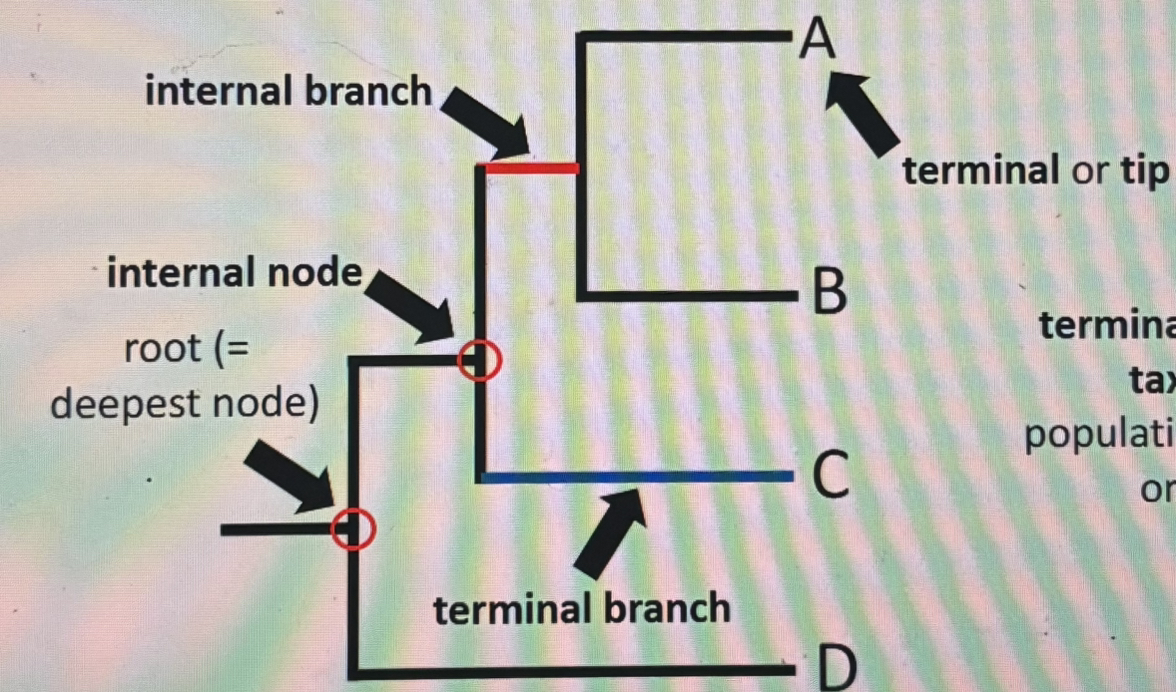
- Terminals or tips can be any taxon: individuals, populations, species, families, orders, phyla, etc.
Phylogenies depict evolutionary relationships
- Unambiguous definition of relatedness:
Taxa (individuals, populations, species, genera, etc.) are more closely related to each other than they are to another taxon (or taxa) if they share a more recent common ancestor
- A phylogeny will tell you how different taxa are related to each other:
- which taxa are more closely related
- which taxa are less closely related
Taxa are more closely related to each other than they are to another taxon (or taxa) if they share a more recent common ancestor
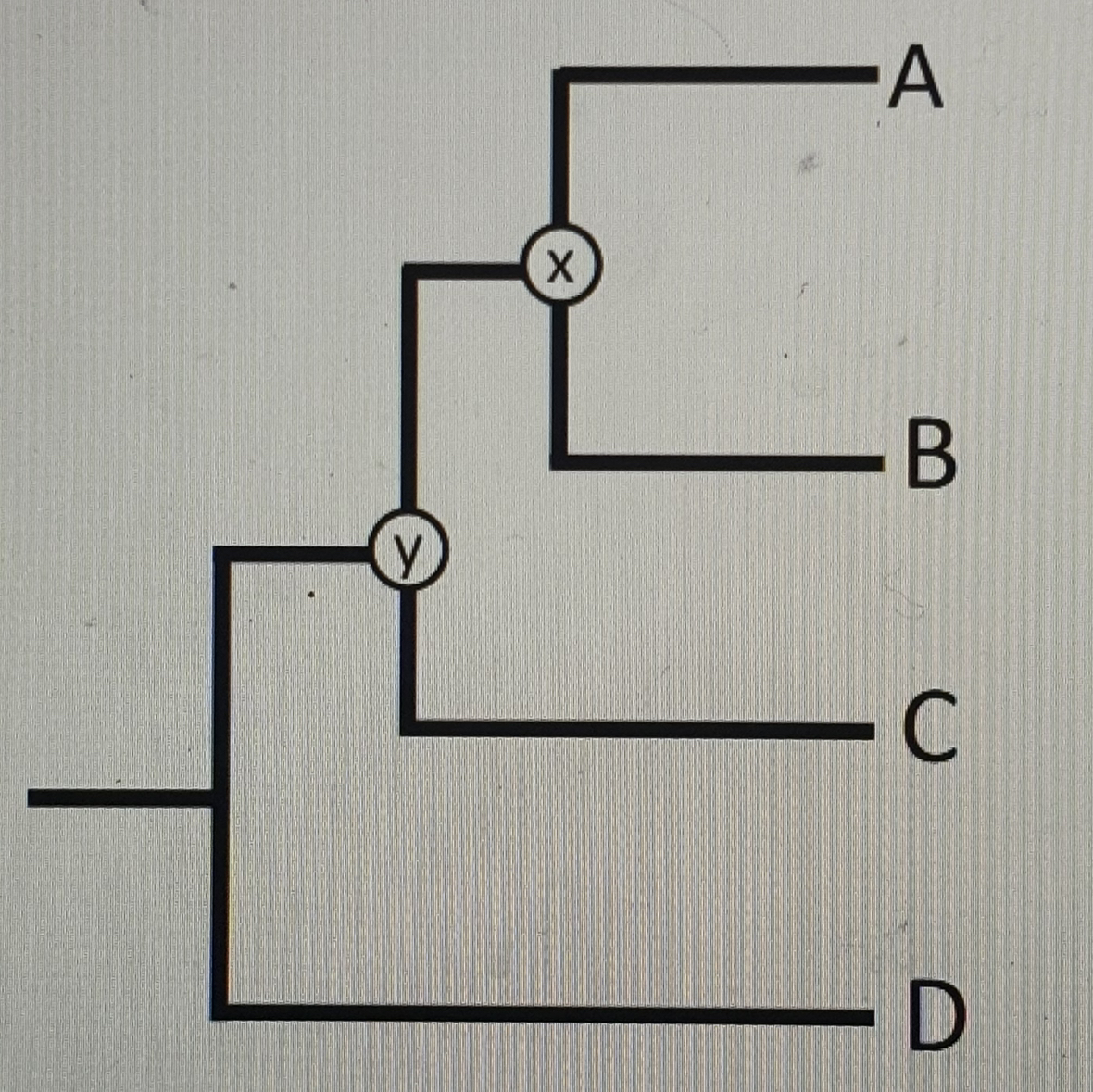
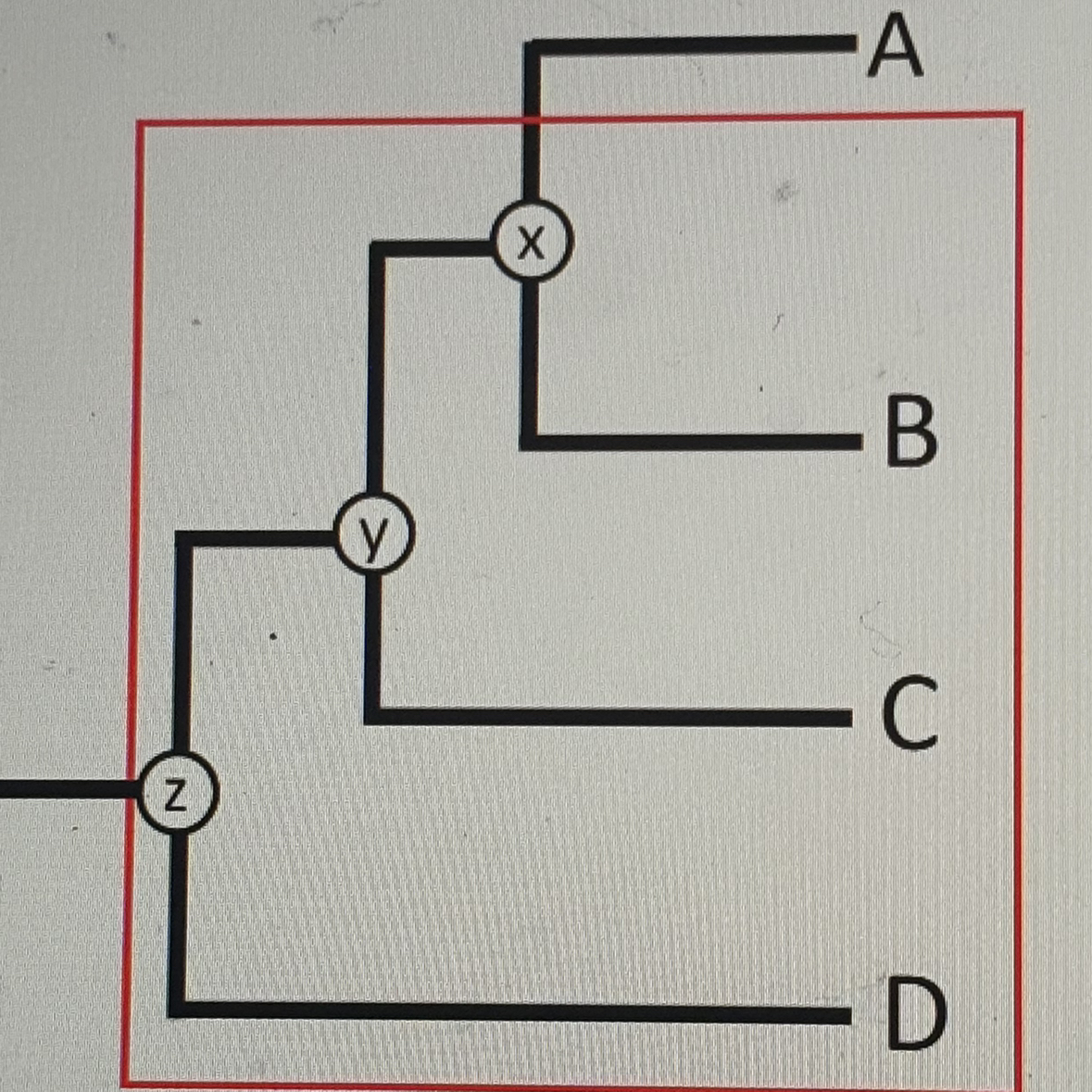
- Nodes in phylogenies represent common ancestors
- A and B are more closely related to each other than to C and D because they share a more recent common ancestor (x)
- A, B, and C are more closely related to each other than to D because they share a more recent common ancestor (y)
- These common ancestors are usually hypothetical – in most cases we can’t say for certain whether or not a particular fossil is an ancestor to a younger taxon
---
———————
What matters is the relationships (= the branching order) shown in the phylogeny
- Trees are like mobiles...
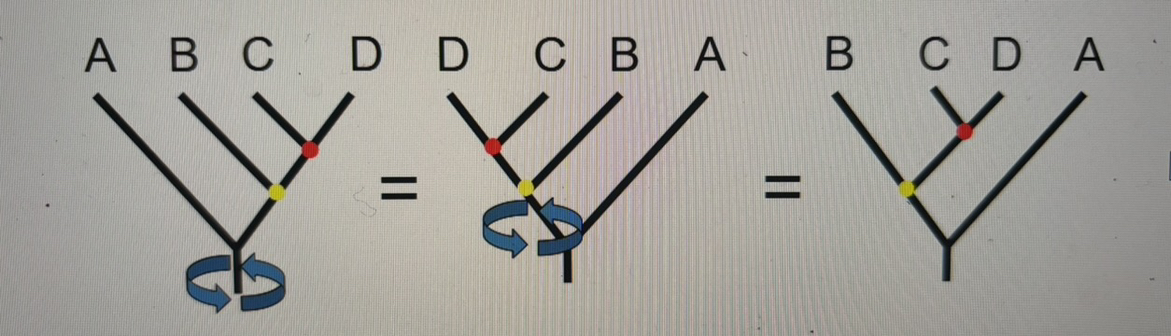
- These three phylogenies show identical relationships
———————-
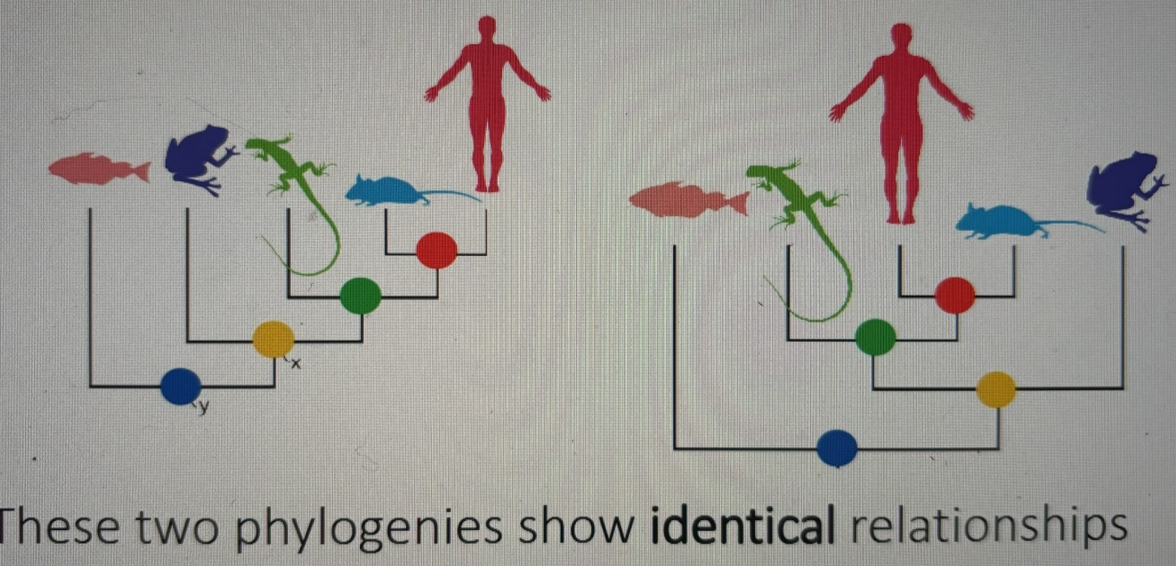
What marters is the Relationships(=the branching order) shown in phylogeny
——————-
Different kinds of groups - monophyletic
- We can use this definition of relatedness to identify and define different kinds of groups
- A monophyletic group (or clade):
- an ancestor and all of its descendants
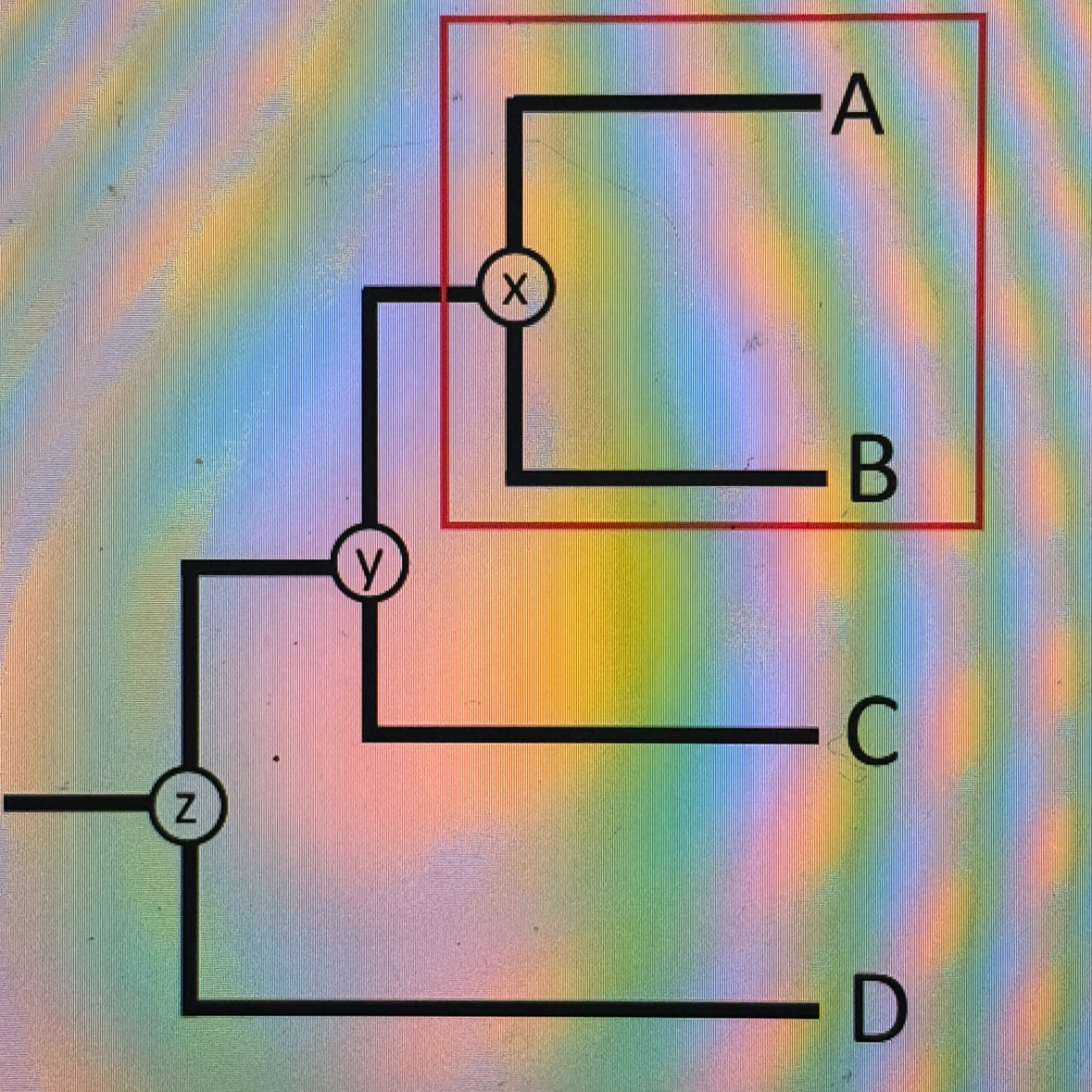
- A + B = a monophyletic group (or clade)^^^
A and B = Clade/ monophyletic
——————
Different kinds of groups - monophyletic
- We can use this definition of relatedness to identify and define different kinds of groups
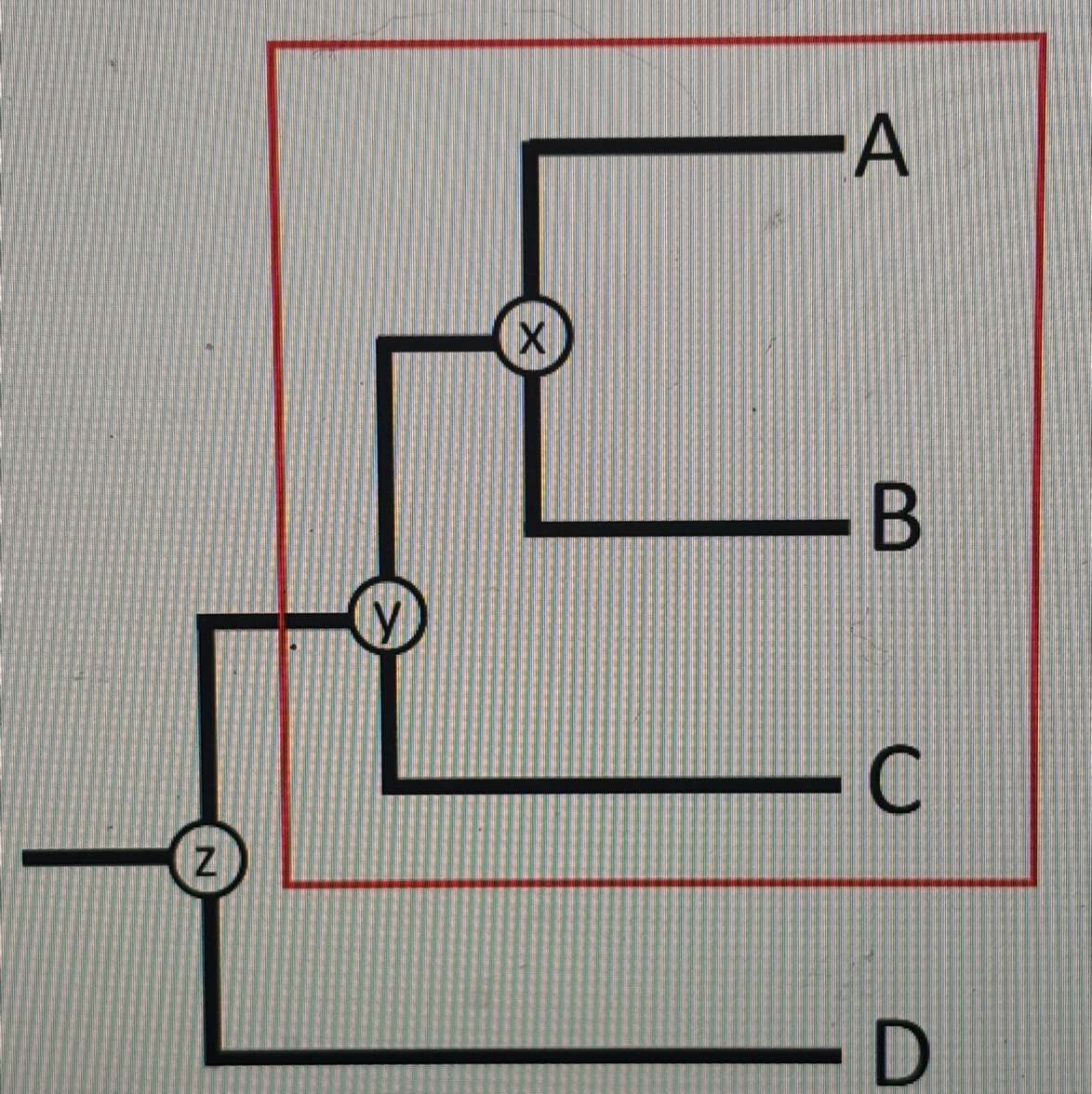
- A monophyletic group (or clade):
- an ancestor and all of its descendants
- A + B = a monophyletic group (or clade)
- A + B + C = a monophyletic group (or clade) ^^^^
————————
Different kinds of groups - monophyletic
- We can use this definition of relatedness to identify and define different kinds of groups
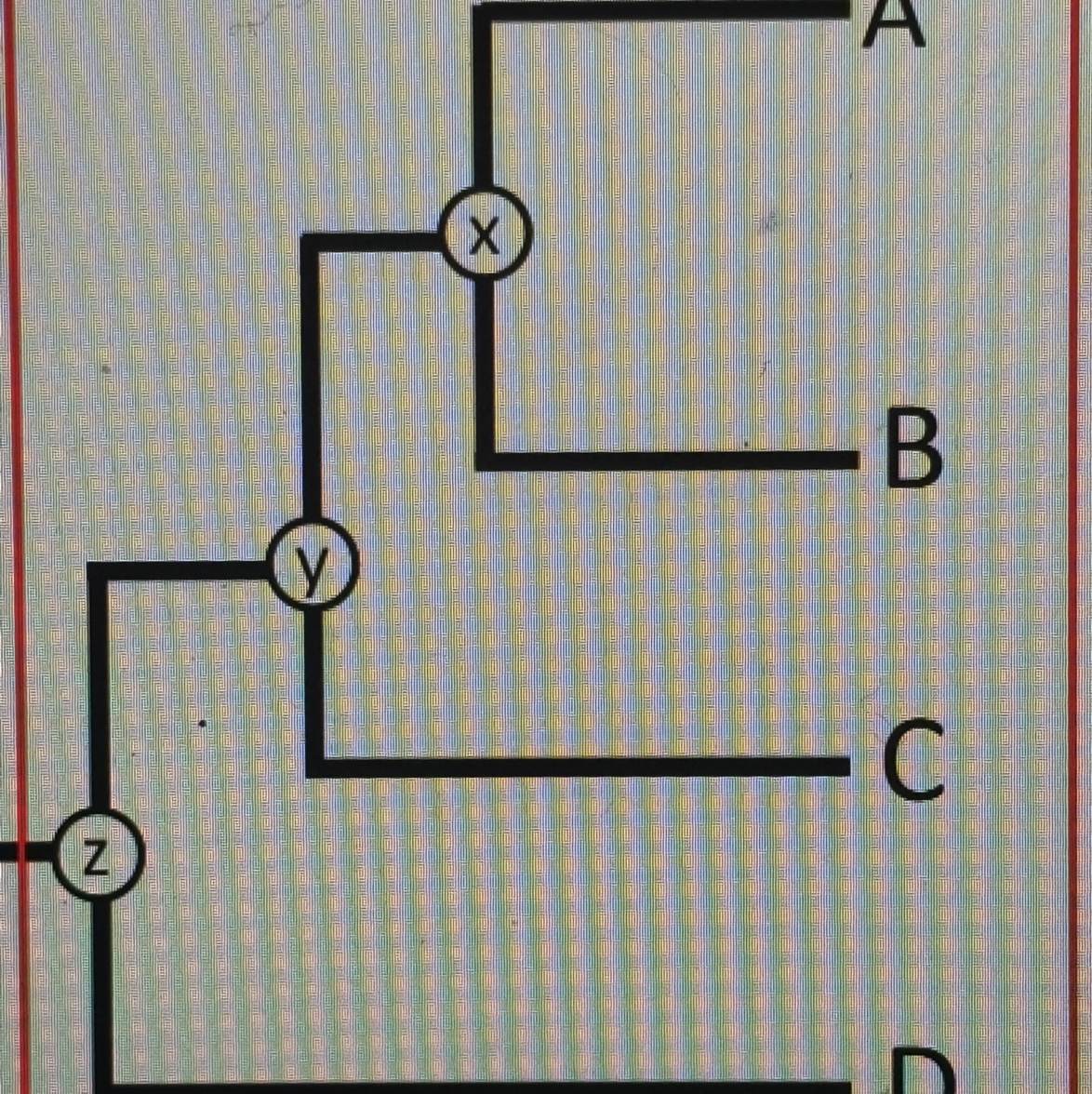
- A monophyletic group (or clade):
- an ancestor and all of its descendants
- A + B = a monophyletic group (or clade)
- A + B + C = a monophyletic group (or clade)
- A + B + C + D = a monophyletic group (or clade)
————————-
Modern systematics is interested in monophyletic groups/clades
- Monophyletic groups/clades are "natural" — they reflect the branching pattern of the Tree of Life
- Increasingly, monophyletic groups/clades are the only groups that are formally recognized and named
——————
Sister-groups or sister-taxa
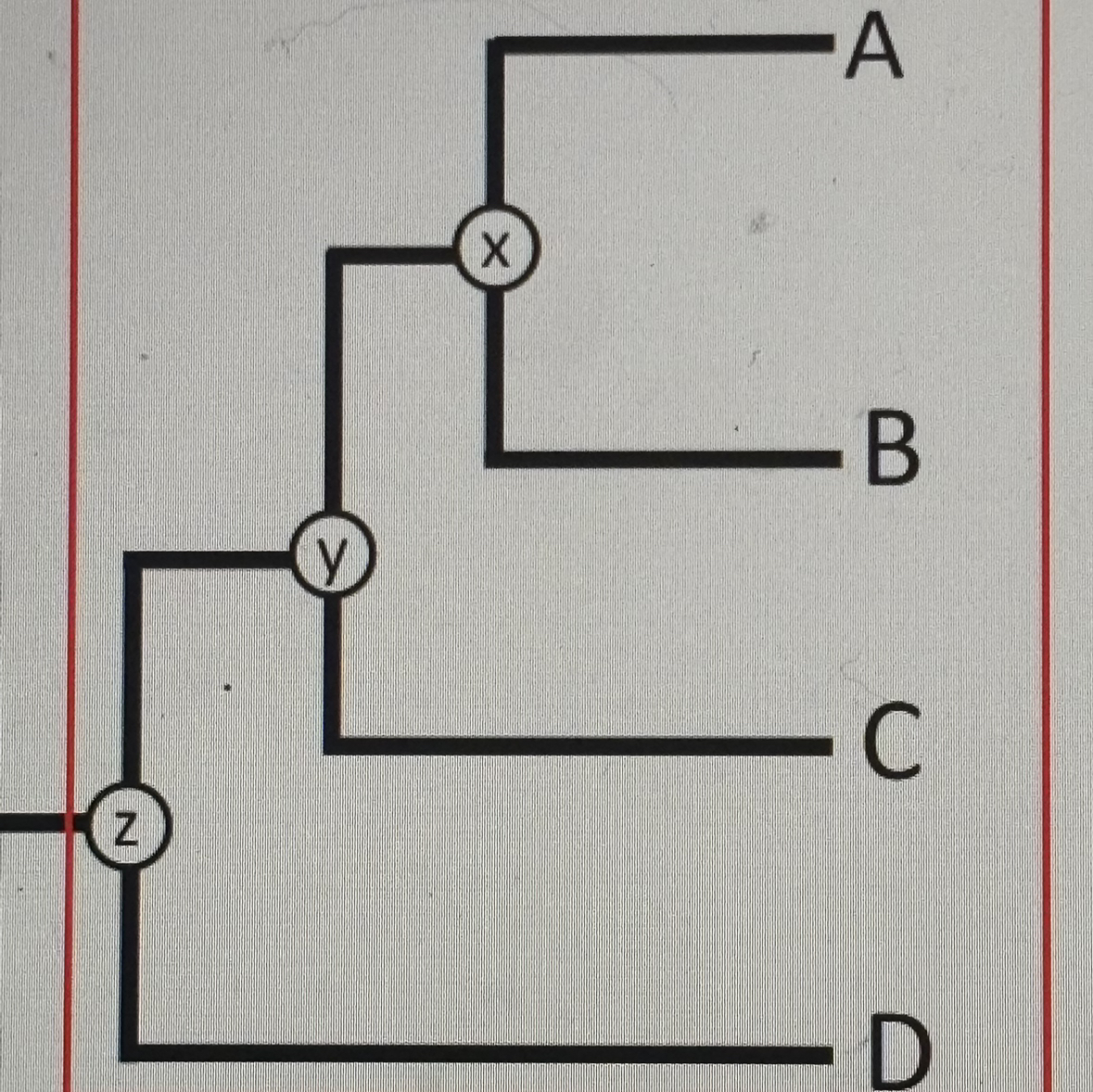
- Sister-group or sister-taxon = closest relative of a particular taxon or clade
- A and B are sister-taxa
- (A + B) and C are sister-taxa
- (A + B + C) and D are sister-taxa
Different kinds of groups - paraphyletic
- We can use this definition of relatedness to identify and define different kinds of groups
- A paraphyletic group:
- an ancestor but only some of its descendants
Different kinds of groups - paraphyletic
- We can use this definition of relatedness to identify and define different kinds of groups
- A paraphyletic group:
- an ancestor but only some of its descendants
- B + C = a paraphyletic group
- C + B + D = a paraphyletic group
- In both cases, we have left out a descendant, A
—————————
Paraphyletic groups are usually when a taxon (or taxa) is left out because it is considered “special” or “distinctive” in some way
- "Invertebrates" = animals minus vertebrates (or chordates)
- common ancestor of animals
Paraphyletic groups are usually when a taxon (or taxa) is left out because it is considered “special” or “distinctive” in some way.
Crustacea = Pancrustacea minus hexapods
Paraphyletic groups are usually when a taxon (or taxa) is left out because it is considered “special” or “distinctive” in some way.
- “Reptiles” = amniotes minus mammals and birds
The problem with paraphyletic groups
- Not "natural" — they don't reflect the branching pattern of the Tree of Life
- What counts as "distinctive"?
- Why exclude birds from reptiles, but not whales from mammals?
- Problem of taxa that appear intermediate or transitional
- Are feathered dinosaurs "reptiles" or birds?
The problem with paraphyletic groups
- They can inhibit our understanding of evolutionary history
- This "fish" (a lungfish)... is much more closely related to than this "fish" (a salmon)
The problem with paraphyletic groups
- If we want to understand the evolution of a particular group, then we need to know what its closest relatives are — paraphyletic groups don’t help with this
- “Protists” = single-celled eukaryotes — paraphyletic — excludes multicellular animals, plants, and fungi
- Different “protists” more closely related to animals, plants, and fungi
Images and labels:
- Chanoanflagellate “protist” — close relative of animals
- Algal “protist” — close relative of plants
- Microsporidian “protist” — close relative of fungi
Paraphyletic groups are not formally recognised in modern systematics
- Using the definition of relatedness to identify and define different kinds of groups.
- A polyphyletic group consists of descendants of different common ancestors.
- A+D is an example of a polyphyletic group.
- Polyphyletic groups are not formally recognized in modern systematics.
Summary – three kinds of groups
- MONOPHYLETIC GROUP or CLADE – a particular common ancestor and all of its descendants
- PARAPHYLETIC GROUP – a particular common ancestor but only some of its descendants
- POLYPHYLETIC GROUP – descendants of different common ancestors