3.2 The Seven Years' War
LEARNING OBJECTIVE: Explain the causes and effects of the Seven Years’ War (also known as the French and Indian war).
INTRODUCTION
Historic European rivalries had been brought to the Americas (Britian, France, Spain)
Basis for conflict was found in Europe
- Disputes between European countries in their colonies served to intensify their differences.
- Britian triumphed in a series of wars —→ the eventual rebellion and loss of their 13 colonies in America.
EMPIRES AT WAR, 1689-1763
Series of wars broke out (involved Britian, France, Spain, Natives, and Other European countries)
Stakes for power, control of colonies, and trade were high
- Sugar-producing islands in the Carribean sea and fur trading networks were valuable posessions—→
- Battles broke out across Europe, India, and North America.
THE FIRST THREE WARS
The first three wars occured between 1689 and 1748 (were named after the British monarch the occured under)
King William’s War (1689-1697)
-British Launced unsuccessful missions to capture Quebec from France.
- American Indians sided with French and burned British frontier settlements.
Queen Anne’s War (1702-1713)
- British gained Nova Scotia from France and trading rights from Spanish America.
King George’s War (1744-1748)
Georgia’s colonial army, led by James Oglethorpe, repulsed Spanish attacks and New Englanders captured Louisburg (major French fortress that controlled access to st. Lawrence River)
- Britain returned Louisburg to French in echanged for political and economic gains in India—→ Furious New Englanders (thought their hard work in capturing the fortress was wasted).
THE DECISIVE CONFLICT
European powers saw little value in commiting regular troops in America (relied on amature colonist for protection)
When the 4th/decisive war began, conditions on how Britian viewed America changed
Great Britian and France recognized the values of colonies for their raw materials.
French Colonies has a small population, but worked with Natives to carry out valuable fur trade
British colonies had a bigger population, and produced: grain, fish, tobacco, lumber, and other products that fuled British industry.
Final conflict is known as the 7 Years’ War/ French and Indian War.
BEGINNING OF WAR
French built a chain of forts in the Ohio River Valley (provoked British and halted westward growth of British colonies)
Virginia governer sent a small militia led by George Washington to stop French from winning control over territory
- Washinton won small victory, but eventually surrendered to superior French and Indian forces
- This encounter marked final war for empire.
Another expedition from Virginia, led by General Edward Braddock, ended in disastrous defear
-2,000 British regulars and colonial troops were routed by smaller French and Native troops.
- Algonquin allies of French ravaged the frontier of western Pennslyvania to North Carolina
- French also repulsed a British invasion of French Canada.
THE ALBANY PLAN OF UNION
Need for coordinating colonial defense —→ British gov called for colony representatives to meet at Alabany, New York (1754)
Delegates from 7 colonies adoped an agreement called the Albany Plan of Union (developed by Benjamin Franklin)
- Provided an intercolonial government and system for recruiting troops and collecting taxes from various colonies for common defense.
- Was not passed due to colonies concerned about preserving taxation powers
- Alabany congress set precedent for later, more revolutionary, congresses in the 1770’s
BRITISH VICTORY
British prime minister concenrated gov’s militray strategy on conquering Canda
Strategy was accomplished by the retaking of Louisburg (1758), surrender of Quebec to James Wolfe (1759), and taking of Montreal (1760)
British victories —→ European powers negotiating peace treaty (Peace of Paris)
Great Britain aquired both French, Canada, and Spanish Florida
- In compensation for Spain’s loss, France ceded to Spain Lousiana (huge territory west of Mississipi River)
- British extended their control of North America, and French power on the continent virtually ended
IMMEDITATE EFFECTS OF THE WAR
Britain’s victory in the 7 Years’ War was a turning point in militray and diplomatic conflict for control of North America among European countries, colonies, and Natives.
Gave Britian unchallenged supremacy among European in North America
Challenged autonomy of many American Indians
Established British as dominant naval power in the world
American colonies no longer faced the threat of attacks from French, Spanish, or American Indians.
Change in how colonies and colonist viewed each other***
THE BRITISH VIEW OF THE WAR
British had a low opinion on colonial military abilities (thought they were poorly trained and disorderly).
Noted that some colonies refused to contribute to either troops or money in the war effort.
Convinced that colonist were unable and unwilling to defend the new frontiers of an expanded British empire.
THE COLONIAL VIEW OF THE WAR
Colonist were proud of their record in all four wars, and developed confidence that they could successfully provide for their own defense.
They were not impressed by British troops or leaderships (their methods of warfare were badly suited to the geography of eastern America).
REORGANIZATION OF THE BRITISH EMPIRE
More serious than resentful feelings caused by the war experience was the British gov’s shift in colonial policies.
Britian had excercised little direct control over colonies
- earlier policy of salutary neglect was abandonded
British adopted more forceful policies for taking control of their expanded territory.
- Britian felt the need to maintain large British military force to guard it’s American frontiers.
- King George III and Parliament wanted American colonies to bear the cost of maintaining the British empires, without having to increase taxes in Britian
- Among British landownders, pressure was building to reduce heavy taxes (that were levied to pay for colonial wars)
PONTIAC’S REBELLION
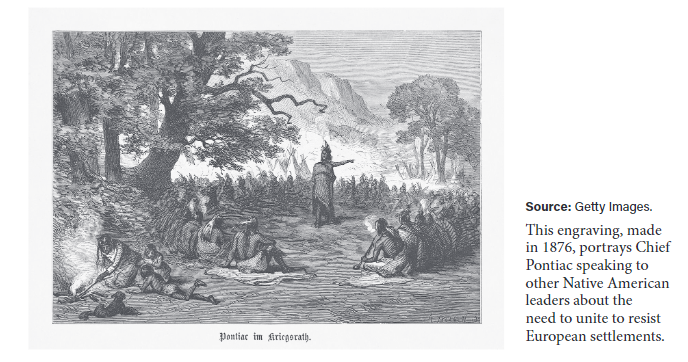
Chief Pontiac led an attack against colonial settlements on the western frontier (first major test of new British imperial policy).
American Indians were angered by the growing westward movement of European settlers, and British refusal to offer gifts as the French had done.
- Pontiac’s alliance with Natives from the Ohio River Valley destroyed forts and settlements from New York to Virginia.
- British sent regular troops instead of colonial troops to stop uprising.
PROCLAMATION OF 1763
British government issued Proclamation of 1763 in an effort to stabalize western frontier
Proclamation prevented colonist from settling west of Appalachian Mountains
- British hoped that limiting settlement would prevent future warfare between colonist and Natives—→ angry and defiant colonist (wanted to reap benefits of access to new land from the 7 Years’ War)
- Colonist ignored the proclamation, defying the British and continuted to move westward past the boundary line.
GROWING BRITISH-COLONIAL TENSIONS
Divergent views on war and changes of British imperial polices provided context conflict between Britian and North American colonies
Become more intense as debates on taxation and representation arise.