3.1 Torque
Torque
- a force that causes an object to rotate → turning or twisting force
- ⬆️ torque means it requires less effort, or less force to do something (e.g. pushing a door open)
- tau (𝛕) measured in newton-metres (N m or N·m)
- AKA moment of a force
- unlike linear, doesn’t produce translational motion (Δx, Δy, Δz) but instead rotational motion (Δθ)
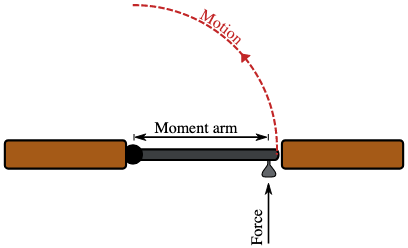
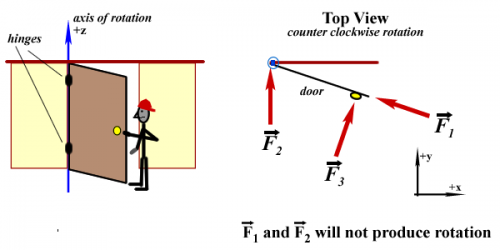
Torque terminology
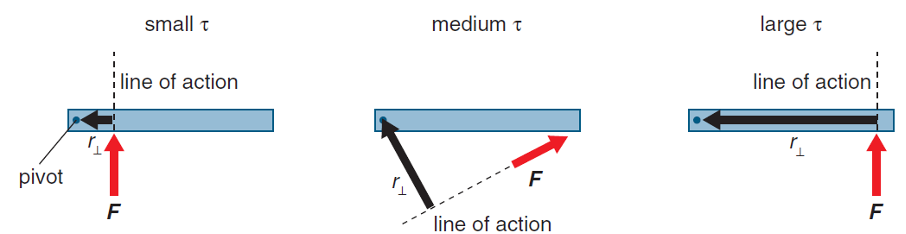
- axis of rotation (pivot, pivot point, fulcrum): the line around which an object rotates (e.g. line formed by a door hinge, a wheels axle)
- radius (r): the position vector from the pivot to the point where the force is being applied
- line of action: an imaginary line extending out both ends of the force vector
- perpendicular distance (AKA force arm) (r⟂ or d): shortest distance between pivot point and line of action
- lever arm/moment arm: roughly equivalent to r, like it’s the actual physical ‘arm’ of a lever - we DON’T say it is perpendicular distance
Determining torque
- magnitude (size) of torque is affected by 3 factors:
- the size of the applied force: ⬆️ force = ⬆️ torque
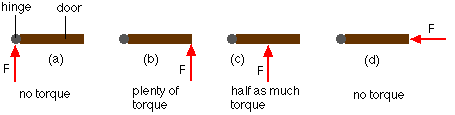
- the perpendicular distance: ⬆️ distance = ⬆️ torque
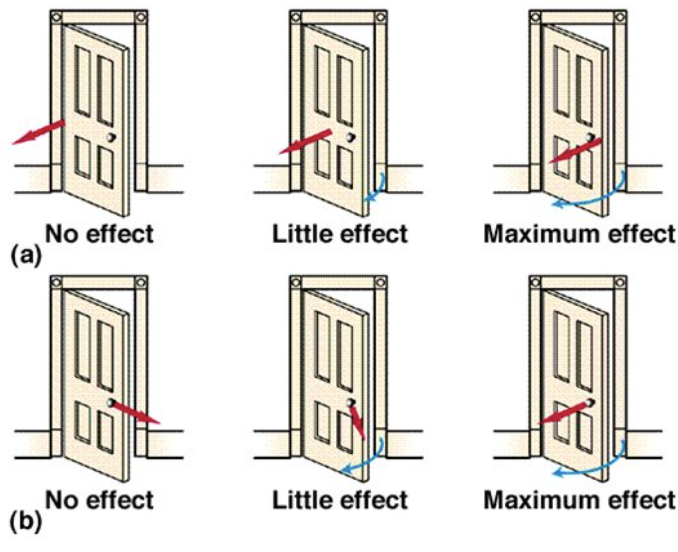
- the angle between the applied force and lever arm (𝜃 sometimes ɸ): ⬆️ sinθ = ⬆️ torque
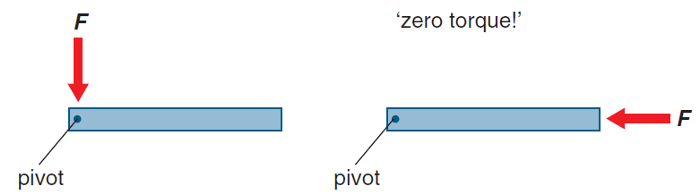
- this is why F pushing directly towards the pivot/centre of mass (180°) or pulling directly away from it (0°) has no torque and why 90° = max torque