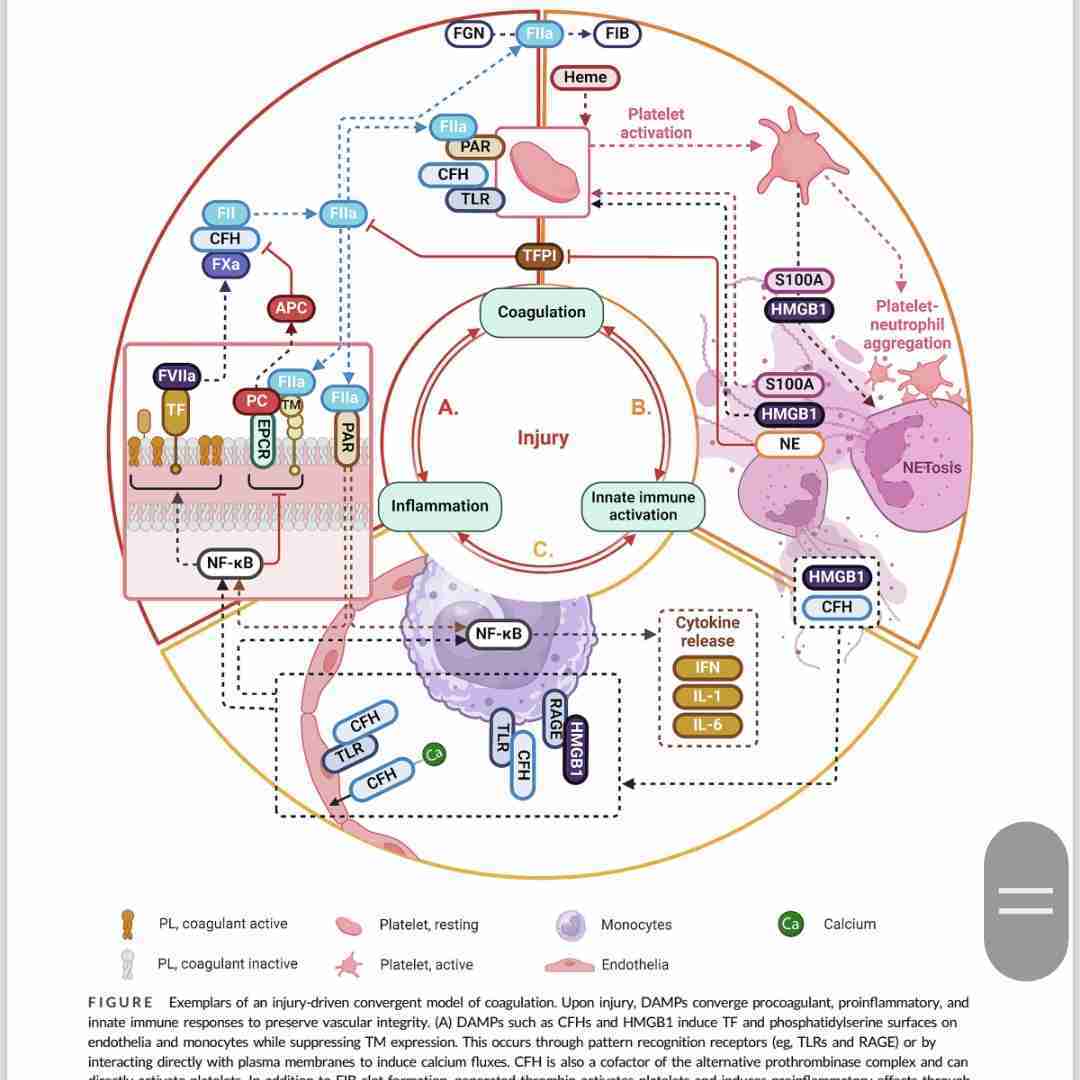
Convergence model of coagulation
Page 1
Submission Details
Received: 15 January 2024
Revised: 18 April 2024
Accepted: 10 May 2024
DOI: https://doi.org/10.1016/j.jtha.2024.05.014
Authors and Affiliations
Jun Yong
Department of Clinical Infection, Microbiology and Immunology, University of Liverpool, UK
Cheng-Hock Toh
Department of Clinical Infection, Microbiology and Immunology, University of Liverpool, UK
The Roald Dahl Haemostasis and Thrombosis Centre, Liverpool University Hospitals NHS Foundation Trust, UK
Correspondence
Cheng-Hock Toh
Contact Details: Department of Clinical Infection, Microbiology and Immunology,Ronald Ross Building, 8 West Derby St, Liverpool, L69 7BE, UK
Email: c.h.toh@liverpool.ac.uk
Funding Acknowledgement
Liverpool University Hospitals NHS Foundation Trust (LUHFT)
British Heart Foundation (BHF)
PG/14/19/30751 and PG/16/65/32313
Department of Health and Social Care (DHSC)
Supported by the National Institute for Health Research (NIHR)
NIHR135073
Abstract
Increasingly recognized interplay between coagulation and innate immunity (immunothrombosis).
Proposes a convergent model of coagulation, linking inflammation and innate immunity in response to vascular injury.
Damage-associated molecular patterns (DAMPs) play a crucial role in wound healing and clot resolution.
Aims to develop novel diagnostics and therapeutics addressing medical challenges, including COVID-19 and vaccine-induced thrombotic conditions.
Keywords
coagulation, damage-associated molecular patterns, histones, innate immunity, neutrophil extracellular traps, thrombin
Page 2
Convergent Model of Coagulation
Describes coagulation as inseparable from innate immune and inflammatory responses to injury.
Evolutionary coevolution of hemostatic, immune, and inflammatory responses rooted in a common ancestral response.
Key Interactions
Crosstalk examples:
Induction of monocytic tissue factor (TF) expression by IL-1 and type 1 IFN.
α-thrombin triggering inflammation through protease-activated receptors (PARs).
Anti-inflammatory effects of activated protein C (APC).
Role of DAMPs
DAMPs recognized as critical in inflammation and innate immune responses.
Examples include cell-free histones, nucleic acids, HMGB1, and calprotectin.
Modulate coagulation enzyme kinetics and platelet surfaces, enhancing clot formation and potentially inhibiting clot resolution.
Page 3
Mechanisms of Coagulation and Inflammation
Procoagulant mechanisms of DAMPs can be explained within the cell-based model (CBM) framework.
Initiation phase can be triggered by CFH and HMGB1.
Amplification of thrombin spark involving platelet-von Willebrand factor axis activation.
Interaction of NETs (Neutrophil Extracellular Traps)
NETs contribute significantly to clot formation by enhancing thrombin generation and promoting platelet activation.
Interaction examples include platelet-derived DAMPs activating neutrophils and influencing clot stability.
Page 4
Illustrative Model
DAMPs facilitate complex interactions enhancing coagulation and inflammatory responses.
Consequences of Injury
Upon injury, DAMPs induce TF and phosphatidylserine exposure on cell surfaces, enhancing procoagulant activity.
Reciprocally, activated platelets enhance neutrophil recruitment through DAMP release.
Page 5
Relevance of the Convergent Model
Highlights coagulation's role in responses to infections, including COVID-19 and sepsis-associated coagulopathy.
Past research emphasized the importance of anticoagulant proteins during sepsis, exploring therapeutic options.
Challenges
Recent therapeutic failures suggest a need for deeper understanding of coagulation dynamics during critical illness.
The risks of bleeding and coagulation complications must be balanced with emerging therapeutic strategies.
Page 6
Future Directions
Recognition of DAMPs in driving thrombotic risks leads to proposals for new therapeutic approaches across specialties.
The integration of innovative therapeutic strategies is needed to address complex coagulation syndromes.
Page 7
Conclusion
The convergent model integrates current knowledge on coagulation emphasizing its relationship with inflammation and immune response.
Further interdisciplinary research is essential for developing new diagnostics and treatments for coagulation disorders.