Cell Components
Cell Membrane: A protective barrier that regulates what enters and exits the cell.
Cytoplasm: A jelly-like substance that fills the cell and holds organelles in place.
Nucleus: The control center of the cell that contains genetic material.
Cells are the basic structural and functional units of all living organisms. They are often referred to as the building blocks of life. Cells perform various essential functions that are necessary for the survival and reproduction of organisms, including:
Metabolism: The biochemical processes that occur within cells, involving energy production and substance transformation.
Growth and Development: Cells are responsible for the growth of organisms through cell division and differentiation.
Reproduction: Cells can divide to produce new cells, which is essential for both organismal growth and repair.
Response to Stimuli: Cells can react to environmental changes, helping organisms adapt and survive.
Homeostasis: Cells maintain stable internal conditions despite external changes, ensuring proper function.
Cells can be classified into two main types: prokaryotic (simple cells without a nucleus, such as bacteria) and eukaryotic (more complex cells with a nucleus and organelles, such as plant and animal cells).
Plant Cells:
Cell Wall: A rigid structure made of cellulose that provides protection and support, allowing the plant to maintain its shape and withstand osmotic pressure.
Chloroplasts: Organelles containing chlorophyll that enable the process of photosynthesis, converting sunlight, water, and carbon dioxide into glucose and oxygen.
Vacuole: A large central vacuole that occupies most of the cell's interior, storing water, nutrients, waste products, and providing turgor pressure to keep the plant upright.
Shape: Generally have a fixed, rectangular shape due to the cell wall.
Animal Cells:
Plasma Membrane: A flexible, semi-permeable membrane that controls the movement of substances in and out of the cell and allows for shape changes.
Organelles: Lack chloroplasts, as animal cells do not perform photosynthesis. They rely on mitochondria to produce energy through cellular respiration.
Vacuoles: Small, often numerous vacuoles utilized for storage and transport.
Lysosomes: Organelles containing digestive enzymes that break down waste materials and cellular debris.
Shape: Typically irregular or varied shapes, adapting to the function and type of tissue they compose.
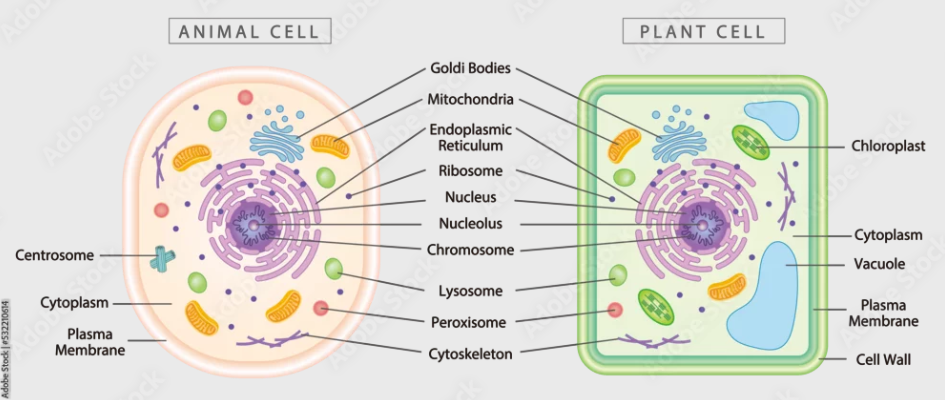
Plant Cell Components:
Cell Wall: Rigid structure made of cellulose for support and protection.
Cell Membrane: Semi-permeable layer regulating substance entry and exit.
Cytoplasm: Jelly-like medium where organelles are suspended.
Nucleus: Contains genetic material (DNA) and controls cell activities.
Nucleolus: A dense region within the nucleus responsible for ribosome production.
Chloroplasts: Sites for photosynthesis; contain chlorophyll to capture light energy.
Vacuole: Large central sac that maintains turgor pressure and stores materials, including water, nutrients, and waste.
Mitochondria: Energy-producing organelles, generating ATP through cellular respiration.
Ribosomes: Sites of protein synthesis, found both in the cytoplasm and on the rough endoplasmic reticulum (ER).
Endoplasmic Reticulum (ER): Network of membranes involved in protein (rough ER) and lipid (smooth ER) synthesis.
Golgi Apparatus: Modifies, sorts, and packages proteins and lipids for secretion or use within the cell.
Plastids: Organelles involved in synthesis and storage of food (includes chloroplasts).
Animal Cell Components:
Plasma Membrane: Flexible membrane controlling the passage of materials into and out of the cell.
Cytoplasm: A viscous fluid containing cell organelles, where metabolic processes occur.
Nucleus: Contains genetic information (DNA) and directs cellular functions and activities.
Nucleolus: Region within the nucleus involved in assembling ribosomes.
Mitochondria: Powerhouse of the cell generating ATP through cellular respiration.
Lysosomes: Organelles containing digestive enzymes that help break down waste materials and cellular debris.
Vacuoles: Smaller storage units for various substances, such as nutrients and waste. They are often more numerous than in plant cells.
Ribosomes: Sites of protein synthesis, found freely in the cytoplasm or attached to the rough ER.
Endoplasmic Reticulum (ER): Includes rough ER (with ribosomes for protein synthesis) and smooth ER (involved in lipid synthesis and detoxification processes).
Golgi Apparatus: Modifies and packages proteins and lipids for transport to various destinations.
Centrioles: Structures involved in organizing microtubules during cell division, important for forming the spindle fibers.
Cytoskeleton: Network of fibers that help maintain cell shape and facilitate movement within the cell.
Labeled Diagram:
The cell wall is a rigid structure that encases the cell membrane in various organisms, including plants, fungi, bacteria, and some protists. Its primary role is to provide structural support, shape, and protection to the cell. Here are the detailed components and characteristics of the cell wall:
Cellulose (in Plant Cells):
Composed of long chains of glucose molecules linked by beta-1,4-glycosidic bonds.
Provides tensile strength and rigidity, preventing cell lysis due to turgor pressure.
Forms a primary cell wall during growth, which may be strengthened by a secondary wall in mature cells.
Pectin:
A polysaccharide rich in galacturonic acid.
Found primarily in the primary cell wall, it acts as a sticky element helping to bind cells together and provide flexibility during growth.
Important in the middle lamella, the layer between plant cell walls that aids in adhesion.
Lignin (in Secondary Cell Walls):
A complex organic polymer that provides additional support and waterproofing to cell walls of woody plants.
Often deposited in the secondary cell wall, it reinforces the structure and allows for greater height and support in terrestrial plants.
Chitin (in Fungi):
A long-chain polymer of N-acetylglucosamine, similar to cellulose in structure but with nitrogen-containing groups.
Provides structural support in the cell walls of fungi, making them rigid and resistant to physical stress.
Peptidoglycan (in Bacteria):
A mesh-like polymer composed of sugars and amino acids, forming a rigid layer outside the plasma membrane.
Provides strength to bacterial cell walls, maintaining cell shape and protecting against osmotic pressure changes.
Variation in peptidoglycan thickness distinguishes Gram-positive (thick layer) and Gram-negative (thin layer) bacteria, affecting their response to antibiotics.
Overall, the composition and structure of cell walls vary significantly between different organisms, adapting to their specific environmental and physiological needs, which is crucial for their survival and function.
The cell wall is a rigid structure that encases the cell membrane in various organisms, including plants, fungi, bacteria, and some protists. Its primary role is to provide structural support, maintain cell shape, and protect the cell from physical stress. Although the cell wall is rigid, it is also permeable, allowing certain substances to pass through while maintaining the integrity of the cell. The composition of cell walls varies among different organisms:
In plant cells, the cell wall is primarily made of cellulose, providing tensile strength and rigidity while allowing water, nutrients, and other small molecules to pass through.
In fungi, the wall is made of chitin, offering structural support and permeability features that allow for gas exchange and nutrient absorption.
In bacteria, peptidoglycan forms a mesh-like layer that reinforces the cell wall, influencing the bacterium's shape and resistance to environmental changes. This layer permits the passage of some molecules while protecting against osmotic pressure fluctuations.
The cell wall's characteristics, including its permeability, are crucial for the survival and function of these organisms.
The cell membrane, also known as the plasma membrane, is a protective barrier that regulates what enters and exits the cell. It is a semi-permeable structure primarily composed of a phospholipid bilayer, which allows certain molecules to pass while restricting others. Key features of the cell membrane include:
Fluid Mosaic Model: Describes the cell membrane as a dynamic structure with proteins embedded within or attached to the phospholipid bilayer, enabling movement and flexibility.
Selective Permeability: The membrane controls the passage of ions, nutrients, and waste, allowing the cell to maintain homeostasis. It selectively allows small, nonpolar molecules to diffuse easily while larger or charged molecules require transport proteins.
Membrane Proteins: Integral and peripheral proteins serve various functions including transport, signaling, and structural support.
Receptors: The cell membrane contains receptor proteins that allow the cell to receive signals from the environment, facilitating communication and responses to external changes.
Cholesterol: Molecules of cholesterol are interspersed within the bilayer which help maintain fluidity and stability, particularly in varying temperature conditions.
Overall, the cell membrane is vital for protecting the cell, facilitating communication, and maintaining the proper balance of substances within and outside the cell.