AP Calculus BC: Composite, Implicit, and Inverse Derivatives
Unit 3: Differentiation involving Composite, Implicit, and Inverse Functions
This unit moves beyond basic differentiation rules (Power, Product, Quotient) to handle more complex function relationships. Mastery of the Chain Rule is the prerequisite for everything else in this unit. In AP Calculus BC, you are expected to apply these concepts to find first and second derivatives of implicit relations and inverse trigonometric functions.
1. The Chain Rule (Topic 3.1)
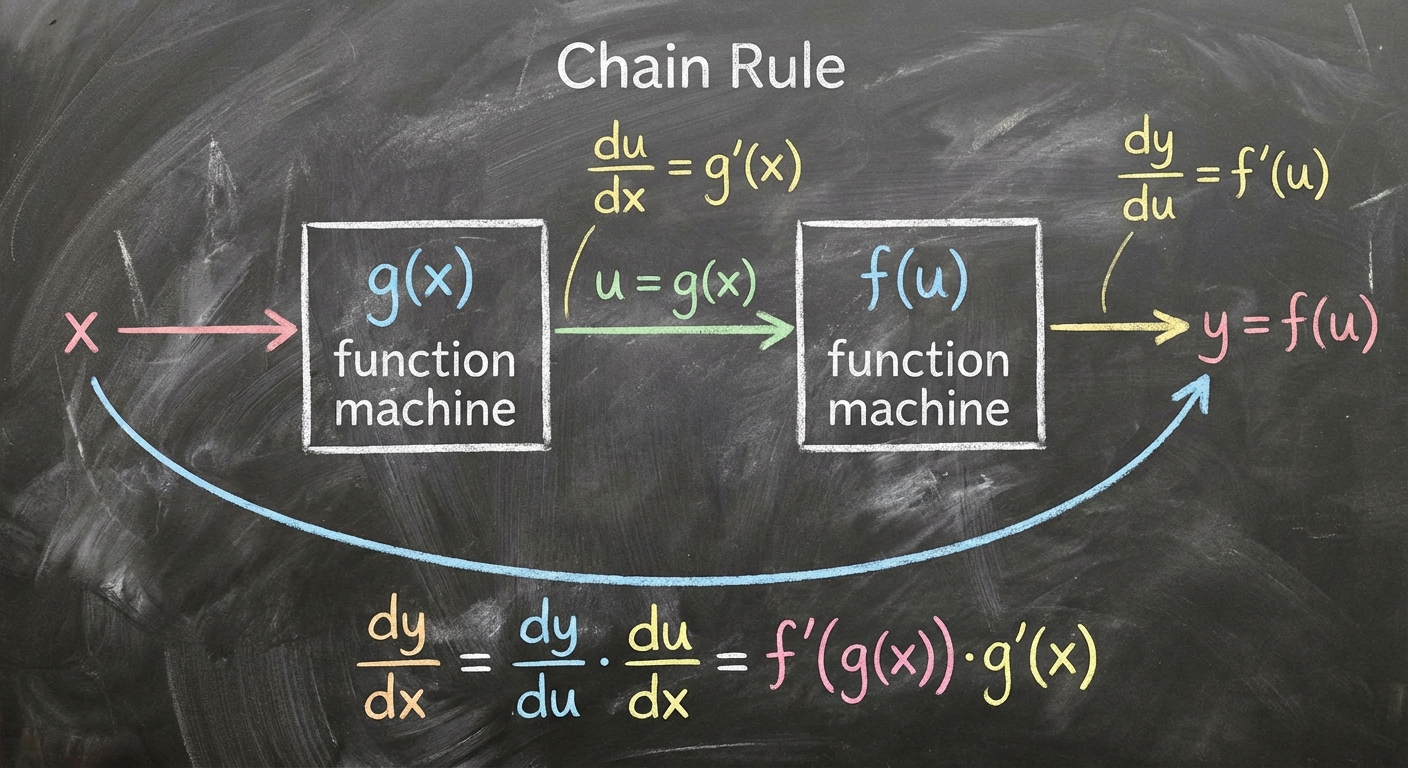
The Chain Rule is the tool used to differentiate composite functions—functions nested inside other functions, like mathematical "onions."
Concept & Formula
If $y = f(g(x))$, where $f$ is the "outside" function and $g$ is the "inside" function, then the derivative is:
In Leibniz notation, if $y$ is a function of $u$ and $u$ is a function of $x$:
The "Peeling the Onion" Method
A reliable mental model for the Chain Rule:
- Differentiate the Outside: Take the derivative of the outer function, keeping the inside exactly as it is (do not change the inside yet!).
- Multiply by the Inside: Multiply the result by the derivative of the inside function.
- Repeat if Necessary: If the inside function is also composite, chain again.
Mnemonic: A popular trick (from the reference notes) is "Douter, Inner, Dinner":
- Douter: Derivative of the outer.
- Inner: Keep the inner function the same.
- Dinner: Derivative of the inner.
Worked Example: Three Layers
Find $y'$ for .
Analysis: Rewrite this as . We have three layers: Cube (outer), Sine (middle), $4x$ (inner).
- Outer (Power Rule): Drop the 3, keep the inside.
- Middle (Trig Rule): Derivative of is , keep the inside ($4x$).
- Inner (Linear): Derivative of $4x$ is $4$.
Common Mistakes
- Changing the inside too early: Differentiating as . Correction: It should be .
- Forgetting the chain: Stopping after the first derivative.
- Parenthesis Errors: is very different from . Watch your grouping symbols.
2. Implicit Differentiation (Topic 3.2)
Explicit equations have $y$ isolated (e.g., $y = x^2$). Implicit equations have $x$ and $y$ mixed together (e.g., $x^2 + y^2 = 25$) and cannot easily be solved for $y$.
Two Key Principles
- Differentiate both sides of the equation with respect to $x$.
- The Chain Rule applies to $y$: Since $y$ is a function of $x$, distinct from $x$ itself, whenever you differentiate a term containing $y$, you must multiply by (or $y'$).
- (Variables match, no chain needed)
- (Variables mismatch, chain needed)
Procedure
- Differentiate every term with respect to $x$.
- Collect all terms containing on one side.
- Factor out .
- Divide to solve for .
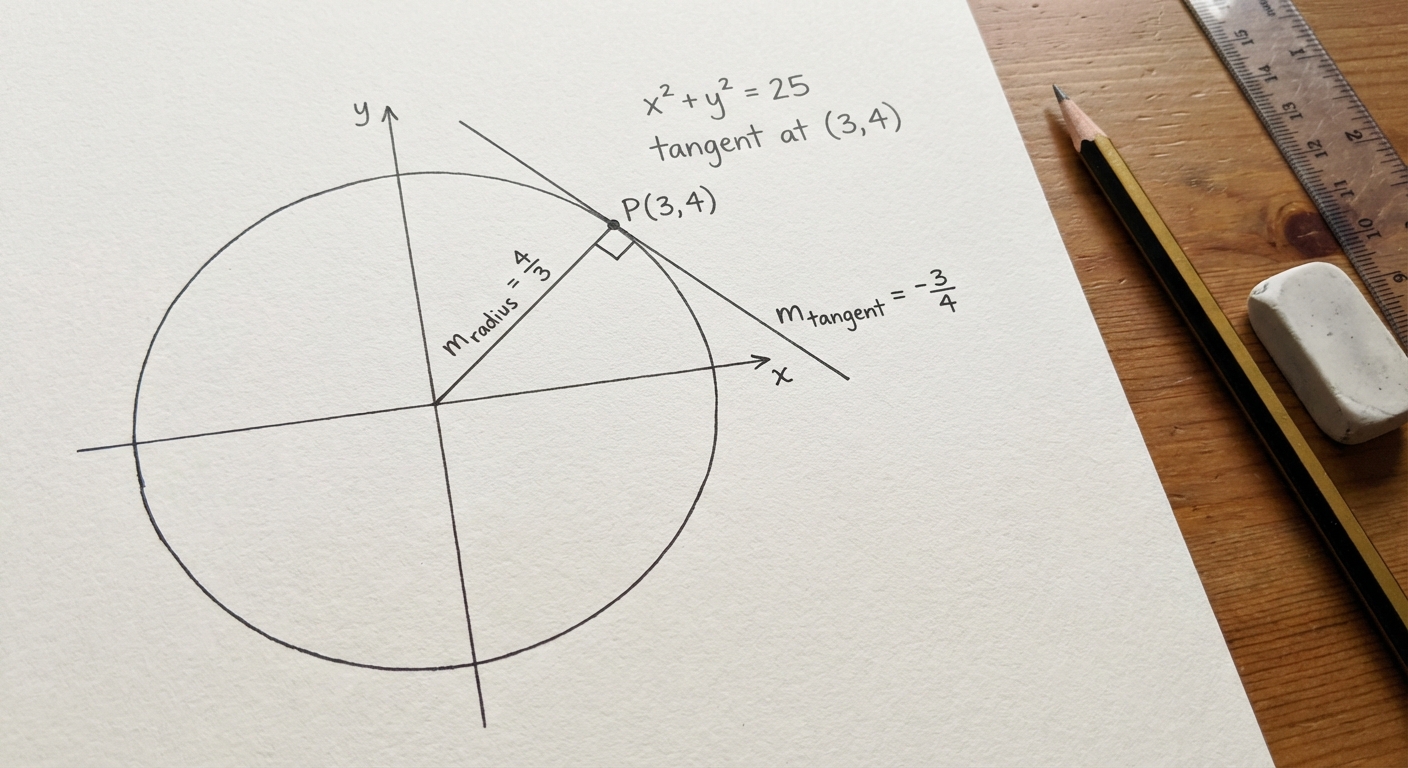
Worked Example: Circle & Tangent Line
Consider the circle $x^2 + y^2 = 25$ at the point $(3, 4)$.
Step 1: Differentiate
Step 2: Solve for
Step 3: Evaluate at point $(3,4)$
Step 4: Tangent Line Equation
Using Point-Slope form ($y - y1 = m(x - x1)$):
Topic 3.6: Second Derivatives (Implicitly)
A common AP BC question asks for the second derivative of an implicit relation.
Using the result above ($y' = -x/y$), let's find $y''$:
- Use Quotient Rule on $-x/y$.
- Crucial Step: When $y'$ appears in your result, interpret it by substituting the original first derivative formula back in.
Substitute $y' = -x/y$:
3. Inverse Function Derivatives (Topic 3.3)
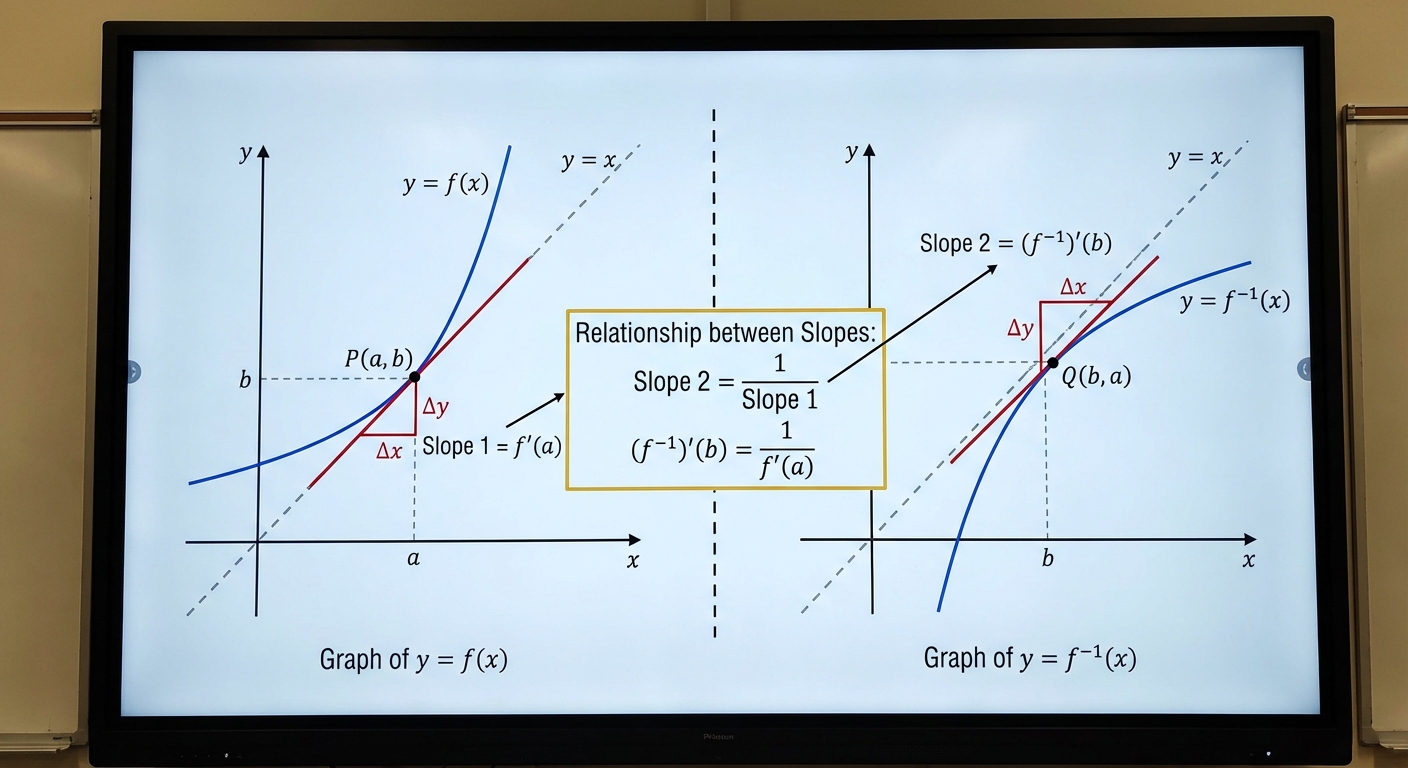
Inverse functions ($f$ and $f^{-1}$, or $f$ and $g$) switch domain and range. Geometrically, they are reflections across the line $y=x$. This symmetry leads to a specific relationship between their slopes.
The Concept
If $(a, b)$ is on the graph of $f$, then $(b, a)$ is on the graph of $f^{-1}$.
The slope of $f^{-1}$ at $x=b$ is the reciprocal of the slope of $f$ at $x=a$.
The Formula
Let $g(x) = f^{-1}(x)$. If $f$ is differentiable and has an inverse, then:
Where $f(a) = b$.
Step-by-Step Strategy
If asked to find $(f^{-1})'(2)$ represented as $g'(2)$ given function $f(x)$:
- Set $f(x) = 2$. Do not plug 2 into $f(x)$. You are looking for the $x$-value that produces a $y$ of 2.
- Solve for $x$. Let's call this value $a$. So $f(a) = 2$.
- Find $f'(x)$.
- Evaluate $f'(a)$.
- Take the Reciprocal: The answer is $1 / f'(a)$.
Example
Let $f(x) = x^3 + 2x - 1$. Find $(f^{-1})'(2)$.
- Set $x^3 + 2x - 1 = 2$. By inspection, $x=1$ works ($1+2-1=2$). So the point on $f$ is $(1, 2)$.
- This means the point on $f^{-1}$ is $(2, 1)$. We need the slope at this point.
- $f'(x) = 3x^2 + 2$.
- Evaluate at $x=1$ (the coordinate from $f$): $f'(1) = 3(1)^2 + 2 = 5$.
- Reciprocate: .
4. Inverse Trigonometric Differentiation (Topic 3.4)
These derivatives frequently appear on the AP exam (especially in integration problems later). While you can derive these using implicit differentiation and a geometric triangle, memorization is highly recommended for speed.
Notation Note
Be ready for both notations: is the same as .
The "Big Three" Formulas
Combine these with the Chain Rule ($u$ is a function of $x$).
| Function ($y$) | Derivative () |
|---|---|
| $\frac{u'}{ |
The "Co" Functions
The derivatives of the "co" functions are simply the negatives of their counterparts.
Common Mistakes
- Missing the Chain Rule: Writing . You MUST multiply by the derivative of $u$ ($4$ in this case) in the numerator.
- Forgetting to square the entire $u$: In , the denominator becomes $1 + (3x)^2 = 1 + 9x^2$, NOT $1+3x^2$.
5. Summary & Exam Tips (Topic 3.5)
Strategy Selection
- Function of a Function? Chain Rule.
- Variable in Base AND Exponent? (e.g., ) Logarithmic Differentiation (Take of both sides, then use Implicit).
- X and Y mixed? Implicit Differentiation.
- Inverse function asking for derivative at a specific value? Use the Reciprocal Slope Formula. Do not try to find the actual inverse function equation first (it is usually impossible algebraically).
AP Exam Hints
- Simplify First: Log rules () can turn a nightmare product rule problem into a simple addition problem before you even start differentiating.
- Evaluate early: If asked for a numerical derivative at a point, plug the number in as soon as you have the derivative expression. Don't simplify the algebra first unless necessary.
- Product Rule in Implicit: This is the #1 algebraic trap. In $xy^2 = 10$, differentiating $xy^2$ requires product rule: . Students often write just $y^2 + 2xy'$.