Module 5 - Heredity
Inquiry question: How does reproduction ensure the continuity of a species
]]explain the mechanisms of reproduction that ensure the continuity of a species, by analysing sexual and asexual methods of reproduction in a variety of organisms, including but not limited to]]
^^Sexual and Asexual reproduction^^
is a method of reproduction with all the genetic information that comes from one parent, which produces offspring that is genetically identical to the parent.
Asexual reproduction is the main form of reproduction in unicellular organisms.
asexual reproduction among plants is more common in harsh environments where organisms are so specific that there is little benefit in having variation within the population in these habitats when favourable conditions arise suddenly, organisms can reproduce quickly and effectively
| advantages of asexual reproduction | disadvantages of asexual reproduction |
|---|---|
| - enables organisms to reproduce quickly as they don’t need to find a mate - Being genetically identical can give organisms a competitive advantage if they live in an environment where they are well-adapted. - Asexual reproduction is common in plants in harsh environments.- Live in an environment where there’s a lack of mates- numerous offspring produced with minimum energy expenditure | - little to no variation in the population, the whole group (or species) is vulnerable to sudden changes in the environment (disease, drought, parasite or predator). These changes may result in the survival of only a few- low levels of parental care |
selection pressures making asexual reproduction favourable
- A shortage of food and other resources doesn’t affect them as asexual reproduction uses less energy to produce offspring
- a small mating population and time and other constraints on finding a mate- only one parent is required for asexual reproduction
^^Types of asexual reproduction include^^
Vegetative propagation
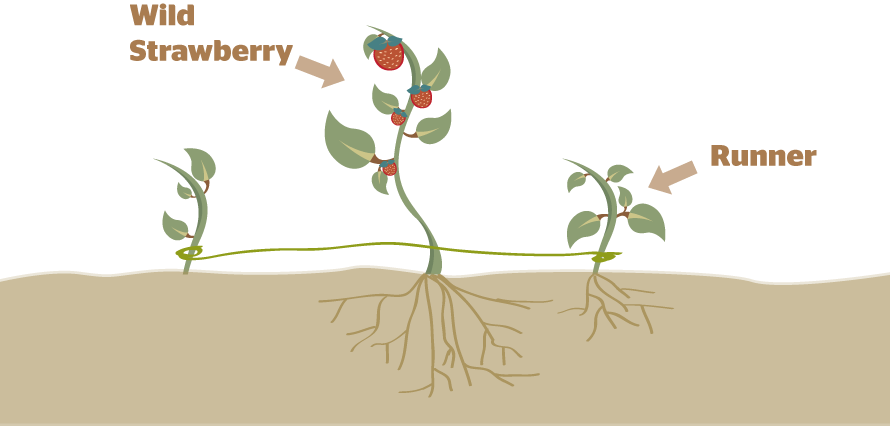
Vegetive propagation is found in plants that produce vegetive organs (bulbs, tubers, rhizomes and suckers) the offspring are genetically identical to the parent. Vegetative propagation is where new independent individuals are formed without seeds or spores (eg. growth of new plants out of rhizomes or stolons like strawberries or the formation on new bulbs tulips)
- runners
- long thin, modified stems that grow along the surface of the soil
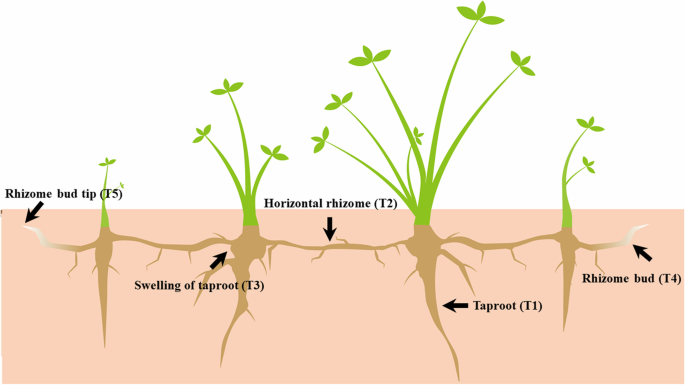
- Rhizomes
- underground horizontal modified stems or rhizomes are characteristic of ginger, ferns like bracken fern and grasses; they give rise to a new shoot at each node.
- Bulbs
-Are grown underground and from these bulbs, buds form which grows new plants 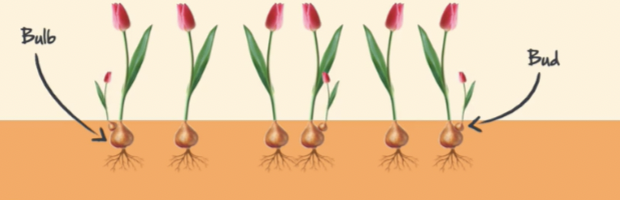
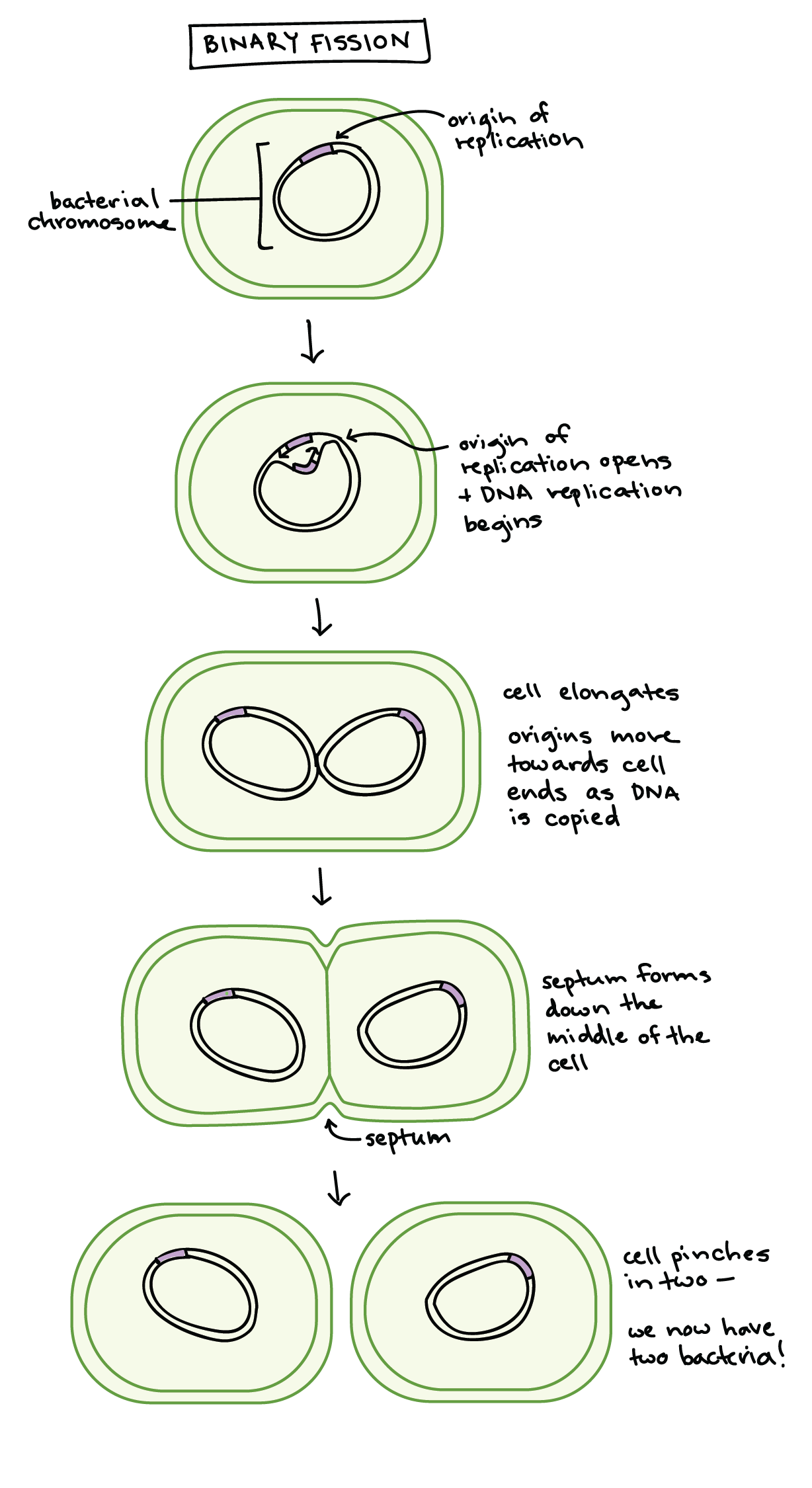
Binary Fission
Binary fission is the main method of asexual reproduction in unicellular organisms such as bacteria and protists. A newly divided cell grows twice its size and replicates their DNA, and equally splits their nucleus and their cytoplasm resulting in two identical organisms.
Budding
In reproductive budding, an adult organism gives rise to a small bud, which separates from the parent and grows into a new individual. It involves one parent dividing its nucleus equally but the cytoplasm unequally; this results in a smaller daughter cell and a larger mother cell (protists)
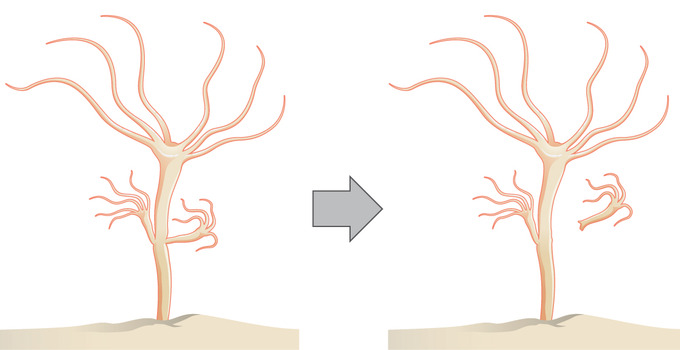
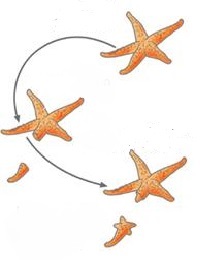
Fragmentation
fragmentation is a form of asexual reproduction where new organisms grow from a number of fragments or pieces of the parent that falls or breaks off; each fragment develops into a mature, fully-grown individual
Spore formation
spores are tiny, unicellular reproductive cells that are produced in organisms like fungi. These organisms produce very large numbers of spores which are easily dispersed by wind.
Spores are able to expand the distribution of new species effectively and are able to colonise new environments.
Parthenogenesis
parthenogenesis is a process in which an unfertilized egg can develop and grow into a new individual. Parthenogenesis occurs naturally in many plants, and invertebrates (eg bees, water flees)
sexual reproduction involves the meeting of gametes that carry genetic material from both parents to the offspring. As a result, the offspring will contain a mix of parental genes and will create genetically different offspring.
| Advantages of sexual reproduction | Disadvantages of Sexual reproduction |
|---|---|
| introduced genetic variation Offspring can possess random variations making them better suited to the environmental conditions - meaning they may be able to out-compete their parents and other individuals, thereby gaining a selective advantage greater amounts of parental care | the process demands greater expenditure of time and energy requires access to suitable mates can make organisms more vulnerable to predators sexual reproduction tends to be forgotten in hardships smaller number of offspring |
During sexual reproduction, a combination of genetic material from two parents is passed onto offspring. Every species has a characteristic number of chromosomes per cell. (eg humans have 46 chromosomes, camels have 70, and tomatoes have 24) each species has two sets of chromosomes arranged in homologous pairs.
To prevent the chromosome number from doubling in each generation, a mechanism to ensure that each parent contributes only half of his or her chromosomes to their offspring is required. This is called meiosis. Meiosis is a type of cell division that takes place in the reproductive organs of plants and animals. When a cell involved in sexual reproduction is divided by meiosis to produce gametes (sex cells), the chromosome number halves. Resulting in each gamete only containing one set of chromosomes.
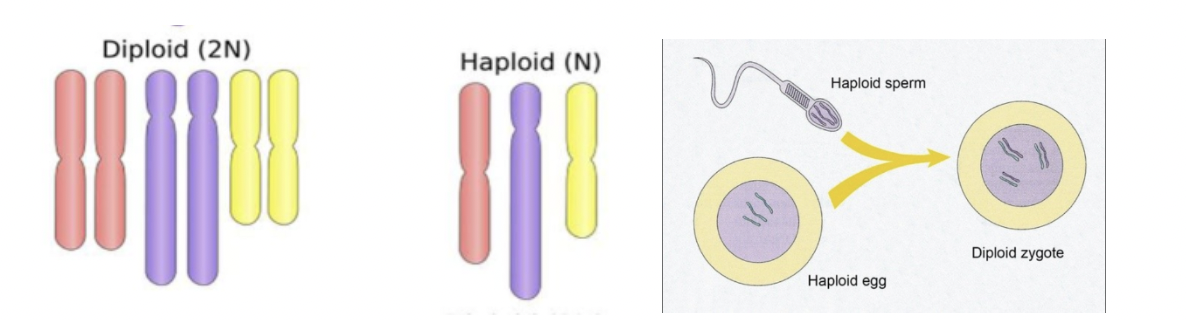
The terms Diploid (full set of chromosomes) and Haploid (single set of chromosomes) refer to the number of sets of chromosomes. Offspring inherit. one set of chromosomes from the mother and the other set from the father. A fertilized egg is called a zygote (arises from the fusion of haploid gametes forming the diploid zygote). The zygote divides by mitosis to become an embryo with identical body cells that all have a diploid number of chromosomes.
External Fertilization
both the male and female release sex cells into their environment for fertilization to take place outside the body (fish and amphibians)
- advantages are: large number off offspring are produced, parents don’t need to meet
- Disadvantages are: Chance of survival are reduced because of environmental factors, wasted resources (release all these cells for only a couple to live, no guarantee any offspring will live
Internal Fertilization
occurs inside the body (mammals, reptiles and birds)
- advantages are: high chance of survival, conservation resources, choosing their mate
- Disadvantages are only few offspring; parents have to meet
| Feature | Sexual reproduction | Asexual reproduction |
|---|---|---|
| number of parents | two | one |
| genetics of offspring | genetically different | genetically identical |
| types of cell division | meiosis | mitosis, binary fission, vegetative propagation and budding |
| advantages | High genetic variation - population is likely to survive any environmental change | high efficiency - less time and energy population size can increase rapidly |
| disadvantages | Low efficiency: (costs time and energy) slow reproductive rate | **Low genetic variation (**less time and energy) population size can increase rapidly |
| organisms | animals , plants, fungi | Plants, fungi, bacteria, protists |
plants: asexual and sexual reproduction
<<asexual reproduction terms<<
runners: side branches with planets that grow in the ground and start new plants
bulbs: grow bulbs underground and new plants form
cuttings: branch from a parent plant is cut where it will then grow
<<sexual reproduction<<
sexual reproduction in plants relies of the successful fusion of male and female gametes, however this fusion in plants is more difficult and they grow on the ground and cannot move
- angiosperms are flowering plants
- fruit develops from the ovary of the flowering plant
- some flowers have both gametes, while others only have one
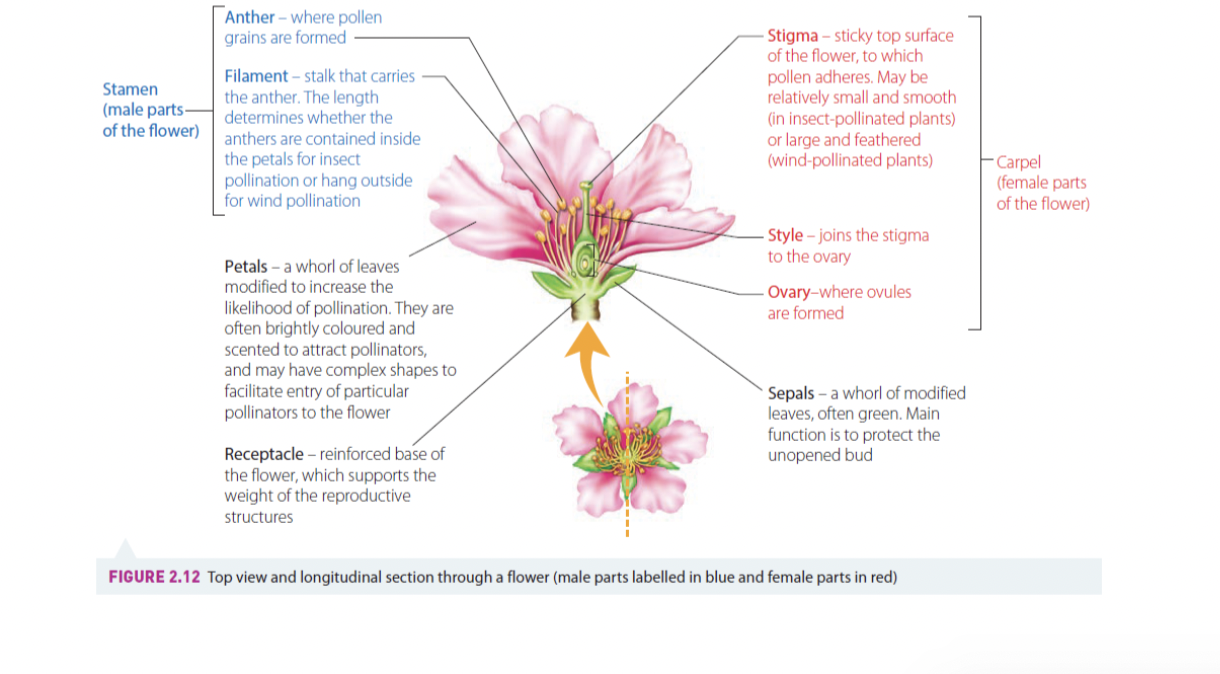
- stamen
- filament
- anther
- Pistil
- stigma
- style
- ovary
- they relay on external agents to carry their gametes from one parent to another - these are called pollinating agents
- they also rely on external agents to disperse their seeds - wind, water, animals
Steps in sexual reproduction of a plant
Pollination, fertilisation, seed dispersal and germination
Pollination
- this process of gamete transfer is pollination
- the male gametes inside the pollen must be carried out from the anthers to the female part of the flower, called the stigma
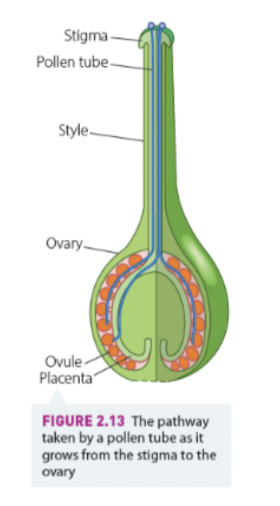
- once pollen has been deposited on the stigma, a pollen tube germinates and grows to carry it inside the male gamete (sperm call) to an ovule contained in the ovary
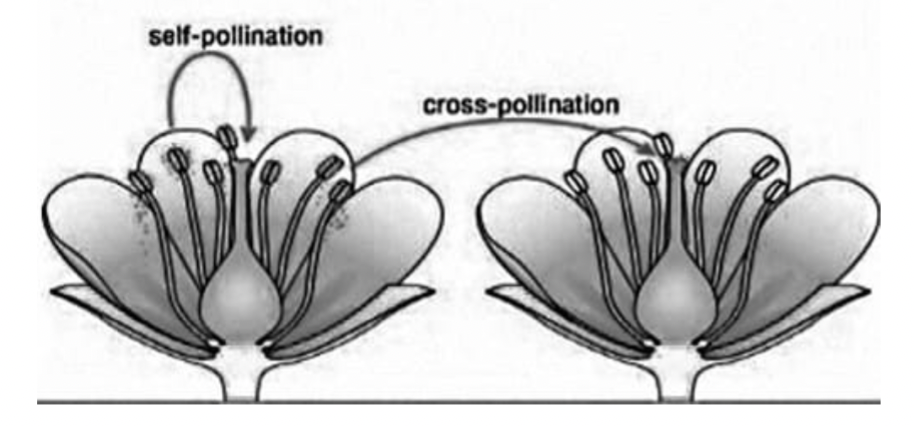
- plants are dependant on agents such as wind, water and animals to carry their pollen from the anthers of one flower to the stigma of a flower on another plant (cross-pollination) or on the same plant (self pollination)
| self-pollination | Advantages - requires less energy as there is no requirement for the plant to produce structures to attract pollinators, such as brightly coloured petals in nectar- they can grow in areas where insects or animals that visit plants are absent as they don’t need them to transfer from one flower to another Disadvantages - not much variation and no production of new species |
|---|---|
| cross-pollination | Disadvantages- they rely on outside agents to transfer pollen from the anthers to the stigmas, these may be abiotic agents such as wind, or water or biotic such as insects, birds or mammals Advantages**-** Increases variation in the species as the offspring will have been produced from gametes from different plants - more resilient to environmental change - species will continue |
| Pollination by wind | - many angiosperms are wind pollinated, and their flowers are small greenish, and odourless, with reduced or absent petals, as they don’t need to attract animals - the flowers are grouped together and hang down in tassels that blow around in the wind and shed pollen - this pollen is very light so it can be picked up by the wind- stigmas are usually spread out to trap the pollen carried by the wind- wind pollination is very inefficient, so large quantities of pollen is produced |
|---|---|
| Pollination by animals | - flowers that attract animals are more effective in transferring pollen - this reduced wastage of pollen by ensuring that it is going to a flower due to a one-to-one relationship - animals such as insects, birds and mammals act as pollinators - they transfer pollen to an anther |
Fertilisation
- in flowering plants, fertilisation occurs internally inside the ovary
- during fertilisation, the sperm cell that was transferred by the pollen tube fuses with the egg cell (ovum) inside the ovule in the female part of the flower. The fertilised ovule develops, protected within the ovary. the ovule containing an embryo has now termed a seed and the surrounding ovary grows to become a fruit
Seed Dispersal
- after pollination and the fertilisation of the flowers of a plant, seeds (fertilised ovules) from inside the ovary, are dispersed
- it is an advantage for seeds to be dispersed over a wide distance as it prevents overcrowding and competition for light, water and soil nutrients
- it also increases the chances of continuity of a species in other locations in case there is a sudden change in the local environment such as fire or disease, there will be other plants located In other areas, so the population doesn’t become extinct
Ways that seeds can be dispersed
| Dispersed by animals | animals can knock the seeds from the plant to the ground or they can carry the seed to the ground |
|---|---|
| Dispersed by wind | built to fly, easily picked up by the wind and its light so its able to move far |
| Self-dispersed | dry seeds usually explode to disperse their seeds - especially during bushfire - some plants need bushfires for their seeds to be opened tp get the seeds to come out and disperse |
Seed Germination
- this the embryo coming out of the seed
- the root is the first thing that comes out - the first root that comes out is called the radicle.
- the plant embryo inside a seed is in a dehydrated form, to allow the seed to survive adverse conditions
- if the seed lands in suitable soil that provides sufficient water, oxygen and warmth, it germinates meaning the embryo begins to grow, producing a radicle or young root to absorb water and soil nutrients, as well as a plumule or young stem, which develops green leaves for food production by photosynthesis. once the seedling becomes established, it grows and developed into an adult plant that can begin the reproduction cycle once again
<<asexual reproduction in plants<<
- does not involve gametes (sex cells - egg and sperm) - there is no production or fusion of gametes and no mix of genetic information to introduce variation
- only one parent is required and all gentic material in the offspring is passed down from the single parent - offspring is genetically identical to the parent and each other
- in unicellar organisms, asexual reproduction is the main form of reproduction
- in multi-cellular organisms, sexual reproduction is more common - asexual reproduction occurs in plants when
- when there is a shortage of food or other resource - asexual reproduction requires less energy to produce offspring
- a small mating population - only one parent is required for asexual reproduction
Asexual reproduction in plants
| Advantages | - increases crop production when conditions not favourable for seed germination (sexual reproduction) - use plants with favourable traits again and again - faster growing plant that grows a lot of something - the plant can be clonded over and over again - growing the plant over and over again which has the same traits - seeds may be unavailable to farmers - they can use bulbs from plants underground instead and regrow them - populations can be increased rapidly when conditions are right as the reproduction is competed much faster than sexual reprodiction -more time and energy efficient - don’t need to do pollination ,seed dispersal etc |
|---|---|
| Disadvantages | - lack of variation and therefore population is vulnerable to change in conditions - offspring are genetically identical to their parent if a disease comes through and kills all of the plant - because they are the same and clones of each other and have the same traits they can all die - examples a fungi disease - disease is likely to affect the population as there is no genetic variation - everyone is immune to the disease or non of them are |
]]Analyse the features of fertilisation, implantation and hormonal control of pregnancy and birth in mammals]]
processes
| basic outline of process (structures) | hormones involved | |
|---|---|---|
| ovulation | ovaryfallopian tubeuterus follicles egghypothalamus anterior pituitary gland luteal phasecorpus luteum | oestrogen progesterone FSHLH GrnRH |
| fertilisation/implantation | endometrium zygote coprus luteum | oestrogenprogesterone |
| pregnancy | uterus | blastocystHCGoestrogen produced by placentathe longer the pregnancy the higher levels of progesterone |
| childbirth | progesrglandinsoestrogen stopsprogesterone oxytocin relaxine |
^^how does sexual reproduction work^^
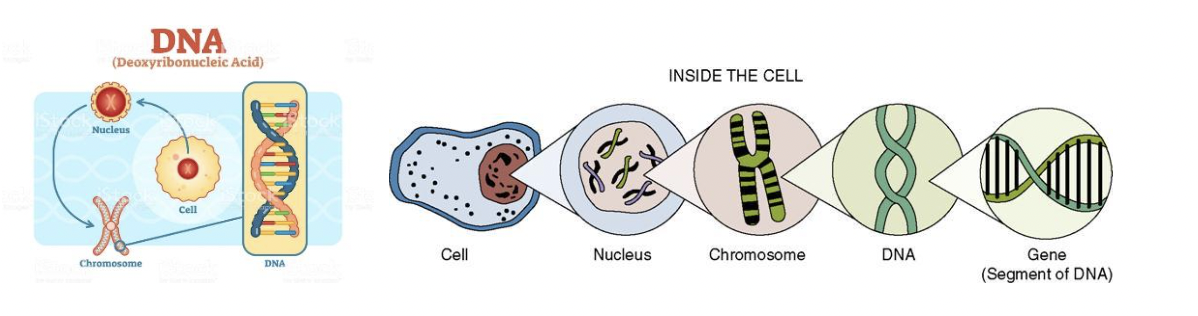
- a combination of genetic material from two parents passed to the offspring
- humans have 46 chromosomes which are in the nucleus
- chromosomes are made up of 2 chromotids, one from the mother and one from the father.
- hapolid is a single set of chromosomes (23 chromosomes) both sperm and egg are haploid as there are 23 chromosomes in each
- diploid 2 sets of chromosomes (46) the sperm and egg combined is 46 chromosomes which makes a diploid zygote
- sperm + egg = offspring
| <<Ovulation<< | the females body releases and egg from of the ovum (one of the ovaries) this is called ovulation - in humans it happens about once a month. the egg travels from the ovary to the fallopian tube - it is a phase of the female menstural cycle and generally occurs about 2 weeks before the start of menstural period |
|---|---|
| <<fertilisation<< | fertilisation is the fusing of the sperm and egg cell to form a single new cell which will develop into a new organism. the sperm enters the female through the vagina and meets the egg, that was released by the ovary, at the fallopian tube - they move through the cervex and uterus to meet the egg - the sperm and egg are haploid gametes, and they fuse to become a diploid cell - this new cell is called a zygote and it contains 46 chromosomes (23 from mother 23 from father) the zygote forms a strong membrane to stop other sperm from entering- the sperm has to go through 3 layers in the egg - corona radiate, zona pellucida and cytoplasm 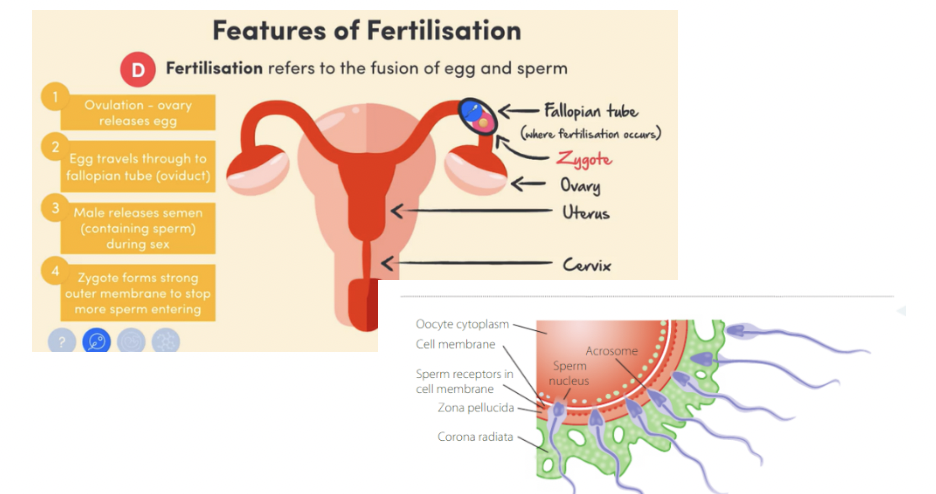 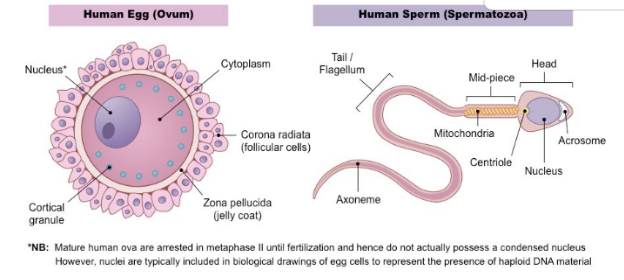 |
| <<implantation<< | - the zygote moves to the uterus - moves into the uterine wall - this is the beginning of pregany - the uterus is where pregnancy occurs- the attachment of the fertilised egg to the uterus lining - the zygote grows into something more human like called an embryo - this is why you don’t get your period when you are pregnant - the egg attachs to the uterus lining to from an embryo instead of going through the uterus and shedding (period)- the amniotic sac, placenta and umbilical cord form Amniotic Sac- inside the uterus is a bag called the amniotic sac which is filled with watery fluid and contains the unborn baby. it helps keep the baby in optimal temperature and provides it with cushioning to help protect it from external force Placenta- it is a large organ that develops during pregnancy - it is attached to the wall of the uterus - placenta provides the baby with oxygen and nutrition it needs to survicee whilst removing carbon dioxide and wastes. the placenta is outside the amniotic sac so the umbilical cord connects the babts abdomen to the placenta to allow substances to move between the two - the nutrients absorbed into the humans bloodstream travels to the placenta and through the umbilical cordUmbilical cord- the umbilical cord connects the embryo to the placents where he food is- made up of three blood vessels (two ateries and one vein) 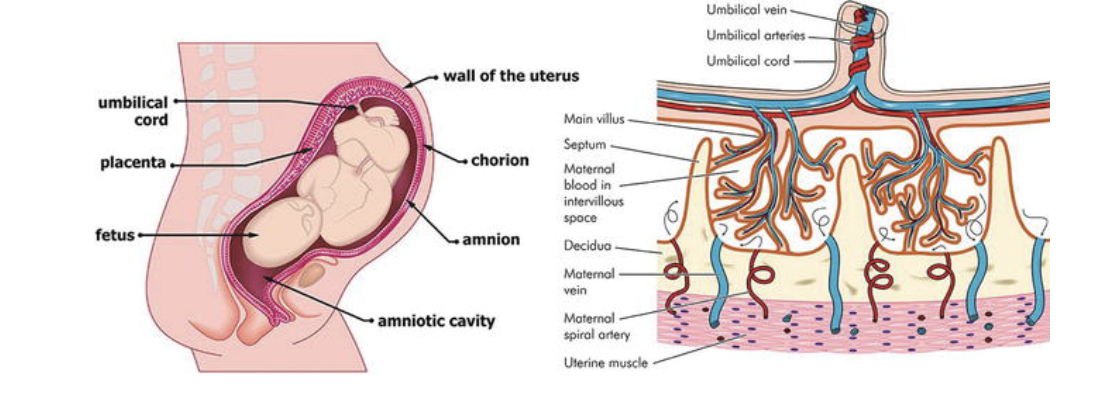 |
| <<hormonal control of pregnancy<< | - pregnancy is usually 9 months in humans (266 days)- varies in mammals - dogs (61 days) - horses (330-342 days) - elephants (617 days)- the time that the baby spends in the female body - from fertilisation to birth. the length of the pregnancy can vary depending on the type of mammal human pregnancy about 9 months elephants almost 2 years - when you are pregnant, you don’t want the uterine lining the shed - the growing embryo secrets human chorionic gonadotropin (HCG) and this maintains the secretion of progesterone and oestrogen by the coprus luteum, which stops your period |
| <<birth<< | - the widening of the uterus, the delivery of the baby and the expulsion of the placentaHormones during birth - if pregnant occurs the coprus luteum continues to secrete progesterone - this maintains pregnancy - the placenta takes over progesterone production later in the pregnancy and the coprus luteum has a ‘rest’- oestgoen promotes the development of the endometrium - lining of the uterus - pregesterone - promotes development of blood vessels. maintain lining of the uterus failure if progesterone can be a cause of misscarriage prostaglandins - initates labour prolactin and oxytocin promotes milk and ledwon ad as well as maternal bonding relaxin - helps to loosen the uterine muscles and prepare the female body for birthoxytocin- stimulates the production of milk and causes the uterine muscle to contract - causing the female to go into labour and give birth as it pormtpes the uterine contractions |
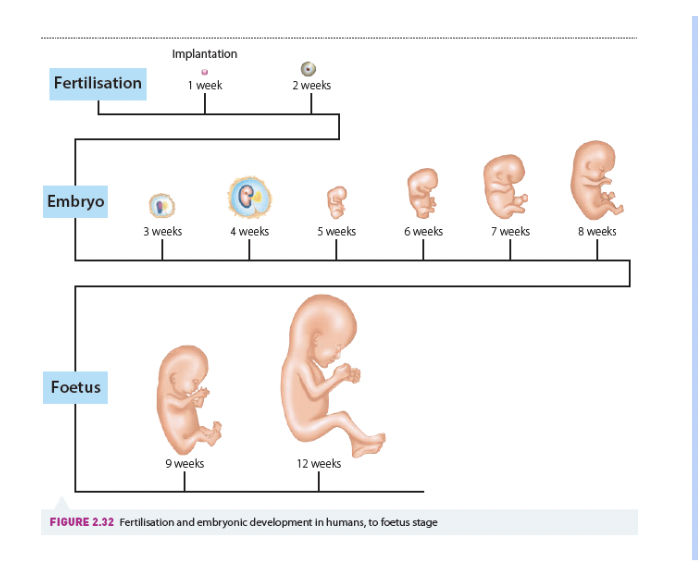
- it becomes an embryo after about 3 weeks of the egg being fertlised - nervous system and heart develop
- it becomes a foetus after about 9 weeks - looks very human like with arms and legs
- embryo is the early stage and foetus is the end stage
Hormones: chemical substance that act like messenger molecules in the body
- produced by endocrine glands and other tissues - secretes hormone sinto the bloodstream
- carried in the blood
- binds to target tissues with correct receptors
- insulin - fat storage hormone which is released by pancreas and regulates many of your metabolic processes
- the hormones that have a significant role in pregnancy include oestrogen, progesterone, oxytocin and relaxin
hormones involved in mamalism reprodcution produced by the sex organs
- androgens
- oestrogen
- progestogens
these are produced by the gonads (primary reproductive organ) which are ovaries (in females) and testes (in males)
| androgens | - present in males and females but much higher in males- controls secondary sexual development of males- main hormones is testosterone produced by the testes testosterone - a hormone produced by the male body - mainly produced in men by the testicles- it affects a mans appearance and sexual development- it stimulates sperm production - builds muscle to bone mass- caused voice to lower |
|---|---|
| oestrogen | - present in males and females but much higher in females- controls secondary sexual development of females- main hormone is oestrogen - promotes the function of ovaries and it is produced by the ovaries- the hormone responsible for the development of female characteristics during pregnancy - it is made by the placenta during pregnancy - it stimulates the body to release an egg - stimulates ovulation - it stiumlates the production of another hormone called progesterone- increases to make follical with the egg inside of it grow and mature, once ovulation occurs it decreases allowing progesterone to cover |
| progesteorne | - primary role in pregnancy - main hormone is progesteorne - produced by the ovaries - promotes milk production in mammary glands - it is released by the ovaries and later by the placenta - stimulates the thickening of the uterine lining in the first stages of the pregnancy to provide a healthy environment for the embryo development- as pregnancy progresses, progesterone levels rise. this keeps the placents working, the uterus relaxed and helps the mothers immune system tolerate the growing infant - strengthens the pelvic floor muscles to support labour - it is produced in the first 8-10 weeks by the corpus luteum before the placenta is developed. the placenta causes the progesterone levels to steadily rise throughout the pregnancy until it reaches a peak. a drastic drop towards the end of pregnancy prepares the body for labour. this drop dosables the impression of oxytocin, generating contraction - secred at a very low level during follicu,ar phase and then during ovulation it start producing progesterone and continues to help produce the lining of the uterus and then it goes down during pre-mensturation when it release es thatbtye egg isn’t being feritlised |
reproductive cycles
| menstural cycle | occurs in primates (monkeys apes and human beings) blood flows in this cycle. can breed all time round. also called seasonal breeders/ |
|---|---|
| oestus cycle | occurs in non-primates (cows, sheep, dogs etc) blood does not flow in this cyle. most mammals are seasonal breeders and only reproductive at different times of year when in ‘season’ this is called oesturs cycle |
gonadotrophins: hormones produced by the pituarity gland (base of the brain) directly control sex hormone production. they stimulate the hormones coming from the ovaries and testies
examples of gonadotrophins
| FSH | follicle stimulating hormone stimulates maturation of ovarian follicles. spikes during ovulation stimulates the last burst of maturing egg helps make the blister bigger |
|---|---|
| LH | lutenising hormone - promotes the maturation of the follicle, ovulation and formation of the corpus luteum (yellow body) on the pvary. low and then before ovulation it increases and there is a spike during ovulation causing the follicle to burst and once its done its job it decreases and goes bac k into regular stateBLISTER BURSTS |
| Prolactin | - secreted by the pituarity which promotes milk production by the mammary tissues |
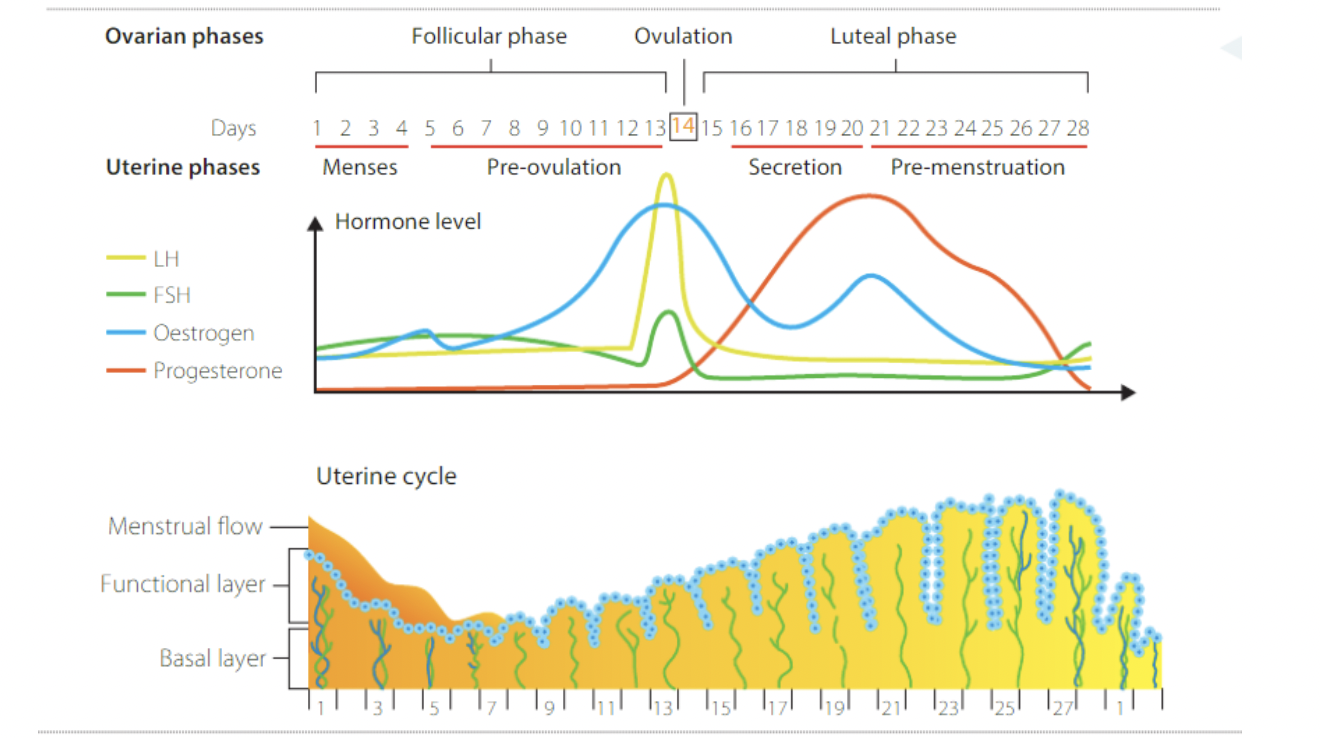
the menstural cycle
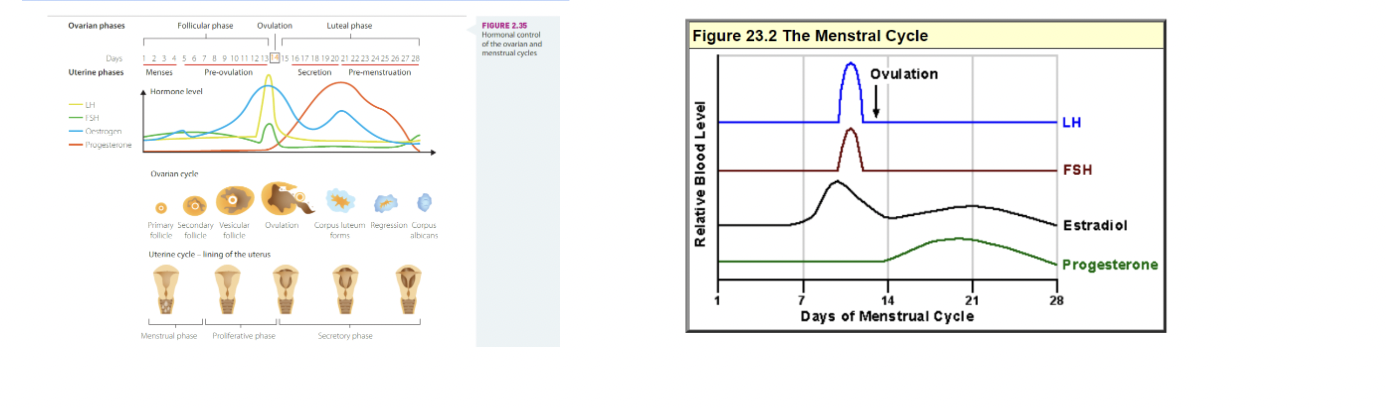
during each menstural cycle every month an egg develops and is released from the ovaries. the lining of the uterus builds up, if a pregnancy doesn’t happen, the uterine lining sheds during a menstrual period. the cycle then starts again next moth
the four phases of the menstural cycle are
- mensturation
- the follicular phase
- ovulation
- luteal phase
| mensturation | - first stage of menstural cycle- starts when an egg from the previous cycle isn’t being fertilised. because pregnancy hasn’t been taken place, levels of the hormones oestrogen and progesterone drop- once the body realise that there is non pregnancy occurring, the progesterone decreases and the lining of the uterus sheds. (period) the thickened lining of the uterus, which would support a pregnancy, is no longer needed so it sheds through the vagins- when the corpus luteum is degraded, it stops secreting progesterone and oestrogen - the end of secretion of these hormones, causes the uterine lining to shed- during your period, a combination of blood, mucas and tissue from the uterus is released- blood vessels proliferate - blood vessels spread and increase in size- gets period for an average of 3-7 days |
|---|---|
| the follicular phase | - starts on the first day of mensutration and ends with ovulation - prompted by the hypothalamus, the pituiaty gland releases follicle stimulating hormone (FSH). this hormone stimulates the ovary to produce around 5-20 follicles (tiny nodules or cysts) which bead on the surface- each follicle houses an immature egg- usually only one follicle will mature into an egg while others die. this can occur around day 10 of the 28 day cycle - the growth of the follicular phase, the developing follicle causes a rise in the level of oestrogen. as the follicle grows, it produced more and more oestrogen) the hypothalamus in the brain recognuses these rising levels and releases a chemical called gonadotropin- releasing hormone (GnRH). this hormone promotes the pituaity gland to produce raised levels of luteinising hormone (LH) and FSH |
| ovulation | - ovulation is the release of a mature egg from the surface of the ovary- this usually occurs mid cycle around 2 weeks or so before mensturation starta- within two days of the developing follicle, ovulation is trigger by the high levels of LH. (the spike in LH due to the oestrogen causes the hypothalamus to increase LH, triggers ovulation (the egg to burst out of the follicle and into the fallopian tube) this is an example of the positive feedback system because oestogren communicates with the hypothalamus to increase the amount of LH levels to stimulate ovuaton (causes ovulation to occur) - the egg is funnelled into the fallopian tube and toward the uterus by wabes of small, hair like projections. the life span of the typical egg is only around 24 hours . unless it meets a sperm during this time , it will die |
| luteal phase | - during ovulation, the egg bursts from its follicle, but the ruptured follicle stays on the surface of the ovary - for the next 2 weeks, the follicle transform into a structure called the coprus luteum and it develops in the ovary- this structure starts releasing progesterone and small amounts of oestrogen - this combination of hormones that are spiked, causes the development of the uterus libing to reach its highest point, maintains the thickened lining of the uterus, waiting for a feritlised egg to stick if a fertilsied egg implants in the lining of the uterus, it produced the hormones that are necessary to maintain the corpus luteum, this included human chorionic gonadotropin (HCG) the hormone that is detected in a urine test for pregnancy. the copus luteum keeps prudcing the trased levels of pregerstone that are needed to maintain the thickened lining of the uterus if pregnancy does not occur, the copus luetum withers and dies, usually around day 22 in a 28 day cycle. the drop in prgoesterone levels cause the libing of the uterus to fall away. this is known as menstueration . the cycle then repeats during luteal phase when there is a lot of progesterone, the libing of the uterus thicke s. the lining id called the endometrium - it does this to ger ready for pregnancy as this is where the embryo is. - endometiral thocmeing diagram of the ovary - ovum (single ovary) is released from the ovary and produced a ruptured follicle and this follicle turins into a coropus luteum, and then formed into a fully formed coprus luteum 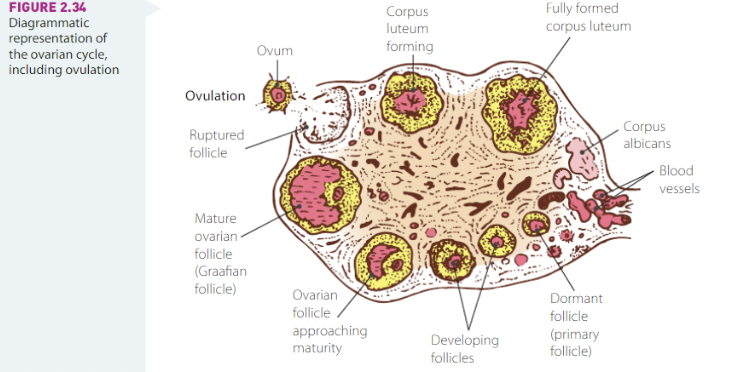 |
- get period average 5-7 days
- middle of cycle 🡪 pre ovulation 🡪 egg is maturing
- day 14 🡪 blister popos and you ovulate 🡪 the egg goes to the oviduct
- secretion 🡪 body is preparing lining for a baby
- pre menstruation 🡪 realises there is no fertilisation 🡪 stops producing progesterone
\n summary of hormones:
- GnRH: causes the reelae of LH and FSH.
- FSH: causes the development of follicle in ovaries
- Oestrogen: causes a spike in LH to help uterine line development
- LH: triggers ovulation
- Progesterone: uterine lining development.
]]evaluate the impact of scientific knowledge on the manipulation of plant and animal reproduction in agriculture]] agriculture: the growth of crops and breeding of animals used to sustain and enhance human life (for human needs)
- Crop and livestock farming
- fisheries
Selective breeding: the creation of organism with certain desirable characteristics
Examples:
- Chickens that lay more eggs
- Tomato plants that grow tomatoes that taste better and don’t bruise so easily.
Ways to do selective breeding (ways to manipulate reproduction in agriculture)
| Selective breeding | placing a male and female from the same species in the same enclosed environment and waiting for them to mate 🡪 they put the animals with the most favourable traits in the same environment for example how fast they run and this allows control of which animals breed with each other, giving the offspring desirable traits. \n Disadvantages: inefficient as it could take months to occur. |
|---|---|
| Artificial insemination | taking a sperm from a male and inserting it directly not the female’s reproductive track. For example, a sperm can be taken from a bull whose mother produced a lot of milk and inserted into a cow who produces a lot of milk to create an offspring that produces a lot of milk. \n Advantage: much more efficient 🡪 can inseminate multiple organisms at once . it’s the same procedure to the whole group at the same time which saves effort, money and time. Its safer. |
| Artificial pollination | the plant version of artificial insemination. It involves taking pollen from one flower and inserting it directly into the other flower using a small brush. The person acts like the bee by transferring the pollen from one organism to the other. They will transfer between plast with favourable characterises 🡪 this technique is used to grow kiwifruit |
| Cloning | 🡪 creating a genetically identical copy of an organism using genetic engineering techniques. |
Impact on these technique’s:
Advantages:
- Increase in sales 🡪 this could come from an increase in production if organisms are manipulated using these techniques to produce offspring that can produce more offspring 🡪 producing a chicken that can lay heaps of eggs
- Improved food quality 🡪 tastes nicer and looks better (bump resistant) 🡪 consumers will pay more for them.
- They can introduce organism that are more resistant to pests and diseases 🡪 farmers can spend less money on pesticides and medicines and gets more products in return.
Disadvantages:
- It can lead to reduced biodiversity (variety of organisms) 🡪 if offspring with more desirable traits keep getting produced the organisms with the undesirable traits will decrease in the gene pool and are bred out, decreasing the variety of different types of organisms 🡪 population is more likely to suffer from changes in the environment as they all have the same traits which could include not being resistant to certain diseases leading to them all dying.
Evaluate (make a judgement)
The overall impact of manipulating organism is positive as long as the threat of having a reduced biodiversity is managed.
word bank for inquiry question one
| Term | Definition |
|---|---|
| reproductive success | is determined by it’s ability to produce fertile offspring that survive to reproductive maturity and produce offspring of their own |
| Biological Fitness | the measure of an individual’s reproductive success |
| Haploid | a single set of chromosomes |
| Diploid | full set of chromosomes |
| Fertilization | both gametes meet each other |
| ovulation | the maturing off an egg cell |
| Follicle | capsule containing the egg |
| somatic cell | |
| paternal vs maternal | |
| follicle | |
| ovulation | |
| ovarian cycle | |
| oestrogen | |
| progesterone | |
| follicular phase | |
| corpus luteum | |
| luteal phase | |
| endomentrium | |
| GrnRH | |
| mensturation | |
| zygote | |
| prosroglandins | |
| placenta | |
| ovary | |
| IH | |
| blastocyst | |
| HCG | |
| relaxine | |
| oxytocin | |
| progesrglandins |
Inquiry question: how important is it for genetic material to be replicated exactly
- ^^Mitosis and Meisosis^^
cell division includes the following stages
- prophase
- metaphase
- anaphase
- telophase
- cytokinesis
Examples of cells which rapidly divide
- skin cells - especially around a wound
- hair follicle cells - they do mitosis more frequently so your hair can grow at a fast rate
- gut cells
- Mitosis is a type of cell division that produced two daughter cells that are genetically identical to parent cells (same number of chromosomes)
- this process is used in humans for growth and repair and replacement of cells
- it divides somatic cells (every cell in the body except for gametes (sex cells)
- not all cells continue to divide. as cells differentiate and specialise, they form tissues and some of these cells lose the ability to divide by mitosis
(Cancer occurs when cells divide too frequently, they are not regulated and uncontrolled. they cant communicate well with other cells, and this may cause them to move to other areas in the body. the uncontrolled growth that cancer cells has can lead to more cells like them which can develop into a tumour. cancer cells can be destroyed by radiation or medication such as chemotherapy which targets the specific cells.)
| growth of multicellular organisms | - from fertilised egg, to embryo, from infant to an adult relies of mitosis division followed by differentiation |
|---|---|
| repair of damaged tissues | - replacement of cells which have been worn out |
| asexual reproduction | - the process of mitosis generates new cells that are genetically identical to each other- the offspring during asexual reproduction is identical to the parent cell and therefore mitosis is the process that allows for asexual reproduction |
| genetic stability | - it is provided genetic stability for a species - mitosis ensures there is precise and equal distribution of chromosomes to each daughter cell. nucleus so the resulting cells have the same chromosomes number and genetic information as each other as the original parent cell |
| reproduction | - mitosis allows an orgnaism to reach the point where they are able to reproduce - allows for the continuity of a species |