PHYSICS TERM 3
YEAR 10 21/04/26
WAVES
FORMULAS
Frequency=1/T(Period)
Wavespeed= FxW (frequency x wavelength)
Period= time/no. of waves
Frequency = no. of waves/time
Wave
an oscillation or vibration that transfers energy or information from one place to another without transferring
Frequency
Definition: The number of complete waves (cycles) passing a fixed point per second.
Unit: Hertz (Hz).
Wavelength
Definition: The distance between two consecutive points in phase, such as from one crest to the next, or one compression to the next.
Unit: Metres (m).
Amplitude
Definition: The maximum displacement (distance) of a point on the wave from its undisturbed (rest) position.
Unit: Metres (m).
Period
Definition: The time taken to complete one full cycle or oscillation.
Unit: Seconds (s).
Cycle
Definition: One complete vibration or oscillation of a wave (one full crest and one full trough)
wavefront
is an imaginary line or surface that connects all adjacent points on a wave that are in the same phase
Longitudinal Wave
A wave in which the particles of the medium oscillate parallel to the direction of energy transfer,
Transverse Wave
A wave in which the oscillations of particles are perpendicular (at right angles) to the direction of energy transfer, featuring peaks and troughs.
Stationary Wave
A wave pattern formed by the superposition of two progressive waves of the same frequency and amplitude traveling in opposite directions, resulting in no net energy transfer.
Progressive Wave
A wave that transfers energy from one point to another through a medium (or vacuum) without the permanent transfer of matter.
Mechanical Wave
A wave that requires a physical medium (solids, liquids, or gases) to travel
Electromagnetic Wave
A transverse wave consisting of oscillating electric and magnetic fields that can travel through a vacuum at the speed of light.
Nodes
are the points on a stationary wave where there is zero displacement
Antinodes
are the points on a stationary wave where there is maximum displacement
Reflection Definition
The bouncing back of a wave as it hits a surface or boundary.
Refraction Definition
The bending of a wave as it moves from one medium into another due to a change in speed.
Diffraction Definition
The spreading out of waves as they pass through a gap or move around an edge
direct propagation
the phenomenon where energy, such as light, travels in a straight line through a uniform medium.
TYPES OF WAVES
Longitudinal Wave
Sound waves
Slinky (pushed/pulled)
Tsunami waves (deep ocean)
Transverse Wave
Light waves
Stadium "crowd" wave
Ripples on water
Stationary Wave
Vibrating guitar string
Air in a whistle
Microwaves inside an oven
Progressive Wave
Ocean waves
Radio signals
X-rays
Mechanical Wave
Seismic (earthquake) waves
Ultrasound
Vibrations on a drum skin
Electromagnetic Wave
Visible light
Wi-Fi signals
Gamma rays
27/04/26
INFO TO REMEMBER
milli (m) = 1/1000 = 10^-3
micro (μ) = 1/1,000,000 = 10^-6
nano (n) = 1/1,000,000,000 = 10^-9
pico (p) = 10^-12
Big values (multiples)
kilo (k) = 1000 = 10^3
mega (M) = 1,000,000 = 10^6
giga (G) = 10^9
MIRRORS
key terms
Real image
Virtual image
Eclipse
REMEMBER - Real image is always formed upside down
Reflection is when a wave bounces off a surface. There are two main types:
Specular Reflection: Occurs on smooth surfaces. Light rays reflect in a uniform direction.
Example: a mirror
Diffuse Reflection: Occurs on rough surfaces. Light rays reflect in various directions.
Example: paper
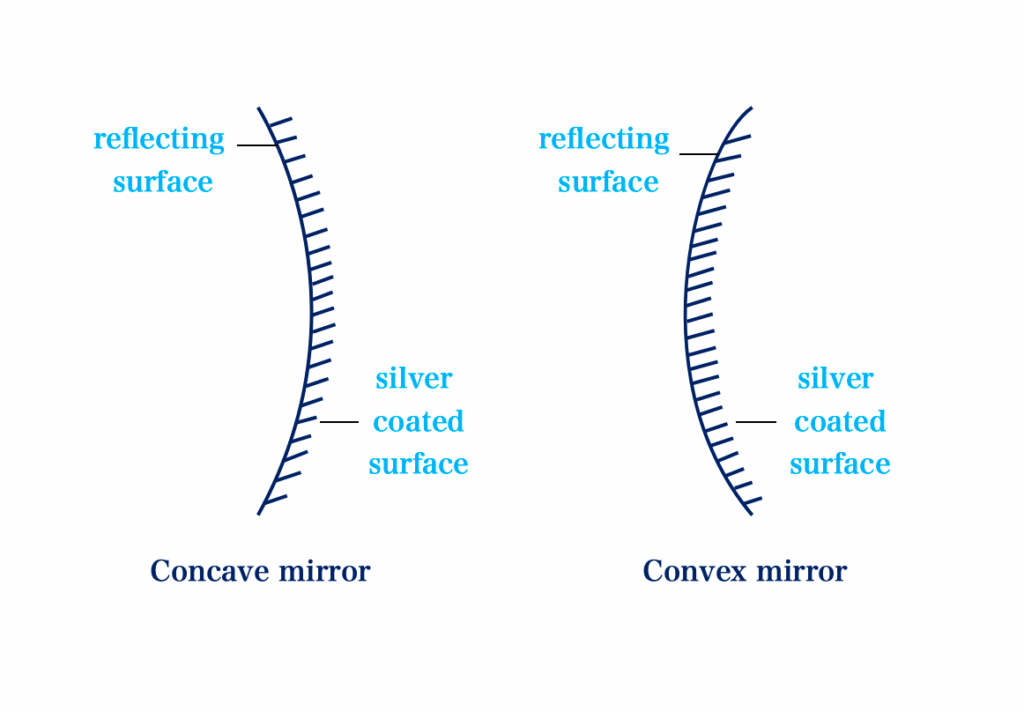
CONCAVE MIRRORS
A concave mirror is a mirror that curves inward. It converges light rays, meaning it brings them together.
Key aspects of concave mirrors:
Focal point: The point where parallel light rays converge.
Principal axis: An imaginary line that passes through the center of the mirror and is perpendicular to its surface.
When light rays parallel to the principal axis hit a concave mirror, they are reflected to the focal point. The distance from the mirror to the focal point is called the focal length (f).
Concave mirror:
Can be upright or inverted
Can be magnified or diminished (depends on object position)
COMMON USES: Shaving/Make up Mirrors, Dentist Mirrors, Reflectors in headlights
Object Position | Image Position | Size of Image | Nature | Orientation |
|---|---|---|---|---|
Beyond C (centre of curvature) | Between C and F | Smaller (diminished) | Real | Inverted |
At C | At C | Same size | Real | Inverted |
Between C and F | Beyond C | Larger (magnified) | Real | Inverted |
At F (focal point) | At infinity (very far away) | Very large | Real | Inverted |
Between F and mirror (P) | Behind mirror | Larger (magnified) | Virtual | Upright |
CONVEX MIRRORS
A convex mirror curves outwards, diverging light rays away from its surface. Unlike concave mirrors, the focal point of a convex mirror is behind the mirror.
Convex mirrors always form upright, diminished, and virtual images, meaning the images appear smaller and are not formed by actual light rays converging.
Convex mirror:
Always virtual, upright, diminished (smaller than the object)
COMMON USES: Car side view mirrors, Security Mirrors, Blind corner mirrors
PLAIN MIRRORS
A plain mirror is a flat mirror that reflects light. When light hits a plain mirror, it bounces back, creating a virtual image behind the mirror. The image appears to be the same size and upright as the object.
The law of reflection applies here: the angle of incidence equals the angle of reflection (θi=θr). This means that the image in a plain mirror is a mirror image of the object.
Plain (Plane) mirror:
Virtual, upright, same size, laterally inverted
COMMON USES: Bathroom mirrors, Periscopes, Rear - view mirrors
Feature | Plain Mirror | Concave Mirror | Convex Mirror |
|---|---|---|---|
Curvature | Flat | Inward | Outward |
Image Type | Virtual, upright, same size | Real or virtual, upright or inverted, magnified or diminished | Upright, diminished, virtual |
REFLECTION & MORE
REMEMBER
Reflection
Angles measured from normal
Angle of incidence = angle of reflection
Refraction
Towards normal = slowing down
Away from normal = speeding up
Frequency never changes
Diffraction
Bigger wavelength → more diffraction
Gap similar to wavelength → maximum diffraction
Reflection
What is reflection?
Reflection is when a wave bounces off a surface.
For light:
Smooth surfaces → clear reflection (plane mirror)
Rough surfaces → scattered reflection
Uses of Reflection
Mirrors
Periscopes
Reflectors on roads/bikes
Telescopes
Laws of Reflection
Angle of incidence = angle of reflection
The incident ray, reflected ray and normal all lie in the same plane.
Key Words
Incident ray = incoming ray
Reflected ray = outgoing ray
Normal = imaginary line at 90° to the surface
Angles are measured from the normal, NOT the surface.
Plane Mirrors
Plane mirrors:
Form virtual images
Image is:
upright
same size
laterally inverted (left-right reversed)
same distance behind mirror as object is in front
2. Refraction
What is refraction?
Refraction is the change in direction of a wave when it passes from one medium to another due to a change in speed.
Examples of media:
air
water
glass
Important Rule
When light:
slows down → bends towards the normal
speeds up → bends away from the normal
Example
Air → Glass:
light slows down
bends towards normal
Glass → Air:
light speeds up
bends away from normal
Why does refraction happen?
Because wave speed changes in different materials.
Frequency stays the same, but:
speed changes
wavelength changes
Refractive Index
Refractive index tells us how much light slows down in a material.
n=speed of light in vacuumspeed of light in mediumn=\frac{\text{speed of light in vacuum}}{\text{speed of light in medium}}n=speed of light in medium/speed of light in vacuum
Higher refractive index:
light travels slower
more bending
Effects of Refraction
Pencil looks bent in water
Swimming pools appear shallower
Lenses focus light
Total Internal Reflection (important!)
Occurs when:
Light travels from denser → less dense medium
Angle of incidence is greater than critical angle
Result:
ALL light reflects back inside
Used in:
optical fibres
endoscopes
3. Diffraction
What is diffraction?
Diffraction is the spreading out of waves.
It happens most when waves:
pass through a gap
go around an obstacle
When is diffraction greatest?
Greatest diffraction occurs when:
gap size ≈ wavelength
Larger wavelength:
more diffraction
Smaller gap:
more diffraction
Examples
Sound heard around corners
Water waves spreading after gaps
Radio waves bending around buildings
Topic | What Happens? | Cause |
|---|---|---|
Reflection | Wave bounces back | Hits a surface |
Refraction | Wave changes direction | Speed changes |
Diffraction | Wave spreads out | Passes through gap/around obstacle |
Type of Eclipse | What Happens | Positions of Sun, Earth & Moon | Type of Shadow | Can Cause… | Seen During | Safety |
|---|---|---|---|---|---|---|
Solar Eclipse | The Moon blocks the Sun | Moon is between the Sun and Earth | Moon’s shadow falls on Earth | Total, partial, or annular eclipse | Daytime | Never look directly at the Sun |
Lunar Eclipse | Earth blocks sunlight from reaching the Moon | Earth is between the Sun and Moon | Earth’s shadow falls on the Moon | Total or partial eclipse | Nighttime | Safe to look at |
REMEMBER
waves transfer energy WITHOUT transferring matter
GIZMO CORRECTIONS
When you throw a stone into a pond, which key property of the ripples determines the energy being transferred from one point to another?
AMPLITUDE
CORRECTIONS
When water waves (or any waves) refract by moving from one medium to another
Frequency: Stays the same because it is determined by the source of the wave.
CORRECTION - PMT 3.2 LIGHT Q.6
When a ray of light travels from a denser medium (glass) to a less dense medium (air), its behavior depends on the angle of incidence:
At the critical angle: The light refracts along the boundary at an angle of 90°.
Greater than the critical angle: The light cannot exit the glass. Instead, it undergoes total internal reflection, meaning the entire ray reflects back into the glass.
CORRECTION - PMT 3.2 LIGHT Q.10
The name of the process where white light is split into different colors by a prism is:
dispersion
CORRECTION - PMT 3.2 LIGHT Q.22
When a beam of light passes through a glass prism, it undergoes dispersion. This happens because different colors of light travel at different speeds in glass, leading to different amounts of refraction
Wavelength and Frequency: Blue light has a shorter wavelength and higher frequency than yellow light.
Refractive Index: Glass has a higher refractive index for shorter wavelengths. Therefore, blue light bends more than yellow light.
Direction of Bending: Light slows down entering the prism and bends toward the normal, then speeds up exiting the prism and bends away from the normal (toward the base of the prism).
If parallel light rays hit a concave mirror, at what point do they converge after reflection?
Focal point
Convex mirrors always form images that are upright, diminished, and virtual