Lab Manual 3+4
Data Collection and Analysis
Sunflower Seed Experiment:
Count stripes on
Helianthus annusseeds.Discuss counting methodology (black/white, one/two sides).
Divide seeds by stripe count into columns.
Analyze stripe distribution for symmetry (bell-shaped).
Calculate range of stripe data (largest # - smallest #).
Observe class-wide seed distribution in graduated cylinders, representing a histogram with 'data bins' for stripe types.
Pill Bug Population Study:
Measure variation in pill bug populations before selection.
Select 50 healthy pill bugs.
Measurements:
Width (mm) and dorsal plates count (using dissection scopes).
Sprint time (two trials, 10 cm track).
Record all data on a shared Google Sheet.
Simulate predation using bird-style (tongs) or rodent-style (fork) predators.
Predation Rules: One attempt per pill bug; survivors evade capture (e.g., under leaves); no predation if curled/on back/on wall; no harm to pill bugs.
Post-Lab Analysis:
Calculate mean and range for all three measured pill bug traits.
Formulate scientific hypotheses for how predation (selection) affected population traits (mean and variance).
Defining Evolution Mathematically
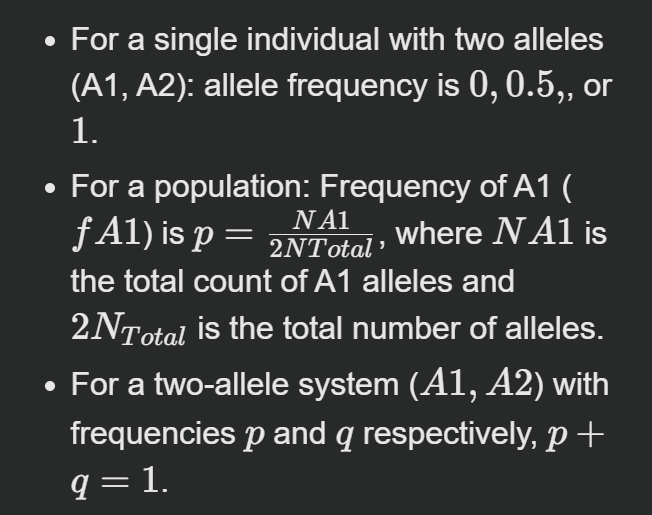
Evolution: Change in allele frequencies in a population over time.
Allele Frequency Calculation
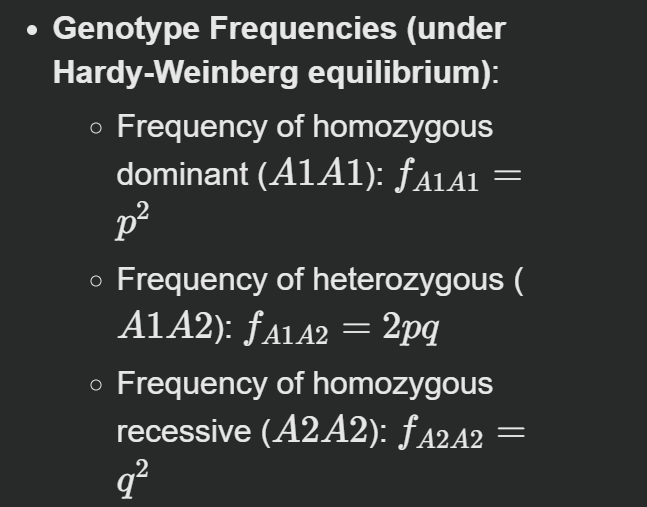
Genotype Frequencies (under Hardy-Weinberg equilibrium)
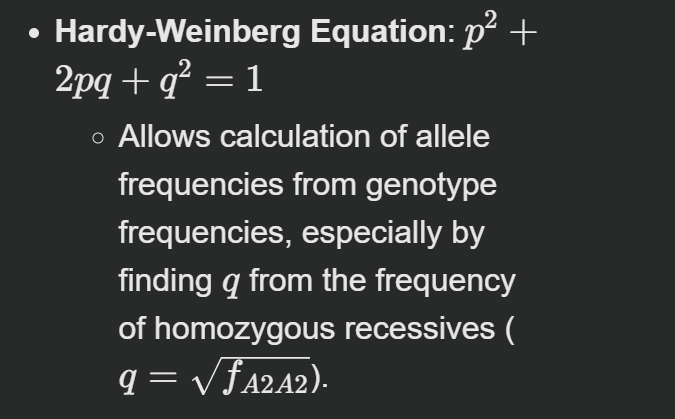
Hardy-Weinberg Equation: .
Hardy-Weinberg Equilibrium and Microevolutionary Mechanisms
Hardy-Weinberg Equilibrium (HWE): A population in which allele frequencies do not change (i.e., not evolving).
Conditions for HWE:
No migration (no individuals leave or enter).
Infinitely large population (no genetic drift).
Random mating.
No mutation (alleles do not change, new alleles are not introduced).
Equal survival and reproduction for all genotypes (no natural selection).
Significance: Deviations from HWE conditions indicate that evolution is occurring, and the specific condition violated suggests the acting microevolutionary mechanism.
Microevolutionary Mechanisms:
Migration (Gene Flow): Movement of individuals/alleles between populations.
Genetic Drift: Random changes in allele frequencies, significant in small populations (e.g., founder effect, bottleneck effect).
Nonrandom Mating: Mating preferences (e.g., by proximity or phenotype) leading to changes in genotype frequencies, measured by 'Frequency of Inbreeding' (F).
Mutation: Change in DNA sequence, introducing new alleles or changing existing ones; slow evolutionary force alone.
Natural Selection: Differential survival and reproduction among genotypes.
Absolute Fitness: Average offspring produced by a genotype.
Relative Fitness: Fitness of a genotype relative to the most fit genotype (scaled from to ).
Heterozygote Advantage: Heterozygotes have highest fitness, maintaining genetic variation.
Combined Forces: Microevolutionary forces can interact, leading to complex and sometimes different outcomes than when acting in isolation.