Unit 5
==5.1 The Role of Operations Management==
− keeping costs as low as possible will help to give competitive advantage
− the good or service must be suitable for the purpose intended
− the need to develop and adapt to new processes and new products is increasingly important in today’s dynamic business environment
The importance of close cooperation and interdependence between business functions (departments) can be illustrated by the following situations where these links did not exist:
- Operations continue to manufacture a product at the same output level even though it is experiencing declining sales.
- Operations have a new product innovation but it fails to be developed effectively owing to a shortage of finance.
- Operations’ plan to increase output in a factory by introducing a third daily shift of workers is not communicated to the human resources department.
- Operations identify a new location for the production facilities but the human resources department is not consulted.
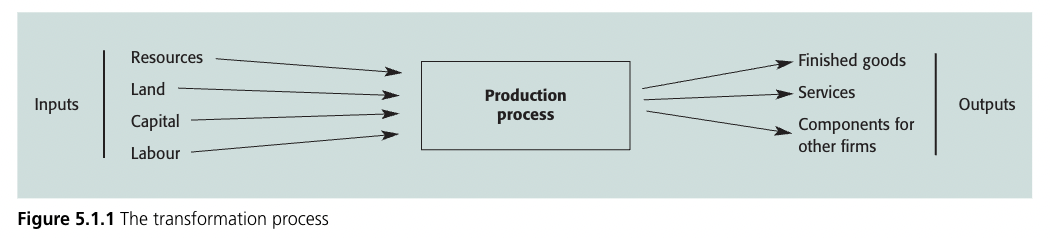
- the difference between the cost of purchasing raw materials andthe price the finished goods are sold for
The degree of value added to the inputs will depend on a number of factors – not all of them operations management issues:
- . Does this allow for economic manufacture, whilst appearing to have quality features that will enable a high price to be charged? Some customers are prepared to pay higher prices for products that offer better quality than cheaper substitutes.
- . For example, by reducing waste, the operations management department will increase the value added by the production process. Increasing productivity will reduce costs per unit and this will increase added value if the customer prices remain unchanged. So efficient operations processes and operations decisions are closely linked to valueadded.
- . A good example is the market for luxury ice creams, where the marketing campaigns increase the willingness of consumers to pay far in excess of input costs for the product.
Resources:
- – All businesses need somewhere to operate from, even if it is the bedroom of a sole trader operating an internet-based website design service. Some businesses, of course, require large sites for the extraction of minerals or the manufacture of finished products.
- – All business activity requires some labour input. This can be the manual labour of a gardener or the mental skills of a research scientist. The quality of the labour input will have a significant impact on the operational success of a business. The effectiveness of labour can usually be improved by training in specific skills – but trained workers will become sought after by other businesses and may leave.
- – This refers to the tools, machinery, computers and other equipment that businesses use to produce the goods and services they sell. The term capital can also mean the amount the owners of a business invest to set it up. Efficient operations often depend on capital equipment, and, in competitive markets, the more productive and advanced the capital, the greater the chance of business success.
- a capacity of ecosystems to maintain their essential functions and processes, andretain their biodiversity in full measure over the long term
- the ability of a community to develop processes and structures which not only meet the needs of its current members but also support the ability of future generations to maintain a healthy community
- within a business context, economic sustainability involves using the assets of the company efficiently to allow it to continue functioning profitability over time
==5.2 Production Methods==
- producing a one-off item specially designed for each customer
- producing a limited number of identical products – each item in the batch passes through one stage of production beforepassing on to the next stage
- producing items in a continually moving production line – also known as line production. This can be a continuous 24-hours-a-day method
- producing large quantities of a standardised product
- producing standardised goods, typically in bulk quantities, by using a continuous input of materials and other resources
- the use of flexible computer-aided production systems to produce items to meet individual customers’ requirements at mass production cost levels
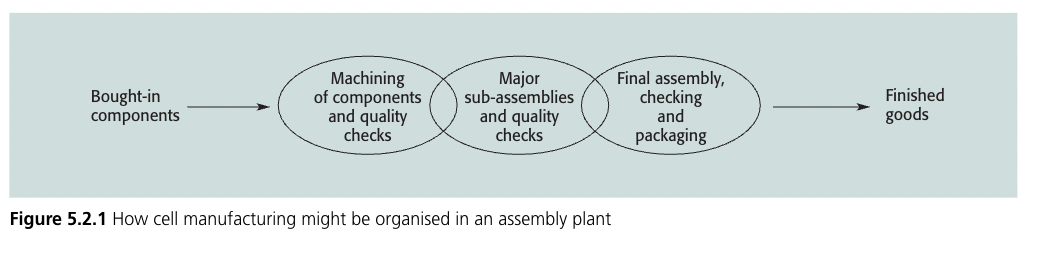
- a lean method of producing similar products using cells, or groups of team members, to facilitate operations by eliminating setup time between operations
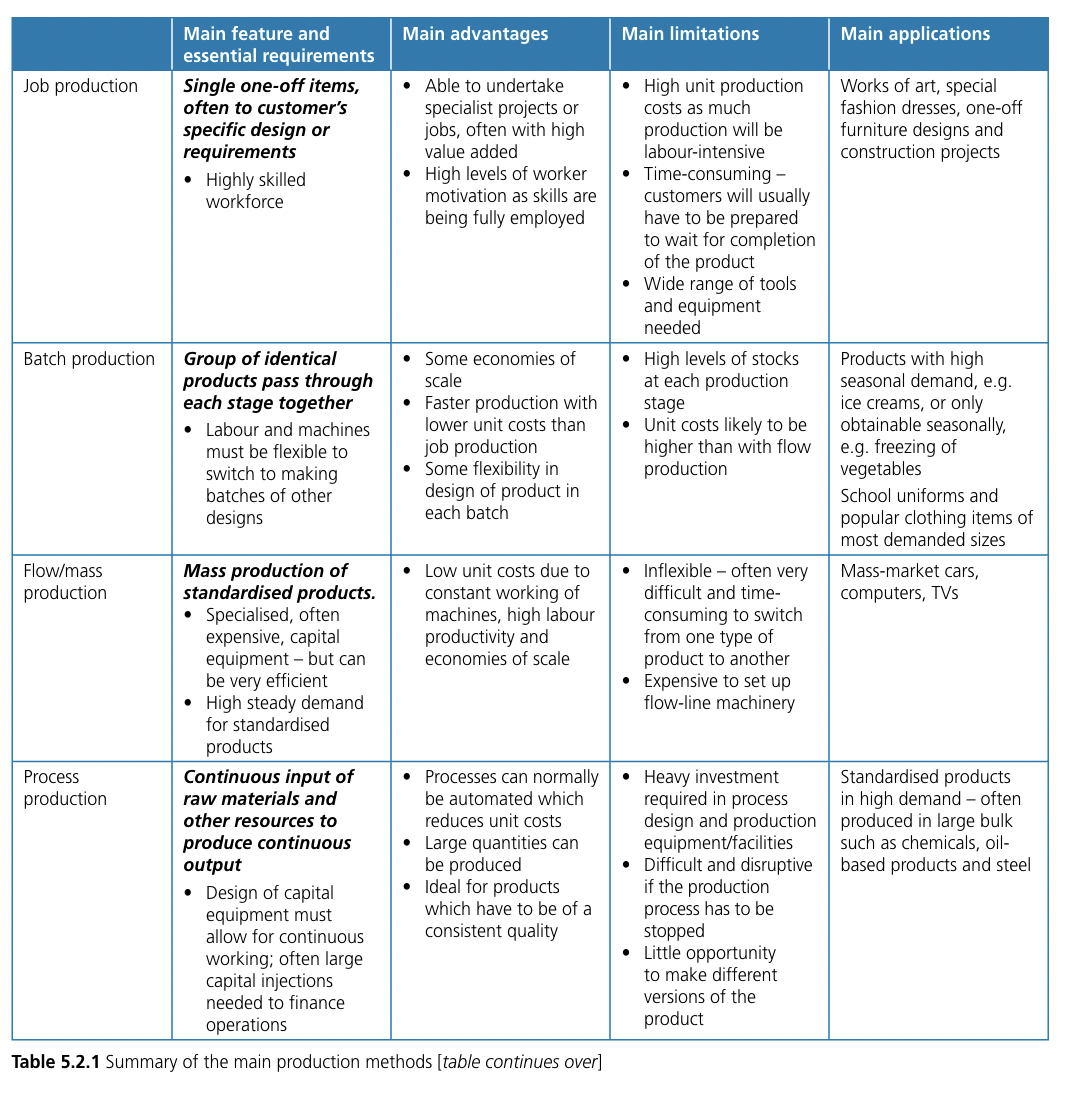
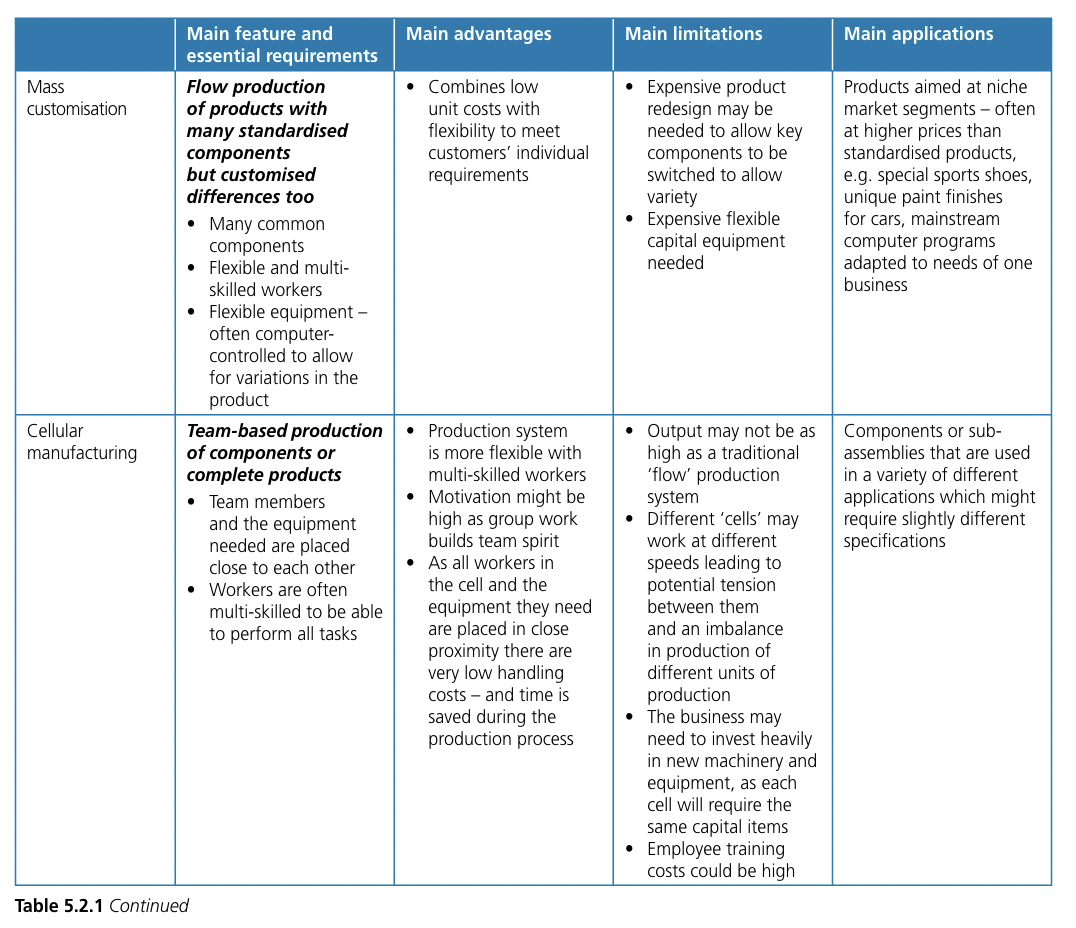
The following factors will influence which production method is appropriate for a particular business/product:
- . If the market is very small, such as for designer clothes, then job production is likely to be used. Flow production is most efficiently adopted when the market for similar or identical products is very large and consistent throughout the year. If mass production is used in this way, then mass-marketing methods will also have to be adopted to sell the high output levels that can be manufactured. Even in a market for mass-produced items, such as cars, there may be market niches that will allow smaller manufacturers to survive by making one-off products or batches of identical goods before changing the design or style for another model. If the market demands a large number of units, but at different times of the year – for example, textbooks at the start of the academic year – then batch production might be most appropriate.
- . A purpose-built flow production line is difficult and expensive to construct. Small firms are unlikely to be able to afford this type of investment and are more likely to use job or batch production.
- Large-scale flow production often requires a supply of relatively unskilled workers and a large, flat land area. Job production needs skilled craftspeople. If any of these resources are unavailable, or very limited in supply, then the production method may have to be adapted to suit available resources, given the market constraint referred to above.
- . If firms want the cost advantages of high volumes combined with the ability to make slightly different products for different markets, then mass customisation or a form of flexible cell manufacturing might be most appropriate. As was seen above, technology is giving businesses increasing flexibility to produce avariety of models from the one basic design and production process.
==5.3 Lean Production and Quality Management==
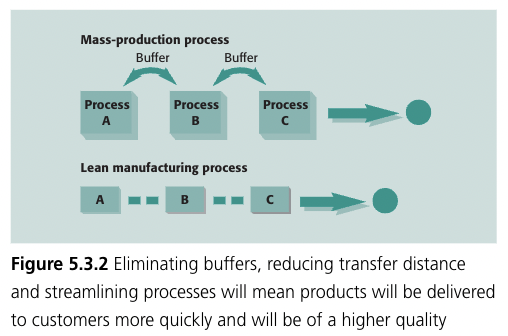
- producing goods and services efficiently with the minimum of waste resources while maintaining high quality
Less Waste:
- excessive transportation of components and products
- excessive stock-holding
- too much movement by working people, e.g. to get supplies of components
- waiting time – delays in the production process
- overproduction – producing ahead of demand
- over-processing – making goods that are too complex as they could have been designed more simply
- defects – products that do not come up to quality standards and have to be rejected or corrected
- the ratio of outputs to inputs during production, e.g. output per worker per time period
Efficiency and productivity can be increased by:
- improving employees’ skill levels
- improving workers’ motivation
- purchasing more technologically advanced equipment
- more effective management of labour and other resources
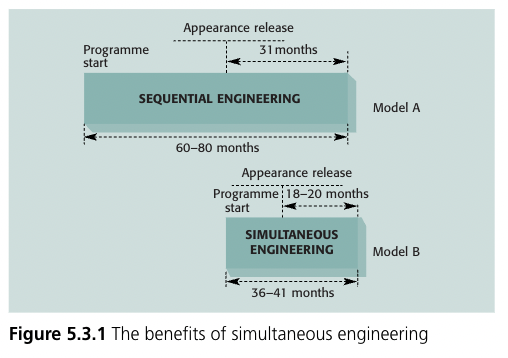
This is a method of developing new products by ensuring that essential design, market research, costing and engineering tasks are done at the same time as each other (simultaneously) – not one after the other (sequentially).
Changing from one design of product to another requires flexible working in three main areas:
- flexible employment contracts that allow non-core workers to be called in or not employed as demand conditions change
- flexible and adaptable machinery – often computer-controlled – that can be quickly switched from one design to another
- flexible and multi-skilled workers able to perform different jobs on different product ranges.
- Japanese term meaning ‘continuous improvement
Conditions necessary for continuous improvement and kaizen groups to operate:
- Management culture must be directed towards involving staff and giving their views and ideas importance −managers must accept that, in many areas of the business, work experience will count for as much as theoretical knowledge.
- Team-working – suggesting and discussing new ideas to improve quality or productivity is best done in groups. These kaizen groups are likely to be drawn from the work team – or cell – operating in the place of work. Kaizen groups should meet regularly to discuss problems that they have identified. This requires management to provide the time and necessary training. Recommendations for change could then be put forward to managers, or each group may be empowered to put their own ideas into practice.
- Empowerment – giving each kaizen group the power to take decisions regarding workplace improvements allows speedier introduction of new ideas and motivates employees to come up with even more ideas. This suggestion is linked with the work of Herzberg and the concept of job enrichment.
- All employees should be involved.
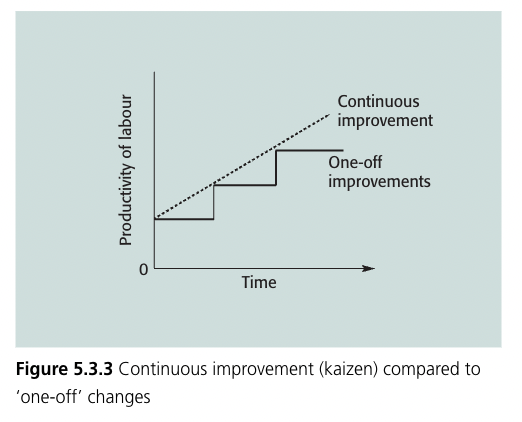
==Cons of Kaizen:==
- Some changes cannot be introduced gradually and may need a radical and expensive solution, e.g. the need for Kodak to invest heavily in the manufacture of digital cameras rather than ‘paper-film’-based cameras when the new technology was introduced.
- There may be very real resistance from senior managers to such a programme due to their existing culture. Kaizen will only work effectively if there is genuine empowerment of the groups involved – authoritarian managers would find this impossible to accept.
- At least in the short term there may be tangible costs to the business of such a scheme, such as staff training to organise meetings and lost output as a result of meeting time.
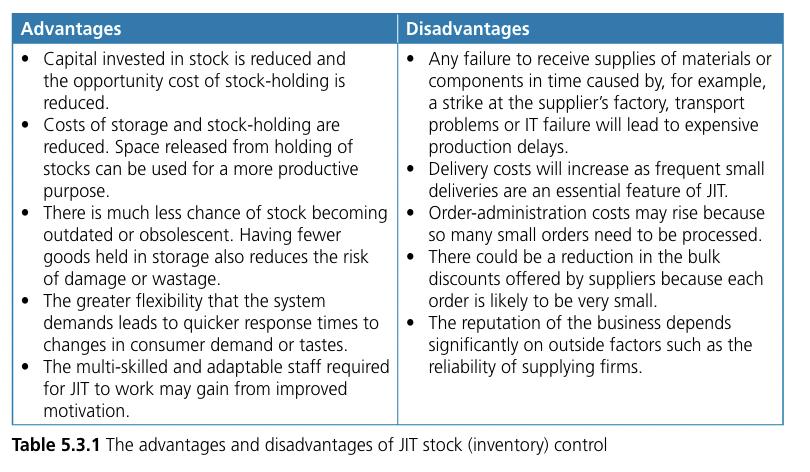
- this stock-control method aims to avoid holding stocks by requiring supplies to arrive just as they are needed in production and completed products are produced to order
%%For JIT to work effectively these conditions must be met%%:
- Relationships with suppliers have to be excellent.
- Production staff must be multi-skilled and prepared to change jobs at short notice.
- Equipment and machinery must be flexible.
- Accurate demand forecasts will make JIT a much more successful policy.
- The latest IT equipment will allow JIT to be more successful.
- Quality must be everyone’s priority.
- Japanese manufacturing system in which the supply of components is regulated through the use of an instruction card sent along the production line
%%When and how kanbans are effective:%%
- Kanbans help simplify planning and match production to meet changing customer demand.
- The system requires planned monthly and weekly production schedules.
- Kanban cards simplify day-to-day flexibility, and changes to the production schedule need only to be given to the final assembly process and will then automatically work their way back up the line.
- Kanban systems can be made more ‘lean’ by removing cards or by reducing the number of parts on a pallet. The effect will be to speed the flow through the process and hence reduce lead times. However, it also makes the system more vulnerable to breakdowns and other causes of dislocation. By identifying the areas within the line that are causing delay, efforts can be focused to improve them. The overall efficiency of the line is raised by overcoming these problem areas.
- a manufacturing term referring to a system to notify management, maintenance, and other workers of a quality or process problem
%%Benefits of andon systems:%%
- Immediate attention to manufacturing problems is raised.
- The system provides a simple and consistent mechanism for communicating information in the factory.
- Andons can lead to immediate reaction to quality, down time and safety problems.
- Andon systems increase employees’ accountability and empower them to take action when problems occur.
- Andons improve the ability of supervisors to quickly identify and resolve manufacturing issues.
- a manufacturing principle that seeks to create production techniques that are not just efficient but are essentially waste-free and truly sustainable.
- a good or service that meets customers’ expectations and is therefore ‘fit for purpose’
- the expectations of customers expressed in terms of the minimum acceptable production or service standards
- this is based on inspection of the product or a sample of products
- a system of agreeing and meeting quality standards at each stage of production to ensure consumer satisfaction
There are three stages to effective quality control:
- – This is the most effective way of improving quality. If the design of theproduct follows the requirements of the customer and allows for accurate production, then the other two stages will be less significant. Quality should be ‘designed into’ a product.
- – Traditionally this has been the most important stage – but it has high costs and these could be reduced by ‘zero-defect’ manufacturing which is the aim of total quality management.
- – This is not just about correcting faulty products, but is also concerned with correcting the process that caused the fault in the first place. This will improve quality in the future.
Quality Assurance Stages:
- – Will the product meet the expectations of consumers?
- – Quality must not be let down by bought-in components. Suppliers will have to accept and keep to strict quality standards.
- – This can be assured by total quality management (TQM) and emphasising with workers that quality levels must not drop below preset standards.
- – Customers need goods and services delivered at times convenient to them. The punctuality and reliability of delivery systems must be monitored.
- – Continued customer satisfaction will depend on the quality of contact with consumers after purchase.
- involves management identifying the best firms in the industry and then comparing the performance standards– including quality – of these businesses with those of their own business
Stages in the benchmarking process:
- – this could be decided by interviewing customers and finding out what they consider to be most important
- – for example, reliability records, delivery records and the number of customer complaints
- – this process might be assessed by management consultants or by benchmarking schemes operated by government or industry organisations
- – this data might be obtained from firms by mutual agreement, from published accounts, specialist industry publications and contact with customers/suppliers
- – these might be the standards set by the best firms or they could be set even higher to create a competitive advantage
- – this may require nothing more than a different way of performing one task, but more substantial changes may be necessary
- – the changes to the process need to be checked to see if the new, higher standards are being reached. Benchmarking is not a one-off exercise and to be effective it should become a continuous process to achieve long-term improvements in productivity and quality
- groups of employees who meet regularly to discussways of resolving problems and improving production and quality in their department/organisation
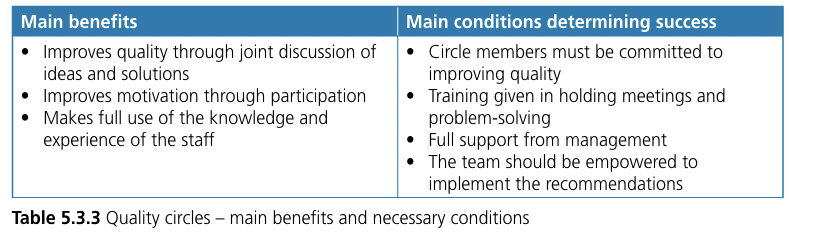
- an approach to quality that aims to involve all employees in the quality-improvement process
- people within the organisation who depend upon the quality of work being done by others
- the aim of achieving perfect products every time
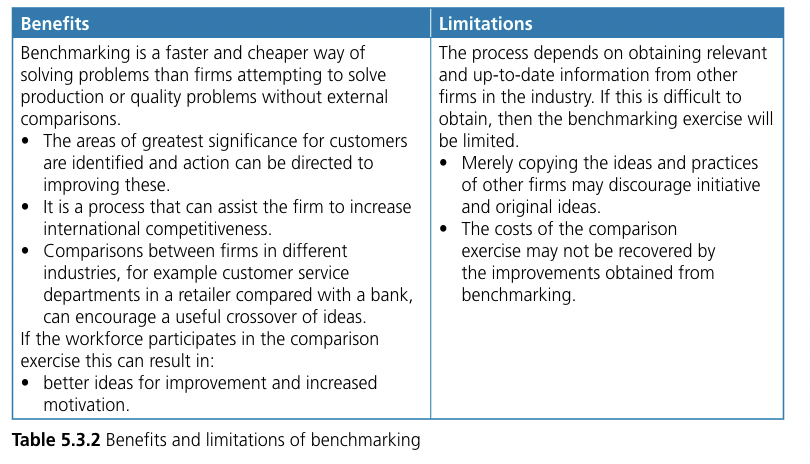
- is a production method aimed primarily at reducing times within the production system as well as response times from suppliers and to customers
%%Main advantages of lean production:%%
- Waste of time and resources is substantially reduced or eliminated
- Unit costs are reduced, leading to higher profits
- Working area is less crowded and easier to operate in
- There is less risk of damage to stocks and equipment
- New products are launched more quickly
- this is an internationally recognised certificate that acknowledges the existence of a quality procedure that meets certain conditions
To obtain the ISO 9000 certificate the firm has to demonstrate that it has:
- staff training and appraisal methods
- methods for checking on suppliers
- quality standards in all areas of the business•procedures for dealing with defective products and quality failures
- after-sales service
==5.4 Location==
- a business location that gives the best combination of quantitative and qualitative factors
- these are measurable in financial terms and will have a direct impact on either the costs of a site or the revenues from it and its profitability
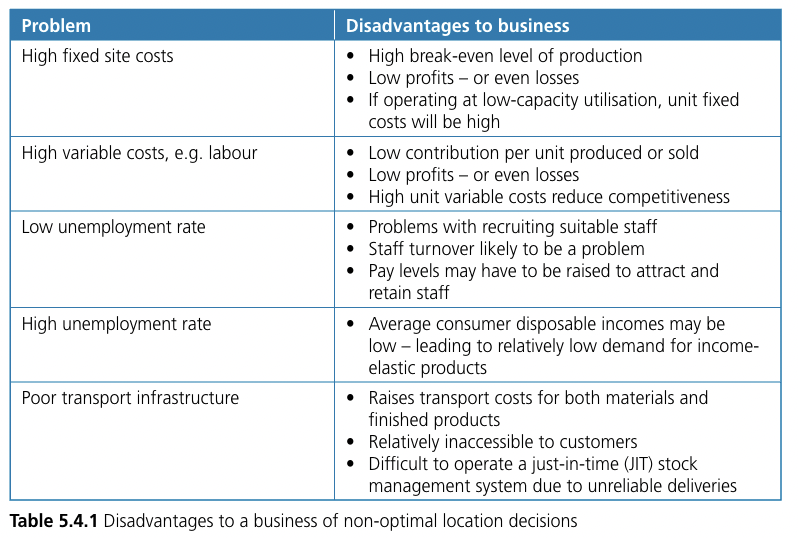
Once these quantitative factors have been identified and costs and revenues estimated, the following techniques can be used to assist in the location decision:
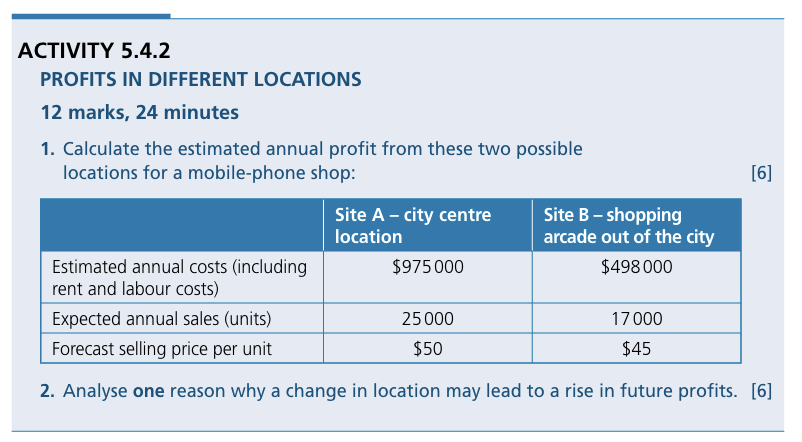
- By comparing the estimated revenues and costs of each location, the site with the highest annual potential profit may be identified
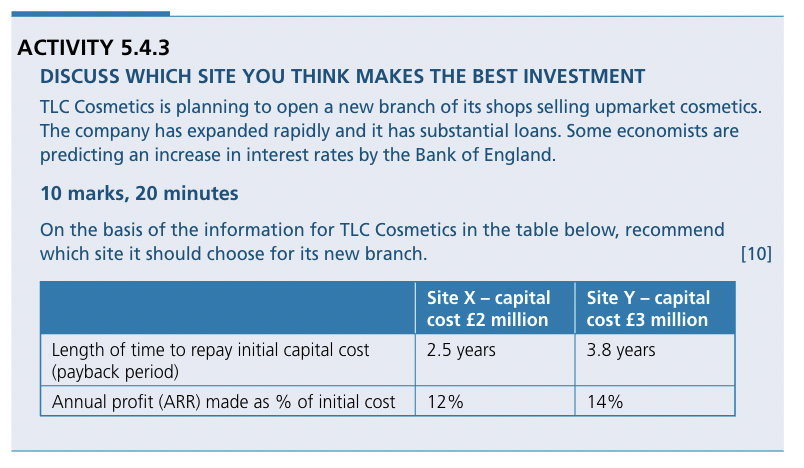
- Location decisions often involve a substantial capital investment. Investment appraisal methods can be used to identify locations with the highest potential returns over a number of years. The simplest of these, the payback method, can be used to estimate the location most likely to return the original investment most quickly. This could be of particular benefit to a business with a capital shortage or in times of economic uncertainty. Calculating the annual profit as a percentage of the original cost of each location is another useful measure.
- This is a straightforward method of comparing two or more possible locations. The lower the break-even level of output the better the site is, other things being equal. This information might be particularly important for businesses that face high levels of fixed costs and which may benefit from a location with lower overheads.
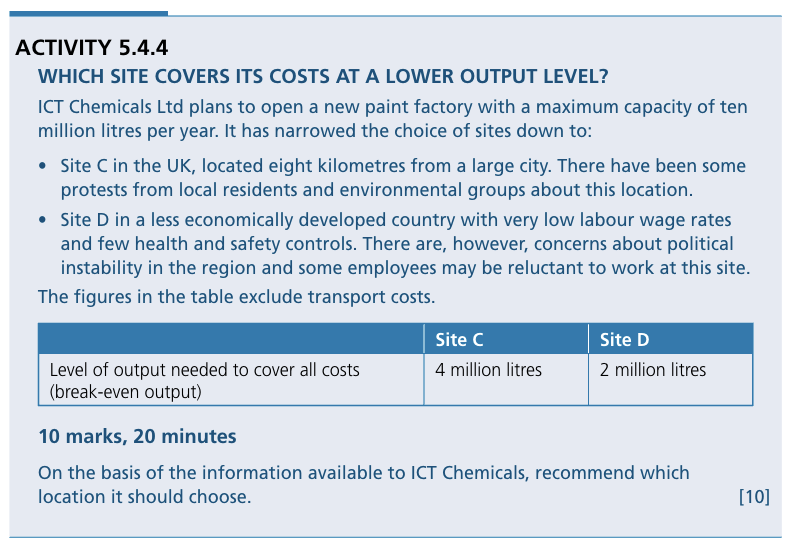
- non-measurable factors that may influence business decisions:
- Safety
- Room for further expansion
- Manegers Preference
- Labour Supply
- Ethical Consideration
- Environmental Concerns
- Infrastructure
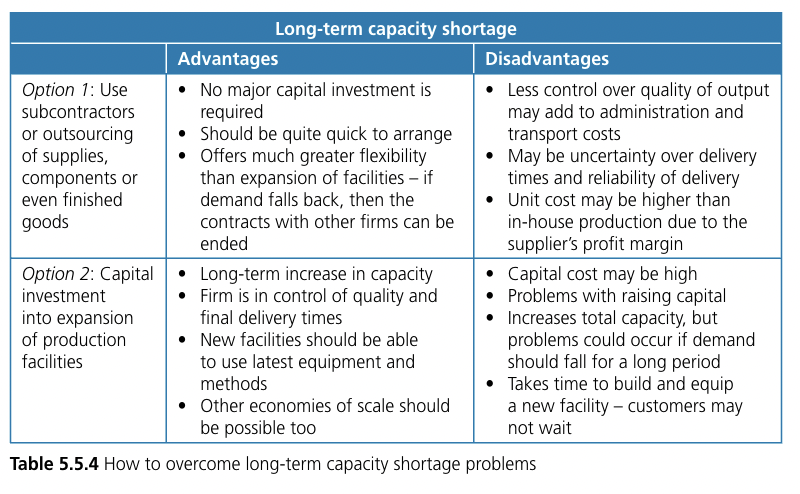
- using another business (a ‘third party’) to undertake a part of the production process rather than doing it within the business using the firm’s own employees
- the practice of assigning to another business (the subcontractor) part of a contract – for example, a specialist activity that makes up part of a construction contract
These are the other major reasons for outsourcing:
- Reduction and control of operating costs
- Increased flexibility
- Improved company focus
- Access to quality service or resources
- Freed-up internal resources
- Loss of jobs within the business
- Quality issues
- Customer resistance
- Security
- a form of outsourcing that uses a third party to take responsibility for complete business functions, such as HR and finance
- the relocation of a business process done in one country to the same or another company in another country
%%Pros:%%
- Access To Affordable Labor and A Diverse Talent Pool
- Cost Savings and Financial Incentives
- 24/7 Operational Capability
- Increase in Operational Autonomy
- Sustainable Scaling Opportunity
- Access to a Global Marketplace
==Cons:==
- Time zone differences
- Cultural and language barriers
- Quality control issues
- Security and intellectual property (IP) issues
- Payrolling and compliance issues
- Negative image due to a loss of domestic jobs
- Day-to-day operational challenges
- a business with operations or production bases in more than one country
- the reverse of outsourcing as it is undertaking a business function or process within the business rather than contracting it to another business
- ending offshoring contracts with overseas suppliers and returning functions or processes to business operations in the home country
%%Pros%%:
- Functional Security
- Close location
- Greater flexibility
- Transparent supply chain logistics
- Familiar political system
==Cons==:
- Lower degree of competitiveness
- Lack of brand recognition
- Limiting of development
- Possible higher logistics
==5.5 Production Planning==
- every business that comes into contact with a particular product– for example, the supply chain for most products will be all the businesses manufacturing parts for the product, assembling it, delivering it and selling it
- materials and goods required to allow for the production and supply of products to the customer
- this stock-control method aims to avoid holding stocks by requiring supplies to arrive just as they are needed in production and completed products are produced to order
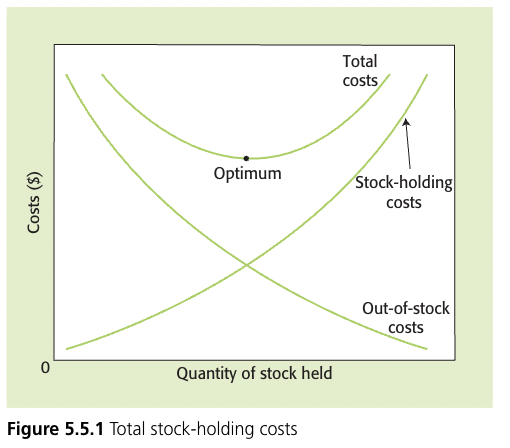
- the stock management strategy that businesses use when they hold a high level of stocks because there is a risk of ‘stock-out’
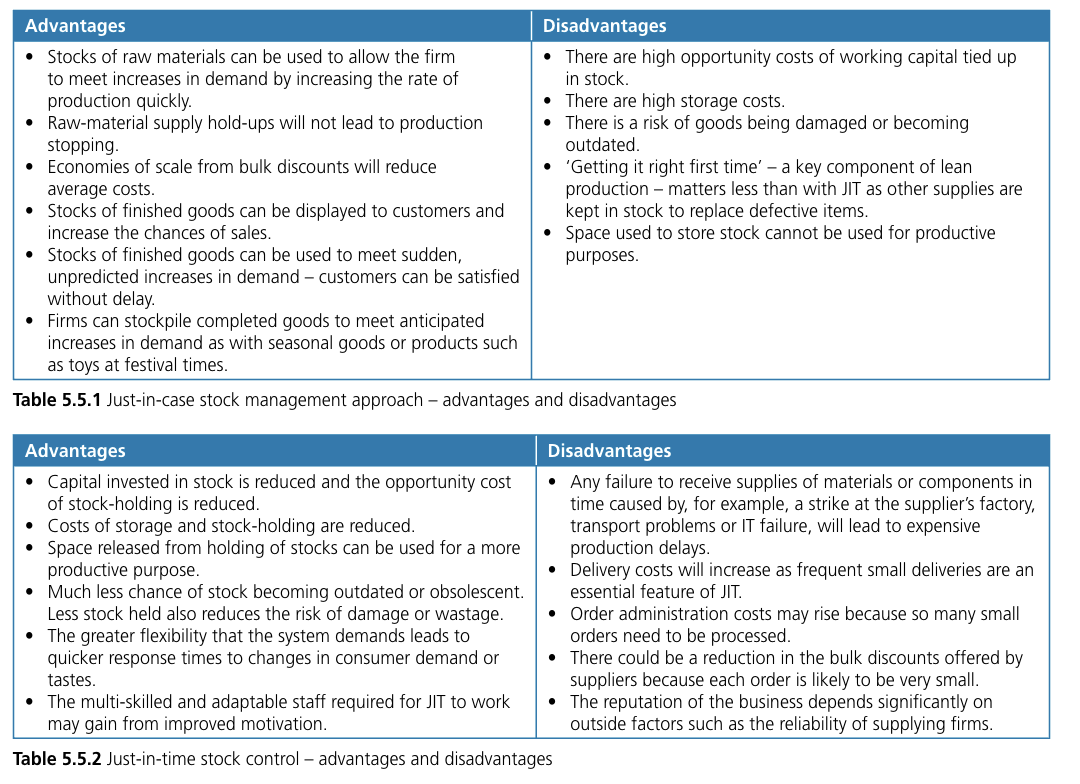
- costs associated with storing unsold inventory:
- Opportunity cost
- Storage costs
- Risk of wastage and obsolescence
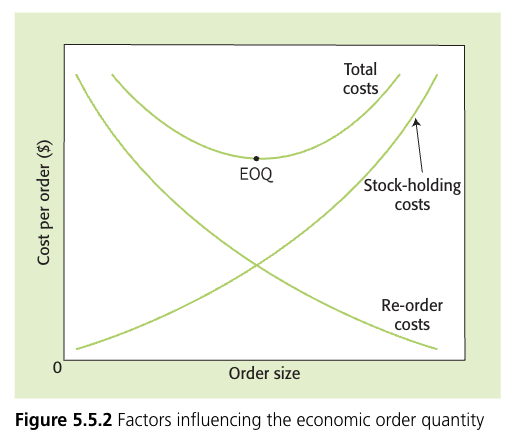
- the optimum or least-cost quantity of stock to re-order taking into account delivery costs and stock-holding costs:
- Lost sales.
- Idle production resources.
- Special orders could be expensive.
- Small order quantities.
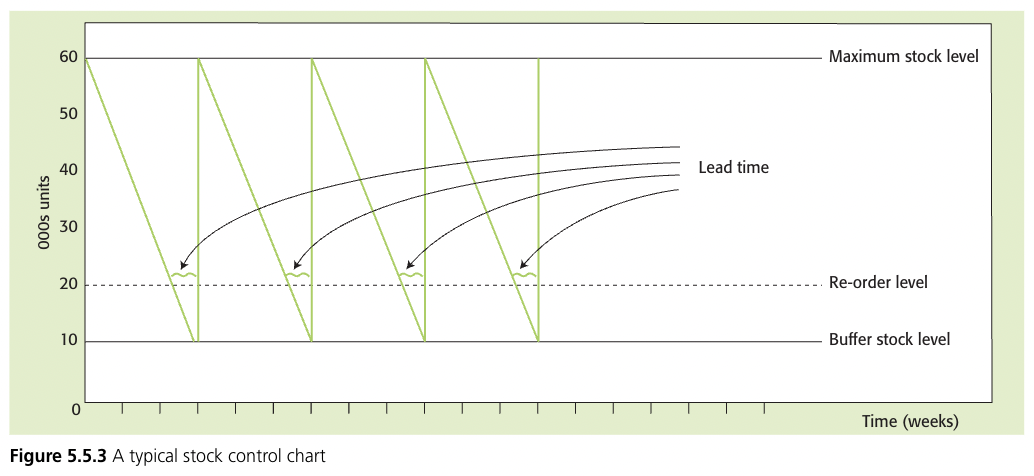
- Buffer stocks.
- Maximum stock level.
- Re-order quantity. This will be influenced by the economic order quantity concept referred to above
- Lead time.
- Re-order stock level
- the proportion of maximum output capacity currently being achieved

- when a business produces at maximum output
- exists when the current levels of demand are less than the full capacity output of a business – also known as spare capacity
- the ratio of outputs to inputs during production, e.g. output per worker per time period
- the number of units produced during a time period \n Raising productivity levels:
- Improve the training of employees to raise skill levels
- Improve worker motivation
- Purchase more technologically advanced equipment
- More efficient management
==5.6 Research Development==
- the practical application of new inventions into marketable products
Research and development (R&D) - the scientific research and technical development of new products and processes
- the formulation or discovery of new ideas for products or processes
- refers to creations of the mind such as inventions, literary and artistic works and symbols, names, images and designs used in business
- legal property rights over the possession and use of intellectual property
- legal right to protect and be the sole beneficiary from artistic and literary works
- a distinctive name, symbol, motto or design that identifies a business or its products – can be legally registered and cannot be copied
- legal right to be the sole producer and seller of an invention for a certain period of time
Several factors may influence the R&D strategy and the level of R&D spending of a business:
- The nature of the industry
- The R&D and innovation spending plans of competitors
- The risk profile or culture of the business
- Finance is needed for effective R&D
- Ethical considerations
==5.7 Crisis Management and Contingency Planning==
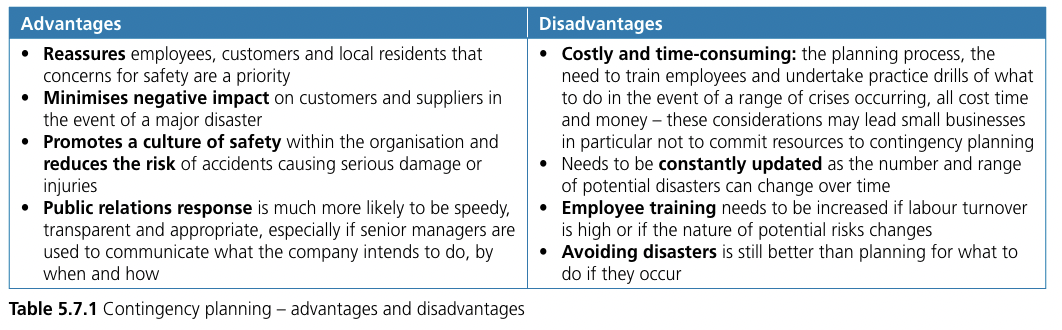
- preparing the immediate steps to be taken by an organisation in the event of a crisis or emergency
- steps taken by an organisation to limit the damage from a significant, damaging event by handling, containing and resolving it
Key steps in contingency planning:
- Identify the potential disasters that could affect the business
- Assess the likelihood of these occurring
- Minimise the potential impact of crises
- Plan for continued operations of the business