midterm review
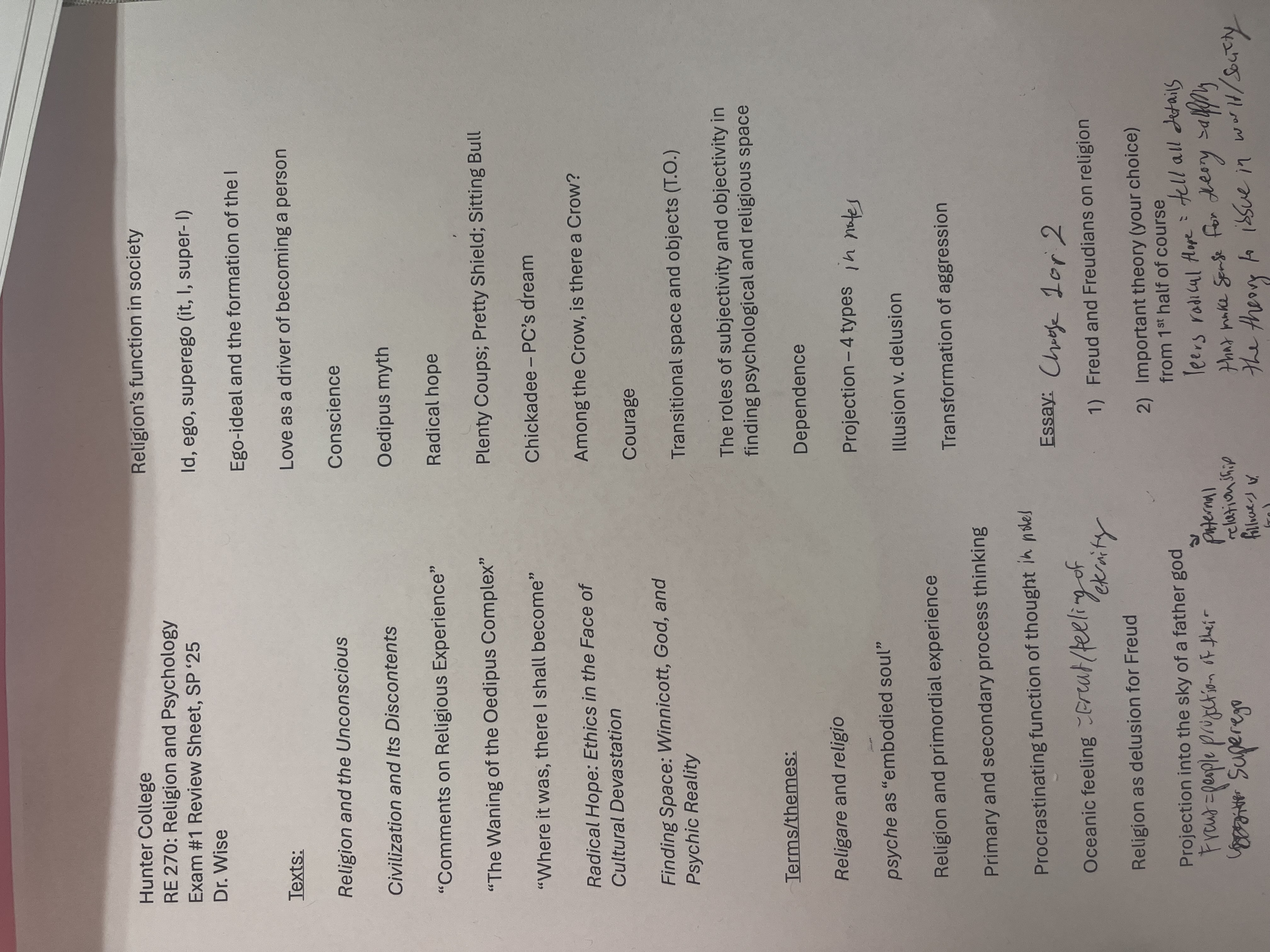
Terms
“religion and the unconscious” *
religare = To bind oneself back to (God)/ religio= Sense of duty obligations in a religious or moral sense
Psyche= study of the embodied= interconnectedness of physical body and spiritual/mental essence (integration of mind-body and spirit )
Embodied soul= psyche is not an independent essence, but deeply tied to bodily existence
Religion and primordial experience= primordial experiences are the raw preconceptual and universal encounters with reality that give rise to religious beliefs, rituals, and traditions
Religion originates in primordial experiences—deep, existential encounters with life, death, nature, and the transcendent. Over time, these experiences are ritualized, symbolized, and institutionalized into religious traditions. Understanding this dynamic helps explain the universal nature of religious belief and why people continue seeking profound experiences of the sacred today.
Carl Jung’s Archetypes and the Collective Unconscious – Jung suggests that religious symbols emerge from deep, universal patterns of human experience (archetypes) that are rooted in primordial psychological structures.
In Freudian psychoanalysis, the procrastinating function of thought refers to the mind’s ability to delay action or impulse through thinking, allowing time for rational evaluation before acting on desires or instincts. This function is primarily governed by the ego, which mediates between the primitive urges of the id and the constraints of reality.
1. Freud’s Perspective on Thought and Delay
Freud saw thought as a substitute for action, particularly in situations where direct gratification of an impulse is not possible or socially unacceptable.
In early childhood, the pleasure principle dominates, meaning desires seek immediate satisfaction (primary process thinking).
As the ego develops, it introduces the reality principle, which forces a delay in action through mental processes like reasoning, planning, or imagination (secondary process thinking).
This ability to "procrastinate" action through thought is a psychic defense mechanism that protects individuals from acting impulsively and allows for more adaptive behavior.
2. Mechanisms of Thought as Procrastination
Fantasy and Daydreaming – Instead of acting on a desire immediately, the mind imagines its fulfillment, offering a temporary substitute.
Rationalization and Intellectualization – The ego engages in logical thinking or philosophical contemplation to delay confronting emotions or impulses.
Doubt and Indecision – When an action provokes anxiety, the ego may prolong decision-making, keeping the individual in a state of mental deliberation.
Symbolic Substitution – Unconscious desires may be expressed through dreams, jokes, or creative works, postponing their direct fulfillment.
3. The Procrastinating Function in Neurosis
Freud linked obsessional thinking to the procrastinating function of thought, particularly in obsessive-compulsive neurosis (OCD).
Obsessive individuals may engage in endless rumination and overthinking as a way of avoiding real-world decisions or actions that provoke anxiety.
This mechanism serves as a compromise: the unconscious impulse is neither fully repressed nor acted upon but is instead suspended in thought.
4. Adaptive vs. Maladaptive Procrastination in Thought
Adaptive – Allows for better decision-making, strategic planning, and moral reasoning.
Maladaptive – Leads to excessive hesitation, self-doubt, and avoidance of action, often seen in anxiety disorders.
Freud’s idea suggests that while the mind’s ability to delay action through thought is essential for maturity, excessive procrastination can become a form of psychological avoidance.
Conclusion
Freud’s concept of the procrastinating function of thought highlights how the mind delays action through thinking as a way to regulate impulses, emotions, and anxiety. While this function supports self-control and planning, excessive reliance on it can lead to indecision, overthinking, and neurotic symptoms.
3. The Oceanic Feeling and the Development of the Ego
Freud suggests that the sense of self develops gradually, beginning with an early stage in which the infant perceives no boundary between itself and its surroundings.
As the ego forms, the child learns to differentiate between "self" and "other," leading to a loss of this original feeling of unity.
He speculates that the oceanic feeling may be a regression to this pre-ego state, where the boundaries of self dissolve, explaining why some experience it as a mystical or religious revelation.
4. Freud’s Critique of the Oceanic Feeling as a Basis for Religion
Freud rejects the idea that the oceanic feeling serves as proof of a divine or transcendent reality.
Instead, he sees it as a psychological residue of early childhood, rather than evidence of a true cosmic connection.
He argues that religious belief is rooted not in this feeling but in the human need for protection, particularly the desire for a father figure (which he links to the God-image).
The oceanic feeling, as discussed by Freud, is a sense of boundlessness and unity with the universe, which he traces back to early childhood experiences before the ego fully develops. While some see it as the foundation of religious belief, Freud interprets it as a psychological remnant rather than proof of a divine reality. His analysis fits into his broader critique of religion as an illusion rooted in human psychological needs.
n his works, particularly The Future of an Illusion (1927) and Civilization and Its Discontents (1930), Sigmund Freudargues that religion is a psychological delusion, a creation of the human mind designed to provide comfort and protection against the harsh realities of life. He views religious beliefs as wish-fulfillments, shaped by deep-seated psychological needs rather than objective truths.
1. Religion as a Psychological Defense Mechanism
Freud believes that religion arises from human anxiety and helplessness, particularly in response to suffering, death, and the forces of nature.
He argues that early human societies personified natural forces (e.g., storms, disease, death) into divine beingsto make them seem controllable.
Religion, therefore, serves as a psychological defense, providing a sense of order and protection in an unpredictable world.
2. The Illusion of a Protective Father Figure
Freud compares religious belief to a child’s relationship with their father:
Just as a child relies on their father for protection and guidance, religion offers a heavenly father figure (God) to protect humans from suffering.
He argues that this need for parental security persists into adulthood, and religious belief fulfills this unconscious longing.
Since religion fulfills deep psychological desires rather than being based on evidence, Freud classifies it as an illusion.
3. Religion and Wish-Fulfillment
Freud defines illusions as beliefs based on wishes rather than reason.
He contrasts illusions with delusions:
An illusion is a belief based on a psychological need (e.g., "God will reward me for my suffering").
A delusion is a false belief detached from reality, often linked to mental illness.
While Freud does not outright call religion a delusion in the clinical sense, he does argue that it functions as a collective delusion, shaping human thought and behavior based on irrational hopes rather than reality.
4. Religion as a Source of Repression and Guilt
In Civilization and Its Discontents, Freud connects religion to guilt and repression, particularly through the superego:
Religious morality often demands suppression of instinctual drives (e.g., sexual desires, aggression).
This leads to internalized guilt, where individuals repress their desires to conform to religious laws.
As a result, religion contributes to psychological suffering, forcing individuals into conflict between their instincts and moral expectations.
5. Religion and Civilization: A Necessary Illusion?
Despite his criticism, Freud acknowledges that religion played a role in shaping civilization, providing moral order and social cohesion.
However, he believes that as science and rationality progress, humanity should outgrow religious illusions.
He argues that replacing religion with a scientific worldview would allow people to face reality more honestly, even if it means confronting life's harshness without the comfort of divine protection.
Conclusion
Freud sees religion as an illusion rooted in human psychological needs, particularly the desire for protection, order, and a father figure. He argues that religious beliefs are wish-fulfillments rather than rational truths and that they contribute to guilt, repression, and psychological suffering. While he acknowledges religion’s role in civilization, he ultimately sees it as a collective delusion that humanity should outgrow in favor of science and reason.
Projection of the Father-God into the Sky = belief in God is a psychological projection, specifically an idealized father figure projected onto the sky or the heavens. Freud suggests that human beings project their unconscious fears, desires, and need for security onto an external divine figure.
In childhood, the father plays a central role in providing protection, authority, and discipline.
As people grow up, the need for a protective father remains, but since their biological father is no longer all-powerful, they transfer (or project) this need onto a divine father—God.
This process, Freud argues, is largely unconscious and serves as a way to cope with feelings of helplessness in an unpredictable world.
According to Freud, belief in a father-God is not based on rational evidence but rather on wish-fulfillment, a concept central to his psychoanalytic theory.
The desire for protection, justice, and order is deeply ingrained in human psychology, leading people to invent a God who fulfills these needs.
This belief system reduces existential anxiety and provides comfort, much like a child seeking reassurance from a parent.
function of religion in society = Psychological Comfort and Coping Mechanism (Freud & William James)
Religion helps individuals cope with existential fears, such as death, suffering, and uncertainty.
It provides a sense of meaning and purpose, reducing anxiety about life's unpredictability.
Rituals, prayers, and religious communities offer emotional support in times of crisis.
✅ Example: People turn to religion after the loss of a loved one, seeking comfort in beliefs about an afterlife or divine justice.
id ego supergo= The id is the most primitive part of the psyche, operating on instincts, desires, and impulses.
🔹 Function: It seeks immediate pleasure and avoids pain, following the pleasure principle.
🔹 Characteristics:Present at birth.
Driven by basic biological needs (hunger, thirst, sex, aggression).
Completely unconscious (we are not aware of its workings).
Irrational, impulsive, and selfish.
Uses primary process thinking (fantasy, wish fulfillment).
The ego is the rational, conscious part of the psyche that mediates between the id, superego, and reality.
🔹 Function: It operates on the reality principle, meaning it delays gratification and makes practical decisions.The superego represents internalized moral standards, social norms, and ideals.
🔹 Function: It acts as the conscience, making us feel guilt, shame, or pride based on our actions🔹 Freud called id “It” because it represents the impersonal, chaotic forces within us that we don’t fully control.
ego = The “I” represents our conscious sense of self—the part of us that interacts with the world and makes practical choices.
superego =Freud called it the “Super-I” because it acts like a higher, overseeing force that criticizes and judges our actions.
Ego-Ideal and the Formation of the "I" in Freud’s Theory= The ego-ideal is the part of the superego that represents our aspirations, ideals, and the image of the “perfect self” we strive to become.
🔹 It is formed through identification with admired figures (parents, teachers, role models) and social values.
🔹 The ego-ideal motivates us to achieve moral and social excellence but can also lead to feelings of inadequacy if we fail to meet its high standards.Freud describes the formation of the "I" (Ego) as a developmental process influenced by:
A. Differentiation from the "It" (Id)
The infant starts life dominated by the id ("It"), seeking instant gratification (hunger, comfort, pleasure).
As the child interacts with reality, the ego ("I") develops to mediate between the id's desires and external constraints (parents, society).
✅ Example: A baby wants to eat candy (id), but through experience, it learns to wait until after dinner (ego control).
B. Influence of the "Super-I" (Superego)
The child internalizes moral standards from parents and culture.
The superego splits into two parts:
The Ego-Ideal (what we aspire to be).
The Conscience (what we should not do).
This moral structure helps shape a stable sense of self ("I").
Love as a Driver of Becoming a Person
Love plays a fundamental role in human development, identity formation, and self-actualization.
Love and the Formation of the Self
From birth, human beings are dependent on love and attachment for survival and identity development.
A. Early Attachment and Identity (Object-Relations Theory)
Psychoanalysts like Freud and Winnicott emphasize that a child's earliest experiences of love (from parents or caregivers) shape their self-image.
Through mirroring love and care, the child develops a sense of self-worth and an ability to relate to others.
Without love, the self remains fragmented, leading to difficulties in forming relationships and a stable identity.
✅ Example: A child who experiences unconditional love develops confidence and emotional security, while one deprived of love may struggle with self-esteem and trust.
2. Love and the “I” (Ego Formation in Psychoanalysis)
Freud and Lacan suggest that the self (“I”) is shaped through relationships with others, especially through love and recognition.
The ego-ideal (the ideal version of ourselves) is often constructed through love for and identification with role models (parents, partners, mentors).
In love, we see a reflection of who we want to become, shaping our personal growth.
Love is not just an emotion but a transformative force that helps people develop a sense of self, moral awareness, and emotional depth.
It allows individuals to move beyond self-centered desires toward self-actualization, wisdom, and connection with others.
Texts summaries
William James’ “Comments on Religious Experience” is part of his larger work The Varieties of Religious Experience(1902), where he analyzes religion from a psychological and philosophical perspective. Below are key notes summarizing his insights:
1. Definition of Religious Experience
James defines religious experience as deeply personal, emotional, and often transformative rather than just institutional or doctrinal.
He focuses on how individuals experience religion subjectively, rather than examining religious traditions from a theological perspective.
Religious experiences can be mystical, emotional, or intellectual but always involve a profound sense of connection to the divine or transcendent reality.
✅ Example: A moment of deep inner peace, mystical visions, or a feeling of divine presence.
2. Types of Religious Experience
James categorizes religious experiences into two main types:
A. The Healthy-Minded
These individuals have a naturally positive religious experience, seeing the world as fundamentally good.
Their religion is often optimistic and joyful, emphasizing love, happiness, and divine grace.
Healthy-mindedness can be achieved through voluntary self-suggestion, where one chooses to focus on positive spiritual emotions.
✅ Example: Christian belief in divine love and forgiveness.
B. The Sick Soul
These individuals experience religion through suffering, guilt, and struggle.
They often have a pessimistic view of the world, seeing it as filled with sin, evil, and suffering.
Their religious experience is shaped by inner turmoil and the need for redemption.
✅ Example: Augustine’s Confessions, where he describes deep guilt before his conversion.
3. The Process of Religious Conversion
James explores how religious experiences transform individuals.
Conversion often involves a dramatic shift in consciousness, where a person moves from doubt, fear, or suffering to faith and spiritual peace.
He distinguishes between gradual conversions (slow spiritual awakening) and sudden conversions (instant transformation).
✅ Example: St. Paul’s sudden conversion on the road to Damascus.
4. Mystical Experiences
James argues that mystical experiences are one of the purest forms of religious experience, often involving:
Ineffability – Difficult to describe in words.
Noetic quality – A sense of gaining deep knowledge or insight.
Transience – The experience is brief but impactful.
Passivity – The individual feels overtaken by a higher power.
✅ Example: Buddhist enlightenment or Christian contemplative visions.
5. Pragmatic Approach to Religion
James does not argue for or against the truth of religion but takes a pragmatic approach, asking:
What effects do religious experiences have on people’s lives?
Do they lead to greater happiness, moral improvement, or deeper wisdom?
He suggests that religious beliefs should be evaluated based on their practical benefits rather than strict theological correctness.
✅ Example: A person who finds meaning and peace through religious faith, even if the truth of the belief cannot be objectively verified.
6. Religion and the Subconscious Mind
James suggests that religious experiences may originate from the subconscious, where deep emotions, instincts, and unconscious thoughts interact.
He argues that while some religious experiences might be explained psychologically, this does not mean they are false—just that they arise from deeper layers of the mind.
✅ Example: Visions and revelations often occur in altered states of consciousness, such as meditation or dreams.
Conclusion
James presents religious experience as deeply personal and psychologically real, regardless of whether one sees it as supernatural or a function of the mind. His analysis remains influential in philosophy, psychology, and religious studies.
id,ego, supergo The id wants instant pleasure.
The superego demands moral perfection.
The ego tries to balance both while dealing with reality.
Freud called it “It” because it represents the impersonal, chaotic forces within us that we don’t fully control.
The “I” represents our conscious sense of self—the part of us that interacts with the world and makes practical choices.
Freud called it the “Super-I” because it acts like a higher, overseeing force that criticizes and judges our actions
Ego-ideal formation of I
The "I" (Ego) forms through a balance between primitive desires (Id), moral standards (Superego), and external reality. The Ego-Ideal serves as a guiding vision of our best self but can also create internal conflict when perfection is unattainable.
🔹 The ego-ideal is the part of the superego that represents our aspirations, ideals, and the image of the “perfect self”we strive to become.
🔹 It is formed through identification with admired figures (parents, teachers, role models) and social values.
🔹 The ego-ideal motivates us to achieve moral and social excellence but can also lead to feelings of inadequacy if we fail to meet its high standards.✅ Example: A child internalizes a parent's praise for hard work and grows up valuing discipline and achievement.
2. Formation of the "I" (Ego)
Freud describes the formation of the "I" (Ego) as a developmental process influenced by:
A. Differentiation from the "It" (Id)
The infant starts life dominated by the id ("It"), seeking instant gratification (hunger, comfort, pleasure).
As the child interacts with reality, the ego ("I") develops to mediate between the id's desires and external constraints (parents, society).
love as a driver of becoming a person From birth, human beings are dependent on love and attachment for survival and identity development.
A. Early Attachment and Identity (Object-Relations Theory)
Psychoanalysts like Freud and Winnicott emphasize that a child's earliest experiences of love (from parents or caregivers) shape their self-image.
Through mirroring love and care, the child develops a sense of self-worth and an ability to relate to others.
Without love, the self remains fragmented, leading to difficulties in forming relationships and a stable identity.
✅ Example: A child who experiences unconditional love develops confidence and emotional security, while one deprived of love may struggle with self-esteem and trust.
2. Love and the “I” (Ego Formation in Psychoanalysis)
Freud and Lacan suggest that the self (“I”) is shaped through relationships with others, especially through love and recognition.
The ego-ideal (the ideal version of ourselves) is often constructed through love for and identification with role models (parents, partners, mentors).
In love, we see a reflection of who we want to become, shaping our personal growth.
✅ Example: A person in love may feel inspired to become more compassionate, ambitious, or creative, influenced by their partner’s view of them.
conscience = Sigmund Freud’s model of the mind divides human consciousness into three levels:
The Conscious Mind (Awareness)
The Preconscious Mind (Accessible Memories)
The Unconscious Mind (Hidden Desires and Drives)
The conscious is the part of the mind that includes everything we are actively aware of at a given moment—thoughts, feelings, sensations, and perceptions.
🔹 It operates on rational thought and logical processing (governed by the ego).
🔹 The conscious mind is limited in capacity compared to the unconscious.The unconscious is the deepest, most hidden part of the mind, storing repressed desires, instincts, and traumatic memories.
🔹 It operates outside of awareness and influences behavior, emotions, and dreams.
🔹 Contains the Id, which seeks pleasure without concern for morality or reality.
Sigmund Freud’s psychoanalytic theory explains conscience as a function of the superego, which develops through internalized societal and parental values. It plays a crucial role in regulating behavior, guiding morality, and enforcing guilt.
first = ego to supergo 2nd= super ego to id (I —> super I/ideal i or ideal ego —» It/id)
1. The Structure of the Mind and Conscience
Freud divides the psyche into three components:
Id ("It") → Unconscious drives (pleasure, aggression, desires).
Ego ("I") → Reality-based mediator between the id and the world.
Superego ("Super-I") → Moral conscience and ideal self (internalized social norms).
🔹 Conscience is part of the superego and acts as an inner moral judge, creating feelings of guilt when one violates moral standards.
2. Conscience as a Function of the Superego
Freud splits the superego into two parts:
The Conscience
Develops from parental prohibitions and societal rules.
Punishes the ego with guilt, shame, and anxiety when moral norms are broken.
Example: A person feels guilty for lying, even if no one finds out.
The Ego-Ideal
Represents aspirations and ideals learned from parents and authority figures.
Drives individuals to seek approval and moral perfection.
Example: A person takes pride in charitable acts because it aligns with their ideal self.
✅ Conscience = Punishing Force (Guilt), Ego-Ideal = Rewarding Force (Pride).
3. The Role of Guilt and Moral Anxiety
Freud believed guilt is the primary emotion behind conscience.
Even if no one is watching, the superego polices thoughts and actions, leading to moral anxiety.
Excessive guilt can lead to neuroticism, while a weak conscience leads to antisocial behavior.
✅ Example: A child steals candy and later confesses out of guilt, even though no one saw them.
4. Conscience and Religion
Freud viewed religion as a collective superego that enforces moral laws.
Religious guilt stems from fear of divine punishment.
He argued that God is a projection of the father figure, and religious conscience is an extension of childhood obedience.
✅ Example: A religious person might feel guilty for impure thoughts due to fear of divine judgment.
Conclusion
Freud’s concept of conscience is rooted in the superego, which develops from parental authority, social norms, and cultural rules. It functions by producing guilt and moral anxiety, ensuring behavior aligns with learned morality. However, Freud saw conscience as not purely rational or divine but rather a psychological construct shaped by experience.
Oedipus myth =The myth inspired Freud’s Oedipus Complex, which suggests that boys experience unconscious sexual attraction to their mothers and rivalry with their fathers.
The Oedipus Complex
Freud argued that, in early childhood, boys experience unconscious sexual desire for their mothers and rivalry with their fathers.
This desire is repressed as the child develops, leading to the formation of the superego (moral conscience).
In normal development, this conflict is resolved, and the child identifies with the father rather than competing with him.
Freud saw Oedipus’ self-inflicted blindness as symbolic of psychological repression—the act of "blinding" oneself to painful truths.
The myth represents the human struggle with unconscious desires and their consequences.
In Greek religion, fate (moira) is unchangeable, much like how in Christianity or Islam, divine predestination plays a role.
Oedipus tries to escape fate but fulfills it unknowingly—similar to the biblical story of Jonah, who tries to avoid God’s will but ultimately submits.
✅ Example: The Christian idea that God’s plan is inevitable, no matter how much humans resist.
B. Hubris and Divine Punishment
In Greek mythology, hubris (excessive pride) leads to downfall.
Oedipus tries to outsmart the gods by fleeing Corinth but ironically fulfills their prophecy.
In Christianity and Judaism, pride before God leads to punishment, as seen in the stories of Adam and Eve or Tower of Babel.
✅ Example: Adam and Eve eating the forbidden fruit and being cast out of Eden, similar to Oedipus being exiled from Thebes.
C. Guilt, Suffering, and Redemption
Oedipus punishes himself (self-blinding) as an act of guilt and atonement.
In Christianity, suffering is often seen as a path to redemption, similar to Job’s trials in the Bible.
Radical Hope = Radical hope is hope in the face of total cultural devastation, where the future is unimaginable because the conceptual framework of a people is destroyed.
It is not blind optimism but a deep trust that new values and ways of living can emerge, even when the present is incomprehensible.
Plenty Coups embraced radical hope, adapting to a future beyond the loss of Crow warrior culture.
Pretty Shield preserved cultural memory, ensuring traditions would not be forgotten.
Sitting Bull resisted assimilation, refusing to surrender his people's way of life.
Wraps His Tail: A young Crow man who led a revolt against the Blackfeet after they stole horses. His actions led to unrest and intervention by the U.S. Cavalry. try to renew the tradition rejected by community
Chickadee +PC’S dream= The chickadee in Plenty Coups' dream symbolizes the adaptability, humility, and resourcefulness that would be needed to navigate the collapse of Crow culture. It represents a shift from traditional warrior values to an openness to new forms of survival and meaning in an increasingly hostile world. This theme is central to Lear’s idea of radical hope—finding the courage to face an unknown future with the conviction that new ways of living can emerge, even in the face of cultural devastation.
Plenty Coups' Dream: As a young man, Plenty Coups experienced a prophetic dream that foretold the coming of a great cultural change. In the dream, he is given a vision that he believes will guide him through the challenges his people will face as their way of life collapses due to U.S. expansion and forced assimilation. (storm wipes out trees only chickadee left standing)
The dream features a chickadee, a small bird that is often associated with humility, adaptability, and resourcefulness in Native American symbolism.
Symbolism of the Chickadee
Adaptability: The chickadee is a bird that survives in harsh environments, adapting to various climates and situations. This symbolism is crucial in the context of Plenty Coups' leadership, as he would later come to realize that survival in the changing world would require adaptability—not clinging to old ways, but adjusting to new circumstances. The chickadee represents finding a way to thrive even in adversity.
Warrior culture counting Coos[= Young men prove their courage goals to survive close contact with enemy old men in community seen as disappointment not brave enough to fight/ be killed in battle
Number of Turman status and tribe joining US Army way of people counting after cultural devastation helping the people that killed their culture
Warrior dance, crow tradition, symbolize warrior strength storytelling represents warriors experience
Plenty coops embrace, Crow children going to white men school become educated to survive and succeed in New World
Among the crow is there a crow? = The phrase "Among the Crow, is there a Crow?" is a philosophical reflection that addresses the question of what it means to be a member of the Crow Nation when its traditional culture is no longer viable or when it no longer functions as it once did. This question asks whether it is possible to maintain a cohesive cultural identity and continue to embody the values and practices of the Crow people when those values are under attack, redefined, or rendered obsolete by external forces such as colonization, assimilation, and forced displacement.
“Am I ought to do what I am ought to do=duty
The very question of whether one can be truly Crow when so many of the practices that defined that identity are no longer possible becomes a central concern.
Lear uses this question to reflect on how cultural identity is shaped not just by external practices, but by the continuing engagement with those practices. Is a person still part of the Crow Nation if the cultural practices that defined it no longer exist in their traditional form?
Transitional space is a term first coined by Donald Winnicott to describe the psychological and symbolic spacethat exists between the inner world (the subjective, internal experience) and the external world (the tangible, material reality).
This space is significant during early childhood development but continues to play a role throughout life. It is where a child can begin to experience the outside world in a way that feels safe and supported by their primary caregivers, particularly the mother.
Transitional space is where the child can project inner fantasies and find external symbols that help them process and make sense of those fantasies, like a favorite toy or blanket.
Psychic reality refers to the internal world that is often expressed in symbols, dreams, or creative works, and transitional space serves as the bridge between this inner world and the external reality.
In adult life, transitional space is where individuals can engage with things like art, religion, or play, which provide a buffer between inner turmoil and external pressures. This space can be creative, helping the individual to engage in symbolic thinking and to navigate life’s uncertainties.
Transitional Objects (T.O.)
Transitional objects (T.O.) are physical objects that hold emotional significance and help individuals, particularly children, navigate the transition from total dependence on their caregivers to a more independent sense of self and engagement with the external world.
Common examples of transitional objects include blankets, stuffed animals, or pacifiers—objects that provide comfort and a sense of security as children move through the process of psychological development.
According to Winnicott, transitional objects are significant because they carry emotional meaning—they are not merely toys but symbolize a connection between the child’s inner world (the fantasy of closeness to the mother) and the outer world (the reality of separation and independence). They help the child deal with anxiety around separation and the need to establish psychological boundaries.
For adults, transitional objects can take the form of religious symbols, artifacts, or even rituals. These objects help individuals engage with the larger, more abstract aspects of life, such as faith or meaning, that lie outside of immediate physical reality.
The Role of Transitional Space and Objects in Psychic Development
Ulanov ties these ideas to the spiritual journey, suggesting that both transitional space and transitional objectsprovide psychic and emotional support during times of existential uncertainty, much as religious practices and symbols can provide meaning and security in the face of life’s challenges.
In religion, for example, God can be seen as a kind of transitional object, offering the comfort and guidance needed as individuals struggle with the vastness of life and death. Just as children use objects like blankets or stuffed animals to comfort themselves, adults may turn to religious symbols, rituals, or even the concept of Godto help them navigate the complex terrain of meaning and identity.
This transitional process—from dependence to independence, from inner chaos to external order—is essential in psychic health. Winnicott’s concept of the True Self relies on the ability to use transitional space and objects in a creative way that supports healthy development.
Transitional Space and the Search for Meaning
Ulanov suggests that religion provides a transitional space where the self can encounter the divine and engage with the unknown or the infinite, while also providing a sense of comfort and meaning in a chaotic world.
Roles of subjectivity and objectivity and finding psychological and religious space
Subjectivity and Objectivity in Religious Space
In religion, the subjective and objective also interact in crucial ways. Subjectivity in religion is tied to the personal, mystical, and spiritual experiences individuals have—encounters with the divine, prayer, meditation, and faith. These experiences are deeply individual and relate to how people interpret and make sense of the divine in their own lives.
Objectivity in religion refers to the religious practices, institutions, rituals, and symbols that exist externally and are often shared by a community. These provide external structure and meaning, offering a sense of belongingand collective purpose.
The Role of Religious Space in Integrating Subjectivity and Objectivity
Ulanov uses Winnicott's concept of transitional space to understand how religious experiences can bridge the subjective and objective worlds. For instance, the rituals and symbols of religion provide external forms that help individuals navigate their internal psychic realities. Religious experiences such as prayer or meditation allow the individual to engage with the subjective world of inner thoughts and desires, while being connected to a larger religious tradition or community (the objective).
In this way, religious practices offer a space where individuals can externalize their inner psychological world(subjectivity) and engage with external objects (religious symbols, scriptures, communal rituals) in a way that helps them make sense of their identity and their place in the world.
Religion, as Ulanov suggests, creates space for individuals to engage with both subjectivity and objectivity in a way that allows for psychic health. It allows for psychological development by providing symbolic representations of deeper unconscious processes, while also offering an external structure to give these processes context and meaning.
Dependence =. Dependence in Psychological Development
Ulanov, building on Winnicott's work, discusses dependence as a fundamental aspect of human development. It is through dependence on caregivers and the external world that individuals begin to form a coherent sense of self and develop the ability to relate to others in meaningful ways. Here's how dependence plays a role:
Primary Dependence in Childhood:
For infants and children, dependence is not just a necessity; it is the foundation of psychic life. Winnicott emphasizes that infants rely entirely on their primary caregivers (usually mothers) for their survival, safety, and emotional well-being. This dependence allows the infant to develop a sense of trust and security, essential for emotional development.
In early stages of life, the child is completely dependent on the mother (or caregiver) as the external objectthat helps them organize their experiences and feelings. The mother's responsiveness to the infant’s needs provides the infant with the psychological space to form an identity and begin to navigate the world.
Transitional Dependence:
Winnicott's concept of transitional space is particularly relevant here. As children grow, they begin to rely on external objects (like a blanket or a stuffed animal) to provide comfort and security. These objects help the child to gradually transition from complete dependence on the caregiver to a more self-sufficientexistence.
In religious terms, this concept can be connected to symbolic objects in religious practices (such as icons, prayer beads, or rituals) that provide individuals with a sense of connection to something greater—even if that connection is abstract or intangible. This sense of dependence on religious symbols helps the individual navigate their internal world while facing external challenges, much like the way transitional objects in childhood function.
Dependence in Religion and Spirituality
In religious contexts, dependence also plays a critical role, not just in the early years of life but throughout an individual’s spiritual journey. Ulanov uses Winnicott's ideas to understand dependence in the religious realm, where the individual’s reliance on God, faith, and spiritual practices provides a psychological framework for making sense of life’s complexities.
Dependence on God as Transitional Object:
God, in Ulanov’s analysis, can be seen as a transitional object in the same way that caregivers or transitional objects function in early childhood development. As children develop from complete dependence on caregivers to a more autonomous sense of self, they may also shift from dependence on external religious practices and symbols to a more internalized faith.
However, this dependence on God never entirely disappears. Rather, the relationship with God can remain a source of comfort, guidance, and meaning, similar to how transitional objects offer the child the security to explore the world while maintaining a link to the familiar and safe.
Psychic Reality and Religious Dependence:
Ulanov emphasizes that religion offers a space for individuals to express their dependence on God or the divine, especially in moments of suffering, loss, or existential crisis. For example, when individuals face personal struggles or life changes, their dependence on God can serve as a psychological support system. This can help individuals reconcile the subjective emotional experiences they are going through with the external religious structures that offer meaning and purpose.
Illusion v delusion = In Freud's psychoanalytic theory, the concepts of illusion and delusion are crucial in understanding how the mind functions and how individuals relate to reality, especially in terms of beliefs and psychological defense mechanisms. Freud distinguishes between these two terms primarily in the context of religion, neurosis, and the individual's relationship to reality. Here's a detailed breakdown of the distinction:
Illusion:
Freud defines an illusion as a wishful fantasy that arises from the individual's unconscious desires. Illusions are not inherently false, but rather are the result of personal longing, hopes, or projections that may not correspond to external reality. However, they are typically not considered pathological or a sign of mental illness, as they are rooted in psychological needs that are natural for the individual.
Rooted in the unconscious: An illusion stems from internal, unconscious desires. For example, a person may have an illusion about a romantic relationship, imagining it is ideal or perfect because they deeply desire that connection or outcome, even though it may not be the case in reality.
Subjective but harmless: Illusions are personal, subjective beliefs that can be comforting, especially in cases where they offer emotional security or meaning. Freud viewed many religious beliefs as illusions in this sense—comforting ideas about a higher power or afterlife that help people manage suffering and uncertainty. However, these beliefs are not delusions, because they do not necessarily distort reality in a pathological way; rather, they offer psychological relief.
Example in religion: Freud often described religion as an illusion because it represents the fulfillment of deep, unconscious desires for safety, immortality, and justice. In this sense, religious belief is an illusion in the way it satisfies the human need for meaning and control over existential fears.
Delusion:
A delusion, on the other hand, is a false belief that is held with absolute certainty despite evidence to the contrary. It is a pathological distortion of reality that typically results from mental illness, such as in psychosis or certain neurotic disorders.
False belief with no basis in reality: A delusion is not just an illusion—it is a false belief that is not grounded in reality or the individual’s experience of the external world. For example, a person may believe they are being persecuted by others without any evidence to support that belief, or they may believe they are a famous historical figure.
Inflexible and resistant to contradiction: Unlike illusions, which may be adjusted or modified if confronted with evidence, delusions are rigid and resistant to change, even when reality shows otherwise. This makes delusions a hallmark of certain mental disorders, like schizophrenia or paranoia.
Example in religion: Freud would consider certain religious fanaticism or belief in the infallibility of divine figures (when taken to extreme, unrealistic levels) to be delusional because these beliefs are held unquestionablyand without regard for external evidence or differing perspectives. A delusional believer might persist in their faith despite contradictory evidence or logic, seeing themselves as the chosen one or a direct messenger of God.
Key Differences Between Illusion and Delusion:
Reality Testing:
Delusions, on the other hand, are false beliefs that completely reject reality. They are resistant to external correction and cannot be modified by new information or logical reasoning.
Psychological Function:
Illusions fulfill psychological needs and may serve as coping mechanisms in difficult circumstances. They are a part of human experience and can help individuals deal with emotional distress.
Delusions often arise as a defense mechanism in response to psychological trauma or mental illness and are considered disorders of reality perception that impair the individual's ability to function effectively in the real world.
Transformation of aggression
Aggression as a Natural Human Impulse:
Aggression, according to Winnicott and Ulanov, is an inherent part of the human psyche and is present from early childhood. It can manifest as hostility, anger, or a desire to dominate or control others. This aggression is typically tied to the primitive instincts of the id in psychoanalysis.
In early development, children may express aggression as part of their emotional development and interaction with caregivers. This aggression can often be seen in behaviors like tantrums, defiance, or violence, especially if the child feels frustrated, threatened, or unable to express their desires in a controlled way.
Winnicott's Concept of Aggression:
Winnicott understood aggression as a normal and necessary part of emotional development, not inherently destructive. He believed that aggression, when contained and processed in a holding environment, could be transformed into a constructive force.
The key idea here is that aggression needs a space to be expressed and contained, much like how Winnicott emphasized the importance of the good enough mother in creating a holding environment where the child can express intense feelings in a safe and supported way.
The Role of Transformation in Aggression:
Transformation refers to the reworking of aggressive feelings into more acceptable and useful forms of expression. Ulanov suggests that if aggression is properly managed and channeled, it can become a source of energy for creativity, self-assertion, and even spiritual growth.
For example, aggression directed inward (as self-criticism or guilt) can lead to personal growth when the individual confronts these feelings constructively, perhaps through self-reflection or therapy.
Aggression directed outward can be transformed into social action, where individuals use their assertiveness and energy to contribute positively to society (e.g., through activism or standing up for justice).
Aggression and Religious Transformation:
Ulanov also connects the transformation of aggression to religious experiences. She suggests that religion offers an important space where aggression can be redirected toward spiritual purposes.
In religious terms, this might mean that anger or hostility can be transformed into compassion, forgiveness, and humility. The process of transformation involves reconciliation with the self, others, and the divine, allowing aggression to be resolved in a way that promotes peace rather than destruction.
Psychological and Spiritual Integration:
Ulanov’s discussion of aggression in the context of religion highlights how psychological healing and spiritual transformation are intertwined. As aggression is processed, the individual may experience a sense of wholenessor integration. This transformation of aggression into something positive allows for the creation of psychic spacethat can hold and contain difficult emotions, promoting both mental health and spiritual growth.
The process of spiritual integration can be seen as a long-term developmental journey, where aggressive tendencies are gradually replaced with more balanced and peaceful ways of interacting with the world and with the divine.\
Projection four types 1st= operates as psychological defense I'm not crazy all the time God image equates what we want to get rid of projection
-Second= rectalation that thing I love in this person is something I have to develop in me for wholeness emotions integrating into experience
3 projection= Help us see what other
Seeing the other= clarity
covering events= making meaning out of trauma, silver linings make meaning where it lacks
4 omnipotence contribute to world usually negative= persons needs were never met= control in their life (all powerful)
Positive= I can contribute to the world if I do something it will do good for the world
projection= see Hope in destruction
lowald= freud didn’t apply secondary processing to religion
primary= biological=freud says ppl need to grow out of need of religion
winicott experience with juveniles = ppl couldn’t depend on other/caregiver to become own person —→ missing developmental self
Psychological Defense: Protecting the self by externalizing negative or rejected aspects.
Emotional Integration: Recognizing positive traits in others that one must develop within oneself for wholeness.
Clarity of the Other: Gaining insight into one’s inner world by seeing it reflected in others.
Omnipotence and Control: Projecting feelings of powerlessness or unmet needs onto external figures or entities, often with religious implications.
Procrastinating Function of Thought: (Freud) The mind's ability to delay action or impulse through thinking, allowing time for rational evaluation before acting on desires or instincts. Governed primarily by the ego.
Pleasure Principle: (Freud) The driving force of the id that seeks immediate gratification of desires and avoidance of pain.
The Development of the Self and the Role of Love and Dependence: The formation of the ego ("I") and a stable sense of self is presented as a developmental process deeply influenced by early attachment, love, and the internalization of moral standards.
The Development of the Self and the Role of Love and Dependence: The formation of the ego ("I") and a stable sense of self is presented as a developmental process deeply influenced by early attachment, love, and the internalization of moral standards.
The Integration of Subjectivity and Objectivity in Religious Experience: Religious experience involves both personal, subjective encounters and engagement with external, objective religious practices and symbols.
The Oceanic Feeling: Freud describes the "oceanic feeling" as a sense of "boundlessness and unity with the universe," tracing it back to a pre-ego state in early childhood. He critiques its use as a basis for religion, viewing it as a psychological residue rather than evidence of a divine reality.( before our self is separate from the rest of the world )
Primary processing= primal needs/ wish fulfillment Freud sees religion as primary processing (id)
Secondary= logical thought (philosophy for Freud) (ego)
Primary Process Thinking:
•
This is the mode of thought characteristic of the id and operates according to the pleasure principle.
•
Its goal is immediate gratification of desires and the avoidance of pain.
•
It is present in early childhood.
•
Primary process thinking is irrational, impulsive, and selfish.
•
It utilizes fantasy and wish fulfillment to achieve temporary satisfaction. This means the mind imagines the fulfillment of a desire as a substitute for actual action.
Secondary Process Thinking:
•
This mode of thought develops as the ego forms and operates according to the reality principle.
•
It involves the delay of gratification and rational evaluation before acting on desires or instincts. This is referred to as the procrastinating function of thought.
•
Secondary process thinking employs mental processes such as reasoning, planning, and imagination to navigate the constraints of reality.
•
It allows for more adaptive behavior by protecting individuals from acting impulsively.
primary processing is unconscious and driven by instinctual desires, while secondary processing is conscious and focused on practicality and reality.
Freud's "procrastinating function of thought" refers to the mind's ability to delay action or impulse through thinking. This function, governed by the ego, allows for rational evaluation before acting on desires. Adaptively, this enables better decision-making, strategic planning, and moral reasoning.
The question "Among the Crow, is there a Crow?" reflects the challenge of maintaining identity when traditional practices are no longer viable, highlighting the need for radical hope to redefine and sustain cultural being.