Algebra 2 Honors - Unit 9 (Conic sections)
9.0a - Coordinate Geometry
Distance Formula:
Problems to look into:
Find all points on the line y=1 that are equidistant from (4,7) and (2,3)
Find all points on the line x=8 that are 13 units away from the point (3,2)
Midpoint Formula:
IN GENERAL MAYBE SCAN OVER PROBLEMS NOT THE BIGGEST CONCERN
9.2 - Intro to Conic Sections: Circles
Circle: the set of all points in a plane that are at a constant distance, the radius, from a fixed point in that plane. The fixed point is the center of the circle.
Equation of the circle centered at the origin with radius r:
Equation (in standard form) of a circle with center (h,k) and radius r:
Ex: In the equation what is the center and radius (needed to sketch graph of circle)?
The center is (-3,4) and the radius is 5
9.3 - Intro to Conic Sections: Ellipses
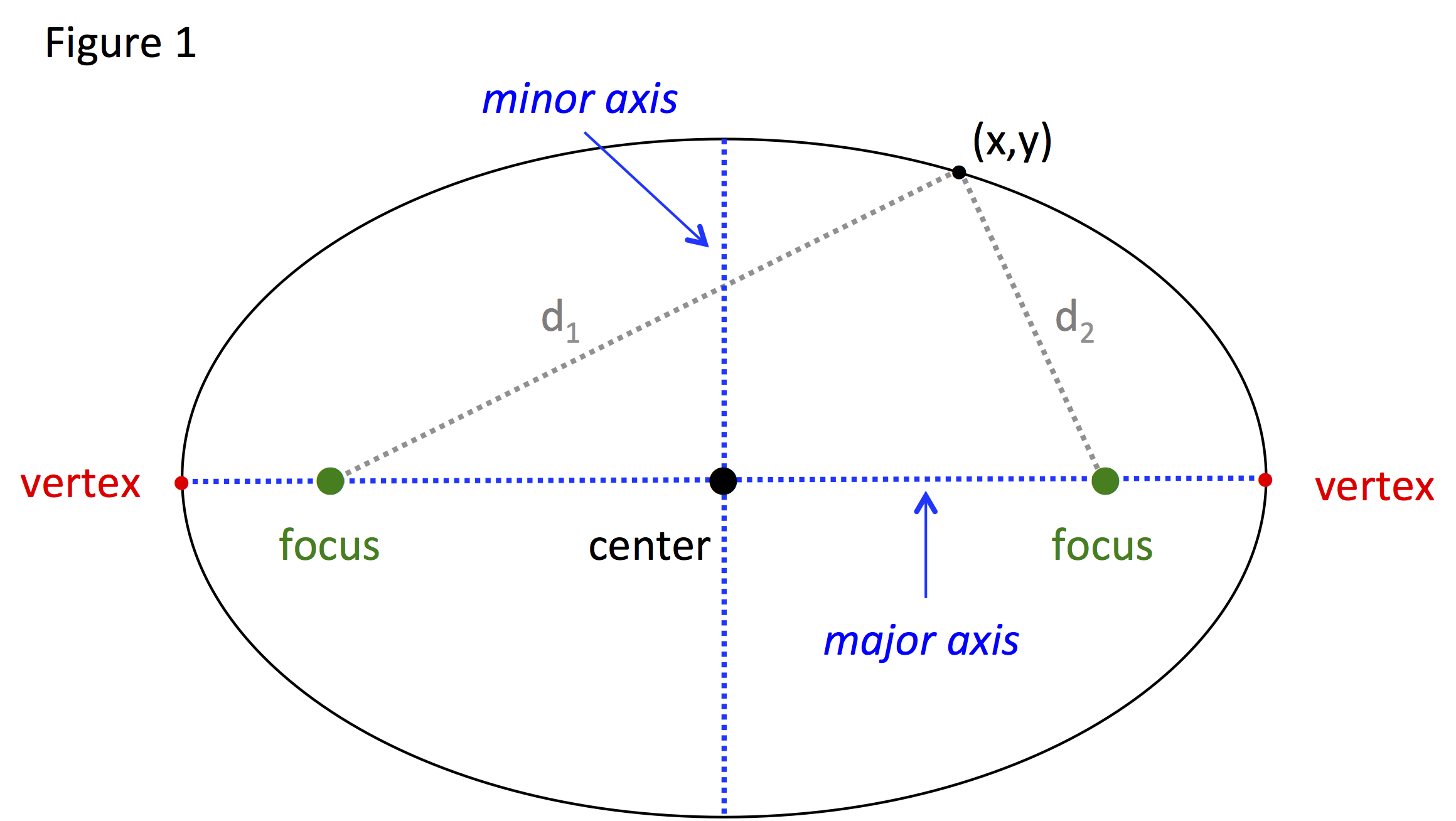
Here, (where (a,0) and (-a,0) represents the vertices)
Ellipse with Horizontal Major Axis: where
(a,0) and (-a,0) represent the coordinates for vertices
(0,b) and (0,-b) represent the coordinates for co-vertices
(c,0) and (-c,0) represent the coordinates for the foci
Ellipse with Vertical Major Axis: where
(0,a) and (0,-a) represent the coordinates for vertices
(b,0) and (-b,0) represent the coordinates for co-vertices
(0,c) and (0,-c) represent the coordinates for the foci
REMEMBER:
foci are always on the major
vertex are on the major
co-vertex are on the minor
a is always > b, so if the larger number is under y², then it’s vertical. When it’s under x², it’s horizontal.
Ex: means it’s vertical
Ex: means it’s horizontal
Equation for when center ISN’T (0,0):
PRACTICE FINDING THE CENTER, VERTICES, AND FOCI
Ex Question: Identify the center, vertices, and foci of
Ex Question: Identify the center, vertices and foci of
ALSO PRACTICE FINDING THE EQUATION OF AN ELLIPSE WITH GIVEN INFORMATION LIKE BEING GIVEN VERTICES, CO-VERTICES, AND/OR THE CENTER
Ex: Write the equation for an ellipse with vertex (0,7), co-vertex (-6,0) and center at (0,0).
Ex: Find the equation of an ellipse with vertices (1,1), (5,1), (3,6), and (3,-4)
9.4 - Intro to Conic Sections: Hyperbolas
Hyperbola: the set of all points P in a plane such that the absolute value of the difference of the distances from P to the foci is constant.
Formulas:
Hyperbola with Horizontal transverse axis:
Hyperbola with Vertical transverse axis:
Notes:
Unlike ellipses, it doesn’t matter if b > a or a > b
Whichever one is positive tells you if it’s vertical or horizontal
To find the asymptotes:
For ,
For ,
It’s the number under the y that’s on top
Theorem 10-9: The equation of a hyperbola with asymptotes on the axes is xy=c, where c does not equal 0
PRACTICE FINDING THE FORMULA FOR THE HYPERBOLA BASED ON FACTORS LIKE VERTICES, CENTER, FOCI, AND/OR ASYMPTOTE FORMULAS
ALSO PRACTICE USING THE FORMULA TO FIND THE CENTER, VERTICES, FOCI, AND/OR ASYMPTOTES
ALSO PRACTICE FINDING THE FORMULAS FOR THE ASYMPTOTES
9.1 - Parabola
Parabola: the set of all points in a plane that are equidistant from a fixed point F and a fixed line.
The point is the focus and the line is the directrix
Formulas:
First, p = the distance between the focus and the parabola’s vertex and/or the distance between the directrix and the parabola’s vertex
(graph opens upward)
(graph opens downward)
(graph opens to the left)
(graph opens to the right)
Formula for when the center isn’t (0,0)
Apply negatives where needed
REMEMBER:
the parabola always “eats” the focus
Latus Rectum: the line segment that’s parallel to the directrix, passes through the focus, and has endpoints that lie on the parabola
LOOK AT SOME OF THE PROBLEMS ON THE NOTES WORKSHEET
10.6 - Second Degree Equations and Systems
For the equation
If A = B, it’s a circle
Ex: x²+y², 3x²+3y², etc
If A and B have the same sign and ARE NOT EQUAL, it’s an ellipse
Ex: 5x²+3y², 7x²+9y², etc
If A and B have different signs and ARE NOT EQUAL, it’s a hyperbola
Ex: 5x²=3y², 7y²-2x², etc
If the equation has x² but not y², or has y² but not x², then it’s a parabola.
Ex: 3x² and 2y, 4y² and x, etc
PRACTICE QUESTIONS WHERE THERE’S MULTIPLE EQUATIONS FROM DIFFERENT CONIC SECTIONS LIKE CIRCLES, PARABOLAS, HYPERBOLAS, ELLIPSES, AND YOU NEED TO SOLVE THE SYSTEM.
Ex: Solve the system x² + y² = 25, . And feel free to go further. Include some systems with greater than, less than, greater than and equal to, less than and equal to as well.
10.7 - Solving Quadratic Systems Algebraically
This is just about solving systems of equations algebraically. So provide problems like this.
Conic Sections - Ellipses, Hyperbolas, Circles
PRACTICE ALL THE PROBLEMS ON HERE AND MAKE SURE YOU KNOW THEM
10.8b - Using Systems of Second Degree Equations
PRACTICE SOME OF THESE PROBLEMS ON THE NOTES WORKSHEET