A.3 Work, energy and power
Work (W) is an objects displacement multiplied by the component of force parallel to the displacement (J), scalar
W = Fs cos θ
if force is perpendicular no work is being done
force and displacement in the same direction the work done is positive, if they point in opposite directions work is negative
total work done use net force (or net force in the x component and y component)
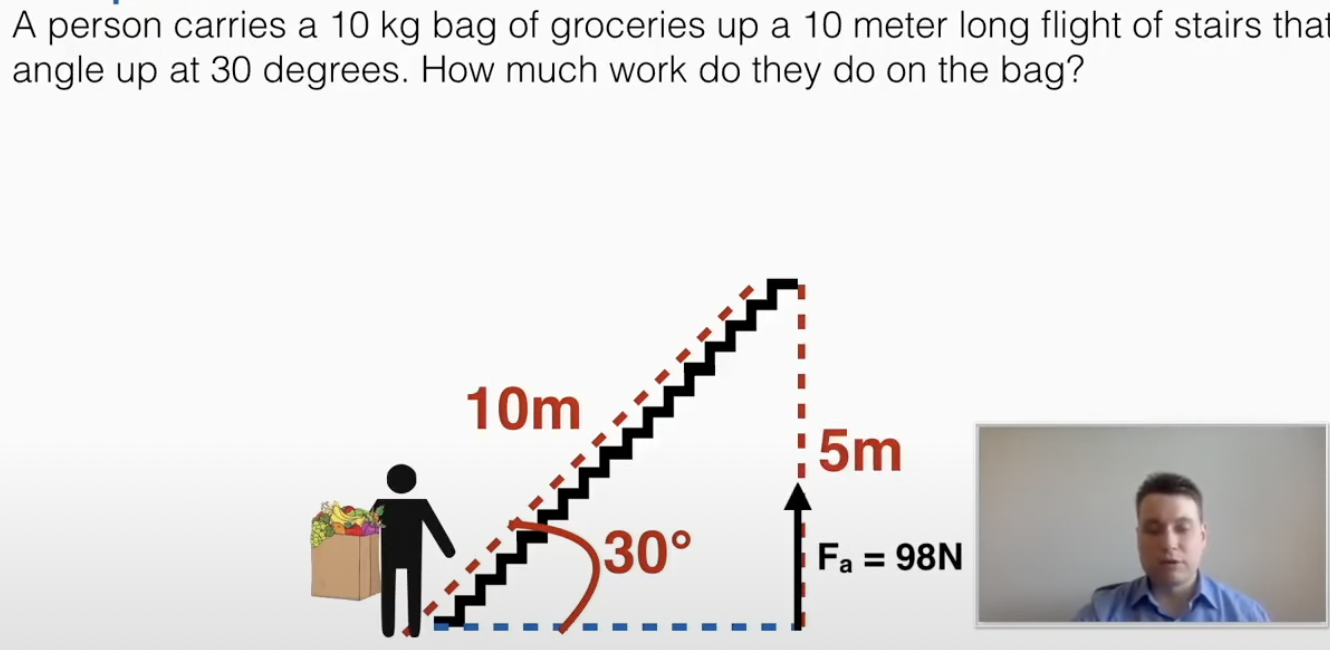
energy (E) is a measurement of the amount of work and object can do (J), scalar. object uses energy when it does work.
W = ΔE
Newtons third law, if one does positive work on another, the other does the same amount of negative work on the first
The Law of Conservation of Energy says that energy can NEVER be created or destroyed, only transferred from one object to another or transformed from one type of energy to another type of energy.
Kinetic Energy (Ek) is the energy an object has as a result of moving. Thus, moving gives an object the ability to apply a force for a displacement, which is the ability to do work (J), can never be negative
Ek = Fs until velocity is 0m/s so Ek = m(-a)s
Ek = ½ mv²
Ek = p²/2m
Gravitational Potential Energy (Ep) is the energy an object has as a result of its ability to fall. As long as it has a vertical displacement (height) that it can move down, it can push or pull objects with its weight until it hits the bottom (J)
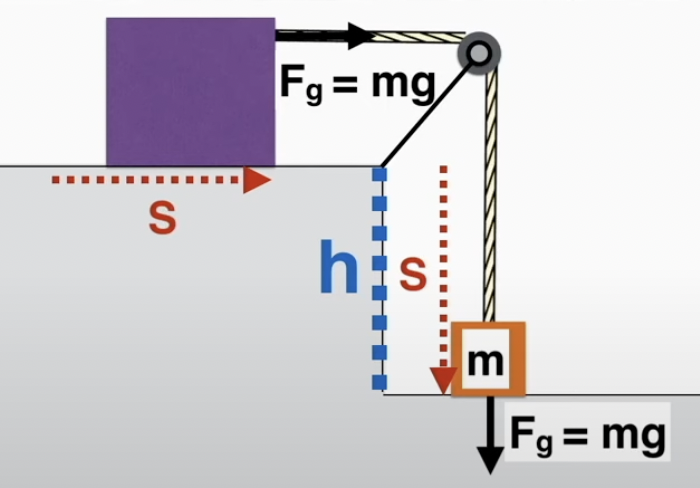
Fg = mg
W = Fg*s
Ep=mgh
Elastic potential energy:
Δx = Displacement of spring from natural length. Always points away from spring's natural length position.
Fs= Force applied by spring on object. Always points towards spring's natural length position.
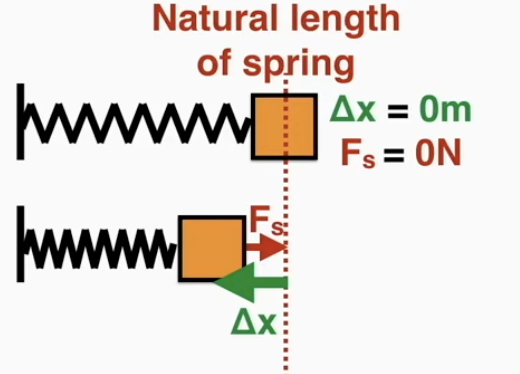
k = spring constant. a measurement of the force of the spring applies per meter its stretched (small = weaker)
Hooke’s law: Fs = -kΔx
Elastic potential energy (Ep) is the energy stored in a spring that has been stretched or compressed from its natural length. When the spring is released, it will apply a force for a displacement until it returns to its natural length, so it has the potential to do work, so it has energy (J)
force displacement graph has slope of k and the area under the curve is the work done. so:
Ep = ½ kΔx²
Thermal energy (Eint) is the energy associated with heat and temperature. Thermal energy appears as a result of friction, air resistance, impacts, and other interactions between objects. Thermal energy is actually a measurement of the random kinetic energy of vibrating particles in an object. (Eint = internal energy) (J). almost always lost from the system. So find for example Ep and Ek and the difference is lost as thermal energy. (perfectly elasatic nothing is lost)
Electrical energy is the energy carried by electrons. People normally use electricity to deliver energy created in power plants to buildings where we convert it into types of energy we use: light energy, heat energy, kinetic energy, etc.
Sound energy is the energy carried by sound waves. In almost all collisions at least some kinetic energy is transformed into sound energy. Sound itself is a wave of energy moving through a medium like air. The energy moves through without carrying the matter along with it.
Chemical potential energy is the energy stored in the bonds between atoms or ions. It can be released or stored in chemical reactions.
Radiant energy is the energy carried by light and other forms of electromagnetic radiation (x-rays, microwaves, radio waves, gamma waves etc).
Nuclear energy is the energy released during nuclear fission or fusion. It is contained within the nuclei of atoms until released.
Open and closed system with energy:
Mechanical Energy: Types of energy associated with the motion & position of an object that we can easily calculate and predict.
Kinetic
Gravitational Potential
Elastic Potential
Non-Mechanical Energy: Other types of energy that are difficult to calculate and predict.
Thermal
Electrical
Sound
Chemical
Nuclear
Radiant
A Closed System in energy is a system where the only energy transfer and transformation that happens involves mechanical energy. Energy is not transferred to objects outside the system. The total energy of the objects in the system stays the same.
An Open System in energy is a system where energy is transformed from mechanical to non-mechanical or vice versa, or mechanical energy is transferred from or to an object outside the system. The total energy in the system changes.
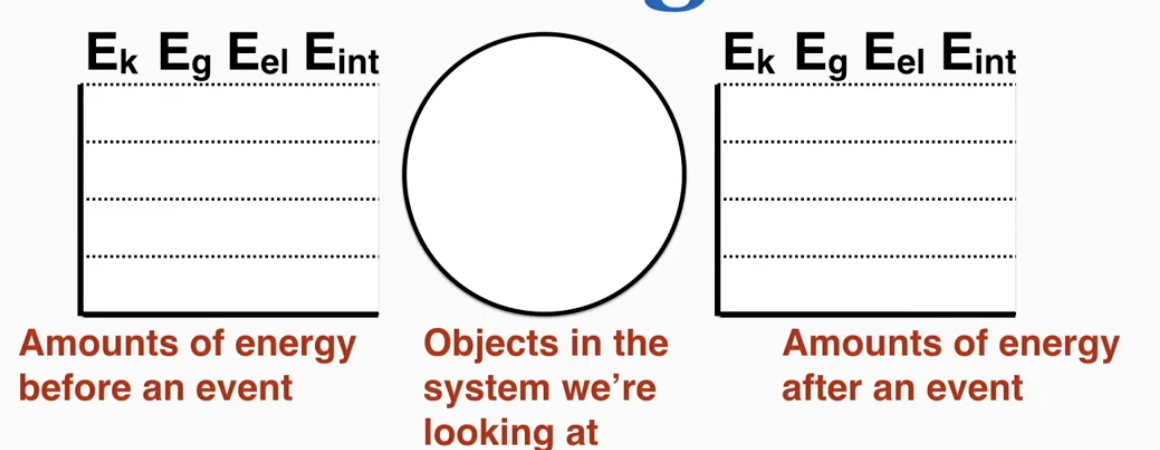
LOL Diagrams:
Power (P) is a measurement of a change in energy per time. It's measured in units of watts. scalar. Power supplied to an object is also equal to the force applied to an object times the velocity of the object. (W)
P=ΔE/t = W/t = Fs/t = Fv
Efficiency is the ratio of how much useful energy or power we get out of a system vs. how much energy we put into the system.
Efficiency = Useful work out / Total work in = Useful power out / Total power in