L5 - Redox Reactions
Oxidation States and Redox Reactions
Redox reactions involve the transfer of electrons between species and the resultant change in oxidation states.
Many elements can exist in multiple oxidation states in the environment.
Examples: Acid mine drainage - Pyrite () is exposed during mining and oxidised to sulfuric acid.
This acid dissolved metals like iron from the rocks.
The dissolved in reducing groundwater is oxidised when exposed to atmospheric causing it to be oxidisied to , turning water bright red.
Different oxidation states influence the properties and behavior of elements.
Calculating Oxidation Numbers
Oxidation numbers can be calculated for elements in chemical species using a set of rules. It represents the number of electrons that at element will either give up or accept.
Five Key Rules for Determining Oxidation Numbers:
The oxidation number of an element in its elemental form is 0 (e.g., , ).
The oxidation number of a monatomic ion is equal to its charge (e.g., , ).
Oxygen usually has an oxidation number of -2. Exceptions exist when combined with another O () in peroxides (e.g., ).
Hydrogen usually has an oxidation number of +1. Exceptions exist when bonded to metals as a hydride (e.g., ).
The sum of the oxidation numbers in a molecule or in a polyatomic ion equals the ion's charge.
Redox Reactions: Oxidants and Reductants
Redox reactions involve the transfer of electrons between chemical species.
Oxidant (oxidising agent): Accepts electrons and is reduced.
Reductant (reducing agent): Donates electrons and is oxidized.
Example: Transformation of magnetite to hematite.
Question: Is iron oxidized or reduced?
Transformation is from oxidation number of (2 and 1 ) to 2 atoms.
Writing Redox Reactions
First, write out the half equations for each side of the equation.
The initial step is to represent the generation or consumption of electrons.
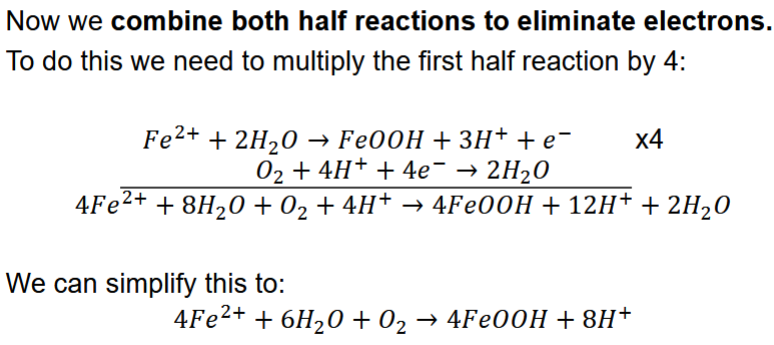
Couple and balance two half reactions to create a full redox reaction that doesn’t contain electrons
Example:
If one half-reaction involves one electron transfer and another involves two, the first reaction must be multiplied by two to balance the electrons.
Balancing Half-Reactions: Step-by-Step
A systematic approach to balancing half-reactions is essential.
Steps for Balancing Half-Reactions:
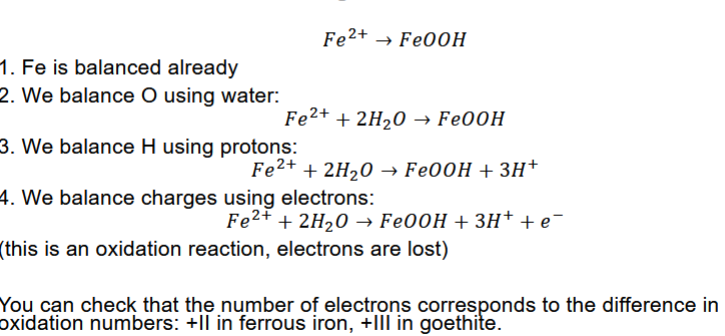
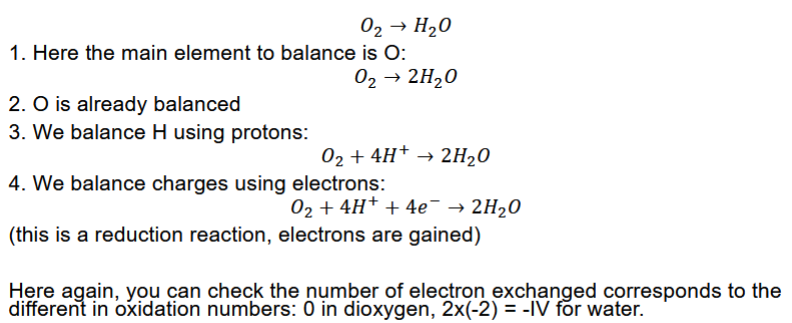
Balance the main element (other than oxygen and hydrogen).
Balance oxygen by adding water molecules () to the appropriate side of the equation.
Balance hydrogen by adding protons () to the appropriate side.
Balance the charge by adding electrons () to the appropriate side.
Example:
Combining Half-Reactions
Combine half-reactions to create a full redox reaction.
Ensure the electrons cancel out during the combination.
Practice is essential, especially in practical exercises.
Electrochemical Measurements: Building a Battery
Redox reactions can be harnessed to create electrochemical cells (batteries).
Galvanic Cell Example: Zinc and Copper Redox Reaction
Half-Cell 1: Zinc electrode in a solution containing (zinc is oxidized).
Half-Cell 2: Copper electrode in a solution containing (copper is reduced).
Electrodes: Metal plates dipped in the solution.
Salt bridge: Carries charge without two solutions being in contact.
Spontaneous chemical reaction generates a potential difference called the electromotive force, or E.
E is the voltage difference between two electrodes in an electrochemical cell.
is the Gibbs free energy in
is the number of electrons transferred in the reaction (2 for the example of copper and zinc).
is the Faraday’s constant
is the electromotive force in Volts
if , the reaction is energetically favourable. This corresponds to a positive E.
If , the reaction is not energetically favourable while the reverse reaction is. This corresponds to negative E.
If we consider this equation at the standard state, we can change the variables in the equation:
is the standard electrode potential
Standard Hydrogen Electrode (SHE)
The Standard Hydrogen Electrode (SHE) serves as a reference for measuring redox potentials. This is needed because we can’t just measure the potential of a single half cell, so a reference half cell is needed to measure all half cell potentials.
Components of SHE:
Platinum electrode (inert, conducts electrons).
Solution with protons () at an activity of 1 (1 mol/L).
Hydrogen gas () bubbled through the solution at standard pressure.
This half cell has a potential of 0V by convention and has the reaction .
Measuring Redox Potential
To determine the potential of a redox couple of interest (e.g., ):
Immerse the electrode in the corresponding solution.
The potential measured is that of the full reaction:
Connect it to the SHE and measure the potential generated.
The measured potential (e.g., 0.77 volts for ) is the hydrogen scale potential (). This is just the electrode potential between the half reaction and
Hydrogen Scale Potential and its Significance
The hydrogen scale potential () is the potential of a redox reaction under standard conditions (all activities are one) with respect to the hydrogen electrode.
It allows for ranking and comparison of different redox couples.
values indicate the spontaneity of reactions:
Positive : The oxidant can be spontaneously reduced by hydrogen.
Negative : The reductant can be spontaneously oxidized by .
Predicting Redox Direction: Under standard conditions, an oxidant with a positive will spontaneously oxidize the reductant of a couple with a negative .
Eh-pH Diagrams
Eh-pH diagrams illustrate the stability of different chemical species as a function of redox potential () and pH.
EH is measured using an EH or ORP probe
Due to the nature of groundwater containing more than one natural redox couple, and some redox active species not coming into equilibrium with the electrode quickly.
However, what we are able to get is a mixed potential which is a good indicator of whether the solution is mainly oxidised or reduced.
Natural waters can be classified based on EH and pH measurements.
Groundwater typically has low EH values.
Introduction to the topic for the next lecture.