1. Intro to women and CJS
Structures of policing
municipal
Provincial
Federal
Municipal
Largest number of police officers in Canada
137 stand-alone police organizations in Canada, with highest number in Ontario (44)
Municipal police are governed by provincial police acts
Provincial
Only three provincial police services in Canada: Ontario, Quebec, and Newfoundland
Provincial police used in areas where RCMP or municipal police forces are not served
Federal
RCMP reports to minister of Public Safety
Operates in some capacity in all provinces and territories under the RCMP Act
Has 15 provincial/territorial divisions, with training depot in Regina, and headquarters in Ottawa
Provides a range of services
Indigenous policing
June 1991
First Nations Policing Policy (FNPP) was introduced There are two main types of policing agreements:
Self-administered Police Service Agreements
A First Nation or Inuit community manages its own police service under provincial policing legislation and regulations
Community Tripartite Agreements
A dedicated group of officers from the Royal Canadian Mounted Police provides
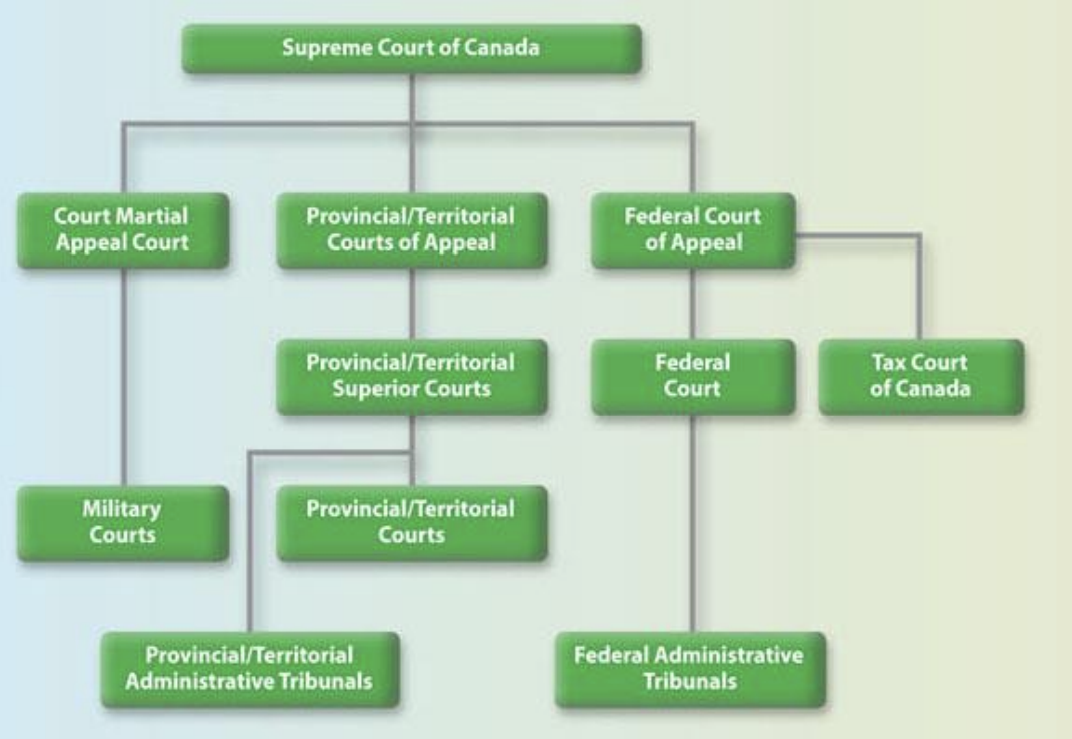
Provincial Courts
Each province has its own provincial court - First venue for criminal cases
Three court levels in each province:
Provincial and territorial courts → Handles wide variety, such as by-law, small claims, traffic violations, family law
Superior Courts → Hears most serious criminal cases
Courts of appeal → Court of review for cases that come from provinces/territories superior courts
→ Provincial specialty courts
Specialty courts exist at provincial and territorial level
Created to hear cases specific to one type of offence
Goal was to divert people away from CJS
Examples:
Toronto’s Drug Treatment Court
Domestic Violence Courts
Federal Courts
Hears cases involving claims against government and cases in federal areas
Made up of specialized courts, such as Tax Court and Military Court
Federal Court of Appeal also reviews decisions of federal tribunals
→ Supreme Court of Canada
All courts fall under the Supreme Court of Canada
They have authority over all private and public law
No trials are held at Supreme Court
Made up of chief justice + 8 other judges appointed by prime minister
Longest service Chief Justice was Honourable Beverley MaLachlin, first woman
Can be changed when a new PM comes in, appointed by PM
Correctional System
Consists of both federal and provincial services
Female are incarcerated at a much lower rate than males (7.5% of federal incarcerated are women)
Due to small number of female offenders, female inmates were housed with male
1849: Brown commission report released – highlighted horrific living conditions and punishment inflicted on women at Kingston Penitentiary
Prison for women
1934: First women for prison (P4W) opened (Kingston)
Many issues with the P4W:
Gendered rehabilitation programs (hairdressing, housekeeping, cooking)
Reports that the penitentiary was costly when less than 50 women were being housed at a time
Reports that there are problems with housing all women in one prison
Reports that women were being housed too far from home
Lack of French programming
Indigenous women’s needs not met
2000: This prison finally closed
Task Force on Federally Sentenced Women (TFFSW) recommended its closure
correctional service of Canada, Elizabeth Fry society → Women centred approach
Women to be transferred to 5 regional facilities, including a healing lodge for Indigenous women
→ 6 Institutions for women
Grand Valley Institution for Women: Located in Kitchener
Ontario Nova Institution: Located in Nova Scotia
Edmonton Institution for Women: Located in Alberta
Joliette Institution: Located in Quebec
Okimaw Ohci Healing Lodge: Located in Saskatchewan
Fraser Valley Institution: Located in British Columbia
Buffalo Sage Wellness House, and Regional Psychiatric Center also house women
Criminalized Women in Canada
Statistics of Incarcerated Women
Department of Justice Canada: 2020 Report on women in the Criminal Justice System
Findings:
The number of women in federal corrections has increased by 20% since 2014/2015, despite the total number of offenders changing very little (+0.3%).
Despite representing only 4% of all women in Canada, Indigenous women made up 42% of women’s admissions to provincial/territorial custody
Since 2007/2008, the number of Indigenous women admitted to provincial/territorial custody has increased dramatically, by 66%, compared to a decrease of 8% for non-Indigenous women
Criminalized women
‘Criminalized’ describes individuals whose behaviours have been criminally sanctioned by law
Criminal offence → Criminalized
Race, class, gender and sexuality can affect the process of criminalization in many ways
Crimes against the Person: 23% of women involved in the CJS were charged with crimes against the person
Crimes against Property: 25.8% of women charged with a crime against property
Theft and fraud
Two most common crimes among women:
Theft and Fraud
27.3% of those convicted of theft are women
28.1% of those convicted of fraud are women.
Reasoning?
Economic needs of themselves and families Some women are also charged with defrauding government agencies (i.e., welfare)
BLACK WOMEN, FRAUD AND WELFARE QUEEN
“The 1980s and 1990s saw another boost in Black mother-blaming through Welfare Reform and the War on Drugs through the construction of the Welfare Queen” (Gurusami, 2019)
‘ welfare queens’
Black mothers are lazy, often drug-addicted, hypersexual, careless parents whose primary goal is to evade work and lead lavish lifestyles funded by state benefits
Illicit Drugs
Women are commonly charged with drug-related activities
Drug related crimes include driving under influence, possession of drugs, trafficking, importation.
From 1991 to 2014, drug related offences have increased 52%, despite Canada’s crime rate decreasing
War on Drugs
President Nixon launched strategies to combat drug use and distribution
Canada followed suit with Harper’s Safe Streets and Community Act
Emily Murphy
Women activist
One of the ‘famous five’
Referred to as the ‘mother of marijuana criminalization’
Incarcerated Mothers
Many incarcerated women are mothers (70%)
Due to being primary caregivers, a lot of children are placed into foster care or live with other family members
Children separated from their moms
Women worry about their children – causes stress
Some women are allowed to have their children with them in prison, but most aren’t
Mother-Child program (MCP)
Government initiative program intended to keep families together
Implemented in 2001 as part of shift in women’s corrections
Child full time with them until 5th birthday, can visit after
Eligibility
Only 150 women eligible since its implementation
Minimum or medium security
No mental health issues or criminal charges against a child
Must have designated inmate babysitter
An alternate caregiver outside prison
Coping strategies
Many women develop coping strategies when incarcerated due to stressors
Coping strategy: any behavior that a person employs to deal with a difficult situation
Some women commit criminal behavior to cope with abuse
Self-injury
Alcohol and Drug Abuse
April 22nd Incident
Women’s prison riot, April 22, 1994
Group of six women jumped officers outside the hospital area at P4W
Many of the officers involved left their job and were negatively affected
During April 22-26, women participated in throwing food, verbally assaulting officers, involved in a slashing, attempted hostage taking, etc.
Evening of April 26 – Warden of P4W called in a male institutional response team
Creating choices report
In 1990, Report called “Creating Choices” was released by Task Force on Federally Sentenced Women
Highlights problems with correctional system
Criticisms of report – failed to define the meaning and criteria of woman centeredness, and needs were still not met
Watchdog groups
Presently, there are number of groups dedicated to ensuring rights are upheld within the CJS Office of the Correctional Investigator (OCI)
Review policies of the CSC and complaints
Citizen Advisory Committees (CAC’s)
Allows members of public to contribute to quality of programs for incarcerated people
Canadian Association of Elizabeth Fry Societies
Elizabeth Fry – prison reformer from England who wanted to improve conditions of incarceration
Goal is to support incarcerated women and girls and increase awareness of ‘decarceration’