Environment and Development in Russia, Transcaucasus, and Central Asia
Russian Federation, Transcaucasus, and Central Asia: Environment and Development
Overview
The lecture discusses the environmental and developmental issues in the Russian Federation, Transcaucasus, and Central Asia.
Introduction
The lecture references the Soviet Anthem and the Red Army Choir as cultural context.
Geographic Context
The region is vast with a wide variety of climates and landscapes.
It's a bounded region with restricted access to world seas.
Extends 6,200 miles east to west and 1,550 miles north to south.
Nearly half the territory is above 60°N.
Mysterious Sleeping Sickness
Since 2014, over 140 people in two tiny villages have been affected by a sleeping illness.
Symptoms include headaches, hallucinations, violent behavior, and narcoleptic symptoms.
Initial theories for the cause included:
Counterfeit vodka
Bin Laden Itch (psychosomatic)
Radium or radon gas
Supernatural causes
The cause is now suspected to be carbon monoxide from a uranium mine in Krasnogorsk.
Resettlement of the population is underway.
Semipalatinsk Test Site
Above-ground nuclear tests at the Semipalatinsk Test Site significantly contributed to radiation exposure in northeastern Kazakhstan.
High winds spread fallout in different directions, affecting various regions.
One estimate suggests that four of the above-ground tests at Semipalatinsk Test Site contributed 95% of the collective radiation exposure to people in northeastern Kazakhstan.
Environmental Destruction and the Soviet Union
According to Zhores A. Medvedev, the Soviet Union experienced significant environmental destruction.
Key points include:
Loss of pasture and agricultural land to radioactive contamination exceeding the total acreage of cultivated land in Switzerland.
Land flooded by hydroelectric dams exceeding the total area of the Netherlands.
Land lost to salinization, water table changes, and dust storms between 1960 and 1989 exceeding the cultivated land in Ireland and Belgium combined.
Decline in cultivated land by one million hectares a year since 1975 amidst food shortages.
Forest loss at the same rate as rainforests disappearing in Brazil.
Chemical poisoning with pesticides leading to high rates of mental retardation in Uzbekistan and Moldavia, requiring simplified educational curricula.
The Environmental Record of the Soviet Union by Arran Gare
Introduction
The Soviet Union's legacy includes severely degraded environment, seemingly disproving communism as an environmental solution.
However, a strong environmental movement existed within the Soviet Union, originating from the left-wing Bolsheviks.
These Bolsheviks had a radical agenda: democratic economic organization and a new relationship between society and nature.
They foresaw the failure of Stalin's command economy, predicting it would continue capitalism's domineering approach to people and nature, leading to serfdom and stagnation.
The Soviet Union's failures validated the left-wing Bolsheviks' concerns.
Environmental disasters highlight the self-destructive tendencies of societies that treat people and nature as mere instruments of production.
An environmentally sustainable society requires acknowledging the creativity of people and nature, overcoming divisions between organizers and the organized, and enabling people to live as creative participants in a creative nature.
Environmental Destruction in the Soviet Union
Major concerns about the USSR's ecological record emerged in 1978 with Boris Komarov's book, The Destruction of Nature in the Soviet Union, which depicted significant environmental damage.
In 1979, Zhores Medvedev revealed a 1957 nuclear waste storage site explosion in the Urals, contaminating hundreds of square kilometers with radionucleides.
Glasnost, partly due to Chernobyl, and the Soviet Union's collapse confirmed Komarov's claims.
Medvedev characterized the environmental destruction in 1990:
Radioactive contamination had affected more pasture and agricultural land than Switzerland's total cultivated land.
Hydroelectric dams flooded more land than the total area of the Netherlands.
Salinization, water table changes, and dust storms between 1960 and 1989 damaged more land than the combined cultivated land of Ireland and Belgium.
Cultivated land declined by one million hectares per year since 1975 amidst food shortages.
Forests were disappearing at the same rate as Brazilian rainforests.
Pesticide poisoning in Uzbekistan and Moldavia led to high rates of mental retardation, requiring simplified educational curricula.
Aral Sea Transformation:
Once the fourth largest lake, it decreased by 40% in area due to damming rivers since the 1950s, with a 13-meter drop in level and increased salinity.
Fish production fell from 49,000 metric tons in 1957 to zero commercial fishing in 1989.
Pesticides, fertilizers, and salt from the dry seabed contaminated 200,000 square kilometers.
Around 43 million metric tons of salt are carried annually from the sea's dried bottom, affecting agricultural land.
The area's climate changed, with hotter summers and colder winters, destroying crops and livestock.
In 1989, frost killed 500,000 hectares of cotton plants, 70% of grain fields were lost, and over 500,000 sheep died.
The water table fell, drinking water became scarce, and the population's health declined with increased infant mortality, intellectual retardation, epidemics, hepatitis, and throat cancer.
Out of 173 animal species around the sea and delta, only 38 survived.
Countervailing forces, like the movement to protect Lake Baikal, existed.
Proposals for wood processing plants and blasting the Angara River's mouth sparked a campaign by scientists, writers, and artists.
Resolutions protecting the lake were passed in 1969, 1971, 1977, and 1987.
Despite such efforts, the Soviet Union failed to address its environmental problems.
Pollution of Lake Baikal was only mitigated, not prevented.
After the 1987 resolution, smaller enterprises still discharged untreated effluent into the lake.
Reasons for failure, according to Philip Pryde:
Priorities: Economic growth was always the priority.
Funding: Environmental problem funding was woefully lacking.
Enforcement: Often lax; principles and directives were ignored.
Lower bureaucracy levels excluded public scrutiny and covered up failures.
Fines were a lesser burden than abiding by directives, incentivizing meeting planned production targets and self-interest.
Soviet Transformation of Nature
Aimed to increase the power of the central bureaucracy and integrate the region.
Examples:
Stalin’s Plan for the Great Transformation of Nature.
Krushchev's Virgin Lands campaign and his project to open Siberia with the Bratsk-Angara Dam.
Brezhnev's River Diversion Project and Baikal-Amur Mainland Railroad.
Lenin had a more conservationist attitude towards nature compared to Stalin.
Karpov argued that these projects prioritized economic growth over ecological concerns, leading to significant environmental degradation in the affected regions.
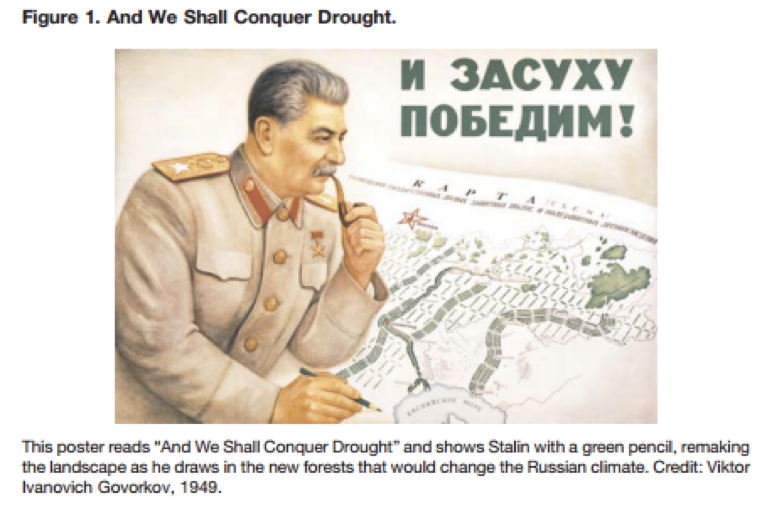
Criticism of Conservation
Conservationists and the science of ecology were criticized by proponents of the new order.
An idea which reeks of ancient cults of nature's deification.
The final goal of acclimatization is a profound rearrangement of the entire living world.
All living nature will live, thrive, and die at none other than the will of man and according to his designs.
Communism and Modernity
Communism championed modernity, pushing for grand designs, social engineering, technology, and transformation of nature.
Mixed Forest and Steppe
Forest is a continuation of the mixed forests of central Europe.
The steppe is flat with tall feathered grasses and matted roots that trap moisture.
which in turn produces a rich dark soil called chernozem, which is very fertile but can lead to dustbowl conditions.
Khruschev’s Virgin Lands Campaign, 1954-1963
1953: Khruschev begins ”de-Stalinization.”
1954: Virgin Land's campaign aimed to increase agricultural production to alleviate food shortages after WWII.
The goal was to turn the Soviet Union into Iowa.
Mega-engineering targeted lands on the right bank of the Volga, in the northern Caucasus, in Western Siberia, and in Northern Kazakhstan.
Steppe was transformed into arable land for grain production.
During the campaign, of steppe were transformed.
Over 300,000 workers and 50,000 tractors were sent to the region in 1954.
Initial bumper crops in 1956 produced half of the USSR’s grain yield.
By 1963, it was acknowledged that increasing grain production was not solely about cultivating new land.
New lands required excessive capital investment for clearing, draining, and preparation.
Climatic variability, including drought and wind erosion, was a problem.
Chernobyl
Explosion and fire released large quantities of radioactive contamination into the atmosphere, spreading over much of Western USSR and Europe.
Official death count was 31, but deaths continue from fallout.
Secondary radiation: vegetation still releases radioactive material into the ecosystem.
It is still unclear how to decontaminate such a large area.
Pripyat was established in 1970 near Chernobyl to house workers and their families.
The city was entirely abandoned after the explosion.
The "zone of alienation" extends 19 miles (31 km) in all directions from the plant and is largely uninhabited.
Ukrainian officials estimate the area will not be safe for human life for another 20,000 years.
The Disappearance of the Aral Sea
In 1960, it was the world’s fourth-largest lake.
Soviet modernization programs brought large-scale irrigation to arid and semi-arid regions, such as the Kara-Kum canal.
Cotton is a major crop, with half of Turkmenistan devoted to cotton monoculture.
Uzbekistan is one of the world’s third-largest cotton producers.
Salinization occurs when water evaporates, leaving behind salt drawn up through the subsoil.
Environmental Legacies of the Soviet Union
Soviet problems have been intensified by the transition to market economies.
Corruption leads to circumvention of environmental regulations.
There is a lack of funding for many cleanup projects.
Reasons for Failures
Priority was always for economic growth.
Funding required to address or prevent environmental problems was lacking.
Principles and directives were often ignored.
Dominance of command economy and military competition.