The plantation economy and slave trade
From Servitude to Slavery
The Plantation Economy of the Chesapeake
🌱 Economic Motivation
Chesapeake settlers came primarily for economic prosperity, not religious freedom.
The hot, moist climate was ideal for cash crops grown for export to Europe.
🌾 Major Cash Crops
Tobacco (most important)
Cotton
Rice
→ Tobacco dominated the Chesapeake economy.
📈 Tobacco Boom (1600s)
European demand for tobacco surged in the early 1600s.
Planters rapidly expanded tobacco cultivation.
Large plantations were established along riverbanks, where:
Soil was fertile
Transportation by river was easy
📊 Production Growth
1622: about 60,000 pounds of tobacco
Late 1600s: nearly 40 million pounds per year
→ Massive expansion in scale and labor needs
💰 Tobacco as Currency
Tobacco became a medium of exchange:
Used to trade for gold
Accepted as payment for taxes and fines
Functioned as a stable and trusted currency in the Chesapeake economy
🏛 Social & Political Impact
Tobacco dominated social, political, and economic life
Colonial governments:
Regulated tobacco prices
Protected planters’ interests
Tobacco was considered an extremely valuable commodity
🧠 Key Idea
Tobacco = “hard cash”
Colonists could literally grow money
The plantation system laid groundwork for labor expansion, eventually leading from indentured servitude to slavery
Indentured Labor in the Chesapeake
👥 Labor Shortage
Expansion of tobacco plantations created high demand for labor.
Labor was hard to find because:
High mortality rates from disease
Majority of early settlers were men
Few women and children, limiting natural population growth
🌍 Failed Labor Alternatives
Colonists attempted to enslave American Indians:
Often resulted in violent resistance
Native groups killed landowners (Jamestown region, 1630s–1640s)
African slave trade existed in Spanish and Portuguese colonies:
African slaves were too expensive at first for English colonists
📜 Headright System
Colonies adopted the headright system to attract labor:
Planters received 50 acres of land for each worker they brought
Planters paid passage from Europe
Encouraged growth of large plantations and land concentration
🇬🇧 Source of Indentured Servants
Recruited from England’s unemployed population
Many displaced by the textile industry slump in early 1600s
Workers signed indentures (contracts):
Served 4–5 years as bonded labor
In exchange for:
Free passage to America
Freedom dues (food, clothing, sometimes land)
⚖ Conditions of Indentured Servitude
System was profitable for planters
Laborers were often exploited:
Servitude extended as punishment for minor offenses
Escape attempts punished by whipping, even for pregnant women
Courts sometimes extended indentures as legal punishment
😠 Outcomes and Discontent
Many servants:
Did not receive promised land or wealth
Worked for low wages on plantations, often for former masters
Became subsistence farmers
Result:
Growing resentment toward colonial government
Discontent contributed to rebellion (context for Bacon’s Rebellion)
🔄 Transition Toward Slavery
Fear of rebellion alarmed landowners
Planters increasingly turned to African slavery:
Seen as more controllable
Lifetime, hereditary labor system
Marks shift from indentured servitude → racial slavery
Bacon’s Rebellion (1676)
🌾 Background Causes
By the late 1600s, wealthy planters controlled most fertile land in the Chesapeake.
Small farmers and former indentured servants were pushed into infertile frontier (hinterlands).
Growing resentment toward Governor Sir William Berkeley because:
High taxes
Refusal to allow settlers to seize Native American lands
Berkeley and colonial elites:
Profited from the fur trade with Native tribes
Wanted to maintain peaceful relations with them
🔥 The Rebellion (1676)
Led by Nathaniel Bacon, a planter
Participants:
About 300 small farmers
Former indentured servants
Some enslaved Africans
Actions:
Attacked Native American communities
Looted wealthy plantations
Rebelled against the colonial government
Event known as Bacon’s Rebellion
⚔ Collapse of the Rebellion
Bacon died of dysentery
British troops crushed the rebellion in 1677
Rebellion was:
Short-lived
Limited in geographic scope
But politically alarming
🧠 Consequences & Significance
Terrified wealthy planters and colonial elites
Revealed dangers of:
Large populations of armed, landless, resentful white laborers
Result:
Planters increasingly turned to African slavery
Slaves seen as:
Easier to control
Less likely to rebel for political rights
Shift from:
Indentured servitude → racial slavery
Strategic logic:
Slavery offered social stability, even if it cost more than servitude
🧩 Big APUSH Takeaway
Bacon’s Rebellion exposed class tensions in the Chesapeake and accelerated the transition to African slavery as a means of social control.
Diagram of a Slave Ship (Middle Passage)


How to read the diagram
Lower decks: Enslaved Africans were packed side by side, often chained, with almost no room to sit or turn.
Men, women, children separated to prevent resistance.
Extremely cramped conditions led to:
Disease
Starvation
Dehydration
High death rates during the Atlantic crossing (Middle Passage).
Ships were designed to maximize profit, not human survival.
The Atlantic Slave Trade (APUSH Notes)
🌍 Origins
Began in the mid-1400s
Started by Spanish and Portuguese
Africans enslaved to work on sugar plantations in:
Caribbean
South America
🇬🇧 British Entry
1662: Sir John Hawkins captured and enslaved 300 Africans from Sierra Leone
Received approval from Queen Elizabeth I
1672: Britain created the Royal African Company
Had a monopoly on enslaving and transporting Africans
Generated huge profits
📉 Expansion & Cheaper Slaves
1698: Royal African Company lost its monopoly
Competition increased → slave prices dropped
At the same time:
Cost of indentured servants rose in Europe (1650–1700)
🔄 Shift After Bacon’s Rebellion
Planters abandoned indentured labor
Turned increasingly to African slavery
By mid-1680s:
More African slaves arrived yearly than European servants
📊 Demographic Changes
1700 (Chesapeake):
Africans = 20% of total population
80% of bonded laborers
1750:
Virginia: Africans ≈ 50% of population
Carolinas: Africans outnumbered whites 2:1
🧠 Big Idea
Economic incentives, fear of rebellion, and falling slave prices transformed slavery into the dominant labor system in the southern colonies.
Example: A Notice on a Slave Ship (Primary-Source Style)
NOTICE TO CAPTAINS AND CREW
Cargo secured below deck according to company specifications.
Maintain strict separation of men and women.
Exercise daily inspections to prevent revolt.
Rations to be kept minimal but sufficient to preserve cargo value.
Any loss shall be recorded and deducted from final profit.Property of the Royal African Company
The Triangular Trade Route 🌍⚓

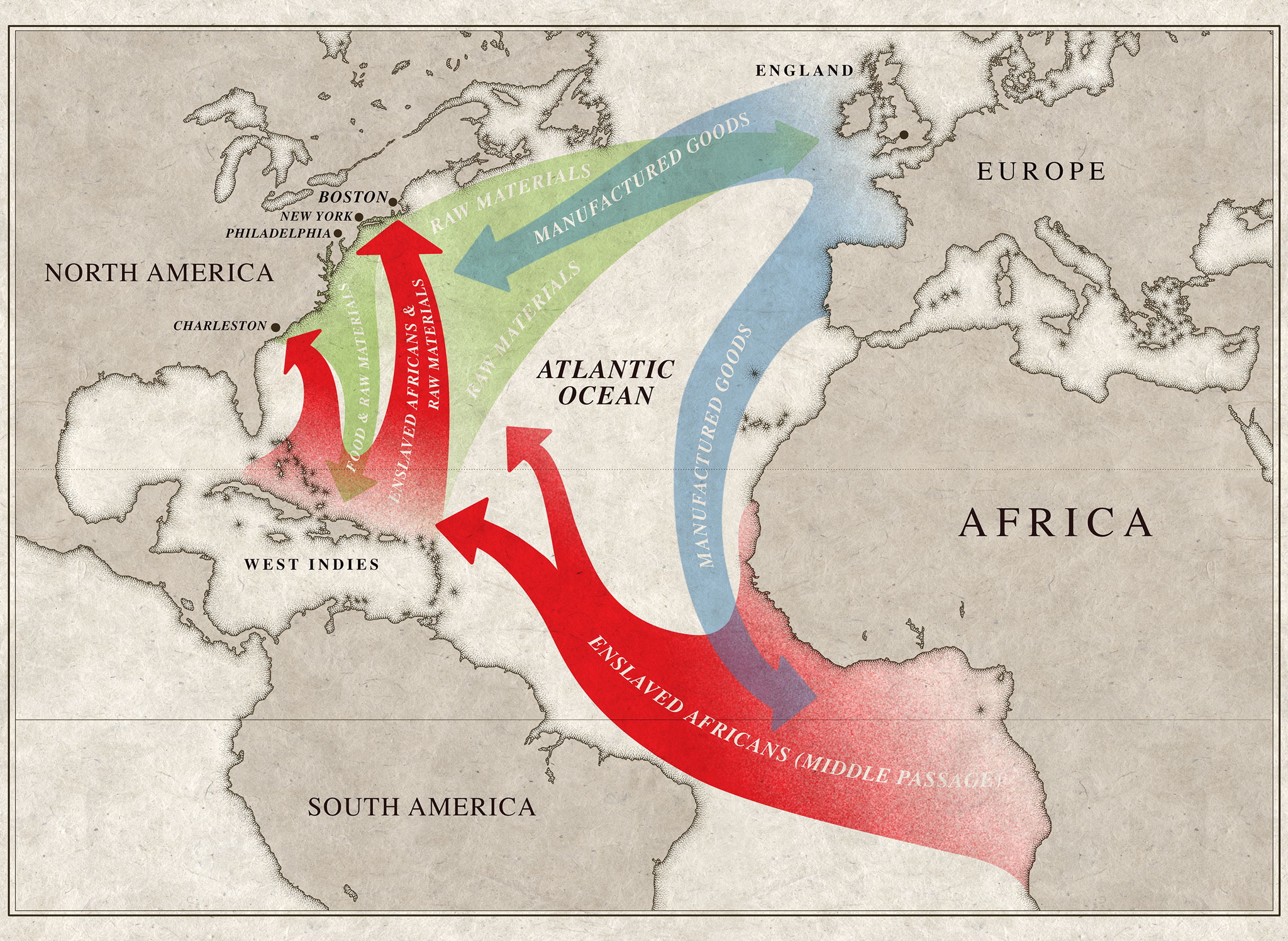
📐 What the Triangular Trade Was
A three-part trade route linking Europe, Africa, and the Americas
Called “triangular” because the route formed a triangle across the Atlantic
🔁 The Three Legs of the Trade
1⃣ Europe → Africa (Outward Passage)
Ships left European ports (especially England)
Carried manufactured goods:
Rum
Textiles
Guns
These goods were traded at West African ports
2⃣ Africa → Americas (Middle Passage)
Ships were packed with enslaved Africans
Africans came mainly from the region between:
Senegal and Angola
Enslaved people were treated as cargo
The Middle Passage was:
Brutal
Overcrowded
Deadly
3⃣ Americas → Europe (Homeward Passage)
Ships unloaded enslaved Africans in the Americas
Then loaded plantation products:
Tobacco
Cotton
Sugar
Rum
Coffee
Goods shipped back to England
🧠 Why It Mattered (APUSH Significance)
Fueled the Atlantic slave trade
Strengthened the plantation economy
Connected slavery directly to European profit
Helped make slavery a permanent system in the colonies
Colonial Politics in the Southern Colonies
🏛 Rise of the Planter Elite
Wealthy plantation owners monopolized political power.
1619: Governor George Yeardley created the House of Burgesses, the first representative assembly in English America.
Structure:
Governor appointed by the Crown
Council of elite aristocrats
House of Representatives elected by landowning men
👑 “First Families of Virginia”
Wealthy plantation families such as:
Lees
Washingtons
Fitzhughs
Known as the First Families of Virginia (FFVs).
They:
Gained control of the House of Burgesses
Often overruled the governor on financial matters
By the American Revolution:
FFVs made up 5% of the population
Held 70% of seats in the Virginia legislature
Racial Division in Southern Society
🧩 Early Labor Status (1619–1640)
Colonists distinguished between white and Black laborers
Race did not automatically mean slavery
Some Black workers:
Gained freedom
Owned land and plantations
Poor whites and Black laborers sometimes allied and rebelled together
⚠ Shift After Rebellion
Rebellions (like Bacon’s Rebellion) alarmed elites
Planters intentionally divided laborers by race to maintain control
📜 Legal Codification of Slavery
1661: Maryland legalized lifelong slavery
1670: Virginia followed
1705: Slavery fully codified across the Chesapeake
Key features:
Slavery became lifelong
Slave status passed through the mother
Race legally tied to enslavement
Psychological & Social Control
🧠 Racial Ideology
Slaveholders enforced beliefs of Black inferiority
African culture, language, and beliefs were:
Suppressed
Replaced with European customs
Enslaved people were subjected to:
Degrading labor
Psychological humiliation
⚖ Divide-and-Control Strategy
Poor white servants were encouraged to believe:
They were superior to Black slaves
Slavery gave poor whites a false sense of status
This reduced alliances between:
Indentured servants
Enslaved Africans
🌍 Communication & Control
Indentured servants:
Could write home
Discouraged European migration through negative reports
African slaves:
Had no means to communicate with families
Were easier to legally and socially subjugate
🧠 Big Historical Takeaway
Southern elites used race, law, and psychological control to divide the labor force, prevent rebellion, and preserve their political and economic dominance.
The Rural South
The plantation economy discouraged city growth.
Large plantations were spread across vast, isolated lands, mainly along the Chesapeake Bay.
Riverfront locations:
Fertile soil for tobacco
Lower shipping costs
Poor roads made land travel difficult, so rivers were the main transportation routes.
🏘 Limited Urban Development
Southern colonies developed few cities, unlike New England.
Settlers often lived miles apart, creating a dispersed population.
Urban society grew slowly and unevenly.
🎓 Education & Society
Distance between families limited access to schools.
Education was mostly available only to children of wealthy planters.
By the late 1700s, only a small number of southern cities existed.
🧠 Big Takeaway
The plantation system created a rural, spread-out society with weak urban growth and limited access to education in the southern colonies.
Profitable Plantations in the South
Colonists came to America seeking economic prosperity through:
Finding gold
Growing cash crops for sale in Europe
The hot, wet southern climate was ideal for crops such as:
Tobacco
Cotton
Corn
Wheat
🌾 Tobacco & Labor
By the 1600s, tobacco became highly profitable.
As plantations expanded, labor demand increased.
Initially:
Indentured servants were cheaper than slaves
Later:
Plantation owners increasingly relied on African slaves
🏛 Wealth & Power
Plantation owners accumulated great wealth.
Their prosperity allowed them to:
Live comfortably
Influence colonial politics and laws
Led to the rise of a powerful planter elite
🧠 Big Takeaway
Profitable cash-crop agriculture created wealthy plantation owners who shaped the economy, labor systems, and politics of the southern colonies.
Former Indentured Servants (Late 17th Century)
Many indentured servants completed their contracts.
After freedom, they often had:
No land
No steady employment
Large numbers drifted into towns and lived in poverty.
😠 Growing Discontent
Former servants were:
Unwilling to reenter servitude
Frustrated by government favoritism toward Native Americans
Angry over lack of access to fertile land
⚠ Social Unrest
Poverty and frustration led to:
Lawlessness
Instability in the Chesapeake region
🔥 Connection to Bacon’s Rebellion
Former indentured servants formed a key part of Bacon’s Rebellion
They fought the colonial government due to:
Economic hardship
Perceived political injustice
🧠 Big Takeaway
The failure to integrate former indentured servants into colonial society created unrest that contributed directly to Bacon’s Rebellion.
Slavery in the South
🔄 Shift After Bacon’s Rebellion
Planters became wary of indentured servants after Bacon’s Rebellion.
Turned instead to African slavery, despite higher initial cost.
Slavery was seen as a better long-term investment because:
Slaves were enslaved for life
Children of slaves were also slaves, increasing labor supply
🚢 The Middle Passage
Africans were transported via the triangular trade route.
The Middle Passage was:
Extremely harsh
Deadly for many enslaved Africans
Survivors were sold to American planters upon arrival.
⛓ Life in the Colonies
Enslaved Africans:
Were separated from families
Had no personal freedom
Worked under brutal conditions
Slaveowners enforced control through:
Physical punishment
Psychological manipulation
Promoting beliefs of racial inferiority
🧠 Big Takeaway
Slavery became a permanent, hereditary system designed to maximize profit and control, shaping southern society for generations.
Tobacco Plantations
Tobacco was extremely profitable in the southern colonies.
It became highly valuable and widely used.
💰 Tobacco as Currency
Used as a secure currency
Could be traded for gold
Accepted as payment for taxes and fines
🏛 Political & Economic Role
Tobacco influenced colonial laws and government
Lawmakers regulated and protected tobacco prices
📈 Growth in Production
1622: 60,000 pounds produced
Late 1600s: nearly 40 million pounds per year
Tobacco functioned as “hard cash”
🧠 Big Takeaway
Tobacco drove the southern plantation economy and shaped colonial politics, labor systems, and society.
Slavery and the Rural Southern Society
Slavery shaped the entire social structure of the South.
Wealth inequality created a rigid class hierarchy.
Lineage and land ownership were highly valued.
Wealthy planters enjoyed leisure while enslaved Africans did the labor:
In plantations
In planter households
🏘 Economic Limitations
Southern colonies focused heavily on agriculture and cash crops.
Made little progress in nonagricultural industries.
Overreliance on slavery led to:
Limited education
Few opportunities in other professions
Weak infrastructure development
🌾 Rural Society
Plantation economy encouraged a rural, spread-out society.
Towns and cities grew slowly compared to the North.
🧠 Big Takeaway
Dependence on slavery and cash-crop agriculture created a rigid, rural society that limited economic diversity and social mobility in the southern colonies.