Week 5 | Day 3 | PSYA02
FINISH
Week 5 | Day 3 | PSYA02
Humanistic Approach
- Humanistic Perspective: Personality is motivated by the internal desire for self-improvement and self-enchancement, which operate at the conscious level of awareness
- Humanistic theories have positive, optimistic view of human natureh, believe that humans have free will
- Free will separates the humanistic approach from the psychodynamic and the trait approaches
- Influential Theoriests * Theories:
- Carl Roger’s Self-Theory
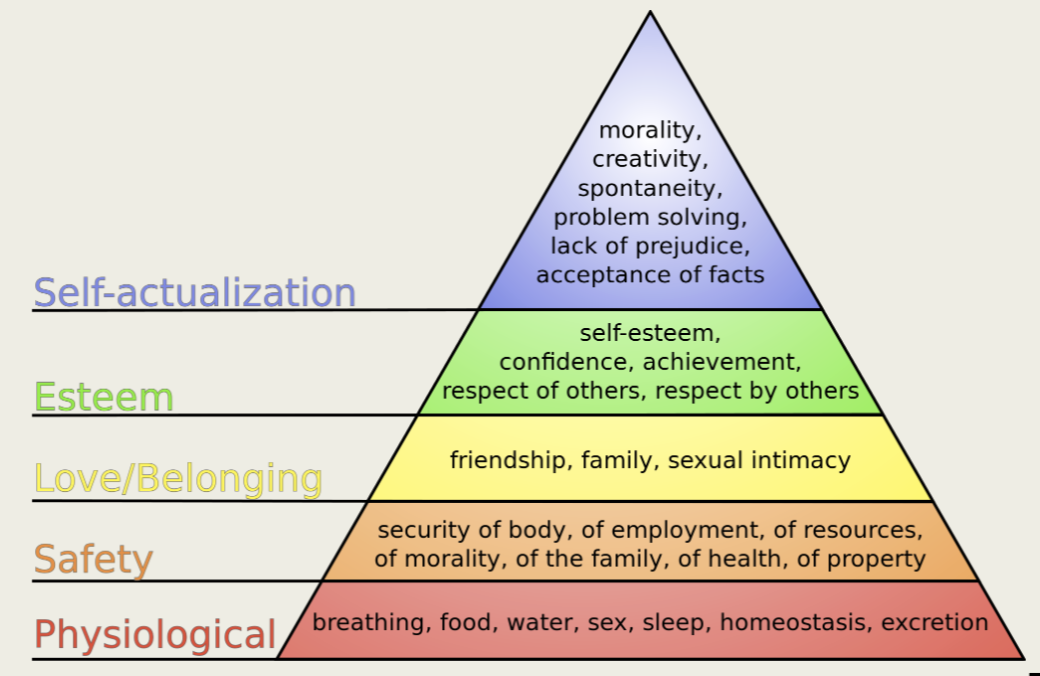
- Abraham Maslow’s Needs Hieracrhy
- Carl Roger’s Self-Theory
- Assumption that people consciously make decisions and take selfs for self-improvement
- Believed that the core element of personality is the self-concept
- Self-esteem is high when positive self-evaluation is consistent with thoughts and actions
- Assesssed an individual’s actual self against the ideal self
- If the difference between these wo measurements increases, self-esteem and self-wirth decreases
- Unconditional positive regard can help facilitate personal growth
Concepts | Definition |
|---|---|
Self-Concept | The perceptio of one’s unique set of skills, abilities, and qualities forming the basis sense of self |
Self-Esteem | The overall favorability of the evaluation of one’s sense of self |
Self-Actualization | The tendency to seek self-improvement and personal enhancement |
- Maslow’s Needs Hierarchy
- Maslow argued that the motifavtional core of personality is the desire for individuals to seek a state of self-actualization
- Maslows (1943) proposed a Needs Hierarchy: only when all other needs are met can a person achieve self-actualiaztion
- Personality difference arise from our ability to satisfy these needs
Humanistic Approahc Strengths & Contributions
- Strengths:
- Positive view of human nature that is consistent with the current focus of positive psychology
- Evidence for the concept of unconditional positive regard
- Contribution of Psychology:
- Personality operates at a conscious level of awareness
- Positve set of motives for personality
Trait Approach
- Trait: A relatively stable disposition to behave in a particular and consistent way
- What are some of these traits? The list is endless
- Researchers use factor analysis to reduce this list to the lowest possible set of traits:
- Individuals rate themselves on hundreds of traits
- Traits that are highly correlated are combined into factors
- Traits with no correlation to one another are considered parts of separate factors
The Five-Factor Model (aka The Big Five)
- Today, most researchers agree upon a give-factor model of personality
- The Big Five personality traits are not correlated with each other
Factor | Characteristics of High Scores | Characteristics of Low Scores |
|---|---|---|
Openness | Creative, artisitics, curious, imaginative, nonconforming | Conventional, down-to-earht |
Conscientiousness | Ambitious, organized, reliable | Unreliable, lazy, casual, spontaneous |
Extraversion | Talkative, optimistic, social affectionate | Reserved, comfortable with people alone, introverted |
Agreeableness | Good-natured, trusting, supportive | Rude, uncooperative, irritable, hostile, competitive |
Neuroticism | Worries, insecure, anxiety-prone | Tranquil, secure, emotionally stable |