hauser on orality
1. Traditional View of the Iliad
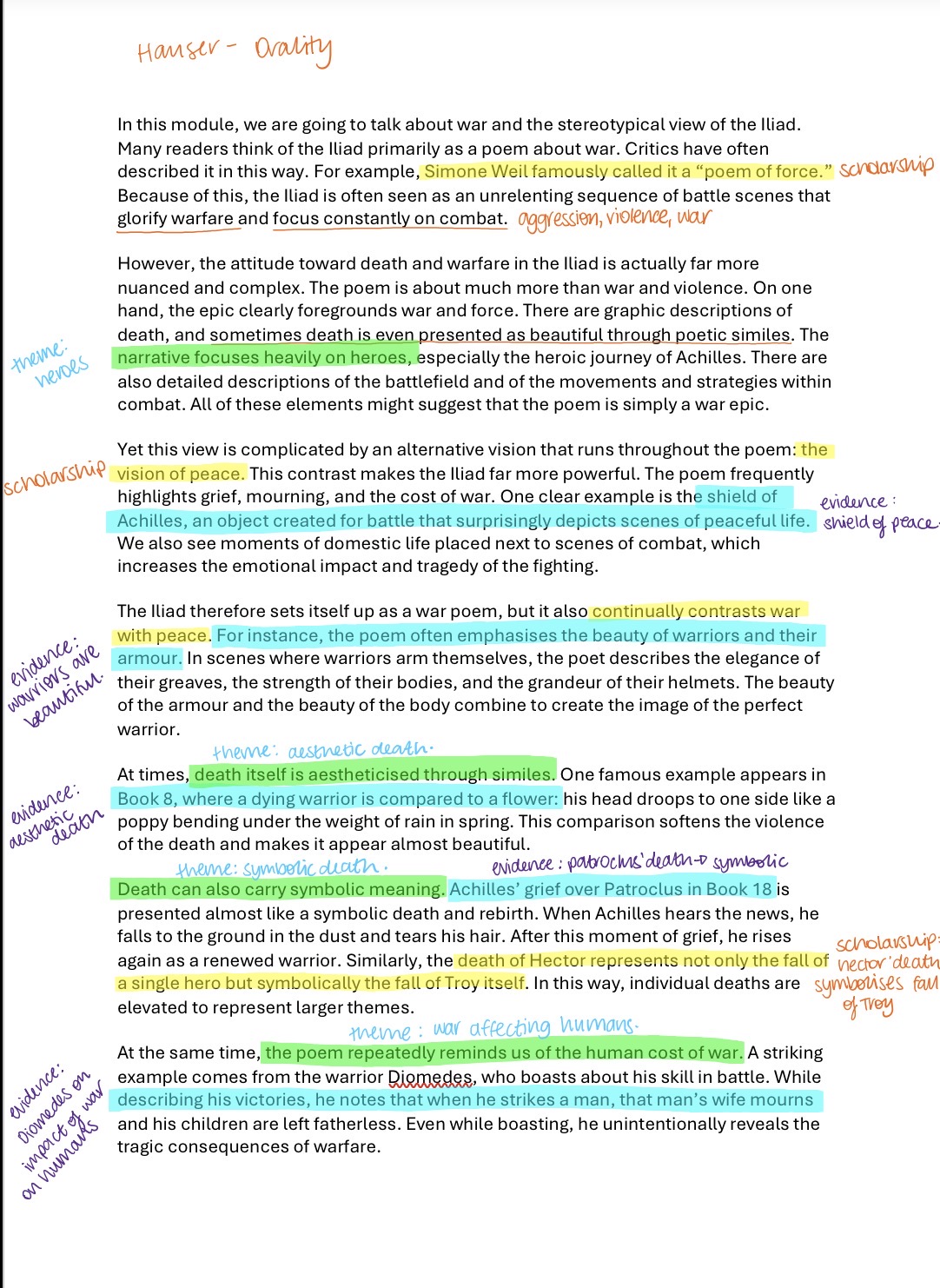
The Iliad is commonly seen as a poem about war.
Critics often describe it as focused on violence and battle scenes.
Simone Weil famously called the Iliad a “poem of force.”
Because of this, readers often view the epic as:
A continuous sequence of battle scenes
A poem that glorifies warfare
A narrative focused almost entirely on combat and violence.
2. The Iliad’s More Complex View of War
The poem’s treatment of war is much more nuanced and complex.
Although war is central, the epic also explores:
Death
Grief
Human suffering
Peace
War in the Iliad
The poem clearly foregrounds war through:
Graphic and gory descriptions of death
Aestheticised deaths through poetic similes
Focus on heroic warriors
Detailed descriptions of:
Battlefields
Military movements
Combat strategy
Central Hero
The epic follows the heroic journey of Achilles.
These elements make the poem appear to be primarily a war epic.
3. The Alternative Vision of Peace
Alongside war, the poem presents a vision of peace.
This contrast strengthens the emotional power of the epic.
The poem emphasises:
Grief
Mourning
The human cost of war
Example
Shield of Achilles
A weapon made for battle.
Yet it depicts peaceful scenes of life.
Juxtaposition
The poem frequently places:
Domestic scenes
next toScenes of combat
This contrast increases the tragedy and emotional depth of war.
4. Beauty of Warriors
The poem sometimes presents warriors as beautiful and heroic.
Armour scenes emphasise:
The beauty of greaves
The strength and beauty of the warrior’s body
The grandeur of helmets
These descriptions combine:
Beautiful body
Beautiful armour
to create the image of the perfect warrior.
5. Aestheticised Death (Similes)
Death is sometimes made beautiful through similes.
Example (Book 8)
A dying warrior’s head droops like:
a poppy bending under the weight of rain in spring
Purpose:
Softens the violence
Makes death appear poetic and aestheticised.
6. Symbolic Death
Deaths often represent larger themes.
Achilles’ Symbolic Death and Rebirth (Book 18)
Achilles hears of Patroclus’ death.
He:
Falls in the dust
Tears his hair
This moment represents a symbolic death.
He then rises as a renewed warrior.
Hector’s Death
The death of Hector symbolises:
The fall of Troy itself.
Thus, individual deaths represent larger themes and events.
7. The Human Cost of War
The poem constantly reminds the audience of war’s consequences.
Example: Diomedes
Diomedes boasts about his success in battle.
Yet he acknowledges that:
The dead warrior’s wife mourns
His children become fatherless
This reveals the tragic impact of war on families.
8. Families Left Behind
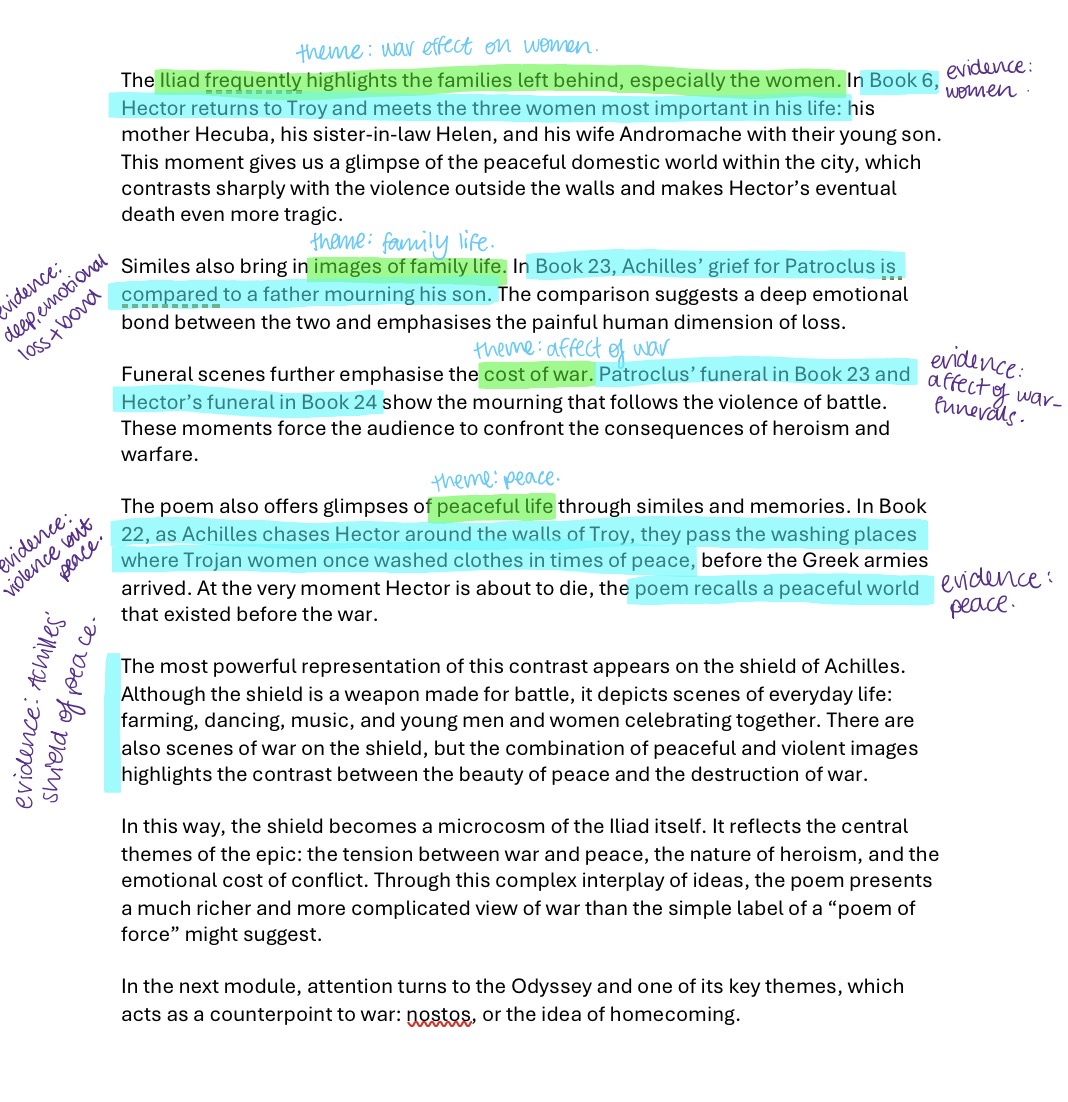
The epic often focuses on those who suffer because of war, especially women.
Example: Hector’s Family (Book 6)
Hector returns to Troy and meets:
Hecuba (his mother)
Helen (his sister-in-law)
Andromache (his wife) and their child
Importance:
Shows the peaceful domestic life inside Troy
Highlights what is at stake when Hector fights.
This contrast makes Hector’s death even more tragic.
9. Similes Involving Family
Similes often introduce family relationships.
Example (Book 23)
Achilles mourning Patroclus is compared to:
a father mourning his dead son
Purpose:
Shows the depth of Achilles’ grief
Highlights the human emotion behind heroic warfare.
10. Funeral Scenes
Funerals show the full emotional cost of war.
Important examples:
Patroclus’ funeral – Book 23
Hector’s funeral – Book 24
These scenes:
Emphasise mourning and grief
Show the consequences of heroic combat.
11. Memories of Peace
The poem sometimes recalls life before the war.
Example (Book 22)
During the chase between:
Achilles
Hector
They pass:
Washing places where Trojan women once washed clothes during peacetime.
Meaning:
Reminds readers of the peaceful world that war destroyed.
12. The Shield of Achilles
The Shield of Achilles is the strongest symbol of the war–peace contrast.
Although it is a weapon, it depicts:
Peaceful Scenes
Farming
Harvesting grapes
Dancing
Music
Young men and women celebrating together
War Scenes
Combat
Conflict
This mixture highlights:
Beauty of peace
Destruction of war
13. The Shield as a Microcosm
The shield represents the entire epic.
It reflects key themes:
War vs peace
Heroism
Human suffering
Cost of conflict
Thus, the Iliad is far more complex than simply a “poem of force.”
14. Transition to the Odyssey
The next module focuses on the Odyssey.
Key theme:
Nostos
Meaning:
Homecoming
Acts as a counterpoint to war.