Spanish test 2 (spring)
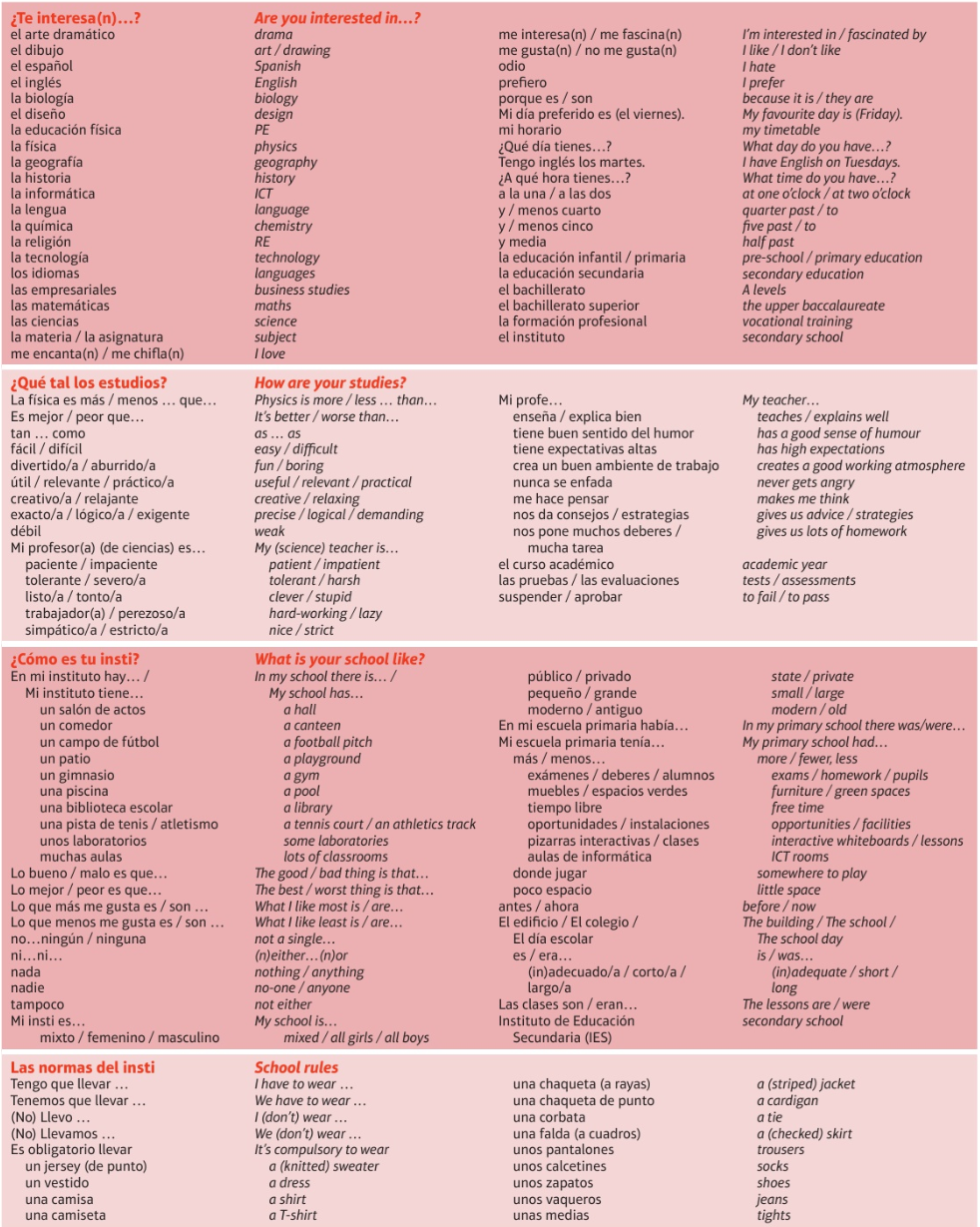
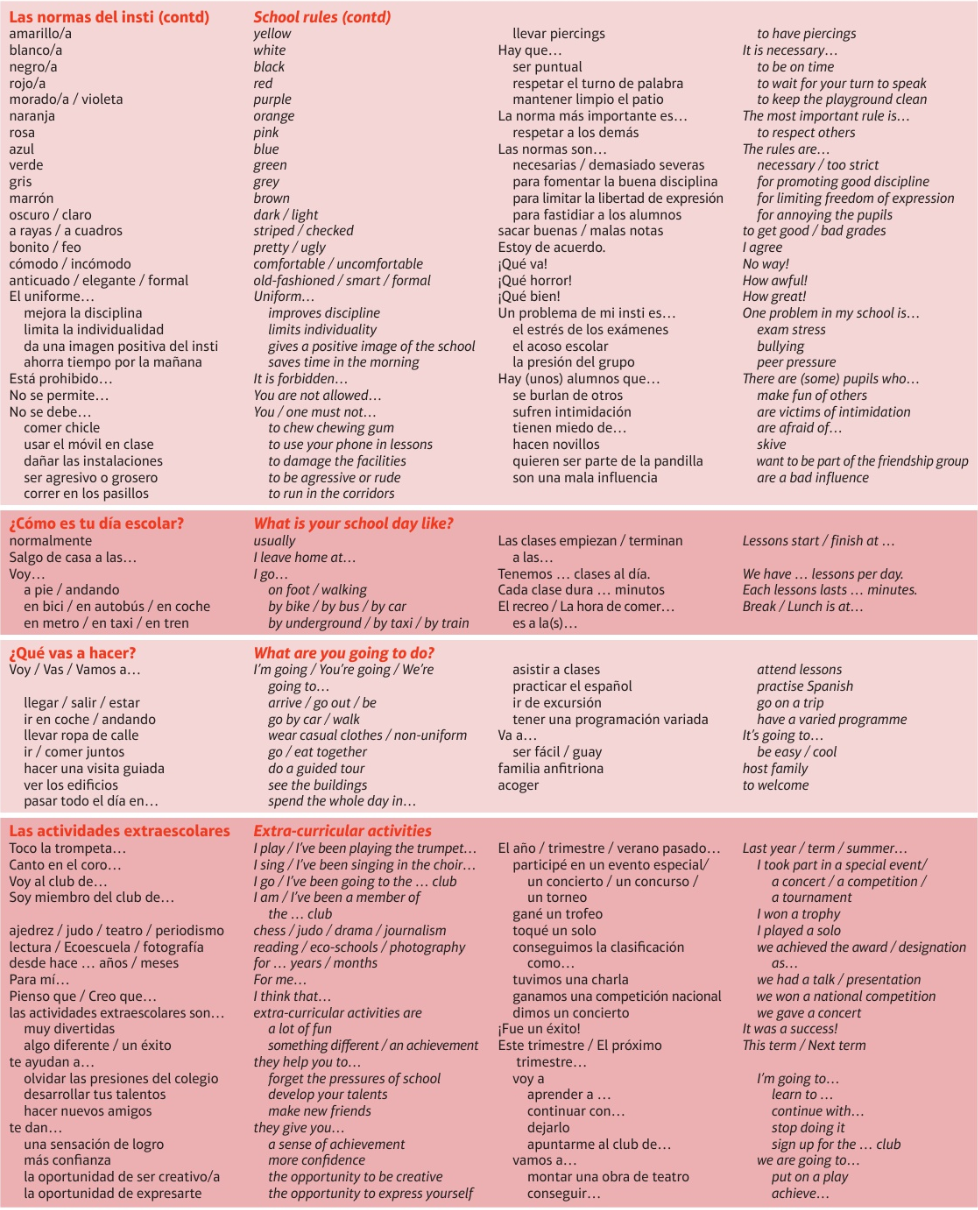
Vocab:
Grammar:
1. Present Tense Endings
Regular Verbs
-ar verbs: hablar
yo -o (hablo)
tú -as (hablas)
él/ella/usted -a (habla)
nosotros/as -amos (hablamos)
vosotros/as -áis (habláis)
ellos/ellas/ustedes -an (hablan)
-er verbs: comer
yo -o (como)
tú -es (comes)
él/ella/usted -e (come)
nosotros/as -emos (comemos)
vosotros/as -éis (coméis)
ellos/ellas/ustedes -en (comen)
-ir verbs: vivir
yo -o (vivo)
tú -es (vives)
él/ella/usted -e (vive)
nosotros/as -imos (vivimos)
vosotros/as -ís (vivís)
ellos/ellas/ustedes -en (viven)
Irregular Present Tense Verbs
Verbs like tener, hacer, ir, ser, and estar have irregular forms in the present tense.
Examples: tengo, hago, voy, soy, estoy.
2. Reflexive Verbs in the Present Tense
Reflexive pronouns: me, te, se, nos, os, se.
Example: lavarse (to wash oneself)
yo me lavo
tú te lavas
él/ella/usted se lava
nosotros/as nos lavamos
vosotros/as os laváis
ellos/ellas/ustedes se lavan
3. Preterite Tense Endings
Regular Verbs
-ar verbs: hablar
yo -é (hablé)
tú -aste (hablaste)
él/ella/usted -ó (habló)
nosotros/as -amos (hablamos)
vosotros/as -asteis (hablasteis)
ellos/ellas/ustedes -aron (hablaron)
-er and -ir verbs: comer, vivir
yo -í (comí/viví)
tú -iste (comiste/viviste)
él/ella/usted -ió (comió/vivió)
nosotros/as -imos (comimos/vivimos)
vosotros/as -isteis (comisteis/vivisteis)
ellos/ellas/ustedes -ieron (comieron/vivieron)
Irregular Preterite Forms
Stem changes or completely irregular forms (e.g., tener -> tuve, estar -> estuve, ser/ir -> fui).
4. Imperfect Tense Endings
Regular Verbs
-ar verbs: hablar
yo -aba (hablaba)
tú -abas (hablabas)
él/ella/usted -aba (hablaba)
nosotros/as -ábamos (hablábamos)
vosotros/as -abais (hablabais)
ellos/ellas/ustedes -aban (hablaban)
-er and -ir verbs: comer, vivir
yo -ía (comía/vivía)
tú -ías (comías/vivías)
él/ella/usted -ía (comía/vivía)
nosotros/as -íamos (comíamos/vivíamos)
vosotros/as -íais (comíais/vivíais)
ellos/ellas/ustedes -ían (comían/vivían)
Irregular Imperfect Forms
Only three verbs are irregular: ir (iba), ser (era), ver (veía).
5. Perfect Tense
Formed with haber in the present + past participle:
yo he hablado/comido/vivido
tú has hablado/comido/vivido
él/ella/usted ha hablado/comido/vivido
nosotros/as hemos hablado/comido/vivido
vosotros/as habéis hablado/comido/vivido
ellos/ellas/ustedes han hablado/comido/vivido
Irregular Past Participles
Some examples include escrito (from escribir), visto (from ver), and hecho (from hacer).
6. Future Tense
Regular Verbs (same endings for all conjugations)
Add endings to the infinitive:
yo -é (hablaré)
tú -ás (hablarás)
él/ella/usted -á (hablará)
nosotros/as -emos (hablaremos)
vosotros/as -éis (hablaréis)
ellos/ellas/ustedes -án (hablarán)
Irregular Future Stems
Irregular verbs like tener (tendré), hacer (haré), decir (diré).
7. Conditional Tense
Regular Verbs (same endings for all conjugations)
Add endings to the infinitive:
yo -ía (hablaría)
tú -ías (hablarías)
él/ella/usted -ía (hablaría)
nosotros/as -íamos (hablaríamos)
vosotros/as -íais (hablaríais)
ellos/ellas/ustedes -ían (hablarían)
Irregular Conditional Stems
Similar to the future tense (e.g., tener -> tendría, hacer -> haría).
Near future tense:
Yo voy → Voy a hablar (I am going to speak).
Tú vas → Vas a hablar (You are going to speak).
Él/Ella/Usted va → Va a hablar (He/She/You are going to speak).
Nosotros/Nosotras vamos → Vamos a hablar (We are going to speak).
Vosotros/Vosotras vais → Vais a hablar (You all are going to speak).
Ellos/Ellas/Ustedes van → Van a hablar (They/You all are going to speak).
Examples with Different Verbs:
Voy a comer (I am going to eat).
Vamos a estudiar (We are going to study).
Ellos van a viajar (They are going to travel).
8. Noun/Adjective Agreements
Gender and Number:
Adjectives usually agree in gender and number with the noun they describe.
Masculine singular: niño guapo
Feminine singular: niña guapa
Masculine plural: niños guapos
Feminine plural: niñas guapas
9. Adverbs
Most adverbs are formed by adding -mente to the feminine form of the adjective.
Example: rápido -> rápidamente, feliz -> felizmente
Common irregular adverbs:
bien (well), mal (badly), muy (very).
Irregular verbs:
Present Tense Irregular Verbs
Tener (to have)
yo tengo
tú tienes
él/ella/usted tiene
nosotros/as tenemos
vosotros/as tenéis
ellos/ellas/ustedes tienen
Hacer (to do, to make)
yo hago
tú haces
él/ella/usted hace
nosotros/as hacemos
vosotros/as hacéis
ellos/ellas/ustedes hacen
Ir (to go)
yo voy
tú vas
él/ella/usted va
nosotros/as vamos
vosotros/as vais
ellos/ellas/ustedes van
Ser (to be - permanent)
yo soy
tú eres
él/ella/usted es
nosotros/as somos
vosotros/as sois
ellos/ellas/ustedes son
Estar (to be - temporary)
yo estoy
tú estás
él/ella/usted está
nosotros/as estamos
vosotros/as estáis
ellos/ellas/ustedes están
Preterite Tense Irregular Verbs
Tener (to have)
yo tuve
tú tuviste
él/ella/usted tuvo
nosotros/as tuvimos
vosotros/as tuvisteis
ellos/ellas/ustedes tuvieron
Hacer (to do, to make)
yo hice
tú hiciste
él/ella/usted hizo
nosotros/as hicimos
vosotros/as hicisteis
ellos/ellas/ustedes hicieron
Ir / Ser (to go / to be - same conjugation in the preterite)
yo fui
tú fuiste
él/ella/usted fue
nosotros/as fuimos
vosotros/as fuisteis
ellos/ellas/ustedes fueron
Estar (to be - temporary)
yo estuve
tú estuviste
él/ella/usted estuvo
nosotros/as estuvimos
vosotros/as estuvisteis
ellos/ellas/ustedes estuvieron
Imperfect Tense Irregular Verbs
Ir (to go)
yo iba
tú ibas
él/ella/usted iba
nosotros/as íbamos
vosotros/as ibais
ellos/ellas/ustedes iban
Ser (to be - permanent)
yo era
tú eras
él/ella/usted era
nosotros/as éramos
vosotros/as erais
ellos/ellas/ustedes eran
Ver (to see)
yo veía
tú veías
él/ella/usted veía
nosotros/as veíamos
vosotros/as veíais
ellos/ellas/ustedes veían
Future Tense Irregular Verbs
Tener (to have)
yo tendré
tú tendrás
él/ella/usted tendrá
nosotros/as tendremos
vosotros/as tendréis
ellos/ellas/ustedes tendrán
Hacer (to do, to make)
yo haré
tú harás
él/ella/usted hará
nosotros/as haremos
vosotros/as haréis
ellos/ellas/ustedes harán
Decir (to say, to tell)
yo diré
tú dirás
él/ella/usted dirá
nosotros/as diremos
vosotros/as diréis
ellos/ellas/ustedes dirán
Conditional Tense Irregular Verbs
Tener (to have)
yo tendría
tú tendrías
él/ella/usted tendría
nosotros/as tendríamos
vosotros/as tendríais
ellos/ellas/ustedes tendrían
Hacer (to do, to make)
yo haría
tú harías
él/ella/usted haría
nosotros/as haríamos
vosotros/as haríais
ellos/ellas/ustedes harían
Decir (to say, to tell)
yo diría
tú dirías
él/ella/usted diría
nosotros/as diríamos
vosotros/as diríais
ellos/ellas/ustedes dirían
Perfect Tense (Past Participle Forms for Irregular Verbs)
Escribir (to write) - escrito
Ver (to see) - visto
Hacer (to do, to make) - hecho
Decir (to say, to tell) - dicho
Poner (to put) - puesto
Abrir (to open) - abierto
Romper (to break) - roto
Volver (to return) - vuelto
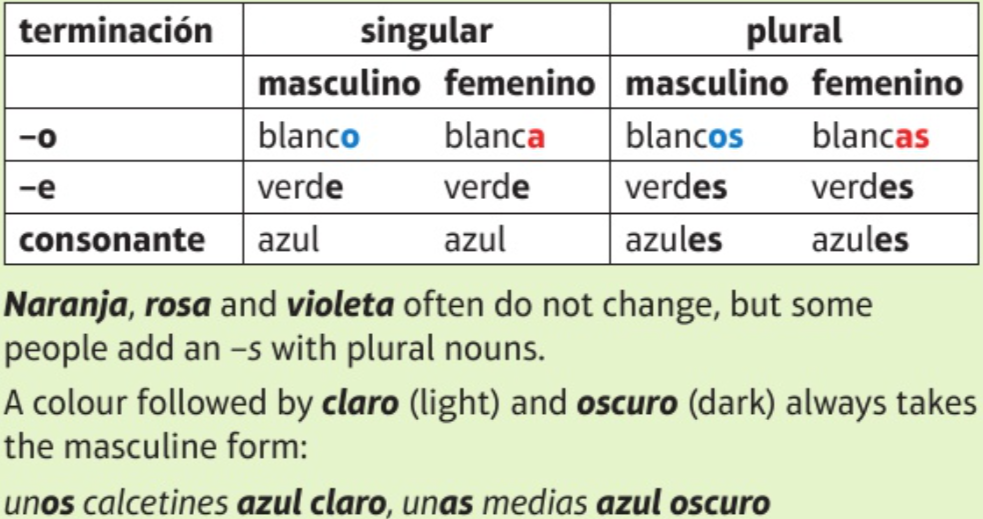
Adjectives of colour:
Comparativos (Comparatives)
más… que → more… than
menos… que → less… than
mejor que… → better than
peor que… → worse than
tan… como… → as… as
Examples:
El español es más fácil que el mandarín.
→ Spanish is easier than Mandarin.La informática es tan creativa como la tecnología.
→ Computer science is as creative as technology.
Superlativos (Superlatives)
el/la más… → the most…
el/la menos… → the least…
el/la mejor… → the best…
el/la peor… → the worst…
Examples:
Mi profesora de inglés es la más divertida.
→ My English teacher is the most fun.El español es la asignatura más interesante.
→ Spanish is the most interesting subject.
Negatives:
No hago nada. → I don’t do anything.
No conozco a nadie. → I don’t know anyone.
No tenemos ni tabletas ni ordenadores. → We don’t have tablets or computers.
No tiene ningún laboratorio. → It doesn’t have any laboratory.
No tiene ninguna pista de tenis. → It doesn’t have any tennis court.
Nunca can go before or after the verb. When after, use no in front of the verb as well:
Nunca estudia. → He/She never studies.
No estudia nunca. → He/She doesn’t ever study.
Tampoco (not either) usually goes in front of the verb:
Tampoco hay piscina. → There isn’t a pool either
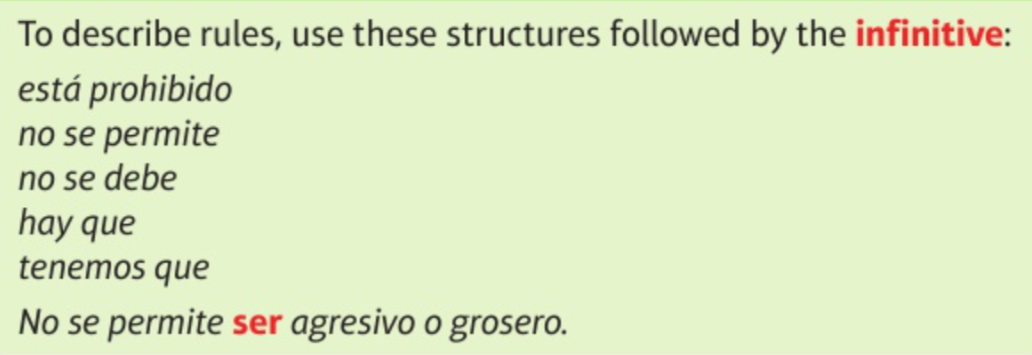
Verbs before the infinitive:
‘How long’ words:
To say how long you have been doing something use ‘desde hace’ and the present tense of the verb.
Desde hace cuanto tiempo tocas el piano? - how long have you been playing the piano?
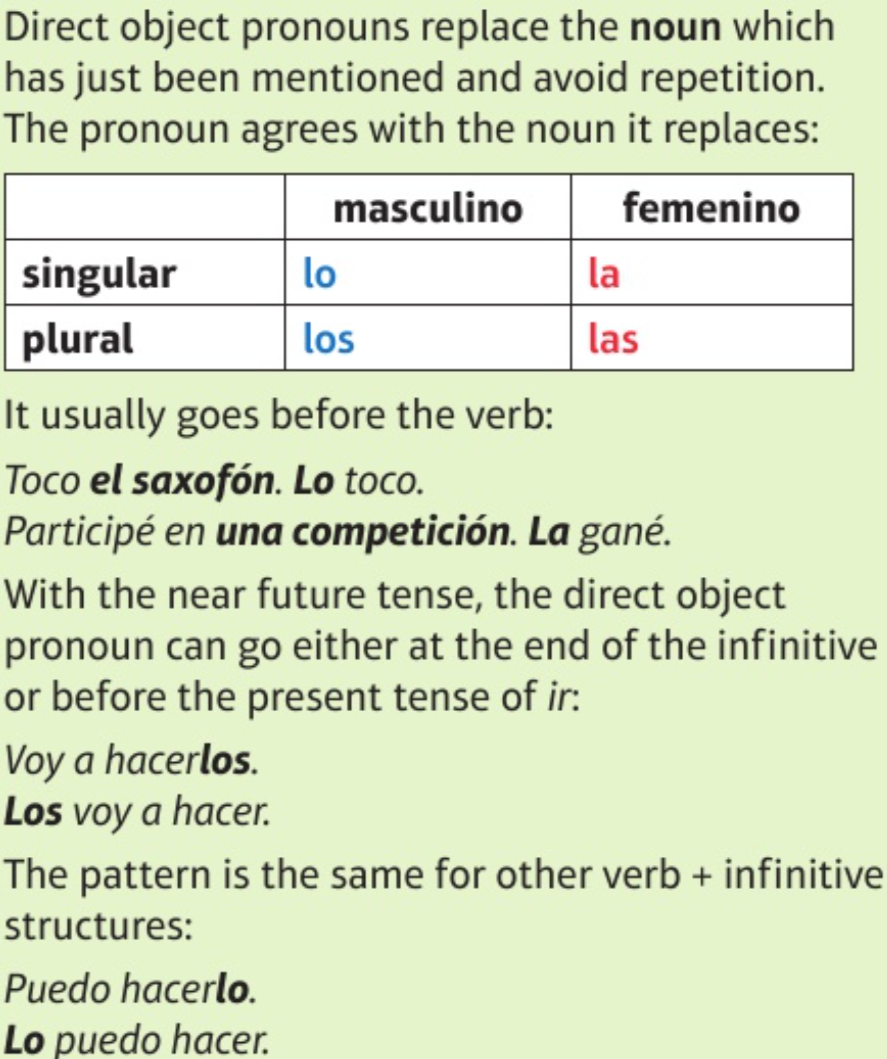
Direct object pronouns: