Anatomy Exam 1
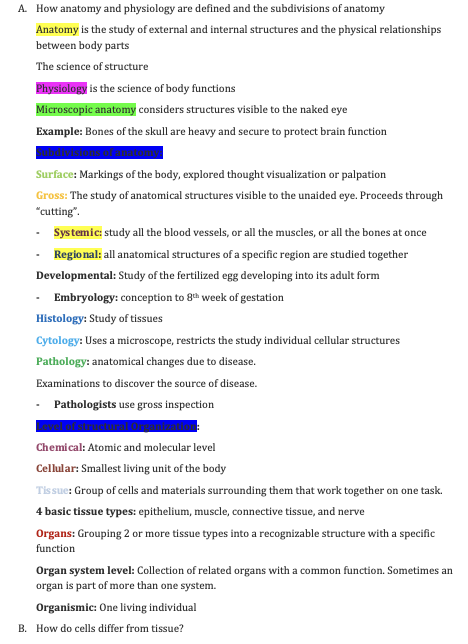
Anatomy is the study of external and internal structures and the physical relationships between body parts
The science of structure
Physiology is the science of body functions
Microscopic anatomy considers structures visible to the naked eye
Example: Bones of the skull are heavy and secure to protect brain function
Subdivisions of anatomy:
Surface: Markings of the body, explored thought visualization or palpation
Gross: The study of anatomical structures visible to the unaided eye. Proceeds through “cutting”.
- Systemic: study all the blood vessels, or all the muscles, or all the bones at once
- Regional: all anatomical structures of a specific region are studied together
Developmental: Study of the fertilized egg developing into its adult form
- Embryology: conception to 8th week of gestation
Histology: Study of tissues
Cytology: Uses a microscope, restricts the study individual cellular structures
Pathology: anatomical changes due to disease.
Examinations to discover the source of disease.
- Pathologists use gross inspection
Level of structural Organization:
Chemical: Atomic and molecular level
Cellular: Smallest living unit of the body
Tissue: Group of cells and materials surrounding them that work together on one task.
4 basic tissue types: epithelium, muscle, connective tissue, and nerve
Organs: Grouping 2 or more tissue types into a recognizable structure with a specific function
Organ system level: Collection of related organs with a common function. Sometimes an organ is part of more than one system.
Organismic: One living individual
B. How do cells differ from tissue?
C. Life processes
Metabolism: The sum of all chemical processes that occur in the body
Responsiveness
- The body’s ability to detect and respond to changes in internal or external environment
Movement at any structural level
- Motion of the whole body
Growth
- Increase number of the size of cells or the material found between cells
Differentiation
- Unspecialized cells become specialized cells
Reproduction
- Formation of new cells or new individuals
D. Components of abdominal exams
E. Directional terms
F. Body landmarks
Body cavities are spaces within the body that have internal organs.
The cranial cavity is the hollow space within the skull which contains the brain.
Three layers of protective tissue, Meninges, and cerebral spinal fluid all protect the brain and spinal cord.
G. The anatomical position
- Prone position: face down
- Supine: face up
H. Planes and sections
Plane: imaginary flat surface that passes through the body
- Horizontal
- Frontal
- midsagittal
Section: one of the two surfaces that results when the body is cut by a plane passing through it
Frontal/coronal: anterior and posterior
Sagittal: Left and right sides
Transverse: horizontal (superior and inferior)
Parasagittal: unequal halves
Midsagittal: equal sides
Oblique: combination of 2 other planes
Deep: Away from surface of the body
Superficial: Towards surface of the body
Distal: away from point of attachment
Proximal: near point of attachment
Ipsilateral: on the same side of the body’s midline as another structure
Intermediate: between two structures
Ventral: relating to the belly side of the body; toward the belly
Caudal: relating to the tail
Rostral: relating to the nose and mouth region; towards the face
Contralateral: on the opposite side of the body’s midline from another structure
External: outside of the structure
Internal: inside of the structure
I. Imaging techniques
Why do we use medical imaging? – No surgery is required and is useful for confirmation of diagnosis
J. The 11 systems of the body
Integumentary system
- Contains the skin, hair, nails, oil glands, subcutaneous tissue
- Protects the body, regulates temperature, and eliminates wastes
The skeletal system
- Bones, joints, and cartilage
- Supports and protects the body and aids body movement
The muscular System
- Consists of skeletal muscles tissue where muscles attach to bone
- Brings about body movements and is the major source of heat production
The cardiovascular system
- Blood, heart, and blood vessels
- Heart pumps blood through blood vessels blood carries oxygen and nutrients to cells and carbon dioxidewasted away from cells and helps regulate acid
The lymphatic system
- Lymphatic fluid, lymphatic vessels, lymph nodes, tonsils, B and T cells
- Returns proteins and fluid to blood and carries lipids from the digestive canal to blood
Nervous system
- Has the brain, spinal cord, eyes, and ears
- Generates action potentials to regulate body cavities
Endocrine System
- Pineal gland, hypothalamus, pituitary gland, parathyroid gland, suprarenal gland, pancreas, ovaries, and testes
- Regulates body activities by releasing hormones which are chemical messengers
Respiratory System
- Lungs. Pharynx, trachea, bronchial tubes
- Transfers oxygen from inhaled air to blood. And then carbon dioxide from blood to exhaled air.
Digestive system
- Mouth, esophagus, pharynx, stomach, small + large intestines, anus, salivary glands, liver gallbladder, and pancreas
- Physical and chemical breakdown of food
Urinary system
- Kidneys, ureters, ordinary bladder, and urethra
- Produces, stores, and eliminates urine and wastes
Reproductive system
Gonads, uterine tubes, uterus, vagina, clitoris, penis, epididymides, seminal glands, prostate, and ductus deferenses