The Science of Astronomy
Modern Science and Its Root in Ancient Astronomy
☉ Astronomy is the oldest of the sciences.
☉ It was often practiced for practical reasons—
In keeping track of time and seasons
for practical purposes, including agriculture
for religious and ceremonial purposes
aiding navigation
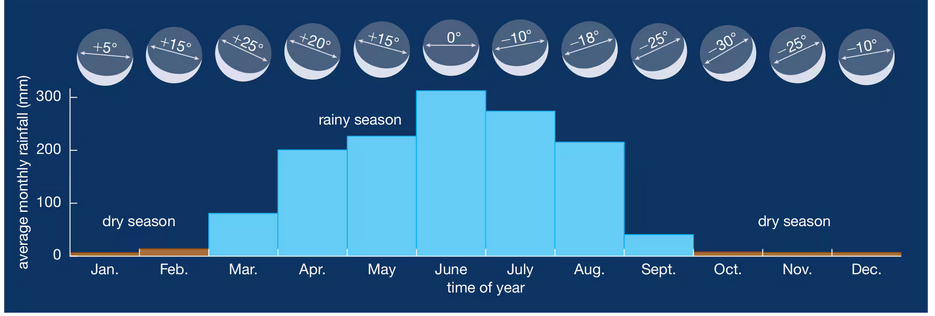
❊ In central Nigeria, the orientation of the “horns” of a waxing crescent moon (shown along the top) correlates with the average amount of rainfall at different times of year. Local people could use this fact to predict the weather with reasonable accuracy
✦ Ancient people used observations of the sky to keep track of the time and seasons and as an aid in navigation.
Astronomy and the Measure of Time
☉The length of a month comes from the Moon’s cycle of phases
☉The length of the year is based on the cycles of the seasons
☉ The seven days of the week were named after the seven “planets” of ancient times
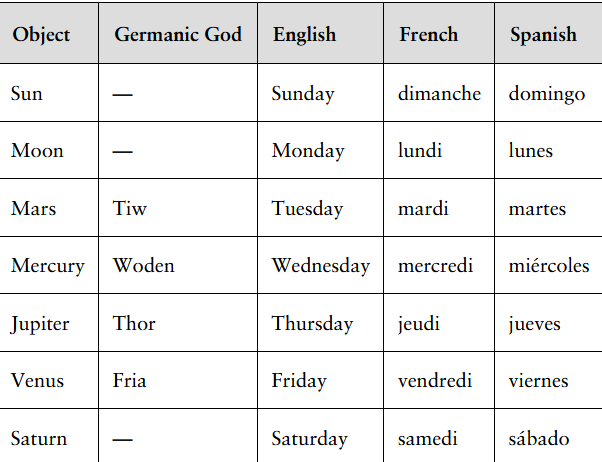
The seven days were originally linked directly to the seven objects. The correspondence is no longer perfect, but the pattern is clear in many languages; some English names come from Germanic gods.
☉ The concept of time measurement has evolved significantly, but its roots are deeply intertwined with observations of astronomical bodies.
☉ We trace the origins of the modern clock to ancient Egypt, where sundials were first developed to measure time during the day based on the position of the Sun.
Egyptians divided daytime and nighttime into 12 equal parts each, which is how we got our 12 hours each of A.M. and P.M.
A.M. — ante meridiem; “before the middle of the day”
P.M. — post meridiem; “after the middle of the day.”
☉ A stick or obelisk acts as a simple sundial, which allows you to estimate the local time because the position of the shadow changes as the Sun moves across the sky during the day.
Solar and Lunar Calendars
☉ The tracking of the seasons eventually led to the advent of written calendars.
☉ Today, we use a solar calendar, meaning a calendar that is synchronized with the seasons so that seasonal events such as the solstices and equinoxes occur on approximately the same dates each year.
19 years on a solar calendar is almost precisely 235 months on a lunar calendar
☉ Some cultures therefore created lunar calendars that aimed to stay synchronized with the lunar cycle, so that the Moon’s phase was always the same on the first day of each month.
A basic lunar calendar has 12 months, with some months lasting 29 days and others lasting 30 days. Therefore is has 354 or 355 days (11 days fewer than an solar calendar)
A lunar calendar always has the same moon phase on the first day of each month.
Metonic cycle → when the lunar phases repeat on the same solar dates (happens about every 19 years)
Ancient Achievements
Archaeoastronomy → the study of astronomical uses of ancient structures.
☉ Navigators used a detailed knowledge of astronomy for their broad navigational sense, and a deep understanding of wave and swell patterns to locate precise landing points
Ancient Greek Science
☉ Greek philosophers developed at least three major innovations that helped pave the way for modern science.
a tradition of trying to understand nature without relying on supernatural explanations and working communally to debate and challenge each other’s ideas
mathematics to give precision to their ideas
allowed them to explore the implications of new ideas in much greater depth than would have otherwise been possible
the power of reasoning from observations and just from a philosophical standpoint
☉ The Greeks (Plato and Aristotle) developed models of nature that aimed to explain and predict observed phenomena.
Geocentric Model → any of the ancient Greek models that were used to predict planetary positions under the assumption that Earth lay in the center of the universe.
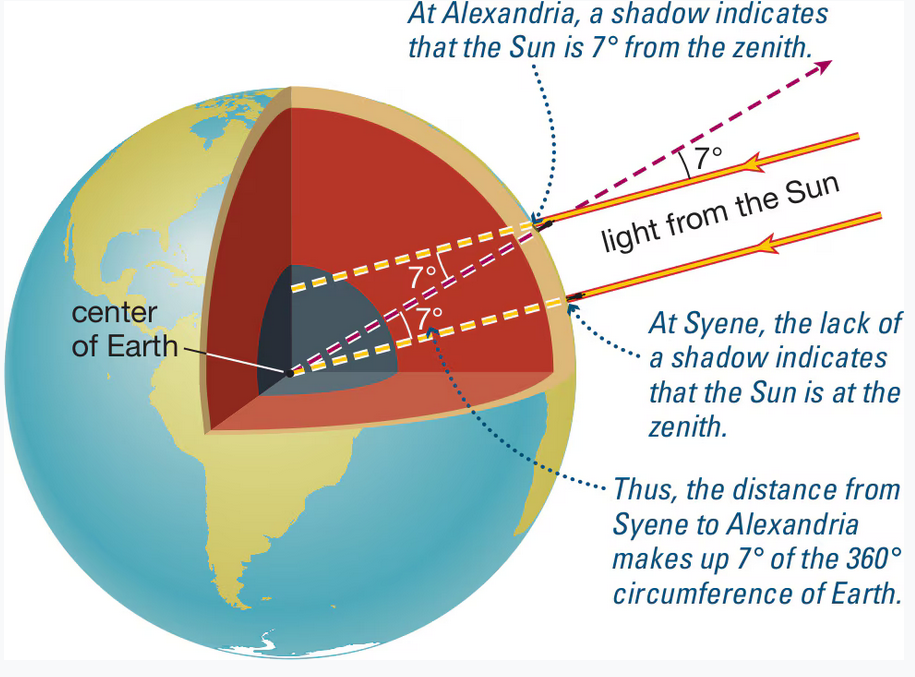
This diagram shows how Eratosthenes concluded that the north-south distance from Syene to Alexandria is 73/60 of Earth’s circumference.
Measurements:
➛ Syene to Alexandria
➛ Distance ≈ 5000 stadia
➛Angle = 7°
Calculate circumference of Earth:
➛ 7/360 x (circum. Earth) = 5000 stadia ➱ circum.
➛ Earth = 5000 x 360/7 stadia ≈ 250,000 stadia
Compare to modern value (≈ 40,100 km):
➛ Greek stadium ≈ 1/6 km 250,000 stadia ≈ 42,000 km
☉ Islamic scholars preserved and extended ancient Greek scholarship, and their work helped ignite the European Renaissance.
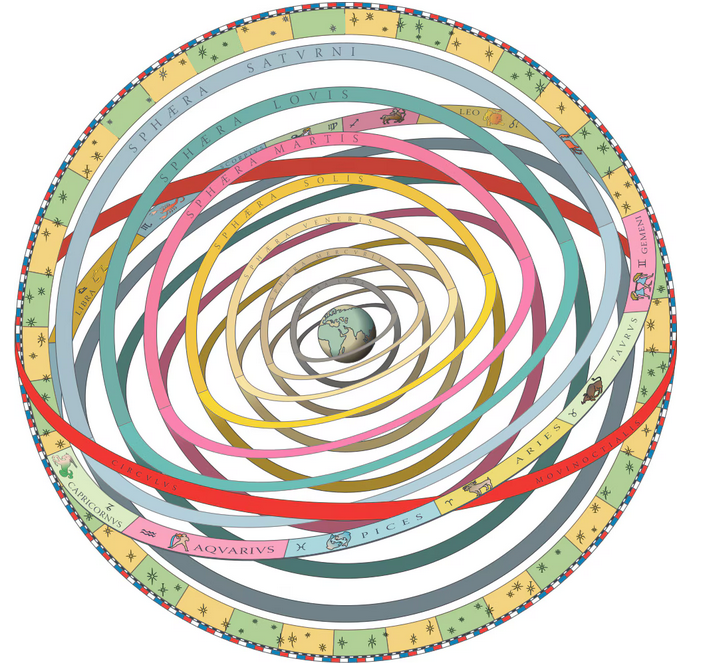
This model represents the Greek idea of the heavenly spheres (c. 400 B.C.). Earth is a sphere that rests in the center. The Moon, the Sun, and the planets each have their own spheres. The outermost sphere holds the stars.
The difficulty with this model was that it made it hard to explain the apparent retrograde motion of the planets
According to the idea of “heavenly perfection” heavenly objects could move only in perfect circles, leading astronomers to struggle with the observation that planets sometimes appeared to move backward against the backdrop of stars.
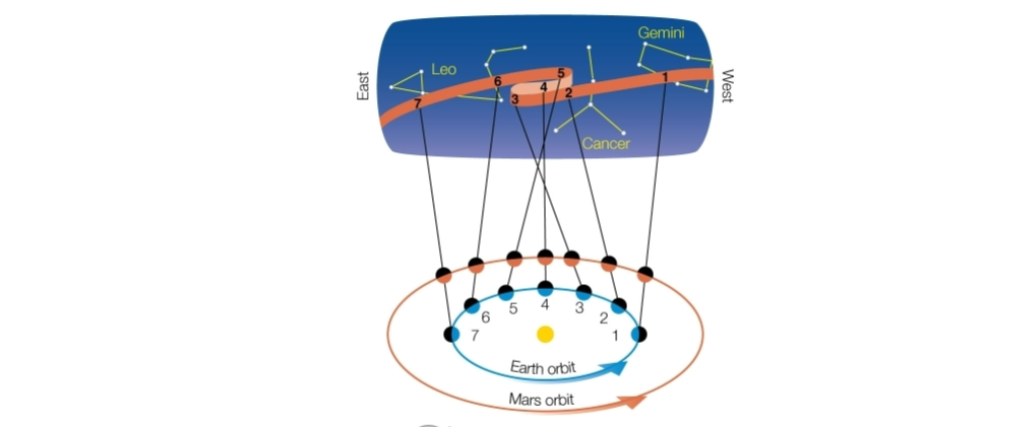
Ptolemaic model → the geocentric model of the universe developed by Ptolemy in about 150 A. — the essence of the Ptolemaic model was that each planet moves on a small circle whose center moves around Earth on a larger circle
The small circle is called an epicycle, and the larger circle is called a deferent.
A planet following this circle-upon-circle motion traces a loop as seen from Earth, with the backward portion of the loop mimicking apparent retrograde motion.
Despite its limitations, the Ptolemaic model remained influential for over a millennium, as it provided a structured way to predict planetary positions and movements.
Sufficiently accurate to remain in use for 1500 years
correctly forecast future planetary positions to within a few degrees of arc
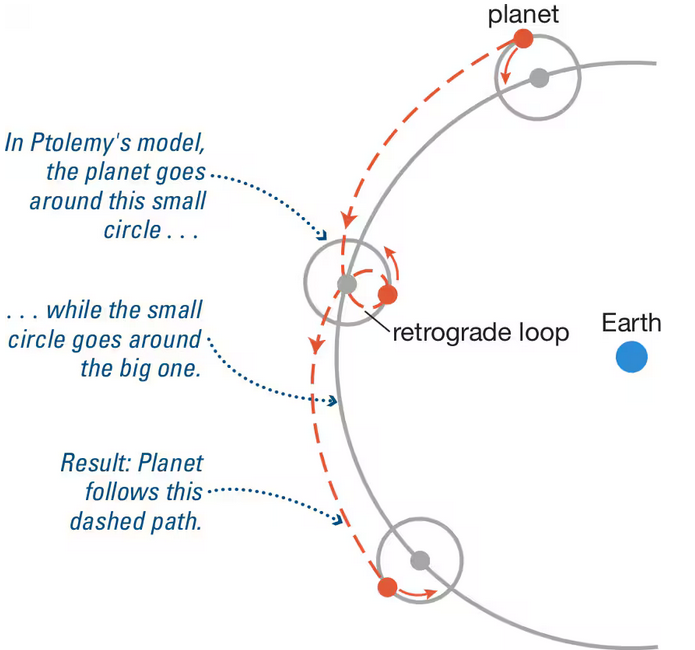
This diagram shows how the Ptolemaic model accounted for apparent retrograde motion. Each planet is assumed to move around a small circle that turns upon a larger circle. The resulting path (dashed) includes a loop in which the planet goes backward as seen from Earth.
Preserving the ideas of the Greeks
☉ The Muslim world preserved and enhanced the knowledge they received from the Greeks while Europe was in its Dark Ages.
☉ Al-Mamun's House of Wisdom in Baghdad was a great center of learning around A.D. 800.
☉ With the fall of Constantinople (Istanbul) in 1453, Eastern scholars headed west to Europe, carrying knowledge that helped ignite the European Renaissance
The Copernican Revolution
Copernican Revolution → the dramatic change, initiated by Copernicus, that occurred when we learned that Earth is a planet orbiting the Sun rather than the center of the universe.
Copernicus proposed the Sun-centered model (published 1543).
He used the model to determine the layout of the solar system (planetary distances in AU).
This paradigm shift not only altered our understanding of the solar system but also laid the groundwork for the scientific method and modern astronomy.
☉ Copernicus discovered simple geometric relationships that strengthened his belief in the Sun-centered idea, because they allowed him to calculate each planet’s orbital period and relative distance (compared to Earth’s distance) from the Sun.
☉ Copernicus’s Sun-centered model was based on the right general ideas, but its predictions were not substantially better than those of Ptolemy’s Earth-centered model because it still used perfect circles
Tycho
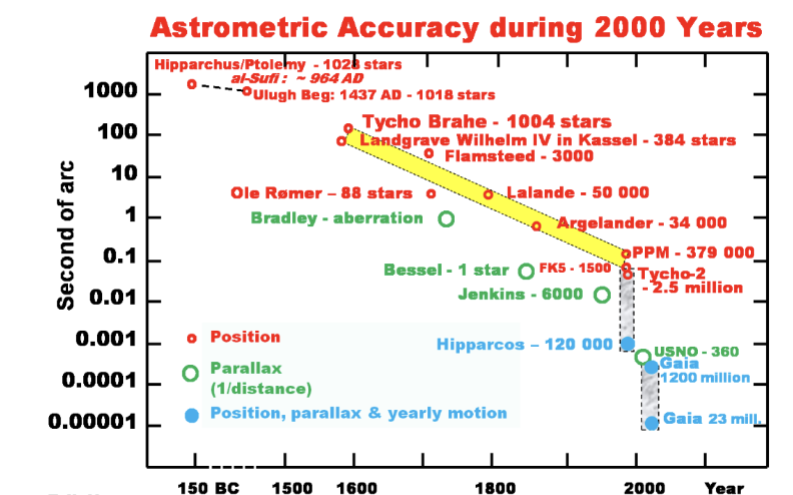
☉ Tycho’s accurate naked-eye observations provided the data needed to improve the Copernican system.
compiled the most accurate (1 arcminute) naked eye measurements ever made of planetary positions.
☉ Tycho advocated a model in which the Sun orbits Earth while all other planets orbit the Sun
he still could not detect stellar parallax, and thus still thought Earth must be at the center of the solar system (but recognized that other planets go around the Sun).
☉ He hired Kepler, who used Tycho's observations to discover the truth about planetary motion.
Kepler
☉ Believed that planetary orbits should be perfect circles, so he worked diligently to match circular motions to Tycho’s observations.
☉ The small discrepancies (8-arcminute) finally led Kepler to abandon the idea of circular orbits—and to find the correct solution to the ancient riddle of planetary motion.
☉ Kepler’s key discovery was that planetary orbits are not circles but instead are a special type of oval called an ellipse.
Semimajor Axis → half the distance across the long axis of an ellipse
Eccentricity → a measure of how much an ellipse deviates from a perfect circle; defined as the center-to-focus distance divided by the length of the semimajor axis.
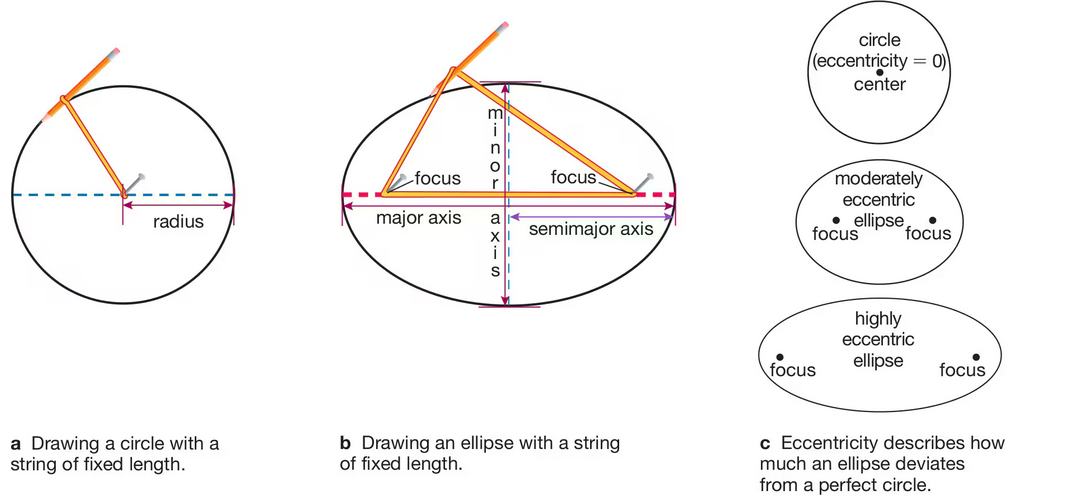
An ellipse is a special type of oval. These diagrams show how an ellipse differs from a circle and how different ellipses vary in their eccentricity.
☉ By using elliptical orbits, Kepler created a Sun-centered model that predicted planetary positions with outstanding accuracy.
Kepler’s Laws of Planetary Motion → three laws discovered by Kepler that describe the motion of the planets around the Sun.
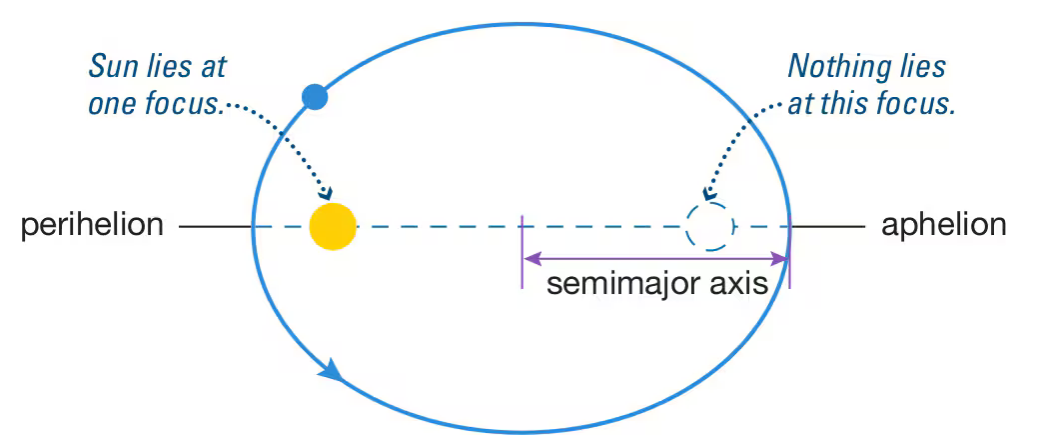
The orbit of each planet about the Sun is an ellipse with the Sun at one focus
a planet’s distance from the Sun varies during its orbit.
it is closest at the point called perihelion (from the Greek for “near the Sun”) and farthest at the point called aphelion (“away from the Sun”).
the average of a planet’s perihelion and aphelion distances is the length of its semimajor axis
the orbit of a planet must be an ellipse with the Sun at one focus. Therefore, the path that shows the Sun in the center of the ellipse, rather than at a focus, cannot be the real orbital path of a planet.
Eccentricity is a measure of how “stretched out” an ellipse is. A perfect circle has zero eccentricity, and the most stretched out ellipse has the largest eccentricity.
Aphelion is the point in a planet’s orbit that is farthest from the Sun.
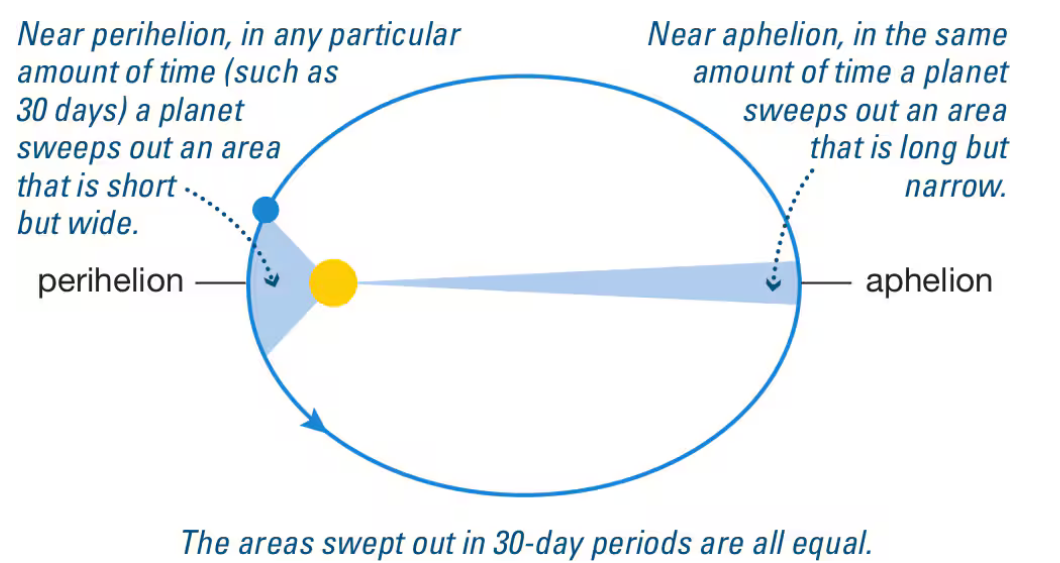
As a planet moves around its elliptical orbit, it moves faster when it is nearer the Sun and slower when it is farther from the Sun, sweeping out equal areas in equal times.
a planet always sweeps out equal areas in equal times. Therefore, Earth sweeps out the same area in any 31-day period, no matter what month it is.
a planet moves faster in its orbit when it is closer to the Sun (near perihelion) than when it is farther (near aphelion).
Kepler's second law tells us that the comet sweeps out equal areas in equal times. Because the area triangle is shorter and squatter for the segments nearer to the Sun, the distance must be greater for these segments in order for all the areas to be the same.
More distant planets orbit the Sun at slower average speeds, obeying the relationship p2 = a3
applies to any orbiting object that meets the following two conditions:
it orbits the Sun or a star of the same mass, and
we measure period in years and distance in AU.
Kepler’s third law tells us that an object’s average orbital distance can be calculated from its orbital period using the formula p2=a3 (where p is the planet’s orbital period in years and a is its average orbital distance in AU). Therefore, all objects that share Earth’s orbital period of 1 year must also share Earth’s average orbital distance of 1AU.
Galileo
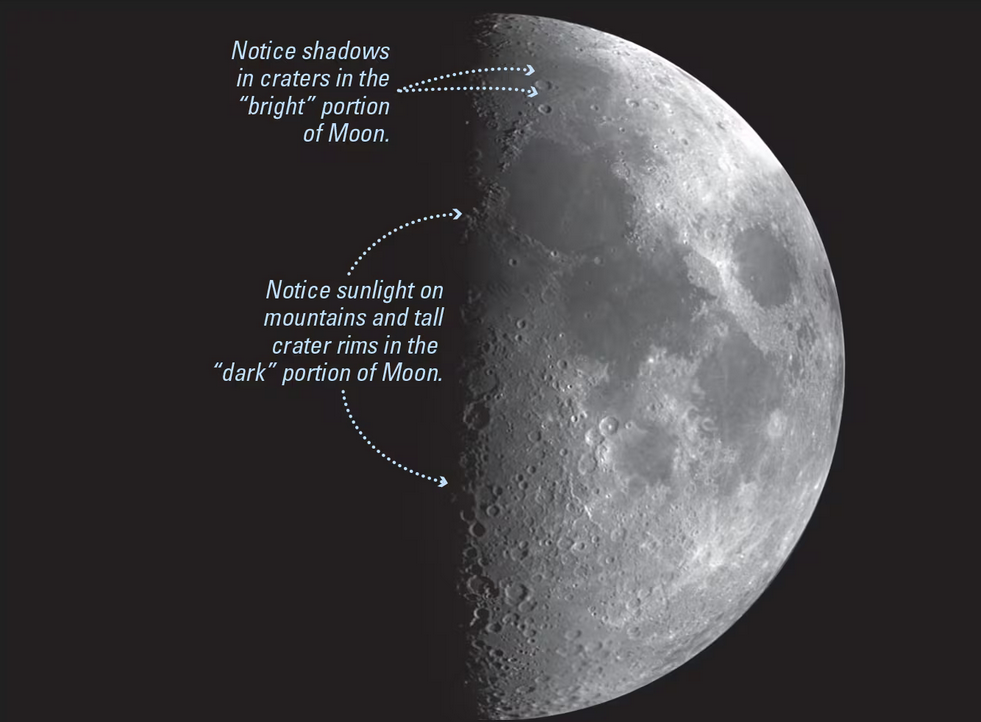
The shadows cast by mountains and crater rims near the dividing line between the light and dark portions of the lunar face show that the Moon’s surface is not perfectly smooth.
☉ Galileo’s experiments and telescopic observations overcame remaining scientific objections to the Copernican idea, sealing the case for the Sun-centered solar system.
☉ Galileo's observations of the phases of Venus directly contradicted the predictions of the Earth-centered model, but agreed with what we expect in a Sun-centered model.