Regional + Directional Terms
Directional Terms
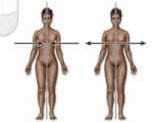
Medial: refers to a position closer to the midline of the body.
Lateral: refers to a position farther away from the body's midline.
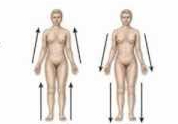
Proximal: refers to a position closer to the point of attachment or a given reference point.
Distal: refers to a position farther away from the point of attachment or a given reference point.
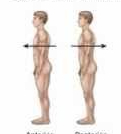
Anterior/Ventral: refers to the front side of the body, or in humans, the chest area.
Posterior/Dorsal: refers to the back side of the body, opposite the anterior or ventral side.
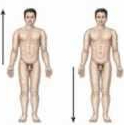
Superior: refers to a position higher or above another part of the body, typically towards the head or top.
Inferior: refers to a position lower or below another part of the body, typically towards the feet or bottom.
Regional Terms
Head Region
Head and Skull: Cranial or Cephalic
Forehead: Frontal
Eyes: Orbital
Cheeks: Buccal
Ears: Auricle or Otic
Nose: Nasal
Mouth: Oral
Chin: Mental
Neck: Cervical
Trunk Region
Chest: Thoracic
Breast: Mammary
Muscles of the chest: Pectoral
Sternum: Sternal
Stomach: Abdominal
Abdomen (icenter): Umbilicus or navel
Hip area: Coxal
Above the genitals: Pubic
Pelvis and Leg
Groin (between legs and genitals): Inguinal
Surrounding the genitals: Pubic
Thighs: Femoral
Knee: Patellar
Shin: Crural
Ankle: Tarsal
Foot: Pedal
Toes: Digital or phalangeal
Upper Limbs
Armpit: Axillary
Upper arm: Brachial
Elbow: Antecubital
Forearm: Antebrachial
Wrist: Carpal
Palm: Palmar
Fingers: Digital or phalangeal
Thumb: Pollex
Postier View
Entire backside: Dorsal
Shoulders: Acromial
Upper back: Thoracic
Lower back: Lumbar
End of spine and above the buttocks: Sacral
Posterior Region of the Legs
Buttocks: Gluteal
Thigh: Femoral
Back of Knee: Popliteal
Sole: Plantar
Body Planes and Cavities
Planes
Sagittal: Divides the body into left and right parts, cuts the body down the middle
Coronal: Divides the body into anterior and posterior parts
Transverse: divides the body into inferior and superior
Cavities
Cranial Cavity: Contains the Brain
Spinal Cavity: Contains the Spinal Cord
Dorsoal Cavity: Cavity in the back
Thoracic Cavity: Chest
Abdominal Cavity: Contains the Liver, Stomach, Pancreas, and Intestines
Pelvic Cavity: Contains the Bladder and Reproductive Organs
Abdomino-pelvic Cavity: It comprises the abdominal and pelvic cavities
Skeletal Structure
Skull
Mandible: Lower jaw
Maxilla: Upper Jaw
Zigomatic: What forms the cheek and the outer side of the eye socket
Lacrimal: A Small one forming part of the eye socket
Nasal: Forms the nose
Temporal: Side of the skull
Ethmoid: Separates the nasal cavity from the brain
Sphenoid: Middle of the skull towards the front
Frontal: Front upper part of the skull
Partial: Forms the uppermost lateral side of the skull
Occipital: Forms the posterior skull and posterior base of the cranial cavity
Bones In The Body
Skull: Head
Mandible: Lower jaw
Cervical:
Vertebrae: Spine
Thoracic: Chest
Lumbar: Lower spine
Pelvis:
Scrum Coccyx
Clavicle:
Scapula:
Sternum: Between the left and right sides of the ribs
Ribs:
Humerus: Upper arm
Radius: A part of the lower arm that is lateral to the body
Ulna: A part of the lower arm, medial to the body
Carplas: Wrist
Metacarpals:
Phalanges; Fingers
Femur: Thigh/upper leg
Patella: Knee
Tibia: The shin bone is medial to the body
Fibula: The Lower leg is lateral to the body
Trasals: Ankle
Metstarsals
Phalanges: Toes
Calcaneus
Rib Cage
k
Pelvic Gridle
,k,
Musles
Types of muscles
l
Sliding Filament Theory
lk
Muscle Anatomy
l
Muscle Rules
ol
Muscle Names
l
Joint+Knee Anatomy
Types of Joints
p
Range of Motion
;;