PT 101
CAREER PATHS & OTHER MEMBERS OF THE REHAB TEAM
Rehabilitation - “ A goal-oriented, cooperative process involving a member of the public, his/her relatives, and professionals over a specified period of time. The aim of this process is to ensure that the person in question, who has or is at risk of having, seriously diminished physical, mental, and social functions, can achieve independence and a meaningful life. Rehabilitation programs consider the person’s situation and the decisions he or she must make, and consist of coordinated, coherent, and knowledge-based measures”
The World Health Organization (WHO) has defined rehabilitation as : The use of all means aimed at reducing the impact of disabling and handicapping conditions and at enabling people with disabilities to achieve optimal social integration.
WHAT ARE THE DIFFERENT PHYSICAL THERAPY SETTINGS?
Physical therapy is a field that offers a great deal of variety. Most people are unaware of the many roles that the physical therapist can play. There are a number of different physical therapy to choose from.
Settings include: hospitals, outpatient clinics, people’s homes, schools, sports and fitness facilities, workplaces, and nursing homes.
Physical therapists - diagnose and treat individuals of all ages, from newborns to people at the end of life. Many patients have injuries, disabilities, or other health conditions that need treatment. But PTs also care for people who simply want to become healthier and to prevent future problems.
WHAT ARE THE DIFFERENT PHYSICAL THERAPY SETTINGS?
ACUTE CARE HOSPITAL - WELLNESS/GYM/SPORTS CENTER
EXTENDED CARE FACILITY - HOME HEALTH
PRIVATE PRACTICE - INDUSTRIAL OR OCCUPATIONAL HEALTH
SCHOOL BASED SETTING - IN-PATIENT HOSPITAL SETTING
HOSPICE AND PALLIATIVE CARE - OUTPATIENT
SKILLED NURSING FACILITIES - TRAVEL
OTHERS: DIRECT ACCESS, TELEHEALTH
ACUTE CARE HOSPITAL
Offers the opportunity to help those who have illness or injury or are recovering from surgery.
The goal is to help them heal and recover as soon as possible.
These different physical therapy settings provide contact with a variety of patients, and are generally busy and fast-paced.
EXTENDED CARE FACILITY
Some people need long-term physical therapy to recover from surgery or injury. In these facilities, you will develop a recovery program for patients and work with them over time to improve their condition.
SKILLED NURSING FACILITY
Provides a setting for physical therapists to improve and maintain the quality of life for seniors. This is a growing area within the field of physical therapy.
PRIVATE PRACTICE
A private practice is a smaller, more intimate environment.
You may work with several different types of patients or only one type, depending on the specialty. Private practices often specialize and provide in-depth services to their patients.
SCHOOL-BASED SETTING
Many schools employ physical therapists to help prevent injury, recover from injury and improve physical performance.
You may work in an adaptive physical education program, helping disabled students.
Sports physical therapists are most common in college settings.
WELLNESS/GYM/SPORTS CENTER
People may utilize physical therapy as part of a larger wellness program.
Wellness centers may focus on preventative therapy or improved physical condition.
You aren’t generally dealing with people who have severe injuries or are disabled, it’s usually more preventative.
Physical therapists also work for clients at the gym or sports center.
HOME HEALTH SETTING
Of the different physical therapy settings, this is the most personal.
You will go to your patient’s home to provide physical therapy for them. Perhaps you will help them learn to gain increased mobility in their home, thus helping them remain independent.
Home health PTs and PTAs work one-on-one with patients in their own environment, making services completely relevant to the patient’s need and goals.
INDUSTRIAL OR OCCUPATIONAL HEALTH
This type of physical therapy setting allows you to help employees prevent workplace injuries or recover from them.
Many large employers keep physical therapists on staff to help they avoid costly injuries from improper techniques, repetitive motion, etc.
There are also clinics that specialize in rehabilitation services for those who have been injured at work.
IN-PATIENT SETTING
Inpatient facilities offer many amenities, round-the-clock care, and hours of dedicated therapy services every day.
They can be a perfect option for those whose injuries or illness make commuting prohibitive or living independently impossible.
Inpatient physical therapy take place in a dedicated facility where the patient stays for a period of time during treatment.
Inpatient rehab therapy is typically reserved for individuals who have more complex rehabilitative needs, such as recovering from a serious injury or a stroke where more intensive therapy treatments from an interdisciplinary teams are required.
OUTPATIENT SETTING
Outpatient clinics often treat patients with similar medical conditions as those in an inpatient settings. The difference is that patients visits a clinic tend to have conditions that, while acute in nature, are less medically
Complex, with fewer comorbidities.
Furthermore, they allow patients to live in the comfort of their own homes and to continue their normal daily activities throughout treatment.
HOSPICE AND PALLIATIVE CARE
Hospice and palliative care both offer compassionate care to patients with life-limiting illnesses.
Hospice can help with such daily activities as administering medications, bathing, dressing, but hospice does not provide full-time caregivers.
Hospice requires that a willing, able, and available caregiver be in the home unless alternate arrangements are made.
Hospice care includes palliative care and addresses the patient’s physical, emotional, and spiritual needs as well.
- Hospice care is reserved for terminally ill patients when treatment is no longer curative during the last 6 months of life, assuming the disease takes its normal course.
- Palliative care can be employed wile the patient is continuing active treatment through different phases of their life-limiting condition.
TRAVELLING PT
Travel therapy is a career option for PTs/PTAs, allowing them to work temporary, short-term contracts while moving around to different facilities all over the United States.
The length of each contract varies from a few weeks up to a year, but the most typical travel therapy contract length is 13 weeks (3 months).
Travel therapists work at facilities that need temporary employees for various reasons which could include: a temporary medical leave, a seasonal increase in caseload requiring increased staffing, or a short-term staffing need while trying to hire a permanent employee.
DIRECT ACCESS PT
PTs can provide evaluation and treatment services without the need for an order or referral from any other health care professional in accordance with state law.
It means the removal of the physician referral mandated by state law to access physical therapist services for evaluation and treatment.
TELEREHABILITATION
Telehealth, one of the oldest areas of applied technology in medicine, refers to the use of electronic information and telecommunications technologies to support long-distance clinical health care, patient and professional health-related education, public health, and health administration.
Telerehabilitation - is the application of telecommunication technology that provides distant support, assessment, and intervention to individuals with disabilities (Ricker et al., 2002).
This offers many new opportunities to provide rehabilitation services in alternative ways and in different clinical settings.
The benefits of using telerahabilitation include:
Decreased travel between rural communities and specialized urban health centers;
Better clinical support in local communities
Improved access to specialized services;
delivery of local health care in rural communities
Indirect educational benefits for remote clinicians who participate in teleconsultations
Reduced feelings of isolation for rural clinicians;
Improved service stability in regions with high staff turnover
Multimedia communication
REHABILITATION TEAM MODELS:
INTERDISCIPLINARY
MULTIDISCIPLINARY
TRANSDISCIPLINARY
UNIDISCIPLINARY/ INTRADISCIPLINARY
INTERDISCIPLINARY
- The highest level in which team members work towards shared goals.
- Involves group responsibility, problem solving and decision making
- Routing communication to achieve goals
- Preferred team delivery system in an In-patient Rehab Facility
- Also found in Skilled Nursing Facility and outpatient programs
MULTIDISCIPLINARY
- Different professionals work with the same person, but within their own professional limits and often without knowledge about each other’s practice.
- Involves multiple professionals working in parallel.
- Found in Skilled Nursing Facility and outpatient programs.
TRANSDISCIPLINARY
- Professionals cross the border into another team member’s professionalism.
- Involves co-treatments, cross training and enhanced coordination
- Less support for this model in the current healthcare system.
- Programs are often the responsibility of a primary interventionist, but treatments are often shared.
- Ongoing training, support supervision, and consultation among disciplines is important to this model.
UNIDISCIPLINARY/ INTRADISCIPLINARY
- Only focused on one’s own profession
- The term “intradisciplinary” will refer to work and/or study within one discipline (physiotherapy) and “collaborative practice” will be defined as working together in a joint effort toward the goal of optimal patient care.
PHYSICAL MEDICINE AND REHABILITATION (PM&R) TREATMENT TEAM
A rehabilitation program is specifically designed for each person depending on the injury, disorder, or illness.
A multidisciplinary team approach for care and service is the basis of rehabilitation treatment. Multidisciplinary is when many different disciplines work together toward a common goal. A physiatrist usually direct the team.
Other specialists also play important roles in the treatment and education process.
Team members involved depend on many factors. These include patient need, facility resources, and insurance coverage for services.
THE REHAB TEAM:
- Patient and family - Orthotist
- Physiatrist - Prosthetist
- Rehabilitation nurse - Psychiatrist, psychologist
- Clinical social worker - Recreation therapist
- Physical therapist - Audiologist
- Occupational therapist - Registered dietitian
- Speech/language pathologist - Vocational therapist
- Respiratory Therapist - Case manager
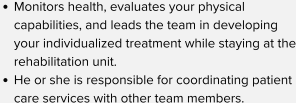
PHYSIATRIST
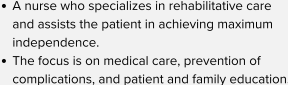
REHABILITATION NURSE
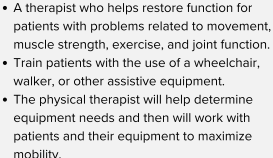
PHYSICAL THERAPIST
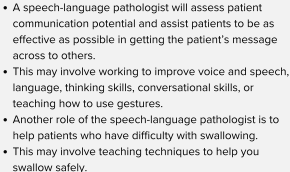
SPEECH-LANGUAGE PATHOLOGIST
OCCUPATIONAL THERAPIST
PATIENT’S FAMILY/FRIENDS/CAREGIVERS
- The patient and family are the most important members of the rehabilitation team
RESPIRATORY THERAPIST
- A therapist who helps treat and restore function for patients with airways and breathing problems.
CLINICAL SOCIAL WORKER
A professional counselor who acts as a liaison for the patient, family, and rehab treatment team.
The social worker helps provide support and coordinate discharge planning and referrals. He or she may also help coordinate care with insurance companies.
CASE MANAGER
A rehabilitation case manager helps plan, organize, coordinate, and monitor services and resources for the patient.
CHAPLIN
A spiritual counselor who helps patients and families during crisis periods.
He or she helps serve as a liaison between the hospital and the home church or place of worship
PSYCIATRIST, PSYCHOLOGIST, OR NEUROPSYCHOLOGIST
A healthcare provider or counselor who conducts cognitive (thinking and learning) assessments of the patient.
He or she also helps the patient and familyt to the disability.
RECREATION THERAPIST
A therapist who coordinates therapeutic recreation programs to help promote social skills and leisure activities.
AUDIOLOGIST
A healthcare professional who specializes in the evaluation and treatment of hearing and hearing loss.
REGISTERED DIETITIAN
A nutritionist who evaluates and provides for the dietary needs of each patient. This is based on the patient’s medical needs, eating abilities, and food preferences.
VOCATIONAL THERAPIST
A counselor who assists people with disabilities to plan careers and find and keep satisfying jobs.
ORTHOTIST
A healthcare professional who makes braces and splints used to strengthen or stabilize a part of the body.
PROSTHETIST
A healthcare professional who makes and fits artificial body parts, such as an artificial led or arm.