ORGANISATION
Principles of organisation
Organelles - subcellular structures
Nucleus, ribosome, mitochondria…
Cells - different organelles, become specialised
Muscle, red blood cells…
Tissues - a group of similar cells that work together to carry out a function
Muscle, epithelial…
Organ - a group of different tissues that work together to perform a function
Stomach, pancreas, liver…
Organ system - a group of organs that work together
Digestive system, cardiovascular system…
Organism!!! - a group of organs
Humans
Cancer
Cancer is a disease caused by cells growing abnormally and uncontrollably which can spread through the body
Tumours are an abnormal mass of cells that form when a group of cells undergo uncontrolled growth and division
Benign - Cells are contained in one area, usually in a membrane
Malignant - Cells aren’t contained in membrane, so can enter the bloodstream and travel through the body.
- Can invade other tissues and form secondary tumours when cells detach (metastasis)
- Process causes damage and is dangerous, so is seen as cancer
Risk factors - Lifestyle
Smoking - Lung, mouth, stomach and cervical cancers
Obesity - Bowel, liver and kidney cancers
UV light exposure - Skin cancers
Alcohol - Liver cancers
Risk factors - Genetics
Genes inherited from our parents can make you more susceptible to certain cancers
‘BRCA’ genes are linked to breast and ovarian cancers
Risk factors - Environmental
Increased exposure to ionising radiation
Exposure to chemical carcinogens (an agent that causes cancer)
The human digestive system
Digestive enzymes break down food in the pancreas and small intestine
Carbohydrates are usually found as starch (a polymer of glucose) and are broken down by amylase to maltose and then from maltose to glucose by maltase, which can be absorbed
Proteins are broken down by proteins (pepsin and trypsin, etc.) into amino acids
Lipids (fats) are broken down by lipase into glycerol and fatty acids
Bile helps this process by emulsifying lipids, which increases the surface area to allow lipase to further break down
All enzymes are broken down by the pancreas and small intestine
The digestive system has two main roles - digestion and absorption - and breaks down food so nutrients are absorbed and waste is excreted
The mouth
Teeth - physically break down food, increases surface area and improves ease of swallowing
Salivary glands - releases saliva, which contains amylase (to digest starch) and wettens food
Oesophagus - food is passed through
Stomach - contracts muscular walls, produces pepsin (type of protease) and produces HCl to kill bacteria and provide the right pH for pepsin
Pancreas - when food enters the stomach, it releases pancreatic juices to the small intestine, which contains enzymes for digestion
Gallbladder - neutralises acid from the stomach and releases bile to emulsify lipids (made in the pancreas, stored in the gallbladder)
Small intestine - Where most of digestion happens
Digestive enzymes are released to break nutrients down
Nutrients are absorbed - the small intestine has lots of villi (and microvilli), with a large surface area, good blood supply and a single layer of cells for increased rate of diffusion
Large intestine - Absorbs excess water
Rectum - Where waste is stored before excretion
The heart
The heart is part of a double circulatory system - pulmonary circuit (with the lungs) and systemic circuit (with the body)
The heart has 4 chambers
The left ventricle, right ventricle, left atrium and right atrium
The left ventricle has a thick muscular wall than the right as it needs to generate high pressure to pump blood to the rest of the body
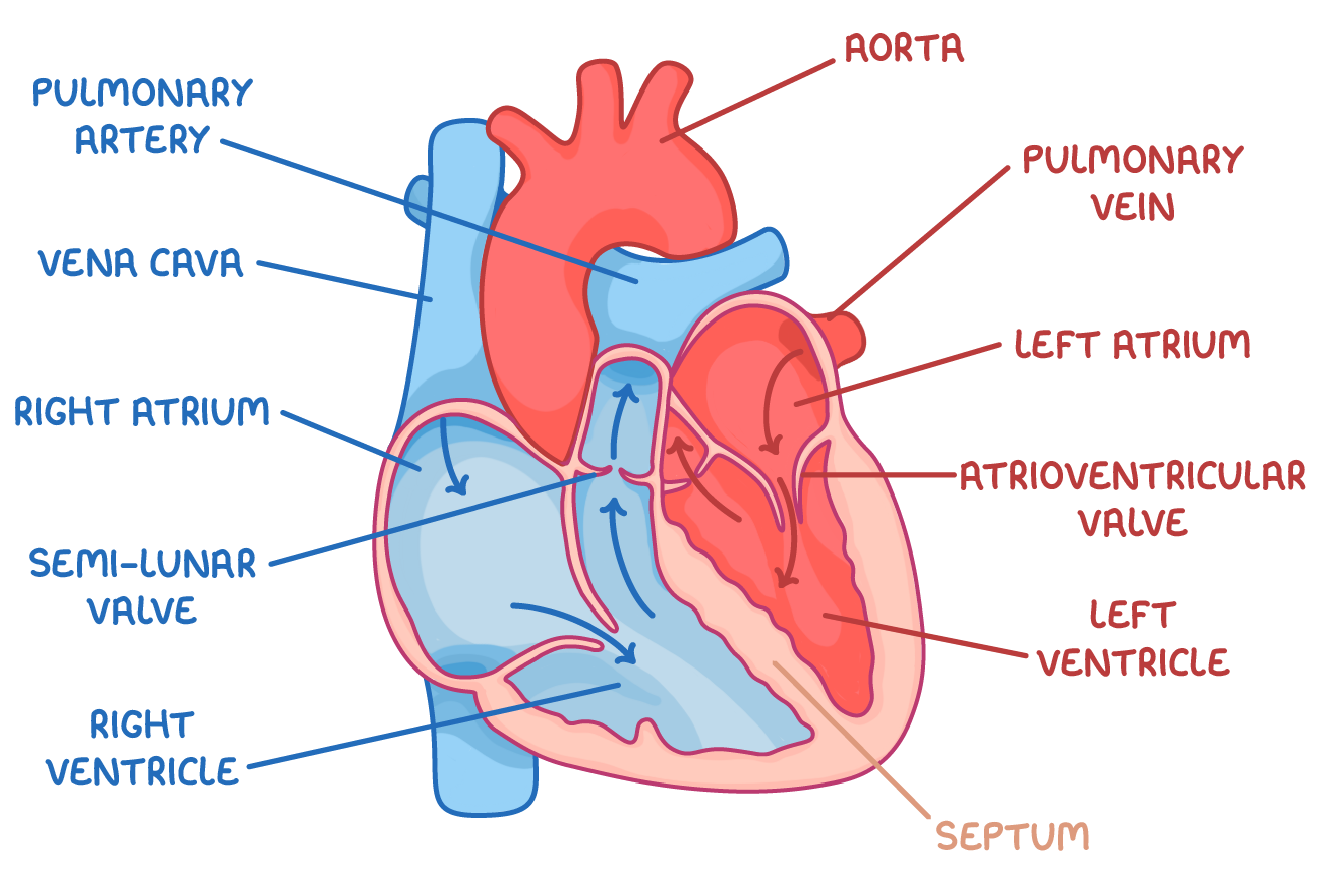
The Vena Cava pumps DEOXYGENATED blood FROM the body to the heart
The Pulmonary Artery pumps DEOXYGENATED blood TO the lungs from the heart
The Aorta pumps OXYGENATED blood TO the body from the heart
The Pulmonary Vein pumps OXYGENATED blood FROM the lungs to the heart
Blood vessels
Arteries - Carry blood AWAY from the heart
Carries at high pressure
Strong and thick elastic and muscle tissue
Small lumen
Capillaries - Really small (single cell thick)
Are permeable - allows for gas exchange to blood and nutrients
Exchange substances with cells - oxygen and nutrients
Remove waste - carbon dioxide
Low pressure
Veins - Carry blood TOWARDS the heart
At a low pressure
Thin walls
Largest lumen
Have valves - stop blood flowing wrong way
Blood
Blood is made up of red blood cells, white blood cells, plasma and platelets
Red blood cells - Make up around half of our blood by volume
Carry oxygen from lungs to cells
Contain haemoglobin
Become oxyhaemoglobin when oxygen is present, and separates so oxygen is free to diffuse into tissues
Adaptations - no nucleus so there is more space for haemoglobin
biconcave disk shape to increase surface area for diffusion
White blood cells - less than 1% of blood
Defend against infections and pathogens :(
They produce
Antibodies - bind onto pathogens and help to destroy them
Antitoxins - neutralise toxins
Perform phagocytosis - engulf pathogens so they can be destroyed by antibodies
Platelets - small fragments of cells (no nucleus)
Float about in blood until we get a cut and they act as a ‘glue’ and help us patch up
Clotting prevents blood loss and stops more pathogens entering
Plasma - around 50% of blood volume
Watery so blood can flow
Carries RBC, WBC, platelets, nutrients (glucose and amino acids), waste products (carbon dioxide and urea), antibodies and antitoxins
In a human, there is around 5 litres of blood
If blood loss is severe, the blood may not be able to efficiently supply oxygen to the tissues
New blood can be given!
New blood (ooooh…)
Artificial blood - adds volume, is mainly salt water, and contains no red blood cells so can’t transport oxygen
Can only replace 1/3 of blood
Blood transfusions - has RBC, but needs to be donated and there are certain types for different people
Coronary heart disease
A cardiovascular disease are any diseases linked to the cardiovascular system (heart and blood vessels)
Coronary heat disease is when the coronary arteries become blocked and can prevent blood supply to the heart
Is caused by a build up of fatty material (cholesterol)
Treatments - Stents
Stents are placed into the coronary arteries and are an expandable tube that ensures blood can keep flowing
A balloon is inflated in the artery and is later removes - stent is left in
Benefits - they are quick and long lasting
Drawbacks - there are risks of infection or heart attack and clots
Statins - Medication that lowers the production of fatty material and cholesterol, taken to prevent coronary heart disease
When too much CDL is made, it causes blocked arteries, which is bad :(
HDL is good fatty material
Benefits - they lower the risks of coronary heart disease, strokes and heart attacks
Drawbacks - have to be taken regularly, can cause kidney failure and headaches
Valves can be damaged over time or become infected
They can be replaced in surgery with either biological or mechanical valves
Heart failure happens when the heart can’t pump blood
This can be treated with a new heart - artificial is temporary and biological is from a donor
Risks of rejection and there is a long wait list
Health issues
Health is a state of physical and mental wellbeing
It is effected by exercise, sleep, diet and medical care
Disease is a condition that causes ill health
Communicable - infectious diseases, like colds or malaria
Viruses, bacterial, parasites and fungi
Non-communicable - can’t spread, like asthma or diabetes
Physical diseases can lead to mental health issues
Immune systems are linked to communicable diseases and our health
Effect of lifestyle on some non-communicable diseases
Risk factors are anything that increases the chance that someone will develop a disease
Lifestyle factors - Diet
Alcohol (liver disease)
Stress (mental and physical health)
Lack of exercise
Obesity from these factors can lead to diabetes, heart attacks and coronary heart disease
Environmental factors - Smoking (lung disease and cancers)
Air pollution
Radiation exposure
Plant cell organisation
Leaves are the main site of photosynthesis in a plant - requires carbon dioxide, water and sunlight
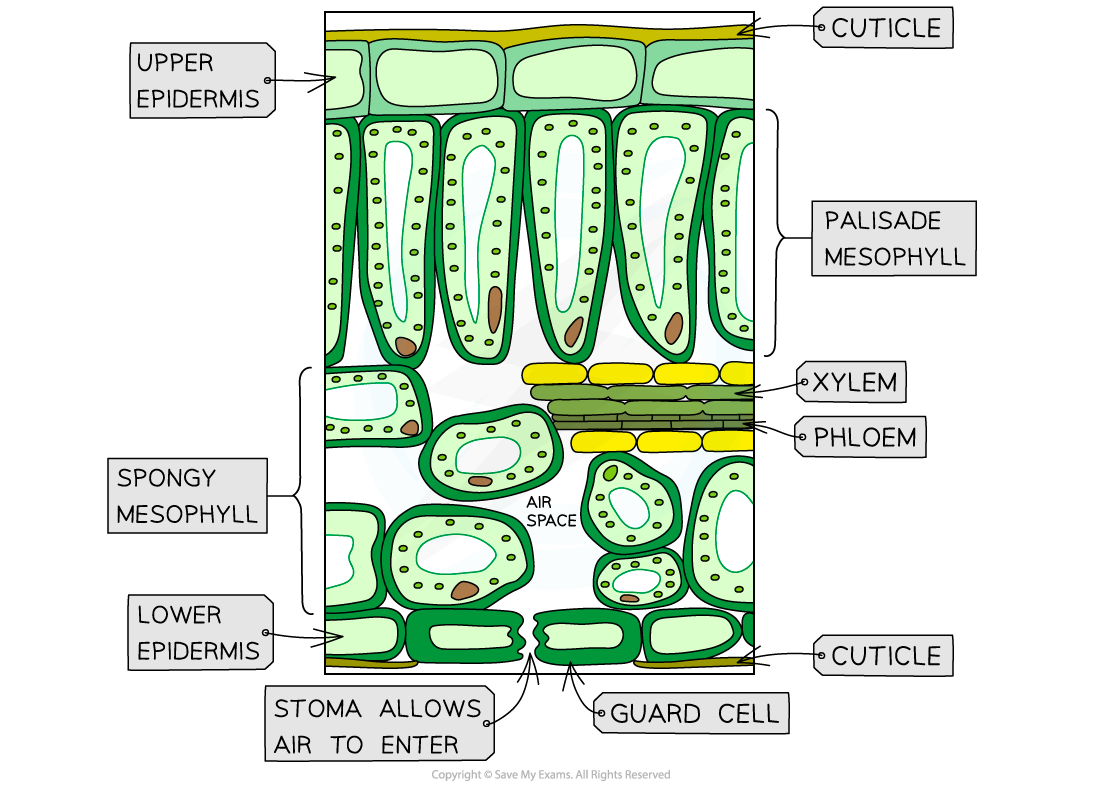
The waxy cuticle protects the surface of the leaf and prevents water loss - is transparent to allow sunlight through
The upper epidermis is almost transparent to allow sunlight through
The palisade mesophyll is where most photosynthesis occurs and therefore has lots of chloroplasts (chlorophyll absorbs sunlight)
Air space is necessary to allow carbon dioxide to easily diffuse
The spongy mesophyll has lots of air space which increases surface area and allows for efficient gas exchange
The lower epidermis allows for gas exchange via the stomata
The stomate allow carbon dioxide to enter and oxygen to leave the leaf
The guard cells control the movement of gases
Xylem transport water from the roots continuously to the palisade cells, which can be lost through the leaf (stomata and surface)
The waxy cuticle prevent water loss from the top side
Guard cells control whether the stomata are open or closed to prevent water loss
If they are well hydrated, the cells are turgid which increases the gap and allows carbon dioxide in
If they are dehydrated, they become flaccid and prevent carbon dioxide from entering
When they are open, water is able to diffuse out of the leaf, which is bad :( if the cell is dehydrated, so they close the gap to decrease this water loss
Guard cells are light sensitive, and close when there is no sunlight - water loss is prevented and no carbon dioxide is needed as photosynthesis can’t occur without light
They are on the underside of the leaf which is shaded and cooler to decrease water evaporation
Transpiration and translocation
Translocation is used to transport sugars in the plant
Transpiration transports water up the plant
Translocation is used to ensure the rest of the plant has sugars made through photosynthesis in the leaf, and transports it

Phloem are used for this translocation and allow movement in both directions
There are pores throughout the structure
They enable the movement of cell sap - sugar and water - which can be used directly for energy or stored for later
Companion cells supply phloem with the energy required to transport cell sap and nutrients - necessary for translocation
Transpiration transports water and minerals up the plant to be used in photosynthesis
Done via xylem tubes
Made of dead cells
Have no ends
Long and hollow
Strengthened by lignin
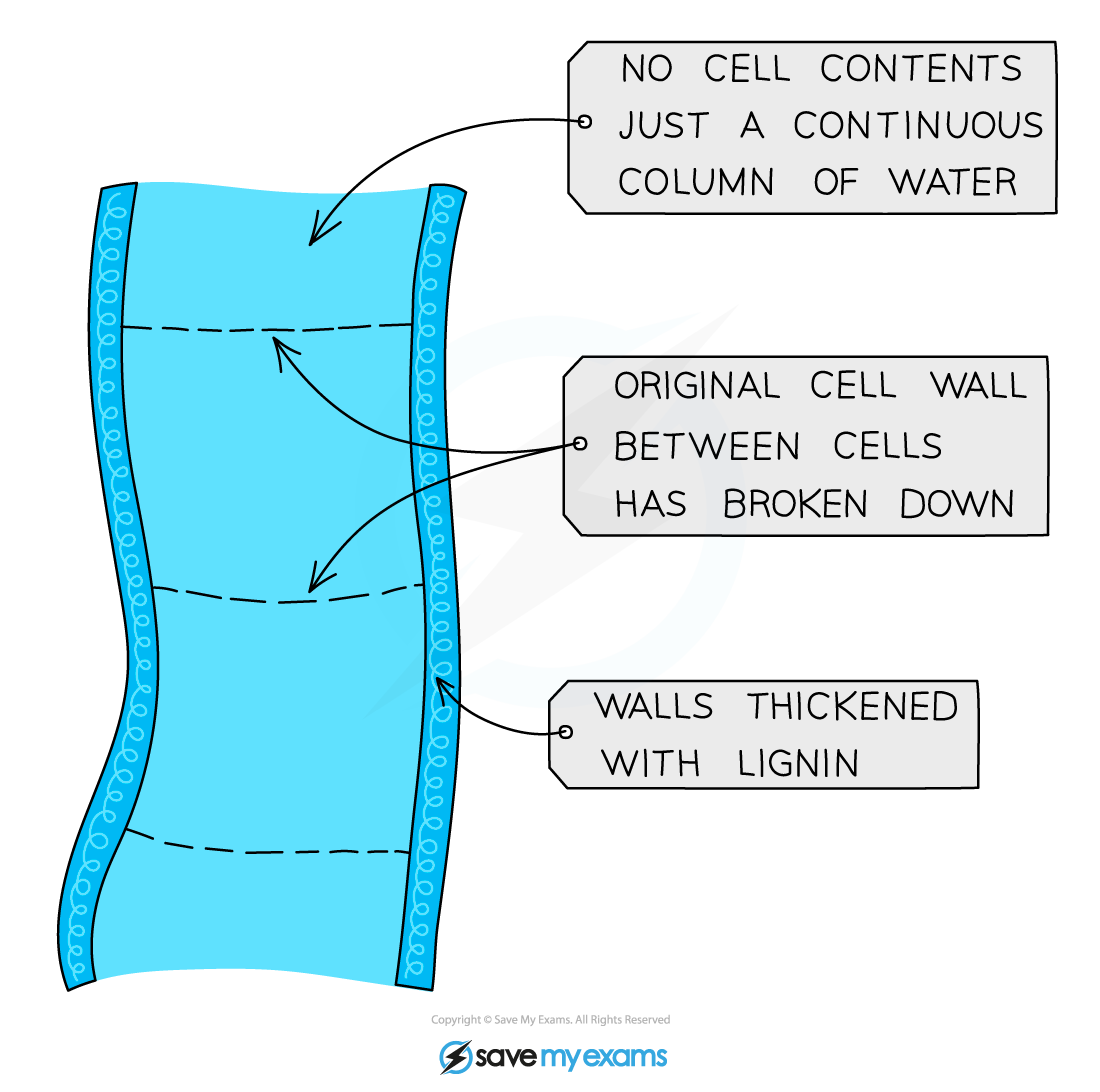
The water stream is constant as it evaporates through the stomate in the leaves when not used for photosynthesis
This stream of water molecules is called the transpiration stream
The rate of transpiration depends on:
Light intensity - more light means a higher rate of photosynthesis so the stomata are open more for carbon dioxide
Means more water is required for photosynthesis and evaporation through stomata
Temperature - the warmer it is the easier water will evaporate as it has more energy so transpiration rate is higher
Air flow - the higher the air flow is, the easier water gets ‘blown away’ so concentration gradient needs to be kept high so the transpiration rate increases
Humidity - the more humid it is, means the air has more water already, so less evaporates from the leaf, so the concentration gradient can be decreased and transpiration rate decreases
DONE!!!