Phenols
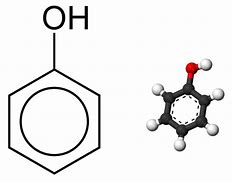
Chemical Formula
C6H5OH
Reactivity
Phenol is slightly more reactive than benzene due to having a higher electron density in the pi-ring.
This is due to the Oxygen from the -OH group donating a lone pair into the pi-ring.
Acidity
Due to the delocalisation of the lone pair of oxygen atom, phenol is a very weak acid, unlike regular alcohols, which are neutral.
Phenol (C₆H₅OH) is more acidic than alcohols but less acidic than carboxylic acids.
It partially ionizes in water:
Reactions of Phenol
Phenols react with alkalis but not with metal carbonates
Acid + Alkali —> Salt + Water ✅
Acid + Metal Carbonate —> Salt + Water + Carbon Dioxide ❌
This can be used to distinguish alcohols, acids, and phenols.
X | NaOH | Na2CO3 |
Phenol | Indicator Temp up | X |
Ethanol | X | X |
Ethanoic Acid | Indicator Temp up | Fizzing Indicator Temp Up |
Phenol —> Bromo-phenol
Reaction: Nucleophilic Substitution
Conditions and Reagents: Br2 (aq)
Other info:
Phenol decolourises bromine.
The 2-4-6-tribromophenol formed with a white precipitate.
This distinguishes it from an alkane test.
Phenol —> Nitro-phenol
Reaction: Nucleophilic Substitution
Conditions and Reagents: Conc. / dilute HNO3 (aq)
Other info:
Dilute nitric acid can be used to decrease the number of substitutions
Phenol —> Ester
Reaction: Nucleophilic Substitution
Conditions and Reagents: Acid chloride, RCOCl, at RT
Other info:
Steamy fumes of toxic HCl(g) are produced
Fume cupboard required
Test for Phenol
Add aqueous FeCl₃ to the sample.
A positive test for phenol results in a colour change from yellow to a violet/purple complex forming.
Reaction:
Phenol reacts with Fe³⁺ ions to form a coloured complex:
Observation:
A purple or violet color indicates the presence of phenol or phenolic group