Rhetorical Analysis
What is Rhetoric?
“The faculty of observing in any given case the available means of persuasion.” - Aristotle
What is Rhetorical Situation?
All authors write within a particular situation and make strategic choices based on that situation. This will likely make more sense once we’ve worked through the Various components of a “situation.”
SOAPSTonE
The first step to effectively analyzing nonfiction is to know certain key background details which will give you the proper context for the analysis
An acronym to help you in this first step is;
Speaker
Occasion
Audience
Purpose
Subject
Tone
Exigence
Speaker
Who is the speaker? Does the speaker have the *ethos* necessary to deliver information on the topic?
Occasion
What is the reason for giving the speech or occasion? As in does it correspond with an anniversary? Funeral? Wedding? Is it for a planned conference? etc. We generally call this rhetorical situation.
It’s important to note the rhetorical situation. You may also sometimes hear this rehearsed.
Audience
In order to connect with the audience, the speaker must establish *pathos,* this means knowing who is being addressed.
Purpose
Why is the speech being given? Is it persuasive, to inform, or to entertain? How/why? One way to determine the purpose is to analyze the speech for it’s rhetorical devices.
Subject
What is the subject of the speech? What exactly is it about? The facts or the details build the *logos.*
Tone
Attitude of a writer/speaker toward a subject. Tone is generally conveyed through diction and details.
Exigence
In rhetoric, exigence is the issue, problem, situation, context, etc. This provides the importance for an author to write or speak on a given topic within that rhetorical situation.
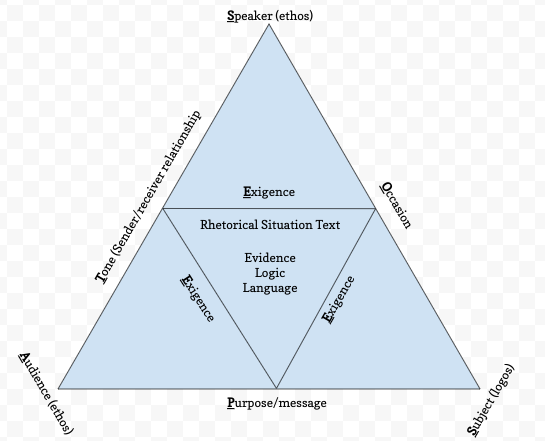
Logos - Logic
The facts or details in an argument that give the argument credibility
Ethos - Credibility
This describe who the speaker is in terms of the subject, the speaker’s authority on the topic
Pathos - Emotion
This involves creating an attachment to the subject matter by appealing to the emotions of the audience
SMELL
Sender/receiver relationship
Message
Evidence
Logic
Language
Sender/Receiver
Who is the speaker? Who is the audience? What is the tone directed from one to the other?
Message
What is the context and/or claim
Evidence
What evidence is provided and to what extent? Is it reliable?
Logic
What is the quality of the reasoning?
What types of appeals are being used?
What’s the line of reasoning?
Does the author Include concessions? Counter arguments?
Language
What stylistic and rhetorical devices are being used?
This is where you’ll identify the author’s choice of schemes, tropes, diction, etc. and explain WHY s/he made those stylistic choices.
Schemes
figures of speech that deal with (???) order, syntax, letters, and sounds
creates balance, interruption, omission, or repetition
Tropes
Figures of speech with unexpected twist in the meaning of the words
creates comparison, word play, overstatement, understatement, or management of meaning
Diction
In all forms of writing and speaking, authors choose particular words to convey a specific effect and meaning to the reader
Can make a logical appeal or emotional appeal.
Syntax
In much the same way that authors consider their word choice very carefully, they also consider how the words are arranged
AKA Construction of sentences
Syllogism
A form of arrangement introduced by Aristotle that consists of 3 levels: A major premise, a minor premise, and conclusion
premise - a statement of fact
Enthymeme
It’s like a syllogism, it must be based on a premise. The difference between the two is that the major premise can be implied
Deductive Argument
Is structured with the major and minor premises first followed by the conclusion
AKA periodic structure
Inductive Arguments
Is structured with the conclusion first followed by the major and minor premises
AKA loose structure
Writing a Rhetorical Analysis
Open Thesis
Statement that tells the reader only the position on a topic
grounded mostly on an opinion
Ex: Florida is a better place to live than Washington
Closed Thesis
Statement that tells the reader both your position and the reasons for your position
Ex: due to the cost of living in discrepancy and incessant rainy weather, Florida is a better place to live than Washington
Intro: Rhetorical Precis
Body #1:
Claims (What)
Evidence (How)
Commentary (Why)
*repeat until fully analyzed*
Conclusion: So what? What is the purpose?