Chapter 3 - Habituation, Sensitization, and Familiarization
Vocabulary:
Non-associative learning: Helps organisms adapt behavior to predictable environments, includes habituation, sensitization, priming, and perceptual learning
Innocuous stimulus: A stimulus that isn’t highly important, more so subtle or slightly bothersome
Habituation: A decreased behavioral response (either in strength or occurrence) to a innocuous stimuli over time as a result of repeated exposure, demonstrated by all organisms. Can be advantageous (avoid wasting time on stimuli that are common to conserve energy and give attention to important stimuli and efficiently allocate resources) or disadvantageous (deer with gunshots). This happens with weak/annoying stimuli
Behaviorist approach: Focuses on behavior allowing objective, quantifiable data, based on changed in behavior from the stimulus
Sensitization: A phenomenon in which a salient/noxious/arousing stimulus (such as an electric shock) temporarily increases the strength of responses to other stimuli. Not stimulus specific, is generalizable, stronger stimuli cause stronger responses, and can develop over a single exposure. Evolutionarily, allows organisms to avoid following danger that comes after initial danger, in an unpredictable dangerous scenario being more responsible is good, including things already habituated to because they may now be dangerous
Learning: A process by which experiences can lead to changes in behavior
Latent learning: Demonstrated by Edward Tolman, when learning takes place without any initial indication of change in behavior, until later when it is used
Acoustic startle reflex: A defensive response (such as jumping or freezing) to a startling stimulus (such as a loud noise)
Orienting response: An organism’s innate reaction to a novel stimulus or important event, tests habituation in infants based on how long they look at a certain object
Fixation time: The amount of time a new stimulus will be focused on visually
Stimulus specific: When something only applies to one stimulus, present in habituation, habituation to one event doesn’t cause habituation to every other event within the given sensory modality. Sensitization is not like this, sensitization to one stimulus will apply to related stimuli
Dishabituation: A renewal of a response, previously habituated, that occurs when the organism is presented with a novel stimulus. A novel/arousing stimulus can temporarily recover responses to the habituating stimulus, with the hew ‘habituation’ fading quickly
Mass exposure: Stimuli that are presented close temporally
Spaces exposure: Stimuli that are presented spread out over time
Short-term habituation: Habituation that goes away in seconds or minutes
Long-term habituation: Habituation that lasts longer than a couple minutes, some synapses may actually be pruned between sensory and motor neurons, as well as more glutamate being depleted than the rate that it is made
Spontaneous recovery: Reappearance (or increase in strength) of a previously habituated response after a short period of no stimulus presentation, when a repeated stimulus stops behavior gradually returns to normal
Electrodermal activity (EDA): Fluctuations in the electrical properties of a person’s skin that are a consequence of activity in the peripheral nervous system
Prepulse inhibition: When quiet noises are played and then a loud startling noise is played, there is less of a response than if just the loud noise was played
Desensitization: The process in which a past experience reduces responses to a wide range of related stimuli, a lot like habituation
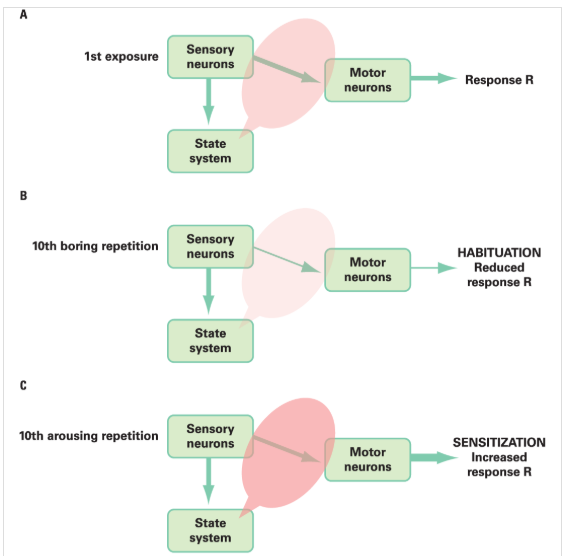
Dual process theory: The theory that habituation and sensitization are independent of each other but operate in parallel. Perceptual learning is a combination of habituation and sensitization
Reflex pathway: Low threshold, weakens with repeated use, utilized within habituation
“State system”: High threshold, when activated increases responses globally, involved with sensitization
Generalization: When one kind of non-associative learning applies to more than just the initial stimulus, this happens more with sensitization than habituation
Weak stimulus: Can activate the reflex pathway, causing a stimulus-specific decline in responsiveness
Noxious stimulus: Reflex and state system activation, state system dominates, and there is a generalized increase in responsiveness known as sensitization
Moderate stimulus: Can activate the reflex and state systems to cause both habituation and sensitization
Opponent process theory: A theory, assumes that experienced events lead to two processes for habituation and sensitization, and that they are emotional (one pleasurable one not). The rebound (opposing process) is directly triggered by the initial emotional response
Priming: Previous exposure to a stimulus affects later processing of the same stimulus or related stimuli, a phenomenon in which prior exposure to a stimulus can improve the ability to recognize that stimulus later, doesn’t need to be consciously remembered. Can be demonstrated in animals and amnesiacs with image noise tests. Neural activity is decreased in certain areas
Noise test: A way to test priming without testing episodic memory, if shown an image impaired by progressively less noise, the animal is better recognize at earlier stages in progressive tests
Perceptual learning: Becoming better at processing/recognizing a set of frequently experienced stimuli, learning in which experience with a set of stimuli makes it easier to distinguish those stimuli. Occurs because the brain is paying attention to differences between stimuli, which tells the brain to pay attention to and pick up on the differences between things (vague mechanisms), requires many exposures
Discrimination training: A way to intentionally promote perceptual learning, speeds up the rate of it. Feedback is given on whether a distinguishing choice made was correct or not, improves the ability to pick up differences between things
Synaptic depression: A reduction in synaptic transmission, a possible neural mechanism underlying habituation
Homosynaptic: Occurring in one synapse without affecting nearby synapses, a feature in Aplysia’s habituation
Interneuron: A neuron that neither directly receives sensory inputs nor produces motor outputs, instead being intermediary message carriers
Neuromodulators: Neurotransmitters that can affect activity in entire brain areas rather than just a single synapse
Serotonin: A neuromodulator that can increase the amount of glutamate vesicles available
Heterosynaptic: Occurring in several nearby synapses simultaneously, applies to Aplysia’s sensitization
Word-stem completion task: A task in which participants are asked to fill in the blanks in a list of word stems (MOT____) to produce the first world that comes to mind, participants are more likely to produce a particular word if primed and exposed to that world previously
Statistical learning: Learning driven by repeated exposures to perceptual events that increases the familiarity and distinctiveness of those events
Sensory cortices: Make important distinctions between features of a stimuli to determine if it is unique, an area of the cerebral cortex that processes visual/auditory/somatosensory (separate) inputs, specific. Can be primary or secondary, primary innervate secondary
Receptive field: The range of sensory stimuli that cause a particular cortical neuron to fire
Tune: The particular stimulus within a neuron’s receptive field that causes it to fire the most
Homunculus: A ‘map’ of the human body, larger regions for areas more sensitive to somatosensory input
Cortical plasticity: The capacity to change cortical organization as a result of experience
Multimodal: Describes how neurons in certain areas respond to inputs from more than one sensory modality (like visual and auditory)
Stroke: An event in which blood flow to some region of the brain stops or in which an artery ruptures causing neurons in the affected region to die, leading cause of brain damage in the USA, leads to a sudden loss in perceptual function
Learned non-use: The phenomenon where a stroke patient will learn to not utilize part of their body due to lack of perceptual input and sensation from that region
Constraint-induced movement therapy: A motor-rehabilitation technique in which unaffected limbs are restrained to increase usage of dysfunctional limbs, used in stroke patients and shows faster recovery than those who are just told use try to use their affected limb. Associated with increased blood flow to sensory and motor cortices, improves perceptual learning, helps users adapt to and perceive the artificial input, though the brain may be damaged this helps rewire the brain via synaptic plasticity to reutilize the limb, as there is no motor deficiency
Sensory prosthesis: A mechanical device designed to supplement or substitute for a faulty sensory modality such as vision or hearing, the device’s sensory detectors interface with brain areas that normally process those sensory inputs, involves perceptual learning of the brain to learn how to use these and cortical plasticity
Cochlear implant: A kind of sensory prosthesis for hearing, stimulates the auditory nerve to produce hearing sensations in deaf individuals, more effective in children or adults who have recently lost hearing, “recreate” sound rather than amplifying it
Groves + Thompson (1970): Showed that habituation and sensitization were differential activation of two different systems, reflex pathway and state system
Hard-wired: Describes how from one organism to another for a species the neurons are the same, LG7 in one and LG7 in another are both responsible for example say molecular timer functions. Applies to Aplysia
Mantle: Protective outer coating that covers Aplysia
Siphon: Part of Aplysia that works in respiration
Gill-withdrawal reflex: Happens when part of the Aplysia (gill/siphon) is touched, causing it to pull the gill into the mantle (hold breath), protective to stop damage from impacting the gill and preserves overall function, though metabolically intensive as it cannot breathe briefly. Used in habituation studies
Congenital blindness: Blindness from birth, demonstrates cortical plasticity as the visual association cortex area is more activated in blind people when tactile (braille) are done, as they can’t use it for the visual purpose, in opossums show unique multimodal areas
Sensory cortical plasticity: How different parts of the brain may change and adapt in terms of sensory processing
2-point touch discrimination threshold: The smallest distance where a participant can reliable determine if there is one or two points. Can be trained lower with discrimination training, naturally smaller on areas with more nerves like fingers
Length of habituation is dependent on factors such as how startling the stimulus is, the number of times experienced, length of time between exposures. The less arousing, the quicker it will habituate. Habituation takes longer when exposures are spaced, though once habituated, it will last for longer.
With habituation, a sensory neuron S will be excited by the stimulus and release glutamate to excite motor neuron M, driving the response. Repeated stimulation will cause S to release less glutamate each time (it may be physically running out of glutamate, rate of release is greater than rate of repackaging of vesicles) gradually decreasing the amount that M will fire (synaptic depression)
With sensitization, a shock may activate sensory neuron T (very high threshold to activate) which activates motor neuron M to cause a motor response, but because of the shocks sensory neuron T may also activate interneurons like I to other neurons like S and U, potentially releasing neuromodulator serotonin to increase the number of glutamate vesicles available to be released every time S fires. The high threshold sensory neuron T will dump serotonin onto the system, making it very easy to excite the motor neurons and cause a motor response from M. Long-term, there may be addition of synapses
Habituation applies to weak/unimportant stimuli. Sensitization applies to stronger, more annoying stimuli
Aplysia are good model organisms for learning mechanisms, due to their hard-wired brains and the fact that they only have 20,000 neurons, some very large
2 3 4 4 2 1 2 1 19
ir s orie en mish row le spassing